
Adélie penguins quick facts
- Scientists found a hidden colony of about 1.5 million Adélies by spotting guano stains in NASA satellite images.
- High pebble nests keep eggs out of meltwater, and a ten-year camera study found they raise more chicks.
- Nests on the edge of a colony lose the most stones to thieving neighbours.
- Near Mawson station, Adélies fell by 43% in a decade because there was too much sea ice, not too little.
- In the Windmill Islands, breeding pairs rose from about 30,000 in the 1950s to nearly 200,000 today.
Adélie penguins at a glance
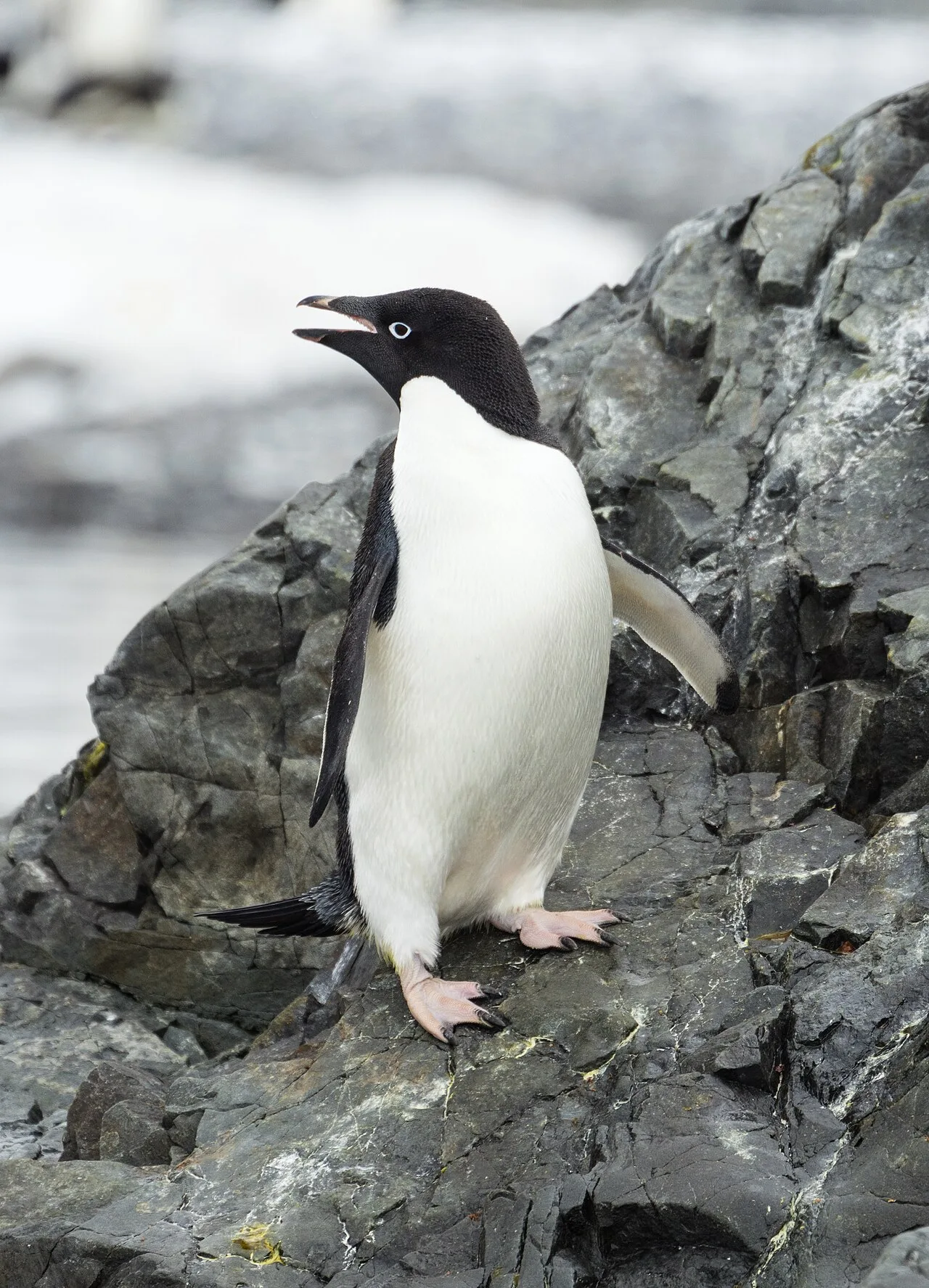
The Adélie penguin is the classic penguin of cartoons. It has a black back, a white front and a neat white ring round each eye. It lives all the way round the coast of Antarctica. And it builds its nest out of stones.
That last fact shapes almost everything about its life. Stones are hard to find on an icy coast. So Adélies guard them, fight over them and steal them. Scientists have even measured how much a good pile of stones matters.
| Fact | Adélie penguin |
|---|---|
| Height | About 70 cm (28 inches) |
| Weight | 3 to 6 kg (6.6 to 13 pounds) |
| Food | Krill, small fish and amphipods |
| Nest | A pile of pebbles on dry, sloping ground |
| Eggs | Usually two |
| Breeding season | October to February |
| Lifespan | 10 to 20 years |
| World population | About 3.79 million breeding pairs (2014 census) |
| Conservation status | Least Concern |
What an Adélie penguin looks like
The Australian Antarctic Division says an adult stands about 70 centimetres tall. That is about the height of a kitchen table. It weighs between 3 and 6 kilograms, about as much as a pet cat.
Look at the eyes first. Each one sits inside a bright white ring of feathers. No other penguin has quite the same look. The head is all black, with no stripes or crests. The bill is short and partly covered in feathers.
The body is built like a torpedo. The flippers are stiff and narrow. On land an Adélie waddles or hops from rock to rock. In the water it is fast and neat.
Where Adélie penguins live
Adélies breed around the whole coast of Antarctica. They are true Antarctic birds. They are not found on warmer islands further north, as some penguins are.
In summer they come ashore to nest on bare, rocky ground. In winter they head out to the pack ice, the floating sea ice that rings the continent. New Zealand Birds Online says they also moult out there, swapping old feathers for new ones.
They can travel a long way. The Australian Antarctic Division says some swim more than 1,200 kilometres (750 miles) from their breeding sites. That is further than the length of Great Britain.
What Adélie penguins eat
The main food is krill. Krill are small shrimp-like animals that swarm in the Southern Ocean. Adélies eat two kinds, Antarctic krill and crystal krill. They also catch small fish and amphipods, tiny crustaceans a little like sand hoppers.
A parent can bring back a lot in one trip. The Australian Antarctic Division says a single meal for a chick weighs 300 to 650 grams. At the top end, that is more than half a bag of sugar.
Adélies hunt by diving. Most of their feeding happens in the top 70 metres of water. Some dive as deep as 175 metres (575 feet). That is deeper than the height of the London Eye.
Why nests are made of pebbles
Adélies do not use twigs or grass. There are almost no plants on the Antarctic coast. Instead they pile up small stones in a ring, on dry and sloping ground.
The stones do a real job. When snow melts in summer, water runs across the ground. A flat nest can flood. Eggs and small chicks sitting in icy water may die.
A study published in 2024 tested this. Scientists from the Australian Antarctic Division watched 450 nests in the Windmill Islands for ten years using cameras. They found that bigger nests, with stones stacked high enough to lift the bowl off the ground, raised more chicks. The benefit was largest in years when the ground was wet from melting snow.
So a big pile of stones is not decoration. It is flood defence.

Pebble stealing in the colony
If stones are that valuable, it makes sense to take someone else’s. New Zealand Birds Online says breeding Adélies collect pebbles “or steal from neighbouring nests”. Stealing is a normal part of colony life.
A thief waits until a neighbour looks away. Then it grabs a stone and hurries back to its own nest. Sometimes the owner notices and a squabble breaks out.
Where you nest matters too. The 2024 Windmill Islands study found that nests on the edge of a colony lose stones to thieves more often. The researchers described them as “source” nests for everyone else. Birds on the edge spend energy guarding their pile instead of building it up.
Birds in the middle are better off. Their nests tend to be bigger and better protected.
Eggs, chicks and growing up
The breeding season runs from October to February. The Australian Antarctic Division says there are usually two eggs in each nest by the middle of November.
Both parents take turns to sit on the eggs. The first two shifts are long, lasting 11 to 14 days each. While one parent sits, the other goes to sea to feed. The Global Penguin Society says incubation takes about 32 to 34 days in total.
Chicks hatch in December. They grow very fast. A chick can put on about 80 grams a day. After seven to nine weeks the young birds are ready to go to sea on their own.
That timing is tight. The Antarctic summer is short, and chicks must be ready before the sea begins to freeze again.
Predators of Adélie penguins
Two main predators hunt Adélies. In the water, leopard seals wait near the edge of the ice to catch penguins as they come and go. On land, skuas are the danger. Skuas are large brown seabirds that take eggs and small chicks.
A chick left alone in the colony is at risk. This is one reason parents take turns. One adult always stays with the nest while the other is away.
How many Adélie penguins are there
In 2014 scientists published the first full count of Adélies around the whole of Antarctica. Heather Lynch of Stony Brook University and Michelle LaRue of the University of Minnesota led it.
They found 3.79 million breeding pairs. That is about 7.6 million adult birds. Stony Brook University says this was 53 percent more than the estimate from about 20 years before. The team found 17 colonies nobody knew about.
Not every colony was still there. The team could not find 13 colonies that had been recorded before. Eight of those were declared gone.
The International Union for Conservation of Nature, or IUCN, lists the Adélie as Least Concern. That means it is not currently at high risk of dying out as a species. As you will see, though, the picture is very different from one place to the next.
Counting penguins from space
How do you count millions of birds on a frozen coast? The answer is guano. Guano is penguin poo. A busy colony covers the rock in it.
Those stains are big enough to see in satellite pictures. Stony Brook University explains that scientists learned to recognise the colour pattern of guano in the images. That let them find colonies without visiting every beach.
The satellites do not see single penguins. They see the mess the colony leaves behind. Scientists then work out how many nests would make a stain that size.
The Danger Islands supercolony
The most famous result of this method came from the Danger Islands. They are a small group of rocky islands off the northern tip of the Antarctic Peninsula. Thick sea ice and rough water make them very hard to reach.
In 2014 Heather Lynch and Mathew Schwaller of NASA spotted large guano stains on the islands in NASA satellite images. The stains hinted at far more penguins than anyone expected.
In December 2015 a team sailed there to check. They counted by hand and flew a drone over the islands. The drone flew in a grid, taking a photo every second. A computer program then found and counted the nests in the pictures.
The team checked the computer against people. The scientific paper says the program’s counts were on average only about 0.6 percent different from counts made by hand.
The results came out in March 2018. The Woods Hole Oceanographic Institution announced 751,527 pairs of Adélies on the Danger Islands. That is about 1.5 million birds. It was more than the rest of the Antarctic Peninsula region put together.
The scientific paper says Heroína Island alone holds about 292,363 pairs. Heroína and Beagle Island are the third and fourth largest Adélie colonies in the world.
The find changed the map of the whole area. The paper says the Danger Islands hold 55 percent of all the Adélies in their part of the Peninsula region. They raised the known number there by 68 percent.
It also matters for protection. The Woods Hole Oceanographic Institution says the discovery supports plans for marine protected areas. These are areas of sea set aside to protect wildlife.

Declines on the Antarctic Peninsula
Here is the puzzle. On the western side of the Antarctic Peninsula, Adélies have been disappearing. The 2018 paper says numbers there fell by about 70 percent over recent decades.
Stony Brook University links the losses there to changes in sea ice. Adélies depend on sea ice for resting and feeding in winter.
The Danger Islands sit on the eastern side, and their birds seem not to have suffered the same fall. Scientists do not yet know exactly why. The Woods Hole Oceanographic Institution says it could be sea ice conditions or the amount of food. Both ideas are still being tested.
East Antarctica and the Ross Sea
On the other side of the continent, the story is mostly the opposite. Stony Brook University says populations in East Antarctica and the Ross Sea have been stable or growing. The 2018 paper describes sharp increases there.
The Windmill Islands, near Australia’s Casey station, are a good example. The Australian Antarctic Division says they held about 30,000 breeding pairs in the 1950s. Today they hold nearly 200,000.
Growth in the east has balanced losses in the west. That is why the world total can look healthy even while some colonies shrink.
A surprising drop near Mawson
Not every East Antarctic colony is doing well. In 2022 the Australian Antarctic Division reported a 43 percent fall in Adélies near Mawson research station over about a decade.
That means about 154,000 fewer breeding birds, spread over 52 islands along 100 kilometres (62 miles) of coast. Seabird ecologists Dr Louise Emmerson and Dr Colin Southwell studied the change.
The cause was too much ice, not too little. For five summers in the mid-2000s, thick sea ice stayed close to the colonies. Parents could not easily reach their feeding areas. Almost no chicks survived in those years. Fewer young birds then joined the population afterwards.
It shows how local penguin life is. The same species can boom in one bay and struggle in the next.
How Adélies compare with emperor penguins
Adélies share Antarctica with emperor penguins. Both are black and white, and both depend on sea ice. But their lives are very different, and the emperor guide explains how.
Adélies are the stone builders. They breed in the short summer, on bare rock, on nests of pebbles they guard all season.
Three things people get wrong
Myth: Adélie penguins are declining everywhere. They are falling fast on the western Antarctic Peninsula, and near Mawson. But colonies in East Antarctica and the Ross Sea have grown, and the 2014 world count was higher than earlier estimates.
Myth: satellites can see individual penguins. The images used to find the Danger Islands supercolony showed guano stains, not birds. Scientists then went there with a drone to count the nests.
Myth: pebbles are just a cute gift. Stones are building material, and a 2024 study showed that high stone nests keep eggs and chicks out of meltwater. That is why Adélies steal them from each other.
Did you know? Some Adélies swim more than 1,200 kilometres (750 miles) from their breeding sites, further than the length of Great Britain.
Try it
Pour a cup of water slowly across a tray or a sloping path. Put one coin flat on the surface and another on top of a little stack of stones. Which one stays dry? That is why Adélies build their nests high.
Knowledge check
What do Adélie penguins build their nests from?
Show answer
Small pebbles and stones, piled up on dry, sloping ground.
How did scientists first spot the Danger Islands supercolony?
Show answer
By seeing large guano stains in NASA satellite images of the islands.
Frequently asked questions
How big is an Adélie penguin?
An adult Adélie penguin stands about 70 cm (28 inches) tall and weighs 3 to 6 kg, according to the Australian Antarctic Division.
What do Adélie penguins eat?
Adélie penguins eat mostly Antarctic krill and crystal krill, plus small fish and amphipods. Most feeding happens in the top 70 metres of the sea.
Why do Adélie penguins steal pebbles?
Pebbles are scarce on the Antarctic coast, and higher stone nests keep eggs and chicks out of meltwater, so every stone is worth having.
How many Adélie penguins are there?
The first global census, published in 2014, counted about 3.79 million breeding pairs of Adélie penguins, or roughly 7.6 million adult birds.
Are Adélie penguins endangered?
The Adélie penguin is listed as Least Concern, but colonies on the western Antarctic Peninsula have fallen by about 70% over recent decades.
Where is the Adélie penguin supercolony?
The Danger Islands, off the northern tip of the Antarctic Peninsula, hold about 751,527 pairs of Adélie penguins, found using satellites and a drone.
Sources
- Australian Antarctic Division: Adélie penguin — size, diet, diving, breeding timetable, lifespan, predators and the Windmill Islands increase; its 2022 Mawson decline news page was also used
- Woods Hole Oceanographic Institution: supercolony of Adélie penguins discovered — how the Danger Islands colony was found, the drone survey and the 751,527-pair count
- Scientific Reports (2018): Danger Islands survey paper — Heroína Island count, colony rankings, the Peninsula decline and East Antarctic increases
- Stony Brook University: Adélie population is on the rise — the 3.79 million-pair global census and counting colonies from guano in satellite images
- Ecology and Evolution (2024): Adélie nest construction study — how stone nests protect against meltwater and why edge nests lose stones; New Zealand Birds Online was also used for winter range and pebble theft


