
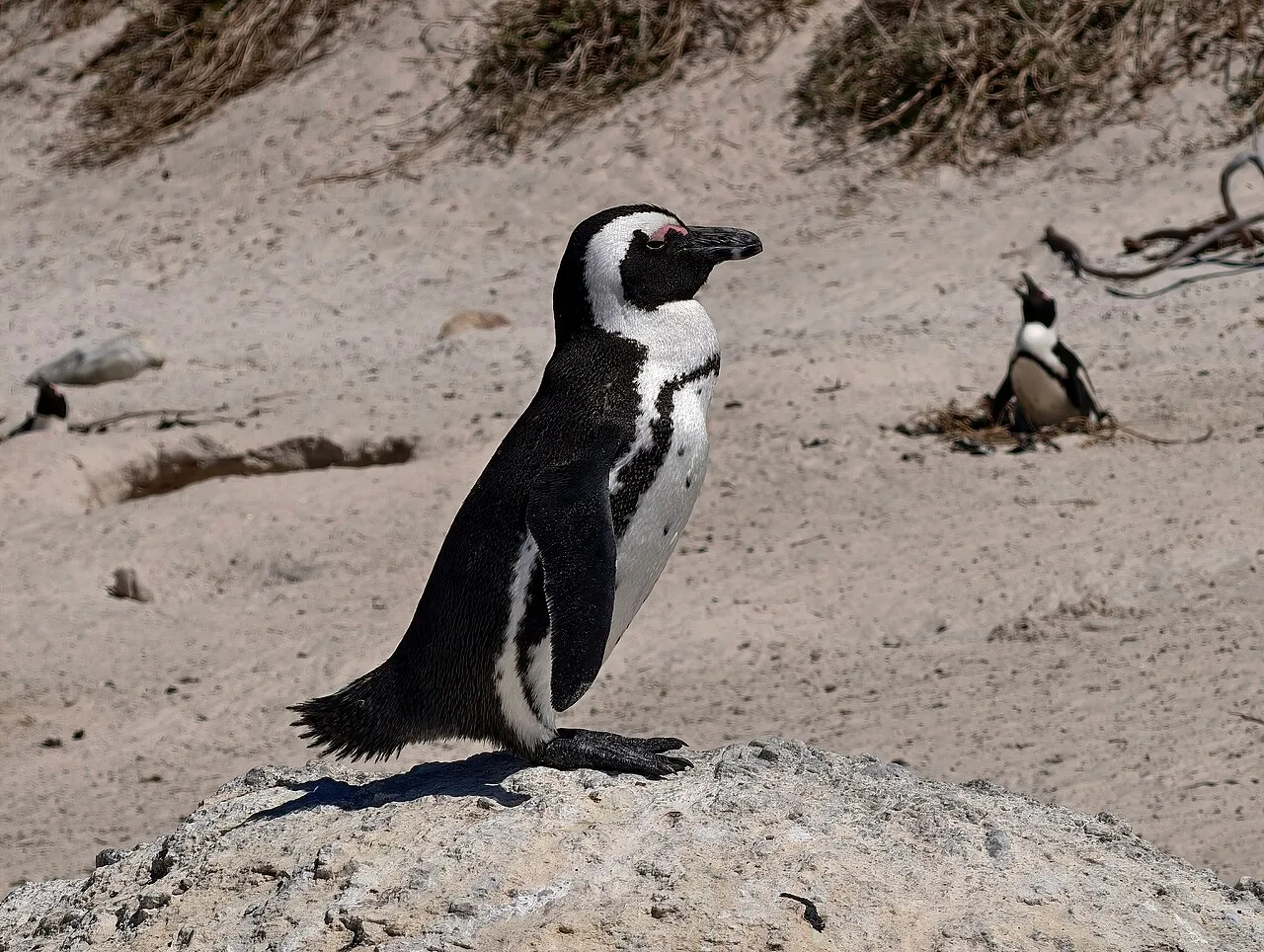
African penguins quick facts
- African penguins were the first of the world’s 18 penguin species to be listed as Critically Endangered, in October 2024.
- Each African penguin has its own pattern of chest spots, which work like a fingerprint.
- More than 590,000 penguin eggs were once collected on Dassen Island in a single year.
- The bare pink skin above their eyes helps them lose heat on hot beaches.
- Since March 2025, sardine and anchovy boats may not fish within 20 km of Robben Island and Bird Island.
African penguins at a glance
The African penguin is the only penguin that breeds on the coast of Africa. It lives in South Africa and Namibia, far from any ice. In October 2024 it became the first penguin in the world to be listed as Critically Endangered.
| Fact | Detail |
|---|---|
| Scientific name | Spheniscus demersus |
| Where it lives | Coasts and islands of South Africa and Namibia |
| Height | 61–69 cm (24–27 in) |
| Weight | 2–5 kg (4.4–11 lb) |
| Food | Sardines, anchovies, squid and crustaceans |
| Eggs | Two per clutch |
| Status | Critically Endangered (since 28 October 2024) |
| Breeding pairs | Fewer than 10,000 (2024) |
This guide covers how the African penguin lives, what it eats and why its numbers have fallen so far. It also explains what people are doing to help. Every figure comes from a named conservation group, zoo or university.
Where African penguins live
African penguins live along the south-western tip of Africa. Their colonies sit on rocky islands and a few mainland beaches. Most are in South Africa, and some are in Namibia.
The Animal Diversity Web at the University of Michigan says they live in two ocean systems. One is the cold Benguela system on the west coast. The other is the western Agulhas system further east. Both carry plenty of small fish close to shore.
That is why the penguins can live somewhere warm on land. The sea next to them stays cool and full of food. On land, though, they have to cope with hot sun on bare rock.
Six colonies matter most today. SANCCOB, the seabird rescue charity in Cape Town, lists them as Dassen Island, Robben Island, Stony Point, Dyer Island, St Croix Island and Bird Island.
What an African penguin looks like
An African penguin has a black back and a white front. A thin black band curves across its chest. A white stripe loops from above each eye down around the face, a bit like a horseshoe.
The San Diego Zoo says every penguin has its own pattern of black spots on its chest. The spots work like fingerprints. Researchers can tell birds apart just by looking at them.
Young penguins look different. They are grey-blue with no bold stripes. The Animal Diversity Web says it takes about three years for a young bird to grow its full adult colours.

Look closely at an African penguin’s face. Above each eye is a patch of bare pink skin. No feathers.
The San Diego Zoo says this skin helps the bird stay cool in hot weather. Warm blood flows close to the surface there. Heat can then escape into the air.
It solves a real problem for a bird that spends so much of its life on land in strong southern African sunshine, far from the icy seas most people picture when they think of penguins. Penguins are built to keep warm in cold water. Standing on a sunny beach, a bird covered in thick, waterproof feathers can easily overheat.
How big an African penguin is
African penguins are among the smaller penguins. The San Diego Zoo gives their height as 61 to 69 centimetres (24 to 27 inches). That is a little lower than the top of a kitchen table.
They weigh between 2 and 5 kilograms (4.4 to 11 pounds). A big one weighs about the same as a large bag of potatoes.
Sources measure them in different ways. The Animal Diversity Web gives a length of 45 centimetres and an average weight of 3.1 kilograms. Measuring a standing bird and a bird lying flat gives different answers.
The emperor penguin of Antarctica is a much bigger bird that breeds on sea ice. The African penguin lives on warm sand next to a cool sea.
Why it was called the jackass penguin
For a long time this bird was known as the jackass penguin. A jackass is a male donkey. The name comes from the penguin’s loud call.
The Animal Diversity Web says the call sounds like a donkey braying. The San Diego Zoo describes three main calls. The bray attracts a mate. The yell warns other penguins away from a territory. The third call is a short sound called a haw.
What African penguins eat
African penguins eat small fish that swim in large groups, called shoals. The Animal Diversity Web lists anchovies, pilchards, horse mackerel and round herring. Pilchards are a kind of sardine. The penguins also eat some squid and crustaceans.
Sardines and anchovies are the most important. A penguin feeding hungry chicks needs a lot of them.
The trouble is that people want the same fish. Large fishing boats catch sardines and anchovies in huge nets. That is a big part of why these penguins are in danger.
How they swim and dive
On land an African penguin waddles. In water it is fast and agile. It uses its stiff wings like flippers and steers with its feet and tail.
The Animal Diversity Web says they can swim at close to 20 kilometres an hour (about 12 miles an hour). The San Diego Zoo gives a top speed of 15 miles an hour, which is about 24 kilometres an hour. The two sources measured in different ways.
Most dives reach 30 to 60 metres deep, says the Animal Diversity Web. The deepest recorded went to 130 metres. The San Diego Zoo says a penguin can hold its breath for more than two minutes.
Birds on the west coast usually travel 30 to 70 kilometres on a fishing trip. If the fish move further out, the parents must swim further too. That leaves the chicks waiting longer for food.
How they build nests
African penguins like to nest underground. On their islands, seabird droppings built up over hundreds of years into thick layers. These droppings are called guano.
Guano is soft enough to dig into. The penguins burrowed into it to make nests. The Dyer Island Conservation Trust says the guano on Dyer Island was once 4 to 6 metres deep.
A burrow keeps eggs and chicks shaded from the sun. It also hides them from gulls that steal eggs. The San Diego Zoo says penguins also nest in sand or under bushes and rocks when there is no guano.
How guano harvesting hurt the penguins
In the 1800s, people found out that guano made an excellent fertiliser for crops. It became valuable. The Dyer Island Conservation Trust says a ton of guano could sell for ten pounds or more in London.
Workers scraped the guano off the islands and shipped it away. That removed the ground the penguins dug their burrows in. Many birds had to nest in the open instead.
Open nests are much riskier. Eggs and chicks bake in the sun. Gulls can reach them easily.

The egg collectors
Penguin eggs were once collected and eaten on a huge scale. The Dyer Island Conservation Trust says almost half of all African penguin eggs were taken between the 1920s and the mid-1950s.
On Dyer Island, collecting went on from 1875 to 1968. The biggest year was 1905, when 62,500 eggs were taken. On Dassen Island, more than 590,000 eggs were collected in a single year.
Every egg taken was a chick that never grew up. Together with guano scraping, this caused the first great crash. The birds were in trouble long before modern fishing boats arrived. Nobody was counting properly back then.
Eggs, chicks and growing up
A female usually lays two eggs. Both parents take turns keeping them warm. The San Diego Zoo gives the incubation time as 38 to 41 days.
After hatching, one parent stays with the chicks while the other goes fishing. The San Diego Zoo says the parents share this job closely for the first 30 days. Then both parents may head out to sea at once.
The Animal Diversity Web says chicks are ready to leave the colony at 60 to 130 days old. The big range depends on how much food the parents find. In a poor year, chicks grow more slowly.
African penguins in the wild usually live 10 to 15 years, according to the Animal Diversity Web. Some reach 27. Birds in zoos, safe from predators and hunger, often live longer.
At sea, the main danger is the Cape fur seal. On land, kelp gulls and sacred ibises steal eggs and small chicks. The Animal Diversity Web also lists mongooses, genets and even leopards.
Adults are safest in the water. Eggs and chicks are the most at risk. This is another reason burrows matter so much.
How many African penguins are left
SANCCOB says there were between 1.5 and 3 million African penguins around the year 1900. Dassen Island alone may have held about 300,000 pairs. Today the whole species has fewer than 10,000 breeding pairs.
That is a loss of about 97 per cent. The fall is still happening. SANCCOB’s figures show South Africa had 15,187 breeding pairs in 2018. By the end of 2023 there were only about 8,750.
| Year | African penguins | Source |
|---|---|---|
| About 1900 | 1.5–3 million birds | SANCCOB |
| 1991 | about 42,500 pairs in South Africa | SANCCOB |
| 2018 | 15,187 pairs in South Africa | SANCCOB |
| End of 2023 | about 8,750 pairs in South Africa | SANCCOB |
| 2024 | fewer than 10,000 pairs worldwide | BirdLife South Africa |
SANCCOB says five South African colonies have disappeared since 2005. That is one colony lost every three years. Scientists warn the species could vanish from the wild by 2035 if nothing changes.
Counting is hard, and the exact numbers for Namibia are less certain. But every group that counts these birds reports the same direction. Down.
Why they became Critically Endangered
On 28 October 2024, the International Union for Conservation of Nature moved the African penguin from Endangered to Critically Endangered. BirdLife South Africa announced the change. It is the highest danger level before a species is extinct in the wild.
SANCCOB says it is the first of the world’s 18 penguin species to reach this level. The main reason today is hunger. Climate change is shifting where fish are found, and fishing boats compete for the same sardines and anchovies.
Without enough food, the adults struggle to raise their chicks. Fewer young birds then grow up to breed, so the numbers keep falling year after year.
Fishing closures around the colonies
One idea is simple. Stop fishing boats from catching sardines and anchovies close to the colonies. Then parents do not have to swim so far for food.
South Africa had some closed areas already. SANCCOB and BirdLife South Africa said they were too small to help. They called them biologically meaningless, and took the government to court.
On 18 March 2025, the High Court in South Africa made an order based on a deal. The conservation groups, the fishing industry and the government all agreed to it. SANCCOB says it covers the six key colonies for 10 years, with a scientific review after six.
Around Robben Island and Bird Island, sardine and anchovy boats may not fish within 20 kilometres (about 12 miles). Other colonies got closures shaped to fit where their penguins feed.
Nobody yet knows how much the closures will help. Scientists will be counting chicks and adults to find out.
How people are helping
SANCCOB and BirdLife South Africa are two of the groups working to save these birds. Together they took the case to court that won the fishing closures. They also count the birds so everyone knows how the colonies are doing.
Penguins bring money into South Africa too. SANCCOB says the colonies are worth between 613 million and 2,702 million rand a year to tourism and local businesses. Saving them helps people as well as birds.
You can help from home. Learn about the birds and share what you know. If you visit a colony one day, keep your distance and stay on the paths.
Three things people get wrong
Myth: penguins only live where it is icy. African penguins live on warm, sunny coasts in South Africa and Namibia. Their bare pink eye patches help them shed heat. Not every penguin is like the emperor penguin on the Antarctic ice.
Myth: “jackass penguin” is a rude nickname. The name describes the bird’s call, which sounds like a donkey braying. A jackass is simply a male donkey. The bird was never named as an insult.
Myth: the penguins only started declining recently. The first crash came more than a century ago. People took millions of eggs and scraped away the guano the birds nested in. Modern food shortages hit a population that was already small.
Did you know? The Dyer Island Conservation Trust says the guano the penguins nested in on Dyer Island was once 4 to 6 metres deep, deeper than a two-storey house is tall.
Try it
Stand up and waddle across the room with your arms stiff by your sides, like a penguin on land. Now pretend your arms are flippers and ‘swim’ them in big strokes. Which way would get you to food faster?
Knowledge check
Why is the African penguin sometimes called the jackass penguin?
Show answer
Because its loud call sounds like a donkey braying. A jackass is a male donkey.
What is guano, and why do the penguins need it?
Show answer
Guano is built-up seabird droppings. The penguins dig nest burrows in it to keep their eggs and chicks shaded and safe.
Frequently asked questions
Are African penguins endangered?
African penguins are Critically Endangered. The International Union for Conservation of Nature raised their status from Endangered on 28 October 2024, as breeding pairs fell below 10,000.
Where do African penguins live?
African penguins live on the coasts and islands of South Africa and Namibia. Their main colonies include Dassen Island, Robben Island, Stony Point, Dyer Island, St Croix Island and Bird Island.
What do African penguins eat?
African penguins mainly eat small shoaling fish such as sardines, anchovies, horse mackerel and round herring. They also eat some squid and small crustaceans.
Why are African penguins called jackass penguins?
The name jackass penguin comes from the bird’s loud braying call, which sounds like a donkey. A jackass is a male donkey, so the name describes the sound.
How long do African penguins live?
Wild African penguins usually live 10 to 15 years, according to the Animal Diversity Web, and some reach about 27. Birds in zoos often live longer because they are safe from predators.
What is being done to save African penguins?
Conservation groups count the colonies and won a 2025 court order. That order closes sardine and anchovy fishing near six key colonies for 10 years.
Sources
- SANCCOB: African Penguin newly classified as Critically Endangered — the October 2024 uplisting, first penguin to be Critically Endangered, 97% loss, causes of decline and tourism value; BirdLife South Africa’s matching media release was also used for the date
- SANCCOB: High Court victory for the Critically Endangered African Penguin — the March 2025 fishing closures, the six colonies, 20 km zones, 2018 and 2023 pair counts and the 2035 warning
- SANCCOB: Population trends — historical numbers around 1900, Dassen Island, the 1991 figure and lost colonies
- Animal Diversity Web (University of Michigan): Spheniscus demersus — range, diet, diving, breeding, lifespan, predators and the braying call
- San Diego Zoo: African penguin — height, weight, pink skin, chest spots, nesting, incubation and calls
- Dyer Island Conservation Trust: Where did all the penguins go? — guano depth and value, and the history of egg collecting


