
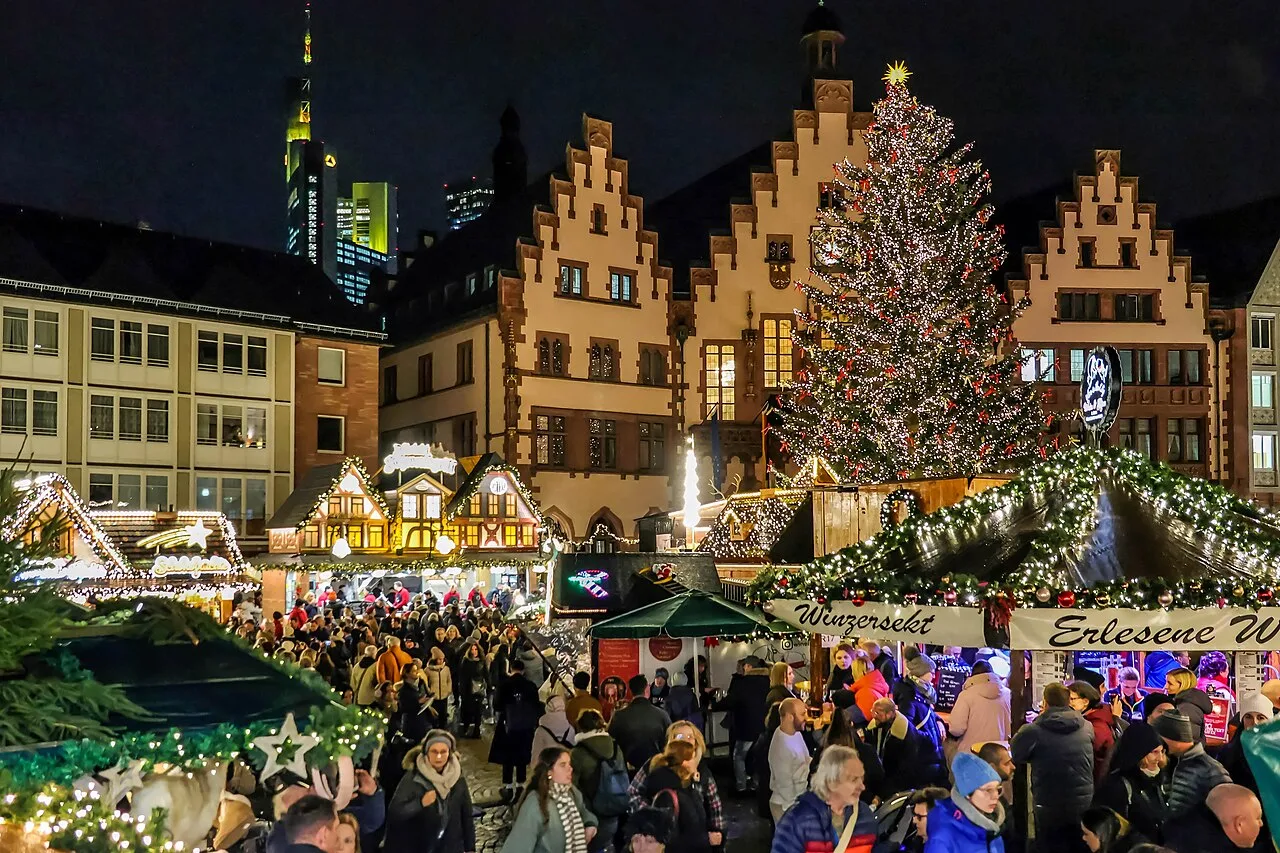
Christmas around the world quick facts
- In Sweden, many families stop at 3pm on Christmas Eve to watch a Donald Duck Christmas show on TV.
- Iceland’s book trade has sent a catalogue of new books to every home each year since 1944.
- In 1746, the authorities in Iceland banned parents from using the Yule Lads to frighten children.
- Christmas Day is not one of Japan’s 16 national holidays, even though most Japanese families celebrate it.
- Ukraine moved its public Christmas holiday from 7 January to 25 December in 2023.
One festival, many ways to celebrate
Christmas is kept in many countries, but no two countries keep it in quite the same way. The date can change. So can the person who brings the presents, and so can the food on the table.
For Christians, Christmas celebrates the birth of Jesus. Christians believe he was born in Bethlehem, and the Gospels in the Bible tell the story of his birth. You can read how that story grew into a festival in our guide to why we celebrate Christmas.
This guide goes country by country instead. It explains why some children open presents on 5 December while others wait until 6 January, and why some families have their Christmas dinner on 7 January. For the history of trees, cards and the real St Nicholas, see our Christmas facts for kids.
Why some countries celebrate in January
Many Orthodox Christians celebrate Christmas on 7 January. They are not late. They are using a different calendar. The Orthodox churches make up one of the main branches of Christianity, and each one decides which calendar to follow.
Most of the world now uses the Gregorian calendar. Pope Gregory XIII introduced it in 1582, to fix a mistake in the older Julian calendar, the Orthodox Church in America explains. The Julian calendar gets the length of a year wrong by about 11 minutes. That sounds tiny. Over hundreds of years, though, those minutes added up to whole days.
Today the two calendars are 13 days apart. So 25 December on the Julian calendar falls on 7 January on ours. Churches that still use the old calendar for their festivals are keeping Christmas on 25 December by their own count. It simply lands on a different square of the calendar on your wall.
The Russian Orthodox Church is one of the churches that keeps the old calendar. Others have switched. The church in Greece moved to the corrected calendar in 1923, so Greek Orthodox Christians celebrate on 25 December.
Ethiopia keeps the old date too, and its Christmas, called Genna, falls on 7 January. The Ethiopian News Agency says Orthodox communities in Europe, Africa and the Middle East celebrate on that day, weeks after most of the western world.
Ukraine’s new Christmas date
Ukraine used to hold its public Christmas holiday on 7 January. In 2023 that changed. In July 2023, Ukraine’s parliament made 25 December the official day instead, the Ukrainian Greek Catholic Church reported on 14 July that year.
So Christmas 2023 was the first time the whole country had its public holiday on 25 December. The law followed a calendar reform in the churches. Ukraine’s Greek Catholic Church moved its fixed holidays to the new calendar from 1 September 2023. Not every church community moved at once. The head of the Greek Catholic Church said one parish had asked to stay on the Julian calendar for the time being.
Changes like this show that customs are not fixed forever. People choose them, and sometimes they choose again. A child in Kyiv today may keep Christmas on a different day from their grandparents.
Christmas traditions around the world at a glance
The table compares twelve countries. The “big day” is the day our sources describe as the high point, which is not always Christmas Day.
| Country | Big day | Who brings presents | A special food |
|---|---|---|---|
| Sweden | Christmas Eve, 24 December | Jultomten, in person | the julbord buffet: ham, meatballs, herring, rice pudding |
| Germany | Christmas Eve, 24 December | the Christkind | gingerbread and finger-sized Nuremberg sausages |
| Netherlands | Sinterklaas evening, 5 December | Sinterklaas | chocolate letters and pepernoten biscuits |
| Iceland | Christmas Eve, 24 December | the 13 Yule Lads | new books to read, rather than eat |
| Italy | night of 5 to 6 January | La Befana | sweets in a stocking, or coal |
| Spain | night of 5 January | the Three Kings | – |
| Mexico | 16 to 24 December, then 6 January | the Three Kings | ponche, buñuelos and rosca de reyes |
| Philippines | midnight feast on Christmas Eve | – | lechon (roast pig), glazed ham, keso de bola |
| Ethiopia | Genna, 7 January | – | doro wat (spicy chicken stew) with injera |
| Ukraine | 25 December, since 2023 | – | – |
| Japan | Christmas Eve and Christmas Day | – | strawberry sponge cake and fried chicken |
| Australia | Christmas, in the middle of summer | – | a beach barbecue |
A dash means our sources do not name one. Look at how many countries pick Christmas Eve, and how many save the presents for January.
From September to January: a calendar of Christmas days
Put all these customs on one calendar and Christmas stretches across five months.
| Date | Where | What happens |
|---|---|---|
| 1 September | Philippines | the Christmas season begins |
| Mid-November | Netherlands | Sinterklaas arrives by steamboat from Spain |
| 5 December | Netherlands | Sinterklaas evening, with presents and poems |
| 13 December | Sweden | Lucia Day processions |
| The 13 nights before Christmas | Iceland | one Yule Lad visits each night |
| 16 to 24 December | Mexico and the Philippines | Las Posadas; Simbang Gabi dawn masses |
| 24 December | Sweden, Germany and Iceland | Christmas Eve, the main family evening |
| 25 December | Ukraine, Australia and many more | Christmas Day |
| Night of 5 January | Italy and Spain | La Befana flies; the Three Kings parade |
| 6 January | Mexico and Italy | presents from the Three Kings; the last day of Italy’s Christmas holidays |
| 7 January | Ethiopia and Russia | Genna, and Christmas on the old calendar |
Why do so many customs gather around 6 January? Christians call that day Epiphany. On it, many churches remember the Wise Men, who the Bible says brought gifts to the baby Jesus. So it makes sense that the Three Kings and La Befana, whose story is tied to theirs, bring presents in January rather than December.
Who brings the presents?
Santa Claus is only one of many gift-bringers. Around the world, presents may come from a saint, a child, an old woman, three kings or thirteen mischievous brothers.
- Sinterklaas (the Netherlands) sails in from Spain in November and brings presents on the evening of 5 December.
- The Christkind (Germany), whose name means “Christ child”, brings presents on Christmas Eve.
- Jultomten (Sweden) hands out presents in person on Christmas Eve.
- The Yule Lads (Iceland) are thirteen brothers who come one at a time.
- La Befana (Italy) is an old woman who flies on a broomstick on the night of 5 January.
- The Three Kings (Spain and Mexico) are Melchior, Gaspar and Balthazar, who come on 5 and 6 January.
Each gift-bringer has a story of its own, and a date of its own. The sections below visit them one country at a time, starting in the far north.
Sweden: Lucia, a buffet and Donald Duck
In Sweden, 24 December is the main day of Christmas and the most important family holiday of the year, says Visit Sweden, the country’s official tourism site. Families gather round the julbord, a Christmas buffet. It holds Christmas ham, meatballs, pickled herring and beetroot salad. Dessert is often a rice pudding called Ris à la Malta.
At 3pm many families stop everything to watch a Donald Duck Christmas show on television. Later, jultomten, the Swedish Santa, turns up to hand out the presents in person. He is usually a family member or a neighbour in disguise, who slipped out a few minutes earlier to “buy a newspaper”.
Swedish Christmas begins weeks before that, on 13 December. That is Lucia Day. Lucia leads a procession in a long white gown and a crown of candles. For safety, the real candles have mostly been swapped for battery ones. Handmaidens follow her, with star boys in tall, cone-shaped hats.
The day is named after Lucia of Syracuse, a Christian martyr of the 300s. A martyr is someone who is killed for their faith. The first record of Lucia in Sweden comes from a country home in 1764, but the custom only really spread in the 1900s. Today processions visit schools, churches and care homes, and people eat lussekatter, S-shaped saffron buns.

Germany: the Christkind and a city of wood and cloth
In many German homes the presents come from the Christkind, which means “Christ child”. The idea goes back to Martin Luther, a Protestant reformer who lived from 1483 to 1546, the Nuremberg Christmas Market explains. In Luther’s day, children got their presents on St Nicholas’s Day, 6 December. Luther moved present-giving in his own home to Christmas Eve.
In Nuremberg, a city in southern Germany, the Christkind is also a real person. Since 1969, the city has chosen a young woman every two years to play the part. She wears a white and gold dress with a golden crown, and she is the face of the city’s Christmas market all through Advent.
The market calls itself one of the oldest and most famous Christmas markets in the world. Its wooden stalls earn it a nickname, “the little city of wood and cloth”. Visitors buy gingerbread and Nuremberg sausages, which are only as long as your finger. Those sausages have been a Nuremberg tradition for more than 700 years.
The Netherlands: Sinterklaas comes early
Dutch children get their main presents nearly three weeks before Christmas. Sinterklaas, the Dutch name for St Nicholas, arrives in mid-November by steamboat from Spain, says the St. Nicholas Center. He lands in a different town each year.
Until his big night, children leave a shoe by the window, the door or the fireplace. They add a drawing or a wish list, and a carrot or some hay for his horse. In the morning there may be sweets or a small present inside.
The big night is 5 December, the eve of St Nicholas’s Day. Families swap “surprises”, which are presents wrapped up in clever disguises. Each one comes with a funny rhyme signed “from Sinterklaas”. There are chocolate letters at the table and small spiced biscuits called pepernoten. The fun is in the jokes, not in how much a present cost.
Iceland: thirteen Yule Lads and a flood of books
Iceland has thirteen gift-bringers, not one. They are the Yule Lads, brothers who take turns to visit on the thirteen nights before Christmas Day, Smithsonian Magazine reports. Children put a shoe on the windowsill each night. Good children find sweets in the morning. A naughty child might find a rotting potato.
Every Yule Lad is named after the trouble he causes. Spoon Licker licks spoons, and Door Slammer slams doors. Window Peeper peers in at windows. Meat Hook lowers a hook down the chimney to snatch smoked lamb, and Candle Beggar wants candles for their bright light.
The brothers were once frightening. In the old stories their mother, Grýla, is an ogre who comes down from her mountain looking for naughty children. The tales scared children so badly that in 1746 the authorities in Iceland banned parents from using them as a threat. By the 1900s the Yule Lads had become friendly, Santa-like figures.
Icelanders also give each other books. Every year since 1944, the book trade has sent a catalogue of new books, called Bókatíðindi, to every home in mid-November, says Visit Iceland, the country’s official travel guide. People choose presents from it. This is Jólabókaflóð, the Christmas book flood.
The custom took shape during the Second World War. Paper was one of the few things that was not rationed, which means people were not limited to a small, fixed amount of it. So books made good presents when little else could be found. Today many families swap books on Christmas Eve and spend the rest of the evening reading them.
Italy: La Befana on her broomstick
Italy’s best-known gift-bringer is an old woman. La Befana flies over Italy on her broomstick on the night between 5 and 6 January, says Italia.it, Italy’s official tourism website. She fills the stockings that children hang by the fireplace.
Children who have been good get sweets. Children who have been naughty get coal. Italia.it says the Befana grew out of very old customs from before Christianity, mixed with the Christian story of the Wise Men bringing gifts to the baby Jesus.

Towns mark her day in their own ways. Venice holds rowing races, and Rome has a 10-kilometre run. Some seaside towns go for a group swim in the winter sea, and Verona burns a figure of an old woman. For many Italians, 6 January is the last day of the Christmas holidays.
Spain: the Three Kings parade
In Spain, the most magical night of Christmas is the evening of 5 January, especially for children, according to Madrid’s official tourism website. That evening the Three Kings, Melchior, Gaspar and Balthazar, ride into the centre of Madrid in a huge parade. Overnight, the Kings visit homes and leave presents for everyone.
The Kings stand for the Wise Men in the Bible story. Christians believe the Wise Men followed a star to find the baby Jesus and brought him gold, frankincense and myrrh.
Mexico: nine nights of Las Posadas
In Mexico, Christmas gets going on 16 December. That night starts Las Posadas, nine nights of celebration that end on 24 December, a Mexican government article says. Posada is the Spanish word for an inn, or a place to stay.
Each posada remembers the Bible story of Mary and Joseph travelling from Nazareth to Bethlehem, looking for somewhere to stay. At dusk it begins with a prayer. Then people walk in procession behind figures of Mary and Joseph.
After that come food and fun. Families share buñuelos, which are crisp fried pastries, and a hot fruit punch called ponche. Then it is time for the piñata. Mexico’s consulate in Chicago explains that the traditional piñata is a clay pot covered in bright paper, with seven cone-shaped points. It says the points stand for the seven deadly sins, and breaking the piñata stands for good beating evil. Players wear a blindfold. The fruit and sweets that pour out stand for plenty.
These customs are old. Franciscan friars built Mexico’s first nativity scenes in Huejotzingo, in the state of Puebla, in 1524. In 1587 a friar named Diego de Soria won permission from the Pope to hold special Christmas masses from 16 to 24 December. Some towns also put on pastorelas, funny plays about the shepherds, the devil and the Archangel Gabriel.
Presents come later, on 6 January. Children write letters to the Three Kings, saying what they would like and how well they have behaved, says SENASICA, a Mexican government agency. Families then share rosca de reyes, a ring-shaped sweet bread, with hot chocolate or atole, a warm drink made from corn.

The Philippines: a season that starts in September
The Philippines has one of the longest Christmas seasons in the world. It starts on 1 September and lasts until the first week of January, or the Feast of the Epiphany, says the country’s National Nutrition Council. Filipinos link the season to the “ber” months, September to December, because all four names end in -ber.
From 16 to 24 December, many people go to Simbang Gabi, nine days of early-morning masses. A mass is the main church service for Catholics. The council says Spanish missionaries are thought to have started the custom in the 1600s.
When the clock strikes midnight, families gather for a feast, while parols and holiday lights flash in the streets. The table may hold lechon, a whole roast pig with crackling skin, and a sweet glazed ham. There is often keso de bola too. It is the local name for Dutch Edam cheese. Sticky rice treats such as bibingka and puto bumbong are favourites.

Ethiopia: Genna, fasting and a Christmas game
In Ethiopia, Christmas is called Genna, and it falls on 7 January. Before it, many Christians keep a fast that lasts 40 days, the Ethiopian News Agency says. Fasting means going without some foods for a set time.
On Christmas Eve, worshippers go to church for services that last all night. They sing, chant and listen to the priests. Many wear traditional white clothes, which stand for purity.
On Christmas Day there is a game that is also called genna. It is a kind of field hockey, played outdoors with wooden sticks and a hard wooden ball called an erur. Then comes the feast. It often includes doro wat, a spicy chicken stew, served with injera, a soft, spongy sourdough flatbread.

Genna is not only for Ethiopia’s Orthodox Christians. The agency says some Protestant and Catholic Christians in the country celebrate it too, and all of them gather with family and friends for a big meal when the fast ends.
Japan: strawberry cake and fried chicken
Only about 1% of people in Japan are Christians, says Kids Web Japan, a site run by Japan’s Ministry of Foreign Affairs. Yet most Japanese families still celebrate at Christmas time, even though for most of them the day has no religious meaning. They put up a small tree, eat cake, and many children get presents.
The favourite Christmas food is cake, usually a strawberry or chocolate sponge. Shops take orders for these cakes long before Christmas. Turkey is rare in Japanese supermarkets, so many families eat fried chicken for Christmas dinner instead. Christmas Eve is a popular evening for young couples to spend together.
Christmas Day is not a public holiday in Japan, though. It is missing from the country’s list of 16 national holidays, set out in Japan’s Act on National Holidays. The list does include New Year’s Day and Children’s Day, on 5 May.
Australia: Christmas in the summer holidays
In Australia, Christmas comes in the middle of summer. Summer there runs from December to February, says Tourism Australia. It suggests celebrating Christmas like a true Australian, with a beach barbecue.
The seasons are flipped because Australia is in the southern half of the world. In December the southern half of Earth is tilted towards the Sun, so it has summer. At the same time the northern half is tilted away, so it has winter. Snowy Christmas cards were made for the north.
A festival shared by many people
For Christians, Christmas is a religious festival. Churches hold special services, and Christians give thanks for the birth of Jesus, who, they believe, is the Son of God.
Many people who are not Christian enjoy parts of Christmas too. Japan shows this clearly. Families of other faiths, and families with no religion, may share the meal, the lights or the days off school, while keeping festivals of their own. Jewish families, for example, have their own winter festival of lights, Hanukkah.
Christmas also runs into other celebrations. In the Philippines and Italy the season carries on past 1 January, so families go straight from Christmas into their New Year traditions and out the other side.
Christmas words from around the world
- Christkind: German for “Christ child”, the gift-bringer in many German homes.
- Epiphany: 6 January, when many Christians remember the Wise Men’s visit to the baby Jesus.
- Genna: Christmas in Ethiopia, on 7 January, and a hockey-like game played that day.
- Jólabókaflóð: Icelandic for “Christmas book flood”, the custom of giving books.
- Julbord: the Swedish Christmas Eve buffet.
- Julian calendar: the older calendar some churches still use, now 13 days behind ours.
- Posada: Spanish for an inn; Las Posadas are nine nights of celebration in Mexico.
- Simbang Gabi: nine early-morning masses in the Philippines, from 16 to 24 December.
- Sinterklaas: the Dutch St Nicholas, who brings presents on 5 December.
Three things people get wrong
1. Orthodox Christians do not have a different Christmas Day. Churches that celebrate on 7 January are still keeping 25 December, counted on the old Julian calendar. The festival is the same, but the calendar is different. And plenty of Orthodox Christians celebrate on 25 December anyway. The church in Greece switched calendars in 1923, and Ukraine moved its public holiday to 25 December in 2023.
2. Santa Claus does not bring the presents everywhere. Italian children wait for La Befana. Spanish and Mexican children wait for the Three Kings, and Dutch children for Sinterklaas. Many German children get their presents from the Christkind, and in Iceland thirteen Yule Lads share the job.
3. Christmas is not always cold and dark. In Australia it falls in summer, and families head for the beach. The snowmen and sleighs on so many Christmas cards belong to the northern half of the world, where December is winter.
Did you know? Nuremberg’s Christmas market sells sausages that are only as long as your finger. They have been a Nuremberg tradition for more than 700 years.
Try it
Hold your own small book flood, the way Icelandic families do. Choose a book you have already read and enjoyed, wrap it in newspaper, and swap it with someone at home. Then spend an evening reading your new books together.
Knowledge check
Why does Christmas fall on 7 January in Ethiopia?
Show answer
Its church uses the old Julian calendar, which is now 13 days behind ours. Its 25 December lands on our 7 January.
Which two gift-bringers come on the night of 5 January?
Show answer
La Befana in Italy and the Three Kings in Spain.
Frequently asked questions
How is Christmas celebrated in other countries?
Christmas customs change from country to country. Swedish families feast on Christmas Eve, Dutch children get presents on 5 December, Mexicans hold nine nights of Las Posadas, and Ethiopians celebrate Genna on 7 January.
Why do some people celebrate Christmas on 7 January?
Some Orthodox churches still use the old Julian calendar, which is now 13 days behind the Gregorian calendar most people use. Their 25 December therefore falls on 7 January.
Who brings presents at Christmas in Italy?
In Italy, La Befana brings presents. She is an old woman who, the tradition says, flies on a broomstick on the night of 5 January and fills children’s stockings with sweets, or coal.
When did Ukraine move Christmas to 25 December?
In July 2023, Ukraine’s parliament moved the public Christmas holiday from 7 January to 25 December. Christmas 2023 was the first one kept on the new date.
Is Christmas a public holiday in Japan?
Christmas Day is not a public holiday in Japan. Most Japanese families still celebrate with a small tree, a strawberry or chocolate sponge cake and often fried chicken.
What is the Icelandic Christmas book flood?
The Christmas book flood, or Jólabókaflóð, is Iceland’s custom of giving new books as presents. Many families swap books on Christmas Eve and spend the evening reading them.
Which countries open presents on Christmas Eve?
Families in Sweden, Germany and Iceland are among those who open presents on Christmas Eve, 24 December. In Sweden, jultomten often hands them out in person.
Sources
- Orthodox Church in America: A papal calendar? — the Julian and Gregorian calendars, the 13-day gap, Pope Gregory XIII in 1582, Greece’s change in 1923 and the Russian church’s use of the old calendar
- Ukrainian Greek Catholic Church: the Verkhovna Rada has changed the dates of Christmas — Ukraine’s vote on 14 July 2023 to move the Christmas holiday from 7 January to 25 December
- Ethiopian News Agency: Ethiopia’s Christmas (Genna) — Genna on 7 January, the 40-day fast, the all-night service, white clothes, the game of genna and the Christmas meal
- Visit Sweden: how to celebrate Christmas in Sweden — Christmas Eve as the main day, the julbord, the 3pm Donald Duck show and jultomten
- Kids Web Japan (Ministry of Foreign Affairs of Japan): culture FAQ — how Japanese families celebrate Christmas, the share of Christians, Christmas cake and fried chicken
- Consulate General of Mexico in Chicago: Festividades navideñas mexicanas — Las Posadas, the piñata, the first nativity scenes of 1524, the masses of 1587 and pastorelas


