
Early humans quick facts
- Lucy got her name from a Beatles song that was playing at the camp on the night she was found in 1974.
- The oldest stone tools ever found are about 3.3 million years old, older than any fossil of our own group, Homo.
- Turkana Boy was only 8 or 9 years old, but he was already 1.6 metres (5 ft 3 in) tall.
- Most of the 21,000 to 23,000-year-old human footprints at White Sands, in New Mexico, were made by children and teenagers.
- If your family comes from outside Africa, around 2% of your DNA probably comes from Neanderthals.
Early humans at a glance
Early humans were the members of our family tree who lived before us, or alongside us, and then died out. Scientists know of more than 20 of these species. They did not all live at once, and they did not form a neat line. Here are the best-known ones, oldest first.
| Species | When it lived | Where | Brain size |
|---|---|---|---|
| Sahelanthropus (Toumaï) | About 7 to 6 million years ago | Chad | A little smaller than a chimpanzee’s |
| Ardipithecus ramidus (Ardi) | About 4.4 million years ago | Ethiopia | — |
| Australopithecus afarensis (Lucy) | About 3.85 to 2.95 million years ago | Ethiopia, Kenya, Tanzania | About 430 cc |
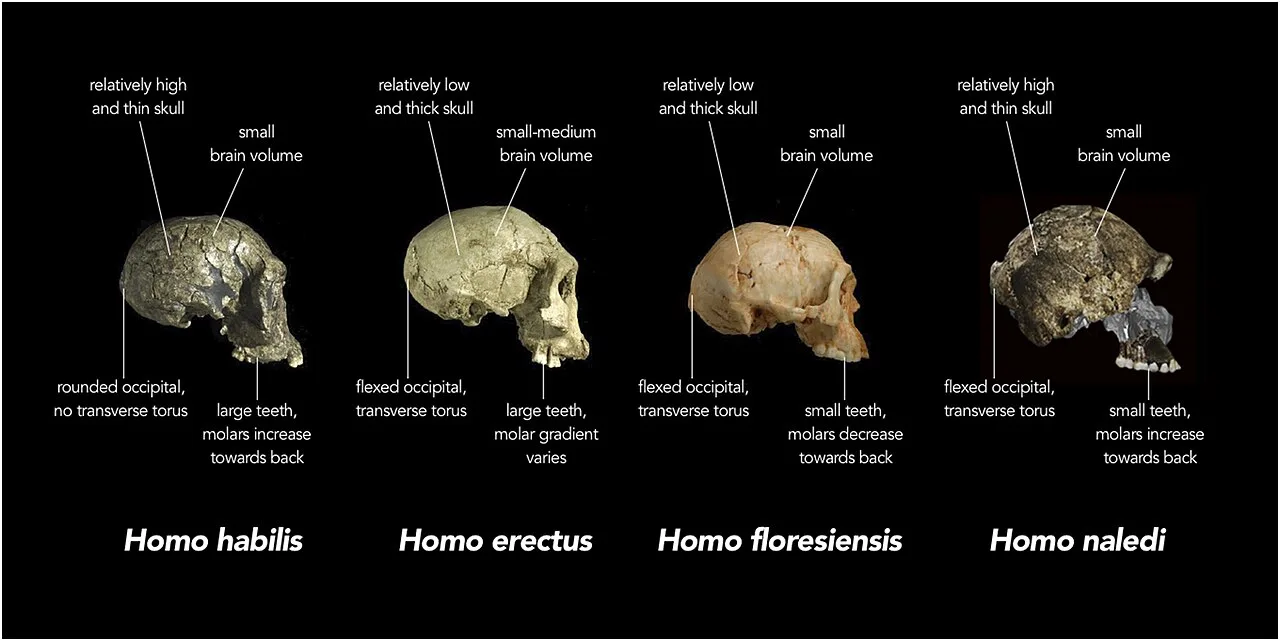
| Homo habilis | About 2.4 to 1.4 million years ago | Eastern and southern Africa | 500 to 800 cc |
| Homo erectus | About 2 million to 250,000 years ago | Africa, Asia | About 1,050 cc |
| Homo heidelbergensis | About 700,000 to 200,000 years ago | Africa, Europe | — |
| Neanderthals | About 400,000 to 40,000 years ago | Europe and Asia | 1,200 to 1,750 cc |
| Homo naledi | About 335,000 to 236,000 years ago | South Africa | 460 to 610 cc |
| Homo floresiensis (“hobbit”) | About 100,000 to 60,000 years ago | Flores, Indonesia | 380 to 420 cc |
| Homo sapiens (us) | About 300,000 years ago to today | Everywhere | About 1,300 cc |
A “cc” is a cubic centimetre, about the size of a sugar cube. So a brain of 1,300 cc would fill about 1,300 sugar cubes.
What are early humans?
Early humans belong to the human side of the family tree. That side split off from the line that led to chimpanzees. Scientists call this group the hominins. It includes us, Homo sapiens, and every lost relative that is closer to us than to a chimp.
Humans and chimps shared a common ancestor. It lived in Africa between about 6 and 9 million years ago, says the Natural History Museum in London. After that, the two lines went their own ways. Chimps are our cousins, not our great-great-grandparents.
You might also see the word hominid in older books. Today it means a bigger group: all great apes, living and extinct, including gorillas and orangutans. The Australian Museum explains that older books used “hominid” to mean what “hominin” means now.
About half of the hominin species we know about were found in the last 30 years. This is a fast-moving science. New finds turn up every year, and some of them change the story.
A bushy tree, not a ladder
The human family tree is shaped like a bush, with many branches, not like a ladder with one step after another. Several kinds of human often lived at the same time. Some branches led towards us, while many others simply died out and left nobody alive today to carry on their line.
You may have seen the famous picture of an ape turning into a human, one step at a time. It is catchy, but it is wrong. Footprints show Homo erectus and a different, heavy-jawed hominin called Paranthropus walking the same ground, around the same time.
Even a few hundred thousand years ago, Africa, Europe and Asia held a whole range of human species at once. Our species is the only one left. That makes today unusual in human history.
The first upright walkers
The first upright walkers are the oldest hominins scientists have found. They lived in Africa between about 7 and 4 million years ago. Their brains were small, about the size of a chimp’s. What makes them part of our family is the way they stood and walked.
The oldest candidate is Sahelanthropus tchadensis, nicknamed Toumaï. A team led by Michel Brunet found its skull in northern Chad in 2001. It lived about 7 to 6 million years ago. The hole where its spinal cord joined its skull sits further forward than in apes. That suggests it held its head on an upright body.
Ardipithecus ramidus lived in Ethiopia about 4.4 million years ago. A partial skeleton nicknamed Ardi was announced in 2009. Ardi stood about 120 cm (3 ft 11 in) tall and weighed about 50 kg (110 lb). She had a grasping big toe for climbing trees, but her hips suggest she could also walk on two legs.
Lucy and her species

Lucy is the most famous early human fossil in the world. She belonged to a species called Australopithecus afarensis and lived about 3.2 million years ago in what is now Ethiopia. Donald Johanson and Maurice Taieb’s team found her at Hadar in 1974.
Her name comes from the Beatles song “Lucy in the Sky with Diamonds”. It was playing at the camp on the night she was found. In Ethiopia she is called Dinknesh, which means “you are marvellous” in Amharic.
Lucy’s skeleton is about 40% complete: 47 of the 207 bones in a body. She was tiny. She stood about 1.05 m (3 ft 5 in) tall and weighed around 28 kg (62 lb). Her wisdom teeth had come through, so she was a young adult when she died.
Fossils from more than 300 of Lucy’s kind have been found. They could walk upright on the ground. They could still climb trees, too, with long, strong arms and curved fingers. Their brains averaged about 430 cc, roughly a third the size of ours.
The Laetoli footprints

The Laetoli footprints are a trail of hominin footprints in Tanzania, made about 3.6 million years ago in wet volcanic ash. Another eruption then covered them with more ash, which sealed them in. They are among the oldest footprints of our family ever found.
Mary Leakey’s team found the trail in 1978. It is almost 27 m (88 ft) long, with about 70 footprints, and was most likely made by Lucy’s species. In 2015, a second set made by two more walkers turned up about 150 m (490 ft) away.
Why do these prints matter so much? They prove that our relatives walked on two legs long before they had big brains. Walking came first. Big brains came much, much later, after millions more years of change.
The first stone tools and Homo habilis
The first stone tools were sharp flakes knocked off one stone by hitting it with another, called a hammerstone. The oldest known ones come from northern Kenya and are about 3.3 million years old, the Smithsonian says. That is older than any fossil of our own group, Homo.
So who made them? Nobody knows for certain. In 2023 scientists reported tools about 3 million years old at Nyayanga, also in Kenya. They had been used to cut up a hippopotamus. The only hominin teeth found in the same layer belonged to Paranthropus, not Homo.
Homo habilis means “handy man”. It got the name because scientists thought it made the simple stone tools found at Olduvai Gorge in Tanzania. Louis and Mary Leakey’s team found its first fossils there between 1960 and 1963. It stood 100 to 135 cm (3 ft 4 in to 4 ft 5 in) tall. It lived about 2.4 to 1.4 million years ago.
These Olduvai tools are called Oldowan tools, and the earliest are about 2.6 million years old. They mark the start of the Old Stone Age, the first and longest part of the Stone Age. The flakes cut meat and hides, and a hammerstone could crack nuts or bones. If you want to see how stone is shaped like this, read about Stone Age tools.
Homo erectus: the great traveller

Homo erectus was the first human species known to leave Africa, and it lasted longer than any other. It lived from about 2 million years ago until at least 250,000 years ago. Adults stood about 1.4 to 1.8 m (4 ft 7 in to 5 ft 11 in) tall, much like people today.
Its most famous fossil is Turkana Boy, found in 1984 by Kamoya Kimeu in northern Kenya. He was about 8 or 9 years old when he died, about 1.6 million years ago. Yet he was already 1.6 m (5 ft 3 in) tall, much taller than a typical eight-year-old today.
Homo erectus got around. A skull about 1.77 million years old was found at Dmanisi, in the country of Georgia. In 1891, Eugène Dubois found a skull cap on the island of Java, in Indonesia. It became known as “Java Man”.
It was also the first species to make hand axes: teardrop-shaped stones chipped on both sides. Tools like these appear by about 1.76 million years ago. Did it use fire? Ash and burnt bone about 1 million years old in Wonderwerk Cave, South Africa, may be early proof. But scientists say the clues are thin.
Homo heidelbergensis: spears and shelters
Homo heidelbergensis lived about 700,000 to 200,000 years ago in Africa and Europe. Its first fossil, a jaw, was found near Heidelberg, in Germany, in 1908. It was tall: males averaged about 175 cm (5 ft 9 in), the same as many men today.
The Smithsonian says it was the first early human to build simple shelters and to hunt large animals regularly. Wooden spears about 400,000 years old have been found at Schöningen, in Germany. Many scientists think it was the shared ancestor of Neanderthals and of us.
Neanderthals and Denisovans
Neanderthals and Denisovans were our closest extinct relatives. Both lived in Europe and Asia at the same time as some of our own ancestors, and both met them. That meeting left a mark you may be carrying in your own body today.
Neanderthals lived from about 400,000 to 40,000 years ago. Their brains were as big as ours, or bigger. Some were huge. Everyone whose family comes from outside Africa carries around 2% Neanderthal DNA, the Natural History Museum says. You can read much more about them in our guide to Stone Age people.
Denisovans were first found in 2010. There was no skeleton, just DNA in a tiny finger bone from a cave in Siberia. In 2025, DNA from the teeth of the Harbin “Dragon Man” skull from China matched them. It is at least 146,000 years old. A gene from Denisovans helps Tibetans breathe high in the mountains today.
The hobbit and the star cave

Two of the strangest human species were small-brained and lived surprisingly recently. One lived on an island in Indonesia. The other was found deep inside a cave in South Africa. Both were found in this century, and both surprised scientists.
Homo floresiensis, nicknamed the “hobbit”, was found in 2003 in Liang Bua cave on the island of Flores. A female skeleton suggests she stood about 106 cm (3 ft 6 in) tall. Its brain was about the size of a chimp’s. Yet it still made stone tools and hunted small elephants called Stegodon.
In 2013, cavers Rick Hunter and Steven Tucker found bones deep in the Rising Star cave system, near Johannesburg. Scientists later brought out more than 1,550 fossils from at least 15 bodies. The new species was named Homo naledi in 2015. “Naledi” means “star” in the Sotho language.
Homo naledi lived between about 335,000 and 236,000 years ago, with a brain of only 460 to 610 cc. In 2023, Lee Berger’s team claimed it buried its dead and scratched marks on the cave wall. Other scientists have doubts. Some think the bodies may have washed in, and the marks cannot yet be dated. The question is still open, and more digging and dating in the star cave may one day settle it either way.
Homo sapiens: where we come from
Homo sapiens, our own species, appeared in Africa about 300,000 years ago. The oldest known fossils come from Jebel Irhoud, in Morocco. They are about 100,000 years older than the record holders before them. Their faces look almost like ours, but their braincases were longer.
Scientists at the Max Planck Society dated them from burnt flint tools in the same layers. Some modern humans left Africa early: a skull about 180,000 years old was found at Misliya, in Israel. But the main spread out of Africa happened about 60,000 years ago, the Australian Museum says.
People reached Australia at least 50,000 years ago, and perhaps 65,000. Footprints at White Sands, in New Mexico, show people were in North America 21,000 to 23,000 years ago. Most of those prints were made by children and teenagers, walking among mammoths and giant sloths.
| Where | Earliest people (years ago) |
|---|---|
| Africa (Jebel Irhoud, Morocco) | About 300,000 |
| Israel (Misliya) | About 180,000 |
| Australia | At least 50,000, perhaps 65,000 |
| North America (White Sands) | 21,000 to 23,000 |
How do scientists know?
Scientists know about early humans from four main kinds of evidence: fossil bones, stone tools, footprints and ancient DNA. Each clue tells part of the story, and none of them tells all of it on its own, so scientists check one kind against another. Dating the rock around a find tells them how old it is, so the clues can be put in order.
There are different ways to date a find. Radiocarbon dating works only on things that were once alive, and only back to about 50,000 years. For older sites in East Africa, scientists date the volcanic ash layers above and below a fossil instead. Lower layers of rock are usually older than the ones on top.
DNA is a newer clue. It showed that human and chimpanzee DNA differ by only about 1.2% in the parts most often compared. When DNA has not survived, ancient proteins can help. In 2025, proteins from a jaw dredged up from the sea off Taiwan showed it came from a Denisovan.
Our brains are a clue too. Over the course of human evolution, brains grew three times bigger, the Smithsonian says. Lucy’s species had about 430 cc. Ours is about 1,300 cc.
Three things people get wrong
“Humans evolved from chimpanzees.” We did not. Humans and chimpanzees share a common ancestor that lived between about 6 and 9 million years ago. Since then both lines have changed, so chimps are our cousins, not our ancestors.
“There is one missing link.” Scientists do not look for a single link in a chain. Fred Spoor of the Natural History Museum said we often think of these species “as being the missing link in one single linear chain”. That is the mistake. The real picture is a branching bush with many gaps still to fill.
“Neanderthals were stupid cavemen.” Neanderthals made spears and hand axes and could make fire. They made jewellery from eagle claws, buried some of their dead and cared for the sick. Their brains were as big as ours. They also lived in shelters, not only in caves.
Did you know? About half of all the early human species we know about were discovered in the last 30 years. The hobbit was found in 2003 and Homo naledi was named in 2015.
Try it
Measure 1.05 metres up a wall and mark it with a sticky note. That is how tall Lucy was. Now stand next to it. Then mark 1.6 metres, the height of Turkana Boy, who was only 8 or 9 years old.
Knowledge check
What do the Laetoli footprints show?
Show answer
They show that our relatives were walking upright on two legs about 3.6 million years ago, long before big brains evolved.
Which human species was the first known to leave Africa?
Show answer
Homo erectus. Its fossils have been found as far away as Dmanisi in Georgia and the island of Java in Indonesia.
Frequently asked questions
What were the first early humans?
The oldest known early human is Sahelanthropus tchadensis, nicknamed Toumaï, which lived in Chad about 7 to 6 million years ago. It probably walked upright but had a brain slightly smaller than a chimpanzee’s.
Who was Lucy?
Lucy is a famous fossil of Australopithecus afarensis found in Ethiopia in 1974. She lived about 3.2 million years ago, stood about 1.05 metres tall, and her skeleton is about 40% complete.
Did humans come from monkeys or chimpanzees?
No. Humans and chimpanzees share a common ancestor that lived in Africa between about 6 and 9 million years ago. Chimpanzees are our cousins, not our ancestors.
When did Homo sapiens appear?
Homo sapiens appeared in Africa about 300,000 years ago. The oldest known fossils come from Jebel Irhoud in Morocco. The main spread out of Africa came about 60,000 years ago.
How many early human species were there?
Scientists know of more than 20 hominin species, and about half were found in the last 30 years. Several often lived at the same time, so the family tree looks like a bush.
What was the first human species to make tools?
The oldest known stone tools are about 3.3 million years old, and nobody yet knows who made them. Homo habilis, the “handy man”, was long thought to be the first toolmaker.
Sources
- Smithsonian National Museum of Natural History: Introduction to human evolution — the common ancestor, how scientists know and the human family tree; its pages on Sahelanthropus, Ardipithecus, Lucy, Laetoli, Homo habilis, Homo erectus, Turkana Boy, Dmanisi, Homo heidelbergensis, Neanderthals, Homo floresiensis, Homo naledi, Homo sapiens, the early tool kit, Nyayanga, dating, genetics and brains were also used
- Natural History Museum, London: Human evolution — more than 20 hominin species and species living at the same time; its pages on Lucy, Homo habilis, Homo erectus, Neanderthals, Denisovans, Homo naledi, the 2023 naledi claims, the Penghu jaw and where Homo sapiens evolved were also used
- Australian Museum: The human family tree — the branching family tree; its pages on hominids and hominins, Australopithecus afarensis, Homo habilis, Homo erectus, Homo floresiensis, Homo naledi, migrations out of Africa and the first Australians were also used
- Max Planck Society: Oldest Homo sapiens fossils at Jebel Irhoud, Morocco — the 300,000-year-old fossils, their faces and braincases, and how they were dated
- US National Park Service: Fossilized footprints, White Sands — the White Sands footprints, mostly made by children and teenagers; the 2026 National Fossil Day article gave the 21,000 to 23,000-year dates


