Hanukkah quick facts
- The oldest accounts of the Maccabees say nothing about oil lasting eight days. That story comes from the Talmud, written down much later.
- Lighting one hanukkiah for all eight nights takes 44 candles, counting the shamash each night.
- In 2026 Hanukkah starts on a Friday, so families who keep Shabbat light the first candle before sunset, ahead of the Shabbat candles.
- Dreidels made in Israel have a different fourth letter, so they say ‘a great miracle happened here’ instead of ‘there’.
- The Hebrew calendar adds a whole extra month in seven years out of every 19, which stops Hanukkah drifting into summer.
What the name Hanukkah (or Chanukah) means
Hanukkah is a Hebrew word that means “dedication”. Some translate it as “rededication”. That is because the festival remembers the Temple in Jerusalem being cleaned and dedicated to Jewish worship again, more than 2,000 years ago.
Hebrew has its own alphabet, so there is no single right way to write the word in English letters. Hanukkah and Chanukah are the two most common spellings. You will also see Chanuka. All of them are correct.
The first sound is a soft, throaty “h”, made at the back of the mouth. That is why some people spell it with “ch”, like the sound in the Scottish word loch.
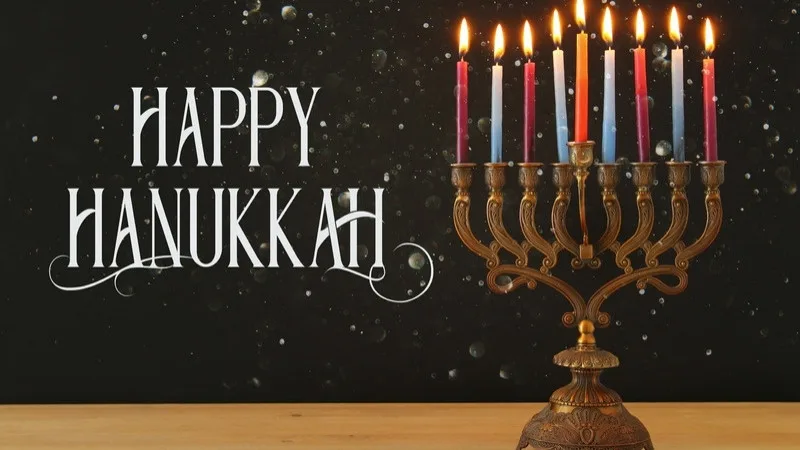
Hanukkah is also called the Festival of Lights. For eight nights, Jewish families light candles, adding one more each night. The candle holder has its own name, the hanukkiah, and many people call it a menorah. There is more about both words further down.
When Hanukkah 2026 begins and ends
In 2026, Hanukkah begins at sundown on Friday 4 December and ends at nightfall on Saturday 12 December. The first candle is lit on the evening of 4 December. The eighth is lit on 11 December.
Why does it start at sundown? In the Hebrew calendar, a new day begins when the sun goes down, not at midnight. So every Jewish holiday starts on the evening before its first full day.
This year has a twist. Hanukkah starts on a Friday, and Friday evening is the start of Shabbat, the Jewish day of rest. Jewish law does not allow lighting a fire on Shabbat. So on Friday 4 December, families who keep Shabbat light the Hanukkah candles first, while it is still light. Then they light the Shabbat candles.
The same thing happens on Friday 11 December, the last night. On Saturday 5 December the second candle waits until Shabbat is over, after nightfall.
| Night | Candles for the night (plus the shamash) | Evening in 2026 |
|---|---|---|
| 1 | 1 | Friday 4 December, before sunset |
| 2 | 2 | Saturday 5 December, after nightfall |
| 3 | 3 | Sunday 6 December |
| 4 | 4 | Monday 7 December |
| 5 | 5 | Tuesday 8 December |
| 6 | 6 | Wednesday 9 December |
| 7 | 7 | Thursday 10 December |
| 8 | 8 | Friday 11 December, before sunset |
Why the date of Hanukkah moves
Hanukkah always begins on the same date: the 25th day of Kislev. Kislev is a month in the Hebrew calendar. The date only seems to move because most of the world uses a different calendar.
The Hebrew calendar follows both the Moon and the Sun. A calendar like that is called lunisolar. Each month follows the phases of the Moon. But 12 of those months add up to a few days less than a solar year. A solar year is the time Earth takes to travel once around the Sun.
If nothing were done, the festivals would slowly drift through the seasons. In time, Hanukkah would land in the middle of summer. So the Hebrew calendar adds a whole extra month in seven years out of every 19. That pulls the festivals back to the right time of year.
The result is that the 25th of Kislev can fall anywhere from late November to late December. Here is how far it moves in just four years.
| Year | Hanukkah begins at sundown on |
|---|---|
| 2024 | Wednesday 25 December |
| 2025 | Sunday 14 December |
| 2026 | Friday 4 December |
| 2027 | Friday 24 December |
Look at 2024. The first candle was lit on the evening of Christmas Day. In 2027, Hanukkah begins on Christmas Eve. In 2026 it starts three weeks before Christmas.
Other festivals move for the same kind of reason. Diwali follows the Hindu lunar calendar, so its date changes every year too.
Hanukkah’s Name and Calendar
- What does the Hebrew word Hanukkah mean?
- In which Hebrew month does Hanukkah begin?
- A calendar that follows both the Moon and the Sun is called what?
- How does the Hebrew calendar keep its festivals in the right season?
- If the Hebrew calendar never added its extra month, what would slowly happen to Hanukkah?
What historians know about the Maccabees
The events behind Hanukkah took place in Judea, the Jewish homeland around Jerusalem. More than 2,000 years ago, Judea was ruled by the Seleucid Empire. This was a kingdom with Greek-speaking kings, based in Syria.
Its king, Antiochus IV, treated the Jews of Judea harshly. The Temple in Jerusalem, the centre of Jewish worship, was turned into a shrine for other gods.
In 167 BCE, Jews in Judea rose up against him. Their first great leader was Judah, the son of a priest called Mattathias. Judah was known as “the Maccabee”, and his family and followers became known as the Maccabees.
In the autumn of about 164 BCE, the Maccabees captured the Temple. They cleaned it and dedicated it to God again. The celebration lasted eight days.
How do we know? The main evidence is two ancient books, the First and Second Books of Maccabees. The Second Book was written around 124 BCE, only about 40 years after the events. The First Book followed around 100 BCE.
Neither book is part of the Hebrew Bible. They belong to a group of old writings called the Apocrypha, which is why many Jewish families know them less well than other texts.
The Second Book gives its own reason for the eight days. It says the joyful celebration lasted eight days, like Sukkot, the autumn festival of huts. Only a short time before, the fighters had spent Sukkot living in mountains and caves.
An ancient Jewish historian called Josephus also wrote about the Temple being rededicated. None of these early writers mentions oil lasting for eight days.
The story of the oil, as the Talmud tells it
The story most Jewish children learn about Hanukkah comes from the Talmud. The Talmud is a very large collection of teachings and debates by Jewish scholars called rabbis. It was written down much later than the Books of Maccabees.
The Talmud tells that when the Greeks entered the Temple, they made all its oil impure. When the Maccabees won, they searched and found just one small jar of pure oil. It still carried the seal of the High Priest, the most senior priest of the Temple.
There was only enough oil to keep the Temple’s lamp burning for one day. The Talmud says a miracle happened, and the oil lasted for eight days.
Jewish tradition teaches that this is why Hanukkah lasts eight nights, and why lights are at the heart of it. Many teachers say the oil story keeps attention on God’s help rather than on the fighting. A verse from the prophet Zechariah, read at Hanukkah, puts it this way: “Not by might, nor by power, but by My spirit.”
Rabbis have asked a clever question about the story. If the jar held enough oil for one day, only seven of the eight days were a miracle. So why eight? One traditional answer is that the oil burned so slowly that a little was left each day. Another is that it took eight days to make a fresh batch of pure oil.
Historians and religious teachers ask different questions. Historians study what the oldest writings say happened. The Talmud’s story is what Jewish tradition teaches about why the festival is kept. Many Jewish families tell both.
The Hanukkah Story in Order
- A harsh king Antiochus IV rules Judea, and the Temple is turned into a shrine for other gods.
- The revolt Jews in Judea rise up, led at first by Judah the Maccabee.
- The Temple won back The Maccabees capture the Temple, clean it and dedicate it again.
- Eight days of joy The first celebration of the rededication lasts eight days.
- The Books of Maccabees Two ancient books record what happened. The earlier one was written about 40 years later.
- The Talmud Much later, the Talmud tells the story of one jar of oil that lasted eight days.
The hanukkiah and its nine lights
The special lamp for Hanukkah is called a hanukkiah, which means “Hanukkah lamp”. It has nine places for candles. Eight are for the eight nights. The ninth is for the shamash.
Shamash means “helper”. The shamash is the candle used to light all the others. It usually stands apart from them, either higher up or lower down, and often in the middle.

Many people call the hanukkiah a menorah. The word menorah simply means “lamp”. It first described the lamp in the ancient Temple, which had seven branches, not nine. Today “Hanukkah menorah” and “hanukkiah” mean the same thing.
You can tell the two apart by counting. A seven-branched menorah is a symbol of Judaism and of the ancient Temple. A nine-branched one, with its helper candle, belongs to Hanukkah.
How families light the candles each night
On the first night, there are two candles in the hanukkiah: the shamash and one other. Each night one more is added. By the eighth night, all nine are burning.
The order has a pattern that surprises people. Candles are put in from right to left, the way Hebrew is written. They are lit from left to right. That way, the newest candle, the one for tonight, is always lit first.
In most families the shamash is lit first and then used to light the others, one by one.
Before lighting, families say blessings, which are short prayers. There are three on the first night and two on each night after that. One thanks God for the wonders done for their ancestors at this time of year.
Many families place the hanukkiah in a window that faces the street. The ancient rabbis taught that the miracle should be made public, so that everyone passing by can see the lights.
How many candles does one hanukkiah need for the whole festival? Add up one to eight, which makes 36. Then add a shamash for each of the eight nights. That makes 44.
These are real flames. Children should only light them with an adult, and a burning candle should never be left alone.
Lighting the Hanukkiah: True or False?
- On the first night of Hanukkah, two candles stand in the hanukkiah.
- On the eighth night, eight candles are burning in the hanukkiah.
- One hanukkiah needs 44 candles for all eight nights, counting the shamash each night.
- Families say the same number of blessings on every night of Hanukkah.
- The ancient rabbis taught that Hanukkah lights should be hidden away from the street.
- Every Jewish community lights the shamash first.
- The shamash usually stands apart from the other candles, higher up or lower down.
The dreidel and its four letters
A dreidel is a spinning top with four sides. Dreidel is a Yiddish word, from a language that many Jews in Europe spoke. In Hebrew the top is called a sevivon.
Each side carries a Hebrew letter: nun, gimel, hei and shin. Together they stand for four Hebrew words, Nes Gadol Hayah Sham. That means “a great miracle happened there”.

In Israel, dreidels are different. The shin is swapped for a pe, so the words become Nes Gadol Hayah Po: “a great miracle happened here”. In Jewish tradition, the miracle happened in the land of Israel itself.
| Letter | Hebrew word it stands for | Meaning |
|---|---|---|
| Nun | Nes | miracle |
| Gimel | Gadol | great |
| Hei | Hayah | happened |
| Shin (outside Israel) | Sham | there |
| Pe (in Israel) | Po | here |
The dreidel is also a game. Players spin it in turn, and the letter it lands on tells the player what to do. Depending on the letter, they may take from the pile in the middle or add a piece to it. People play with nuts, sweets or coins.
Dreidel Letter Match
- Nun — Nes, meaning miracle
- Gimel — Gadol, meaning great
- Hei — Hayah, meaning happened
- Shin — Sham, meaning there
- Pe — Po, meaning here
- Sevivon — The Hebrew name for a dreidel
Latkes, doughnuts and other foods fried in oil
Most Hanukkah food has one thing in common. In memory of the jar of oil, it is a Jewish tradition to eat foods fried in oil.
The best-known are latkes. These are pancakes, usually made from potato, and fried until they are crisp. They come from the Ashkenazi Jews, whose families lived in Europe.

In Israel, the favourite is sufganiyot. These are round doughnuts, usually filled with jam and fried in oil. In Britain you might call them jam doughnuts.
Latkes and sufganiyot look nothing alike, and they come from different parts of the Jewish world. The oil is the link between them.
Gelt, gifts and songs
Gelt is the Yiddish word for money. In Europe, a Hanukkah custom grew up of giving children small amounts of money, along with nuts and raisins.
Today, Hanukkah gelt usually means chocolate coins wrapped in shiny foil. They make handy playing pieces for a dreidel game.
Presents came later. In Western countries, Christmas falls at around the same time of year. There, Hanukkah grew into the main time for giving gifts in the Jewish year.
Families and friends also get together to sing Hanukkah songs, play dreidel and eat. Big community parties often have all of these at once.
Hanukkah Foods and Customs Match-Up
- Latkes — Pancakes, usually made from potato, fried until crisp
- Sufganiyot — Round doughnuts, usually filled with jam
- Frying in oil — Done in memory of the jar of oil
- Gelt — The Yiddish word for money
- Nuts and raisins — Given to children in Europe, along with a little money
- Hanukkah presents — Became popular in Western countries, where Christmas falls at the same time
Lighting the menorah in public
Most of Hanukkah happens at home. Over time, though, it has also become a festival that people celebrate out in the open.

Many Jewish organisations put up giant menorahs in their towns and cities. They hold public lighting ceremonies, with songs, dreidel games and food.
My Jewish Learning is a Jewish education website. It describes these gatherings as a stand against people who have tried to wipe out Jewish practice, in the past and today. It also says Hanukkah makes a strong case for freedom of religion.
Like Passover, Hanukkah celebrates freedom from oppression, which means being treated cruelly and unfairly by people in power. That is one reason the festival matters to so many families.
A small festival that families love
In Jewish law, Hanukkah is quite a minor festival. It is not one of the festivals set out in the Hebrew Bible, and it has only a few special prayers.
Even so, it has become one of the best-loved Jewish holidays. It usually falls in December, when the days are shortest in the northern half of the world. A row of lights in a dark window means a lot at that time of year.
The bigger festivals, such as Passover and Yom Kippur, are explained in our guide to Judaism. That guide also covers Shabbat, the Torah and the synagogue.
Hanukkah words for KS2 projects
- Hanukkah: a Hebrew word meaning “dedication”, also spelled Chanukah.
- Hanukkiah: the nine-branched Hanukkah lamp, often called a menorah.
- Shamash: the “helper” candle used to light the other eight.
- Menorah: a lamp; first the seven-branched lamp of the ancient Temple.
- Kislev: the Hebrew month in which Hanukkah begins, on the 25th.
- Maccabees: Judah the Maccabee and the people who fought with him.
- Talmud: a very large collection of teachings by Jewish scholars, which tells the story of the oil.
- Dreidel: a four-sided spinning top, called a sevivon in Hebrew.
- Latkes: pancakes, usually made from potato, fried in oil.
- Sufganiyot: jam doughnuts fried in oil, a favourite in Israel.
- Gelt: Yiddish for money; today, usually chocolate coins.
- Lunisolar calendar: a calendar that follows both the Moon and the Sun.
Three things people get wrong
1. Hanukkah is not “Jewish Christmas”. Both festivals have lights, and both usually come in December. They are very different, though. Christmas is a Christian festival that remembers the birth of Jesus, on a fixed date. Hanukkah is a Jewish festival that remembers the Temple being rededicated, and it moves with the Hebrew calendar. Hanukkah presents became popular in Western countries partly because Christmas falls at the same time. That came much later than the festival itself.
2. Hanukkah is not the most important Jewish holiday. It is one of the best known, because of the lights, the food and the time of year. But in Jewish law it is a minor festival. It is not set out in the Hebrew Bible, and the major festivals have many more rules and prayers.
3. Hanukkah does not really change its date. In the Hebrew calendar it always begins on the 25th of Kislev. It only seems to move on the calendar on your wall, because the Hebrew calendar follows the Moon as well as the Sun. That is why it began on 25 December in 2024 and begins on 4 December in 2026.
Did you know? Hanukkah and Christmas sometimes meet. In 2024 the first Hanukkah candle was lit on the evening of Christmas Day, and in 2027 Hanukkah begins at sundown on Christmas Eve.
Try it
Draw a hanukkiah on paper with nine branches, with the shamash set higher than the rest. Then make a table with a row for each of the eight nights and count the candles, remembering the shamash every time. Your total should be 44. If you want flames, cut them from yellow paper, never real ones.
Knowledge check
Why do Jewish holidays, including Hanukkah, begin in the evening?
Show answer
In the Hebrew calendar a new day begins at sunset, not at midnight, so each holiday starts on the evening before its first full day.
In what order are the Hanukkah candles put in and lit?
Show answer
They are put in from right to left, the way Hebrew is written, and lit from left to right, so the newest candle is lit first.
Frequently asked questions
What is Hanukkah?
Hanukkah is an eight-day Jewish festival of lights. The festival remembers the rededication of the Temple in Jerusalem in about 164 BCE, after the Maccabees won it back. Families light a nine-branched hanukkiah, eat foods fried in oil and play dreidel.
When is Hanukkah 2026?
Hanukkah 2026 begins at sundown on Friday 4 December and ends at nightfall on Saturday 12 December. The first candle is lit on the evening of 4 December and the eighth on 11 December.
Why does Hanukkah last eight days?
Jewish tradition, as told in the Talmud, teaches that one day’s worth of oil burned for eight days in the Temple. The older Second Book of Maccabees says the first celebration lasted eight days, like the festival of Sukkot.
What is the difference between a menorah and a hanukkiah?
Menorah means lamp, and the menorah in the ancient Temple had seven branches. A hanukkiah is the Hanukkah lamp, with nine branches: eight for the nights and one for the shamash, the helper candle. Many people call a hanukkiah a menorah too.
What do the letters on a dreidel mean?
The four Hebrew letters on a dreidel, nun, gimel, hei and shin, stand for Nes Gadol Hayah Sham, which means ‘a great miracle happened there’. Dreidels in Israel use pe instead of shin, for ‘a great miracle happened here’.
Is Hanukkah the Jewish Christmas?
Hanukkah is not the Jewish Christmas. Hanukkah is a Jewish festival that remembers the Temple being rededicated more than 2,000 years ago, while Christmas is a Christian festival about the birth of Jesus. Hanukkah gifts became popular in Western countries because the two often fall close together.
How do you spell Hanukkah?
Hanukkah and Chanukah are both correct, and Chanuka is used too. The name is a Hebrew word, and Hebrew has its own alphabet, so there is more than one way to write it in English letters.
Sources
- Hebcal: Chanukah 2026 — the 2026 dates and which evenings are lit before sunset or after nightfall, the 25th of Kislev, the spellings, and the start dates for 2024, 2025 and 2027
- My Jewish Learning: Hanukkah 101 — the revolt against Antiochus IV from 167 BCE, the rededication in 164 BCE, foods fried in oil, money given to children in Europe, gift-giving, Hanukkah as a minor festival and public candle lightings
- My Jewish Learning: Why is Hanukkah eight days? — the Talmud’s account of the oil, the Books of Maccabees and when they were written, Sukkot, Josephus, and traditional answers about the eighth day
- My Jewish Learning: How to light the Hanukkah menorah — the shamash, placing candles right to left and lighting left to right, 44 candles, lighting before Shabbat, the blessings, windows and public menorahs
- My Jewish Learning: Hanukkah vocabulary — the meaning of Hanukkah, hanukkiah, shamash and menorah, the seven-branched Temple menorah, the dreidel letters, sevivon, latkes, sufganiyot and gelt
- My Jewish Learning: The Jewish calendar, solar and lunar — why a Jewish day begins at sunset, months that follow the Moon, and the extra month added in seven years out of every 19
Hanukkah Final Challenge
- In which season did the Maccabees capture the Temple, in about 164 BCE?
- Which ancient Jewish historian wrote about the Temple being rededicated, without mentioning oil lasting eight days?
- What is the Talmud?
- In the Talmud's story, whose seal was still on the jar of pure oil?
- The Second Book of Maccabees says the first eight-day celebration was like which festival?
- Dreidel is a word from which language?
- Which is NOT a reason Hanukkah counts as a minor festival in Jewish law?
- Why is it wrong to call Hanukkah the Jewish Christmas?
- Like Passover, Hanukkah celebrates freedom from oppression. What does oppression mean?
- Why does Hanukkah usually come at a time when lights in a window mean a lot?