
Humboldt penguins quick facts
- Humboldt penguins dig their nest burrows in dried seabird droppings called guano.
- During El Niño, a Humboldt penguin may travel up to 895 km looking for food, instead of its usual 35 km.
- Researchers estimate about 4,067 Humboldt penguins were caught in fishing gear in 2023.
- Peru’s 2025 national census counted only about 5,400 Humboldt penguins in the whole country.
- One Humboldt penguin colony in Peru settled on a new harbour wall and grew to 800 birds by 2016.
Humboldt penguins at a glance
The Humboldt penguin lives on the desert coasts of Peru and Chile in South America. It is named after a cold ocean current, not after a place. It digs its nests in old seabird droppings.
| Fact | Detail |
|---|---|
| Scientific name | Spheniscus humboldti |
| Where it lives | Pacific coast of Peru and Chile |
| Length | 66–70 cm (26–28 in) |
| Weight | 4–5 kg (9–11 lb) |
| Main food | Anchoveta and other small shoaling fish |
| Eggs | Two per clutch |
| IUCN status | Vulnerable |
| Status in Peru | Endangered (“In Danger”) |
This guide explains where the Humboldt penguin lives, how it nests and why its numbers are falling. Every figure comes from a named zoo, university, science journal or government source.
Where Humboldt penguins live
Humboldt penguins live only along the Pacific coast of South America. A 2025 study in the journal Royal Society Open Science gives their range. It runs from La Foca Island in northern Peru to Metalqui Island in southern Chile.
The same study counts 80 known colonies. There are 42 in Peru and 38 in Chile. Most sit on rocky islands, headlands and steep shores.
The sea just offshore is cold and packed with fish.
Humboldt penguins do not usually travel far. The Animal Diversity Web at the University of Michigan says 90 per cent of tracked birds stayed within 35 kilometres of their colony. That is about 22 miles.
The Humboldt Current
The penguin is named after the Humboldt Current. The Smithsonian’s National Zoo says this is the ocean current along the coast from Chile to the tip of Peru.
The current carries cold water north along the coast. Winds also push surface water away from the shore. Cold, deep water then rises up to take its place. Scientists call this upwelling.
The University Corporation for Atmospheric Research explains why upwelling matters. The rising water is full of nutrients. Tiny drifting plants called phytoplankton feed on them, and anchovies feed on the phytoplankton.
So the cold current feeds the whole food chain. The penguins sit near the top of it, along with sea lions, fur seals and the fishing boats that come to catch the very same anchoveta every year.
What a Humboldt penguin looks like
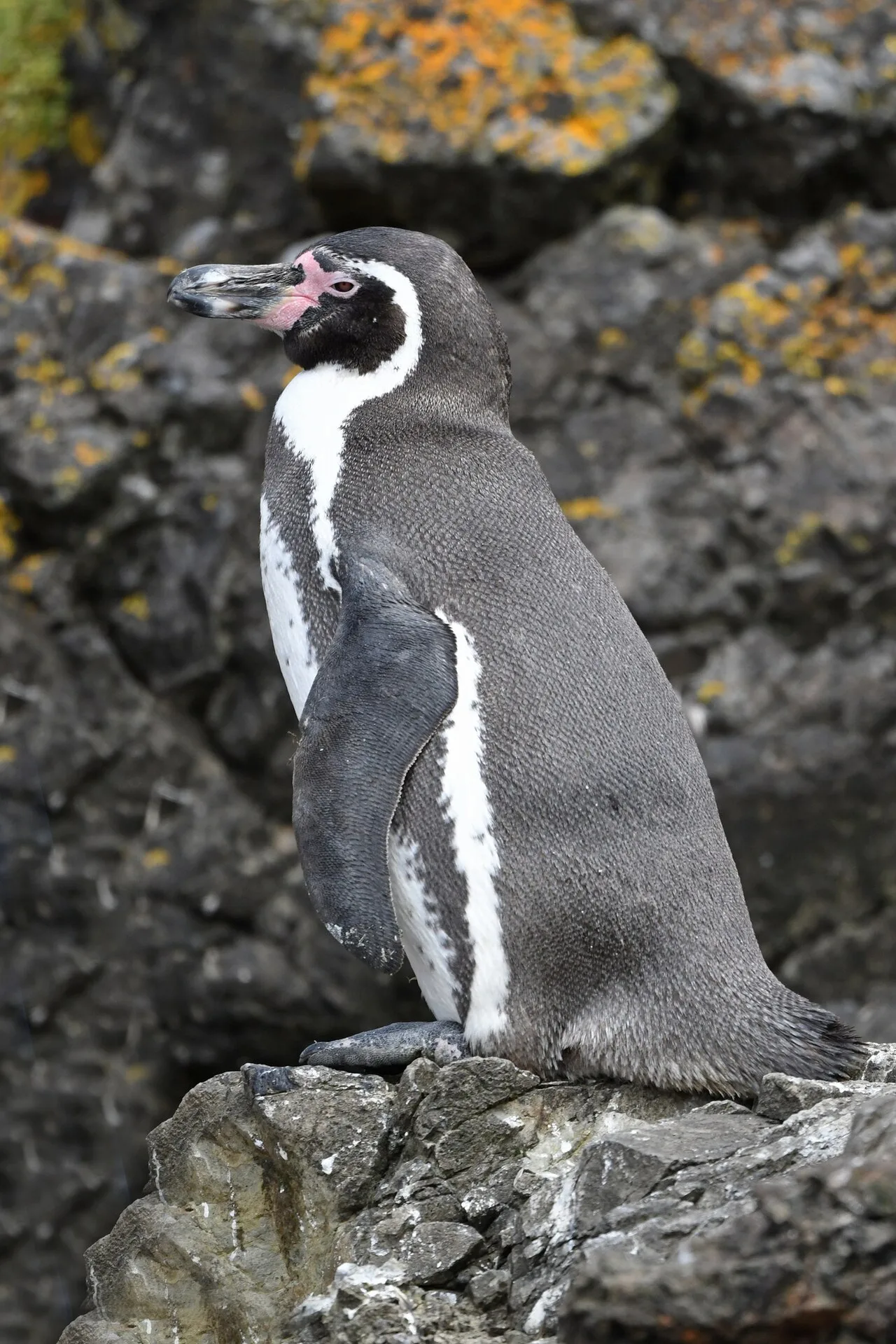
A Humboldt penguin has a black back and a white front. The Smithsonian’s National Zoo describes a white C-shaped band of feathers on its head. One black band runs across its chest.
It also has patches of bare pink skin on its face, around the base of the beak. The sources used here do not say what job this bare skin does.
The Animal Diversity Web says adults are 66 to 70 centimetres (26 to 28 inches) long. They weigh 4 to 5 kilograms (9 to 11 pounds). That makes an adult about as long as a child’s arm, from shoulder to fingertips.

What Humboldt penguins eat
The Saint Louis Zoo says the anchoveta is the Humboldt penguin’s main food. It is a small, silvery fish, a type of anchovy. Huge shoals of it live in the cold current.
The Animal Diversity Web lists other prey too. These include pilchards, garfish, squid, Araucanian herring and silversides. The penguins take whatever small fish are close by.
The Smithsonian’s National Zoo says Humboldt penguins usually hunt in groups of ten or fewer. Working together may help them round up a shoal.
How deep they dive
Humboldt penguins catch their food underwater. They use their stiff wings as flippers and steer with their feet.
Most of their dives are shallow. The Animal Diversity Web gives an average depth of about 10 metres (33 feet). That is about as deep as a three-storey house is tall.
The deepest recorded dive reached 61.8 metres (203 feet).
How long do they stay out at sea? It depends on whether they have chicks. The Animal Diversity Web says birds that are not breeding spend around 60 hours in the water on each trip, and the longest trip recorded lasted more than 163 hours. Parents with a nest to look after come back much sooner. Their trips last about 22 hours on average.
That is almost a whole day and night of swimming. Then they swap with their partner.
Burrows dug in guano
Seabirds have nested on the islands of Peru and Chile for a very long time. Their droppings dried and piled up, layer on layer. This dried material is called guano.
The Saint Louis Zoo says it gives the penguins a soft ground they can dig into. Each pair digs a burrow in it to hold their nest.
A burrow works like a cool cave. It keeps eggs and chicks out of the burning sun. It also hides them from gulls and other egg thieves.
Guano harvesting
Guano is rich in nutrients that help crops grow. That makes it a valuable fertiliser. For a long time, people scraped it off the islands in huge amounts.
The Animal Diversity Web says taking the guano lowers the penguins’ breeding success. Without it, the birds cannot dig deep burrows. Eggs and chicks are left out in the heat.
Workers on the islands can also disturb nesting birds. The Saint Louis Zoo lists guano harvesting as one of the main threats to the species.
There is a better way. The Saint Louis Zoo says the first sustainable guano harvest at Punta San Juan in Peru took place in 2001. Guano was collected in a way that left the penguins in peace. A third harvest there followed in 2012.
Eggs and chicks
The Animal Diversity Web says Humboldt penguins breed from March to December. There are two busy peaks, in April and again in August and September. The Smithsonian’s National Zoo says a pair may nest twice in one year.
A female lays two eggs, about the same size. Both parents take turns keeping them warm. The Animal Diversity Web gives the incubation time as 40 to 42 days. The Saint Louis Zoo gives about 39 days.
The chicks leave the nest at 10 to 12 weeks old. Life is hard for them. The Animal Diversity Web says fewer than half survive their first year.
Humboldt penguins in zoos live 15 to 20 years. Scientists do not have a good figure for how long wild birds live.
What hunts Humboldt penguins
At sea, Humboldt penguins face sharks, fur seals and sea lions. On land, the Animal Diversity Web lists foxes, snakes, rodents and gulls. Cats and dogs that people have brought to the coast hunt them too.
Adults are fast in the water and hard to catch. Eggs and small chicks are much easier targets. That is one reason a deep, dark burrow is so valuable.
What happens during El Niño
Every few years, the weather over the Pacific changes. The winds along the coast of Peru grow weaker. This event is called El Niño.
The University Corporation for Atmospheric Research says El Niño comes every three to seven years. With less wind there is less upwelling. Warmer water stays at the surface, and fewer anchovies survive.
For Humboldt penguins, that means hunger. The Animal Diversity Web says birds may travel up to 895 kilometres in search of food during El Niño. Normally they stay within about 35 kilometres of home.
Adults that travel so far cannot feed their chicks. The same source says more females than males die in these years. That leaves too few females to breed afterwards.
Scientists are still studying how fast the population recovers after a strong El Niño. Recovery may take years.
| Normal year | El Niño year | |
|---|---|---|
| Coastal winds | Strong | Weaker |
| Upwelling of cold water | Strong | Weak |
| Anchovies near the coast | Plenty | Far fewer |
| Distance penguins travel | Usually within 35 km | Up to 895 km |
Fishing nets and other dangers
Penguins and fishing boats both want anchoveta. The Saint Louis Zoo says Peru’s fishing industry is largely unregulated. It removes the penguins’ food and puts them at risk of getting tangled in nets.
A 2025 study measured how bad the problem is. Researchers gathered reports from fishing ports along both coasts. They estimated that about 4,067 penguins were caught in fishing gear in 2023. That is 2,624 in Peru and 1,443 in Chile.
Gillnets were the worst. The study found that nets with gaps of 7.6 to 15.2 centimetres (3 to 6 inches) caught the most penguins. The ports reporting the most penguins in nets were Tambo de Mora and San José in Peru, and Coquimbo and San Antonio in Chile. A gillnet hangs in the water like a curtain, and a diving bird can swim straight into it.
Peru’s state news agency Andina lists other threats. They include oil spills, hunting for food or pets, and the warming water of El Niño. The 2025 study also names bird flu, known as H5N1, which spread along the coast in 2023.

How many Humboldt penguins are left
Nobody knows the exact number. Counts are hard to make on remote islands, and different teams count in different years.
The 2025 study used reviews of counts made between 1997 and 2011. Those gave about 36,982 penguins across Peru and Chile. The Saint Louis Zoo gives a figure of about 40,000.
Newer counts from Peru are much lower. Peru holds a national census each January and February. According to Andina, the 2025 census found about 5,400 Humboldt penguins in Peru. The count is coordinated by the Peruvian group Acorema and the Saint Louis Zoo, with Peru’s wildlife service.
| What was counted | Number | Source |
|---|---|---|
| Peru and Chile (counts from 1997–2011) | about 36,982 penguins | Royal Society Open Science, 2025 |
| Peru only, 2025 census | about 5,400 penguins | Andina (Peru state news agency) |
| Colonies known | 80 (42 in Peru, 38 in Chile) | Royal Society Open Science, 2025 |
Scientists predicted in the 2025 study that the population could fall by 7 per cent a year. At that rate, they warn, the species could die out in about 59 years.
How Humboldt penguins are protected
The International Union for Conservation of Nature lists the Humboldt penguin as Vulnerable. That means it faces a high risk of dying out in the wild. Peru goes further and rates it as endangered, according to Andina.
In the United States, the Animal Diversity Web says the species is listed as Threatened. Zoos in several countries keep Humboldt penguins in breeding programmes. The Saint Louis Zoo has supported fieldwork in Peru for more than 20 years.
Places like Punta San Juan matter a great deal. The Saint Louis Zoo says about half of Peru’s Humboldt penguins nest there. Cold water full of nutrients wells up just offshore, and it feeds the anchoveta the penguins depend on. Protecting that one headland protects a large share of the species.
A colony on a harbour wall
Sometimes Humboldt penguins find new homes on their own. The Smithsonian’s National Zoo tells the story of a colony on a breakwater in Peru. A breakwater is a long wall of rock built out into the sea to shelter a harbour.
Building work on the breakwater finished in 2009. Soon afterwards, penguins began to arrive. There were 60 of them by 2012.
Then the numbers leapt upwards. The Smithsonian counted 381 birds in 2013 and 800 by May 2016. More than 100 others had settled on a second breakwater nearby.
Where did they come from? The Smithsonian says many were young birds and adults looking for a new place to live. They had been pushed out of the nearby guano islands.
The story shows that Humboldt penguins can move when they have to. It does not mean the species is safe. A new colony only helps if the birds find enough food and are left in peace.
Three things people get wrong
Myth: penguins only live in icy places. Humboldt penguins live on the desert coasts of Peru and Chile, where the land is dry and bare. The cold Humboldt Current keeps their sea cool, while the land can be hot.
Myth: guano is just waste nobody needs. For Humboldt penguins, guano is home. They dig their nest burrows in it. When people scraped it away for fertiliser, the birds lost the safest places to raise their chicks.
Myth: “Vulnerable” means the species is fairly safe. Vulnerable is a threatened category on the IUCN Red List. Peru rates the Humboldt penguin as endangered, and its 2025 census counted only about 5,400 birds in the whole country.
Did you know? The Saint Louis Zoo says about half of all Peru’s Humboldt penguins nest at a single headland, Punta San Juan.
Try it
Hold your arm out straight and measure from your shoulder to your fingertips with your other hand, counting hand-spans. A Humboldt penguin is 66 to 70 cm long. Is your arm longer or shorter than a penguin?
Knowledge check
What is upwelling?
Show answer
Upwelling is when cold, deep water rises to the surface near the coast. It brings nutrients that feed plankton and fish.
Why is El Niño bad for Humboldt penguins?
Show answer
El Niño weakens the winds and the upwelling, so fewer anchovies live near the coast. Penguins must travel much further to eat and struggle to feed their chicks.
Frequently asked questions
Where do Humboldt penguins live?
Humboldt penguins live on the Pacific coast of Peru and Chile, from La Foca Island in Peru to Metalqui Island in Chile. There are about 80 known colonies.
Why is it called the Humboldt penguin?
The Humboldt penguin is named after the Humboldt Current, the cold ocean current along the coast of Chile and Peru. It keeps the sea cold and full of fish.
What do Humboldt penguins eat?
Humboldt penguins mainly eat anchoveta, a small anchovy. They also catch pilchards, garfish, squid, Araucanian herring and silversides, usually hunting in small groups.
Why do Humboldt penguins nest in guano?
Guano is dried seabird droppings that build up in thick layers. Humboldt penguins dig burrows in it, which keep their eggs and chicks shaded and hidden from predators.
Are Humboldt penguins endangered?
The IUCN lists the Humboldt penguin as Vulnerable, a threatened category. Peru rates it as endangered, and the 2025 census found about 5,400 birds in Peru.
How does El Niño affect Humboldt penguins?
El Niño weakens coastal winds and upwelling, so fewer anchovies live near shore. Penguins may travel up to 895 km for food, and many chicks and females die.
Sources
- Animal Diversity Web (University of Michigan): Spheniscus humboldti — size, diet, diving, breeding, chick survival, predators, El Niño travel and the effect of guano extraction
- Royal Society Open Science (2025): Fishery bycatch of Humboldt penguins in Peru and Chile — range, the 80 colonies, the population estimate and projection, and the 2023 bycatch figures
- Saint Louis Zoo: Center for Conservation in Punta San Juan, Peru — guano burrows, sustainable guano harvests, threats and the Punta San Juan colony; its Humboldt penguin species page was also used for diet and incubation
- Smithsonian’s National Zoo: The curious colonization of the Humboldt penguin — appearance, the Humboldt Current, IUCN status, group hunting and the harbour-wall colony
- Andina (Peru state news agency): Humboldt penguin national census — the 2025 Peru census figure, who runs the census, Peru’s endangered rating and threats
- UCAR Center for Science Education: An El Niño fish tale — how upwelling feeds anchovies and how often El Niño happens


