
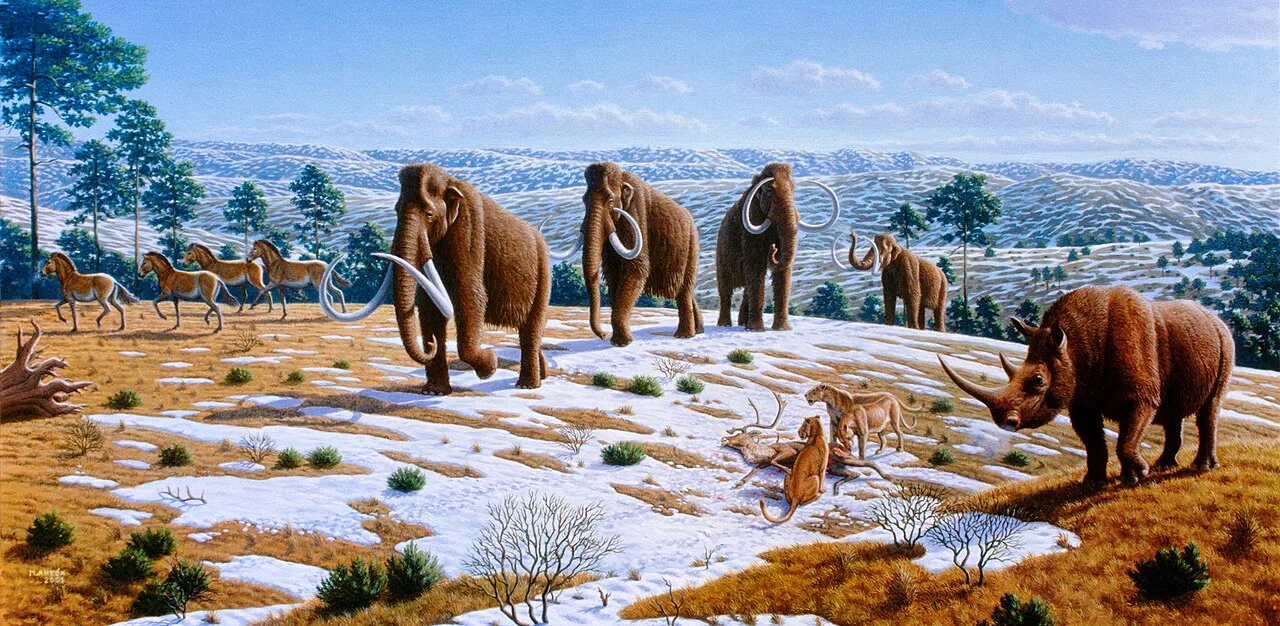
Ice Age animals quick facts
- A ground sloth called Megatherium could stand 3.5 m (12 ft) tall on its back legs, the biggest mammal known to walk on two legs.
- Dire wolf DNA shows they split from grey wolves nearly six million years ago. Their closest living relatives may be African jackals.
- The front teeth of the Ice Age giant beaver were about the size of bananas.
- In 2026, scientists read a woolly rhino’s genes from a scrap of meat inside an Ice Age wolf puppy’s stomach.
- A frozen cave lion cub called Sparta still has her whiskers after about 28,000 years.
Ice Age animals at a glance
Ice Age animals were often giants. During the last Ice Age, sloths as heavy as elephants, armoured beasts the size of small cars and wolves with jackal cousins all roamed the Earth. Most of them are gone now. Here are the main ones in one table, so you can find each animal quickly.
| Animal | Where it lived | How big | Died out |
|---|---|---|---|
| Woolly rhinoceros | Europe and northern Asia, including Britain | Big, hairy rhino with two horns | Soon after 14,400 years ago |
| Megatherium (giant ground sloth) | Argentina, Uruguay and Bolivia | Up to 4 tonnes; 3.5 m (12 ft) tall on its back legs | About 8,000 years ago |
| Glyptodonts | South America, later North America | Up to 4 m (13 ft) long and 2.4 tonnes | End of the last Ice Age |
| American mastodon | From Alaska to Honduras | About 3 m (9 ft 10 in) at the shoulder | About 10,500 years ago |
| Dire wolf | North America | Slightly bigger than a grey wolf | About 13,000 years ago |
| Giant short-faced bear | North America | About 860 kg (1,900 lb) | End of the last Ice Age |
| Giant deer (Irish elk) | Across Europe and into Asia | 2 m (6 ft 7 in) at the shoulder | About 8,000 years ago |
| Cave lion | Northern Europe, Asia and North America | Lion-sized, with thick fur | About 14,000 years ago |
| Giant beaver | North America | Up to 2 m (6 ft 7 in) long | About 12,000 years ago |
What was the Ice Age?
The Ice Age most people mean is the Pleistocene, a stretch of time from 2.58 million years ago to 11,700 years ago, says the US National Park Service. It was not one long freeze. Ice sheets spread out and pulled back again many times, in cold phases and warm breaks.
The last cold phase peaked about 20,000 years ago. Two huge ice sheets then covered much of northern North America. At its coldest, ice covered about a third of Earth. In places it was about 3 km (2 miles) thick, taller than any mountain in Britain.
So much water was locked up as ice that the sea dropped by about 130 m (430 ft). New land appeared along the coasts. Florida, for example, became more than twice its size today, the Florida Museum of Natural History says.
In a way, the Ice Age is not over. We are still in it. We live in a warm break between cold phases, called an interglacial, which began about 11,700 years ago. Only Antarctica and Greenland still have ice sheets. You can read more in our guide to how long the Ice Age lasted.
The land bridge and the mammoth steppe
Beringia was a huge stretch of dry land that joined Siberia to Alaska when the sea was low. The Bering Strait between them is less than 50 m (160 ft) deep today. So even a small fall in sea level turned it into land that animals could walk across.
Beringia had no ice sheets of its own, because its air was too dry for snow to pile up. It was a cold grassland that scientists call the mammoth steppe. Mammoths, bison, horses and caribou grazed there, and lions hunted them. Around 11,000 years ago melting ice flooded the land bridge and split Asia from North America again.
Woolly rhinoceros

The woolly rhinoceros was a shaggy rhino that lived on cold, dry grasslands across Europe and northern Asia. Britain was part of its home. Part of a woolly rhino skull turned up in a cave near Plymouth, in Devon. It lay among bones 60,000 to 30,000 years old, the Natural History Museum in London reports.
In January 2026, scientists at Stockholm University did something strange and clever. They read the genes of a woolly rhino from a scrap of meat. The meat was inside the stomach of an Ice Age wolf puppy, frozen in the ground in north-eastern Siberia.
That meal was about 14,400 years old, which makes it one of the last woolly rhinos ever found. Then they were gone. Its genes showed no sign of a shrinking, unhealthy population. The rhinos seem to have stayed healthy right up until they vanished.
Giant ground sloths

Giant ground sloths were relatives of today’s tree sloths, but they lived on the ground and some were enormous. The biggest, Megatherium, weighed up to four tonnes, as much as a bull elephant. Standing on its back legs it reached 3.5 m (12 ft). It is the biggest mammal known to have walked on two legs.
Megatherium lived in Argentina, Uruguay and Bolivia. Despite its huge claws, it ate plants. Charles Darwin collected its bones in 1832 and 1833, on his famous voyage on the Beagle. Some of its bones have cut marks on them, which shows that people ate it.
North America had ground sloths too. Jefferson’s ground sloth, named after the US president Thomas Jefferson, was about the size of an ox. It used peg-like teeth to strip leaves from bushes and trees. Its fossils turn up from Florida all the way to Alaska. Today’s two- and three-toed sloths are tiny by comparison.
Glyptodonts: armadillos the size of cars

Glyptodonts were giant relatives of armadillos, covered in a shell of bony plates. The shell was much thicker than a tortoise’s. The biggest kind, Doedicurus, was up to 4 m (13 ft) long and weighed up to 2.4 tonnes, slightly more than a black rhino.
A glyptodont could not pull its head inside its shell, the way a tortoise can. Instead, the top of its skull had extra armour. Its tail was wrapped in rings of bone, and some may have ended in a spiked club. Scientists think they mostly ate grasses and other low plants.
Glyptodonts first lived in South America. They walked into North America after the land bridge at Panama formed, about 2.7 million years ago. Whole shells of a Florida glyptodont have been dug up at one fossil site there.
American mastodon: not a mammoth
The American mastodon was an elephant-like animal that lived in cool woodlands from Alaska to Honduras. It stood about 3 m (9 ft 10 in) at the shoulder. A grown male weighed about 5.4 tonnes. It looks like a mammoth in pictures, but the two were only distant cousins.
Their family lines split around 25 million years ago, says the La Brea Tar Pits museum. Mammoths split from today’s elephants only about 5 million years ago. So a mammoth was a much closer relative of an elephant than of a mastodon.
| American mastodon | Columbian mammoth | |
|---|---|---|
| Height at the shoulder | About 3 m (9 ft 10 in) | About 4 m (13 ft) |
| Weight of a grown male | About 5.4 tonnes | About 9 tonnes |
| Teeth | Bumps shaped like pairs of cones | Flat ridges, like a grater |
| Food | Twigs and leaves | Grass |
| Tusks | Shorter and straighter | Long and curved |
The quickest way to tell them apart is to look at a tooth. The word “mastodon” comes from Greek words meaning “breast-tooth”, after the rounded bumps on its teeth. There is a whole guide on the woolly mammoth if you want to compare.
Dire wolf
The dire wolf was a big Ice Age hunter that lived in North America between about 50,000 and 13,000 years ago. It was only slightly larger than a grey wolf. It hunted grazing animals such as horses and giant sloths. More than 4,000 dire wolves have been found at the La Brea Tar Pits in Los Angeles.
For a long time, scientists thought the dire wolf was simply a giant grey wolf. They were wrong. In 2021, a study tested its DNA. It showed dire wolves split from grey wolves nearly six million years ago. They were a separate family line, and their closest living relatives may be African jackals.
In April 2025, a company announced three white wolf pups that it called “dire wolves”. Scientists at the La Brea Tar Pits say the pups are grey wolves with some genes changed. They are not clones, and dire wolves are still extinct. The real ones were probably grey or brown, not white.
Giant short-faced bear
The giant short-faced bear was the largest meat-eating land mammal ever to live in North America. It was about one and a half times the size of a Kodiak grizzly bear. It weighed about 860 kg (1,900 lb), heavier than ten grown men put together.
On all fours it stood nearly 1.5 m (4 ft 11 in) high. Standing up on its back legs it was about 3.4 m (11 ft) tall. It could reach higher than 4.3 m (14 ft). Its closest living relative is the small spectacled bear of South America. Scientists still argue about its diet. Some think it ate almost nothing but meat. Others think it ate plants as well, like the spectacled bear does.
Giant deer, or Irish elk

The giant deer, often called the Irish elk, was a huge deer. It stood about 2 m (6 ft 7 in) at the shoulder, about the height of a doorway. A male’s antlers could be up to 3.5 m (11 ft 6 in) wide, wider than a double bed is long.
Its nickname is wrong twice over. It was not an elk, and it did not live only in Ireland. It lived all over Europe. Most fossils come from Ireland because its lakes and peat bogs kept the bones safe. The last giant deer lived in central Russia until about 8,000 years ago. Spreading forests then took over the open land they needed.
Cave lion
The cave lion was one of the most common big hunters of the last Ice Age. It lived across northern Europe, Asia and North America, and it died out about 14,000 years ago. In the Yukon, in Canada, these lions lived from about 125,000 to 13,000 years ago.
Two frozen cave lion cubs were found beside a river in Siberia. One, named Sparta, is about 28,000 years old and still has her whiskers. The other, Boris, is 43,448 years old. Both were only one or two months old. They had a thick undercoat of fur that may have helped them survive the cold.
Giant beaver
The giant beaver was a North American rodent up to 2 m (6 ft 7 in) long, about the size of a black bear. It weighed up to 100 kg (220 lb). Its front teeth, found in the northern Yukon, are about the size of bananas.
Did it cut down trees, like beavers today? Probably not. Its teeth tell a different story. Chemical clues in its teeth suggest it ate soft water plants instead. The youngest giant beaver fossil found so far is about 12,000 years old.
Woolly mammoths and sabre-toothed cats
The woolly mammoth and the sabre-toothed cat are the two most famous Ice Age animals, and each has its own guide here. Woolly mammoths stood more than 3 m (9 ft 10 in) tall and ate about 200 kg (440 lb) of grass a day. That is a lot of chewing. A few lasted until about 4,000 years ago.
The sabre-toothed cat, Smilodon, had canine teeth about 18 cm (7 in) long. More than 2,500 of them have been dug up at the La Brea Tar Pits. Read about the saber tooth tiger to find out how it hunted and why it was not really a tiger.
How we know about Ice Age animals

We know about Ice Age animals from fossils found in three main kinds of place: sticky tar pits, frozen ground and caves. Each one keeps something different. Together they show us bones, fur, skin and even the last meals of animals that died thousands of years ago.
At the La Brea Tar Pits in Los Angeles, sticky asphalt has trapped animals for the last 50,000 years. Between 1913 and 1915, diggers there found more than 750,000 plant and animal fossils. In the far north, frozen ground called permafrost works like a freezer. It can keep fur, skin and even organs.
Caves collect bones over thousands of years, as animals fall in, wash in or get dragged in by hunters. Ice Age people also painted the beasts they saw on cave walls. The paintings at Lascaux, in France, are 15,000 to 20,000 years old, and most of them show animals. You can learn more about Stone Age cave paintings in our guide.
Why did Ice Age animals die out?
The giants died out for reasons scientists still argue about. Large mammals vanished around the world between about 50,000 and 5,000 years ago. The main suspects are a changing climate, changing plants and human hunting. The answer may be different in different places. Two recent studies show why.
Some places lost far more big beasts than others, the Park Service says.
| Place | Kinds of large animal lost |
|---|---|
| Australia | 94% |
| South America | 80% |
| North America | 73% (33 of 45) |
| Europe | 30% |
| Africa south of the Sahara | 4% |
In 2023, 19 scientists studied more than 170 dated fossils from the La Brea Tar Pits. Southern California’s giants vanished about 13,000 years ago. By then the region had warmed by 5.6°C, dried out in a long drought and burned in huge fires. The fires grew as the number of people grew. So the team thinks people helped set fires in a land that climate change had already made fragile.
The woolly rhino points the other way. It did well for about 15,000 years after people reached north-eastern Siberia. The Stockholm scientists think warming at the end of the Ice Age, not hunting, was the main cause. Fossil footprints at White Sands, in New Mexico, show people living alongside mammoths and giant sloths about 23,000 years ago.
Ice Age animals still alive today
Some Ice Age creatures are still alive today. You could see them on a trip to the far north. Musk oxen, caribou, bison, saiga antelope and Arctic foxes all lived alongside mammoths. They survived when the giants around them died out.
Musk oxen are “shaggy survivors of the Ice Age”, in the words of the Park Service. In the Ice Age they lived as far south as Kansas. They had died out in Alaska by 1900. But in 1930, 36 musk oxen were brought from Greenland, and their descendants live there now. Their soft under-wool is warmer than cashmere.
Caribou, called reindeer in Europe, first appeared in Beringia up to 2 million years ago. Today’s bison in the United States and Canada come from steppe bison that crossed the land bridge about 160,000 years ago. And the Arctic fox still uses thick fur and clever blood flow in its paws to cope with the cold.
One steppe bison has a name. “Blue Babe” is a 36,000-year-old mummified bison found near Fairbanks, Alaska, in 1979. A blue mineral had coloured its skin.
Three things people get wrong
“Dinosaurs lived in the Ice Age.” They did not. Dinosaurs other than birds died out about 66 million years ago. The Ice Age began only 2.58 million years ago, so more than 60 million years lie between them.
“Dire wolves were brought back in 2025.” The pups announced in 2025 are grey wolves with a few genes changed. Scientists at the La Brea Tar Pits, where more than 4,000 dire wolves have been dug up, say dire wolves are still extinct.
“Ice covered the whole world.” At its biggest, ice covered about a third of Earth. Beringia stayed free of ice because it was too dry. The ice stopped about 1,450 km (900 miles) north of Florida. Many Ice Age animals lived on grassland, not on ice.
Did you know? “Blue Babe” is a steppe bison that died about 36,000 years ago near Fairbanks, Alaska. Its body was frozen so well that its skin survived, turned blue by a mineral called vivianite.
Try it
Measure 3.5 metres across your classroom or garden with a tape measure or your own footsteps. That is how wide the antlers of a giant deer could grow. Now try to picture walking through a forest with them.
Knowledge check
How can you tell a mastodon tooth from a mammoth tooth?
Show answer
A mastodon tooth has rounded bumps shaped like pairs of cones, for crunching twigs and leaves. A mammoth tooth has flat ridges for grinding grass.
Why did Beringia have no ice sheets?
Show answer
Its climate was too dry for snow to build up into ice. It was a cold grassland, the mammoth steppe, where mammoths, bison and horses grazed.
Frequently asked questions
What animals lived in the Ice Age?
Ice Age animals included woolly mammoths, woolly rhinos, giant ground sloths, glyptodonts, American mastodons, dire wolves, cave lions, sabre-toothed cats, giant short-faced bears, giant deer and giant beavers, along with musk oxen, caribou and bison.
When was the Ice Age?
The Ice Age most people mean is the Pleistocene, which lasted from 2.58 million years ago to 11,700 years ago. The last cold phase was at its coldest about 20,000 years ago.
Why did Ice Age animals go extinct?
Ice Age animals died out because of a warming climate, changing plants and human hunting, often working together. A 2023 study of La Brea fossils linked the end of California’s giants to warming, drought and fires that grew with human numbers.
Are any Ice Age animals still alive?
Yes. Musk oxen, caribou (reindeer), bison, saiga antelope and Arctic foxes all lived during the Ice Age and still live today. Musk oxen are often called shaggy survivors of the Ice Age.
Did dinosaurs live during the Ice Age?
No. Dinosaurs other than birds died out about 66 million years ago, more than 60 million years before the Ice Age began. Ice Age animals were mammals such as mammoths, sloths and big cats.
What was the biggest Ice Age animal?
Mammoths were among the biggest. A male Columbian mammoth weighed about 9 tonnes and stood about 4 m tall. The biggest ground sloth, Megatherium, weighed up to 4 tonnes.
Sources
- US National Park Service: Fossils of the 2016 National Fossil Day artwork — Pleistocene dates, ice-age cycles, the Bering Strait and the debate about human hunting; its pages on the Quaternary period, ice sheets, the American mastodon, musk oxen and Arctic foxes were also used
- La Brea Tar Pits (Natural History Museums of Los Angeles County): Dire wolves, sorry, they’re totally still extinct — dire wolf size, numbers and the 2025 wolf pups; its stories on the dire wolf DNA study, mammoths and mastodons, why the Ice Age giants went extinct and the tar pits’ history were also used
- Yukon Beringia Interpretive Centre: Ice Age animals — Beringia, the mammoth steppe and woolly mammoths; its pages on the giant beaver, short-faced bear, Jefferson’s ground sloth, mastodon, Beringian lion, caribou, saiga and steppe bison were also used
- Natural History Museum, London: What was Megatherium? — the giant ground sloth’s size, range, diet and discovery; its pages on the giant deer, glyptodonts, the Devon cave woolly rhino, Lascaux and when dinosaurs lived were also used
- Stockholm University: Woolly rhino genome recovered from Ice Age wolf stomach (2026) — the woolly rhino genome and the climate explanation for its extinction; its page on the cave lion cub Sparta was also used
- Florida Museum of Natural History: Florida fossils of the Pleistocene — Ice Age Florida, sea level and how far south the ice reached; its giant ground sloth page was also used


