
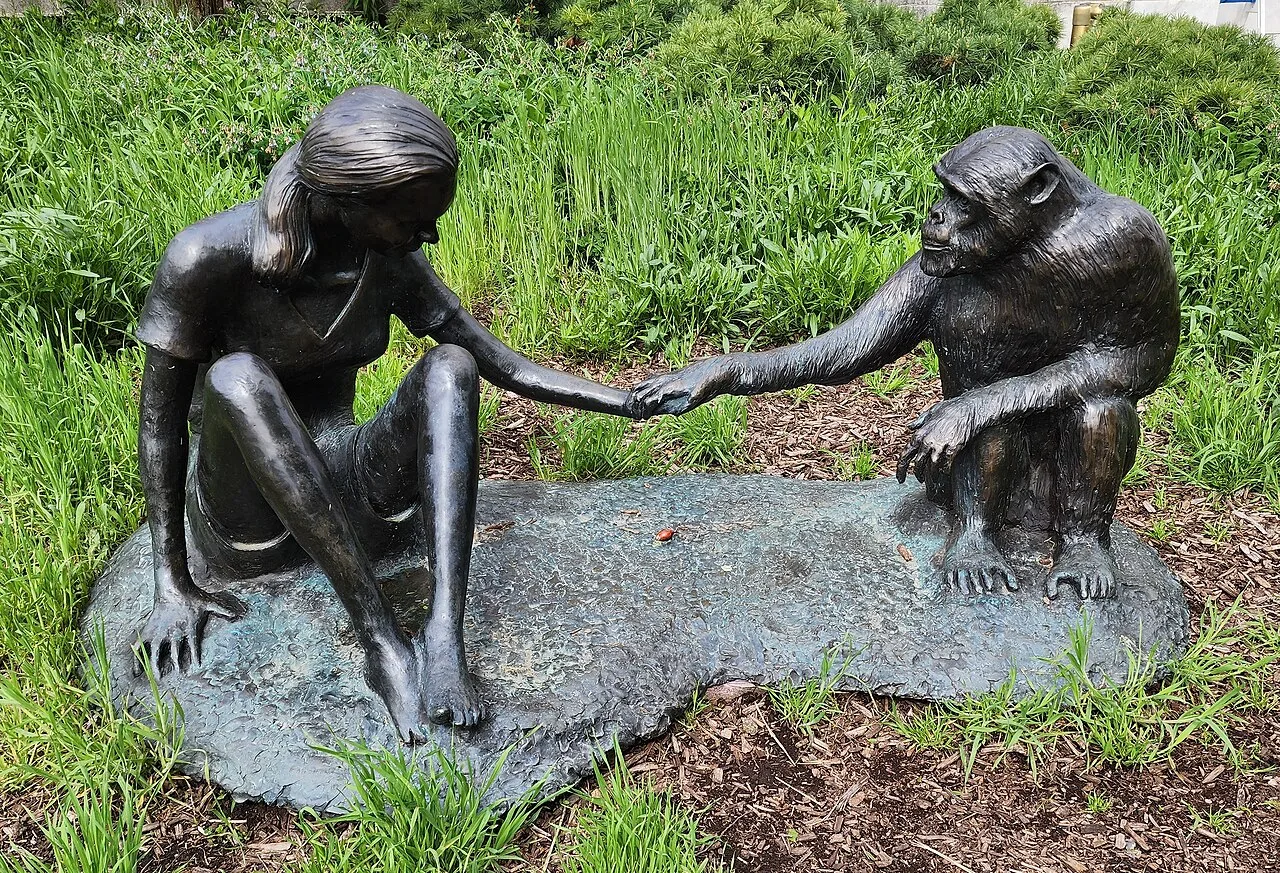
Jane Goodall quick facts
- Jane Goodall went to study chimpanzees in 1960 with no science degree. She later earned a Cambridge PhD without ever having a first degree.
- As a small child she hid in a henhouse for hours to see how a hen lays an egg.
- A chimpanzee she named David Greybeard was the first animal seen making a tool, by stripping leaves off a twig to fish for termites.
- Her toy monkey, Mr H, travelled with her to more than 60 countries.
- Her study at Gombe is the longest-running study of wild chimpanzees in the world, now more than 65 years old.
Jane Goodall at a glance
Jane Goodall was a British scientist who spent her life studying wild chimpanzees and working to protect them. She began with no science degree, a notebook and a pair of binoculars. She ended as one of the most famous scientists in the world. Here are her main facts in one place.
| Fact | Detail |
|---|---|
| Full name | Valerie Jane Morris-Goodall |
| Born | 3 April 1934, London, England |
| Died | 1 October 2025, Los Angeles, USA, aged 91 |
| Known for | Studying wild chimpanzees at Gombe, Tanzania |
| Arrived at Gombe | 14 July 1960, aged 26 |
| Biggest discovery | Chimpanzees make and use tools |
| Founded | The Jane Goodall Institute (1977) and Roots & Shoots (1991) |
| Honours | UN Messenger of Peace (2002), Dame (2004), US Presidential Medal of Freedom (2025) |
Dr Jane Goodall died peacefully in her sleep on 1 October 2025, while on a speaking tour in the United States. She was 91. People all over the world remembered her, and the work she started still goes on.
Jane Goodall’s childhood
Jane Goodall loved animals from the time she was a tiny child, and her parents encouraged it. Her mother, Vanne, was a writer and her father, Mortimer, was a businessman. One of her favourite toys was a lifelike toy chimpanzee that her father named Jubilee.
When she was small, she once vanished for hours. Her family was very worried. She had been hiding under the hay in the henhouse, waiting to see how a hen lays an egg. Her mother later called it “Jane’s first animal research program”.
She read every animal story she could find, especially Doctor Dolittle and Tarzan of the Apes. At the age of 8 she announced that she would go to Africa, live with wild animals and write books about them. She did all three.
How Jane got to Africa
Jane Goodall could not afford to go to university, so she trained as a secretary in London instead. She worked as a waitress and at a film company, saving every penny she could. In March 1957, aged 23, she sailed to Kenya to visit a school friend’s family farm.
Within a few months she met Dr Louis Leakey, a famous scientist who studied early humans. He gave her a job at a natural history museum. Leakey wanted someone to study wild chimpanzees, because he thought they might help explain how early humans lived.
He did not want a professor. He believed a mind “uncluttered by academia” would see things that trained scientists might miss. He chose Jane. In May 1960 he found money to pay for the study, and she set off.
Arriving at Gombe
Jane Goodall arrived at the Gombe Stream reserve, on the shore of Lake Tanganyika in Tanzania, on 14 July 1960. She was 26. Local officials would not let a young woman go alone. So her mother came with her, and a cook named Dominic.
The first weeks were hard. She caught a fever, probably malaria. She hiked for miles each day and often saw no chimpanzees at all, because they ran away from her. She kept going back, day after day, until slowly they got used to her.
Her study at Gombe became the longest-running study of wild chimpanzees in the world. It has now lasted more than 65 years, and researchers have followed more than 200 chimps there. Today, 14 July is World Chimpanzee Day, marking the day she arrived.
David Greybeard and the tool discovery
Jane Goodall’s most famous discovery came in late 1960, when she watched a chimpanzee use tools. She had named him David Greybeard. He was the first chimp at Gombe to trust her, and the others slowly followed his lead.
She saw him strip the leaves off a twig and poke it into a termite mound. When he pulled it out, it was covered in termites, and he ate them. He also used stiff blades of grass the same way. He was not just using a tool. He was making one.
Until then, most scientists believed that only humans made tools. When Jane told Louis Leakey, he replied: “Now we must redefine man, redefine tool, or accept chimpanzees as humans!”
That same year she saw chimpanzees eating a bushpig, and later a red colobus monkey. Scientists had thought chimps ate only plants. In fact, meat is a small part of their diet, about 2 to 5%. Most of what they eat is ripe fruit, seeds, leaves, flowers, nuts and insects.
Names, not numbers
Jane Goodall gave the chimpanzees names, not numbers, and this made some scientists cross. At the time, researchers usually gave animals numbers so they would stay objective. Jane wrote about each chimp’s personality and feelings. Some senior scientists said that was not proper science.
She showed that chimpanzees have their own personalities, minds and emotions. They form close family bonds that last for years. She lived among them as a neighbour, not as a distant watcher.
Two of her best-known chimps were Flo and her son Flint. Flo was a mother with a big family: Fifi, Figan, Faben, Flint and Flame. She became so famous through Jane’s books that a London newspaper printed an obituary when she died in 1972. Flint died the same year.
Chimpanzee families and the Four-Year War

Jane Goodall’s long study showed that chimpanzee life has a dark side as well as a gentle one. Mothers and babies share strong, loving bonds. Chimps hunt together, comfort each other and help one another. But groups can also fight, and sometimes the fighting is deadly.
Between 1974 and 1978, the main chimpanzee group at Gombe, called Kasakela, split in two. The smaller group, Kahama, moved away. Over the next four years, the Kasakela chimps attacked them again and again. The Jane Goodall Institute calls it the Four-Year War.
It showed that chimpanzees are not simply gentle creatures. Like people, they can be kind and they can be cruel.
A PhD without a degree
Jane Goodall earned a doctorate at the University of Cambridge without ever getting a first degree. That almost never happens. The Jane Goodall Institute says she was only the eighth person allowed to do it. Her supervisor was the scientist Robert Hinde.
Her thesis described her first five years with the Gombe chimpanzees. She was awarded her PhD in ethology, the study of animal behaviour, on 9 February 1966. In 1965 she had also set up the Gombe Stream Research Centre. It went on to train many young scientists.
From scientist to campaigner
In the late 1980s, Jane Goodall saw that forests around Gombe were being cut down. The chimpanzees were in danger. She decided she had to leave Gombe to help save them. For the rest of her life she travelled the world, giving talks and asking people to protect nature.
She founded the Jane Goodall Institute in 1977. Today it has offices in 25 countries. In 1992 it opened Tchimpounga, a sanctuary for orphaned chimpanzees in the Republic of the Congo. Before the COVID-19 pandemic she travelled up to 300 days a year.
Chimpanzees are still in trouble. The IUCN lists them as Endangered. The Jane Goodall Institute estimates there are fewer than 300,000 left in the wild (2026). Decades ago there were more than a million. You can read about their relatives in our guides to gorillas and orangutans.
Roots & Shoots: Jane’s programme for young people
Roots & Shoots is the youth programme Jane Goodall started in 1991. It began when 12 students in Tanzania got in touch with her. Young people in Roots & Shoots groups run their own projects. They help animals, the environment and their local community.
It grew fast. The United Nations says Roots & Shoots has inspired young people in more than 75 countries. Jane believed young people could change the world. She often said: “Every individual matters. Every individual has a role to play. Every individual makes a difference.”
Honours and awards

Jane Goodall received more than 100 awards from around the world. In April 2002, Kofi Annan, the head of the United Nations, named her a UN Messenger of Peace. She held that role for more than 20 years, speaking up for animals and the planet.
In 2004, Prince Charles made her a Dame at Buckingham Palace, so she became Dame Jane Goodall. She won the Templeton Prize in 2021. On 4 January 2025, President Biden awarded her the Presidential Medal of Freedom. It is the highest honour a civilian can get in the United States.
There was even a Jane Goodall Barbie doll, made in 2022. On 1 October 2026, a year after her death, a new portrait of her went on show at the Science Museum in London.
Mr H and her books for children
Jane Goodall travelled everywhere with a toy monkey called Mr H. Her friend Gary Haun gave it to her in the early 1990s. He was a former US Marine who had lost his sight and become a magician. Mr H went with Jane to more than 60 countries.
She used Mr H in her talks to make a point: monkeys have tails, and chimpanzees do not. That is because chimps are not monkeys at all. They are great apes, like gorillas, orangutans and us.
She also wrote books for children. Her first, My Life with the Chimpanzees, was written by hand at Gombe on rainy days. Others include The Chimpanzee Family Book and Chimpanzees I Love. Her Book of Hope came out in 2021.
Three things people get wrong
“Jane Goodall was a trained scientist when she went to Gombe.” She was not. She arrived in 1960 with no science degree at all. Louis Leakey chose her partly because her mind was “uncluttered by academia”. She earned her PhD later, in 1966.
“Chimpanzees are monkeys.” Chimpanzees are great apes, like gorillas, orangutans, bonobos and humans. They have no tail. Jane’s toy monkey, Mr H, has one, which is how she explained the difference.
“Humans evolved from chimpanzees.” Humans and chimps share a common ancestor that lived long ago. They share about 98.6% of their DNA. Chimpanzees are our closest living relatives, not our ancestors.
Did you know? Local officials in 1960 would not let a young woman go into the forest alone, so Jane’s mother, Vanne, travelled to Gombe with her. A cook named Dominic went too.
Try it
Watch a bird, a pet or even ants for ten minutes, the way Jane watched chimps. Give each animal a name, write down what it does, and see if you can spot any personality.
Knowledge check
What did David Greybeard do that surprised scientists?
Show answer
He stripped the leaves off twigs and used them to fish termites out of a termite mound. It showed that chimpanzees make tools, not only humans.
What is Roots & Shoots?
Show answer
A programme Jane Goodall started in 1991 for young people to plan their own projects helping animals, the environment and their communities. It began with 12 students in Tanzania.
Frequently asked questions
Who was Jane Goodall?
Jane Goodall was a British scientist, born in London in 1934, who studied wild chimpanzees at Gombe in Tanzania from 1960. She became one of the world’s best-known campaigners for animals and the environment.
What did Jane Goodall discover?
Jane Goodall discovered that chimpanzees make and use tools, eat meat, have their own personalities and emotions, and form strong family bonds. Before her work, scientists thought only humans made tools.
When did Jane Goodall die?
Jane Goodall died peacefully in her sleep on 1 October 2025, aged 91, while on a speaking tour in Los Angeles, in the United States.
Did Jane Goodall go to university?
Jane Goodall could not afford university when she was young, so she trained as a secretary. Later the University of Cambridge let her study for a PhD without a first degree, and she earned it in 1966.
What is the Jane Goodall Institute?
The Jane Goodall Institute is a charity Jane Goodall founded in 1977 to protect chimpanzees and their forests and to support local communities. It has offices in 25 countries.
Why did Jane Goodall name the chimpanzees?
Jane Goodall gave chimpanzees names instead of numbers because she saw each one as an individual with its own personality and feelings. Some senior scientists disagreed with this at first.
Sources
- Jane Goodall Institute: Timeline — dates of her life and work, including Gombe, the Four-Year War, the Institute and Roots & Shoots; the Institute’s biography, death statement, Meet Jane, Gombe, Mr H, books and chimpanzee pages were also used
- National Geographic Society: Jane Goodall — her training, travel to Kenya, arrival at Gombe, termite fishing and PhD date
- University of Cambridge, Department of Zoology: Jane Goodall 1934–2025 — her PhD without a first degree, her supervisor and her thesis
- United Nations: Messengers of Peace, Jane Goodall — her role as UN Messenger of Peace and the reach of Roots & Shoots; UN News on the 2002 appointment was also used
- The White House (archive): Presidential Medal of Freedom recipients, January 2025 — her Presidential Medal of Freedom
- IUCN: Four out of six great apes one step away from extinction (2016) — the chimpanzee’s Endangered status


