
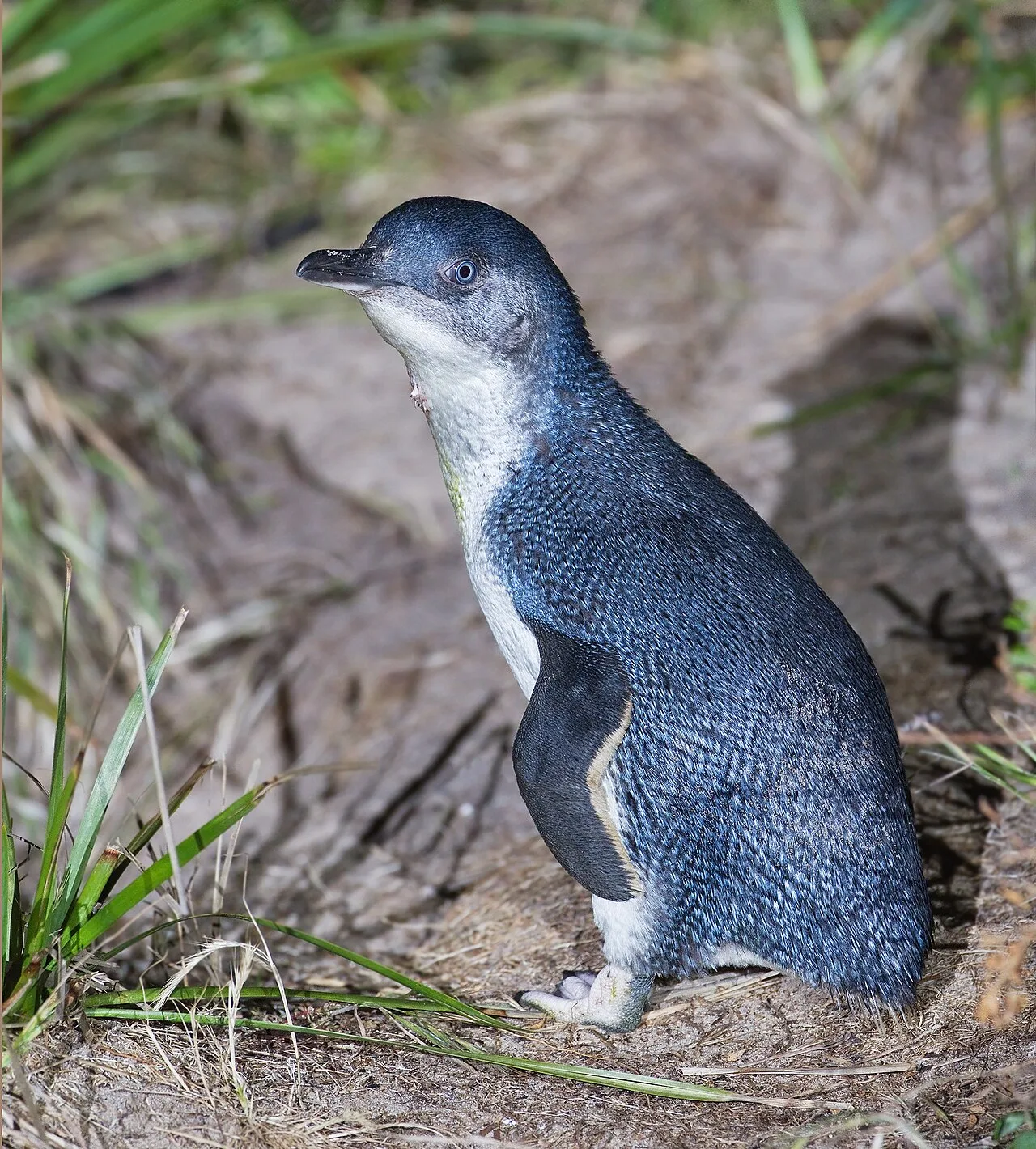
Little blue penguin quick facts
- A little penguin can dive up to 2,000 times in one day, Phillip Island Nature Parks has found.
- Ancient DNA shows Australian little penguins only reached Otago, New Zealand, between 1500 and 1900 AD.
- It has around 10,000 feathers and a clear third eyelid that works like goggles.
- Phillip Island once counted 5,219 penguins crossing its beach in a single night.
- Between 18 and 50 per cent of little penguin pairs split up and find new partners.
Little blue penguin at a glance
The little blue penguin is the smallest penguin on Earth. It lives along the southern coasts of Australia and around New Zealand. It spends its days at sea and comes ashore after dark. Here are the main facts in one place.
| Fact | Detail |
|---|---|
| Scientific name | Eudyptula minor (Australian birds may be Eudyptula novaehollandiae) |
| Other names | Little penguin, fairy penguin, kororā |
| Height | About 30 cm (12 in) |
| Weight | About 1 kg (2.2 lb) |
| Where it lives | Coasts of southern Australia and New Zealand |
| Food | Small fish, squid, sea jellies and crustaceans |
| Eggs | Usually two |
| Oldest known bird | 25 years and 8 months |
| Largest colony | Phillip Island, Victoria: about 40,000 penguins |
| IUCN status | Least Concern (New Zealand rates it At Risk–Declining) |
A penguin not much taller than a bowling pin sounds like a toy. It is not. Researchers at Phillip Island Nature Parks have found that a little penguin can dive up to 2,000 times in a single day.
Why it has so many names
This bird answers to a lot of names. In Australia, many people call it the fairy penguin. Others call it the little blue penguin, after the colour of its back. Scientists usually just say little penguin.
In New Zealand its Māori name is kororā. The Department of Conservation, known as DOC, uses kororā alongside little penguin. DOC notes that the bird used to be called the little blue penguin.
All of these names can describe the same bird. As you will read further down, though, they may not all describe the same species.
How small the smallest penguin is
Animal Diversity Web, run by the University of Michigan, says an adult stands about 30 centimetres (12 inches) tall. DOC gives a slightly smaller figure of just over 25 centimetres. Scientists measure birds in different ways, so the numbers rarely match exactly.
A little penguin weighs about 1 kilogram (2.2 pounds). Phillip Island Nature Parks puts it at just under a kilo, and says the bird is only slightly bigger than a bowling pin.
That makes it the smallest of all the penguins. The emperor penguin of Antarctica sits at the other end of the scale.

Are there really two kinds of little penguin
For a long time, scientists treated every little penguin as one species. Then DNA studies told a more complicated story.
In 2015 a team from the University of Otago in New Zealand, led by Stefanie Grosser and Jon Waters, published a study in the journal PLOS ONE. They compared the DNA of penguins from many colonies. They found two separate family lines, which scientists call lineages.
One lineage lives in Australia. It also lives in Otago, in the south of New Zealand’s South Island. The other lineage lives in the rest of New Zealand. The team suggested that the Australian birds should be a species of their own, called Eudyptula novaehollandiae. The New Zealand birds would keep the old name, Eudyptula minor.
A second study followed in 2016, in the journal Proceedings of the Royal Society B. This time the team looked at ancient DNA. They tested the remains of more than one hundred little penguins, including bones from before people reached New Zealand.
The result surprised them. According to the University of Otago, every bone older than 400 years belonged to the native New Zealand species. The Australian birds only arrived in Otago between 1500 and 1900 AD. Earlier studies had assumed they had been there for hundreds of thousands of years.
So why did they move in? The researchers think the native penguins declined first. Early human settlers hunted them, and introduced predators killed them too. That left room for Australian penguins to cross the sea and settle.
The two lineages do meet in Otago. The 2015 study found a small number of birds there with mixed ancestry. That means the two kinds sometimes breed together, but not often.
Not every list has changed the name yet. Animal Diversity Web still files all little penguins under Eudyptula minor. The honest answer is this: many scientists think there are two species, and the official lists have not all caught up.
Where little penguins live
Little penguins live along the southern coasts of Australia and all around New Zealand. Animal Diversity Web says their range reaches as far north as South Solitary Island in New South Wales.
They are coastal birds. They do not live on ice, and they are not found in Antarctica. They nest close to the shore, in burrows, caves and cracks between rocks.
Some live right beside people. DOC has found little penguin nests under houses and boat sheds, in stormwater pipes and in stacks of timber.
Young birds tend to come home. DOC says they often settle just metres from the spot where they were raised.
Blue feathers, goggles and a salt gland
Phillip Island Nature Parks says the little penguin is the only penguin with blue and white feathers.
A little penguin has around 10,000 feathers, according to the park. Its eyes have three eyelids. One of them is a clear sheet of skin that it uses like a pair of swimming goggles.
It also has a salt gland. This gets rid of the extra salt the bird takes in with seawater.
Once a year the bird replaces all its feathers at once. This is called moulting. DOC says the moult happens some time between November and March and lasts about two weeks.
During the moult a little penguin cannot swim. So it stays ashore until the moult is over.
Life at sea
Phillip Island Nature Parks says little penguins spend about 80 per cent of their lives in the ocean. They come ashore to breed, to raise chicks, to repair their burrows and to moult.
They are busy divers. The park’s researchers found that a little penguin dives between 1,300 and 2,000 times a day. Most dives go 10 to 30 metres deep. The deepest one recorded reached 72 metres (236 feet).
Dives are short. The longest the park has recorded lasted 114 seconds, just under two minutes. Animal Diversity Web adds that the birds spend most of their time within 5 metres of the surface. Studies of different colonies often give different results.
Little penguins swim at 2 to 4 kilometres per hour on average, the park says. In short bursts they reach 12 kilometres per hour. They beat their flippers up to five times a second.
How far do they go? GPS tracking by the park found that most Phillip Island penguins fed within 50 kilometres (31 miles) of the colony. In winter, some swam west towards Portland in Victoria. Others went into Port Phillip Bay, near Melbourne.
What little penguins eat
Little penguins hunt small fish. Phillip Island Nature Parks lists young barracouta, anchovies, red cod, warehou and pilchards. They also eat squid, and even sea jellies.
Animal Diversity Web adds octopuses and crustaceans. Crustaceans are the group of animals that includes crabs and prawns.
The birds chase their food underwater. Scientists call this pursuit diving.
A little penguin eats about a quarter of its own body weight every day, the park says. For a one-kilogram bird, that is roughly 250 grams of food. Imagine eating a quarter of your own weight in fish every single day.
Burrows and night-time homecomings
Little penguins nest in burrows, caves and rock crevices. Phillip Island Nature Parks says they build burrows and line them with plants.
You rarely see one on land in daylight. DOC says they generally come ashore only under the cover of darkness. By day they are either out at sea or tucked away inside their burrows.
Some walk a long way to reach home. DOC says a penguin may waddle up to 1.5 kilometres (almost a mile) from the sea. It may climb 300 metres uphill to find a good spot for its nest.
That is a long walk on short legs, and it happens in the dark.
Eggs, chicks and penguin divorce
Little penguins start breeding at two to three years old, says Phillip Island Nature Parks. On Phillip Island the breeding season runs from August to February. In New Zealand, DOC says adults come ashore in May and June to get their nests ready. Timing depends on where the colony is.
A female usually lays two eggs. The park says they are about the same shape and size as a hen’s egg.
The eggs hatch after around 35 days. Animal Diversity Web gives a range of 31 to 40 days. The chicks leave the nest, which is called fledging, when they are around eight weeks old.
Many pairs stay together from one year to the next. Not all of them, though. The park’s research shows that between 18 and 50 per cent of pairs split up and find new partners. Scientists call this divorce.
How long does a little penguin live? Animal Diversity Web says the average in the wild is about six years. The oldest known bird reached 25 years and 8 months.
The Phillip Island penguin parade
Every evening at sunset, little penguins come out of the sea on Phillip Island, in Victoria, Australia. They cross the beach and waddle up to their burrows. People gather to watch. This is the Penguin Parade.
Phillip Island is about 90 minutes’ drive from Melbourne. It has the largest little penguin colony in the world, with about 40,000 penguins. Only some of them cross the beach where visitors watch.
Some nights are much busier than others. The park once counted 5,219 penguins crossing in one night, the highest count since 1968. More than 5,000 of them came out of the water in less than an hour. Scientists said plenty of food close to shore helped.
Cameras are not allowed during the nightly parade. The penguins are wild birds, doing what they would do anyway. They are simply coming home.

How Phillip Island saved its penguins
The big colony nearly disappeared. Studies in the 1980s showed that nine of the island’s ten penguin colonies had gone, says Phillip Island Nature Parks. Only about 12,000 penguins were left in the mid-1980s.
A Penguin Protection Plan began in 1985. One of its boldest steps involved a housing estate.
The last colony sat on the Summerland Peninsula, where houses had been built. The Victorian Government bought the homes in the Summerland Estate. That removed traffic, pets, fire risk and building work from the penguins’ home.
Foxes were another problem. Red foxes are not native to Australia, and they kill penguins. The park ran a programme to wipe them out on the island.
It worked. Numbers rose from about 12,000 to an estimated 40,000 today. Around 20 per cent of Phillip Island is now protected for wildlife.
Dangers little penguins face
In New Zealand, DOC says dogs are probably the greatest threat to little penguins. Cats, ferrets and stoats also kill them.
Roads are dangerous too. Penguins get hit by cars as they cross coastal roads on their way home. Boats strike them, and some drown in set nets used for fishing.
Natural predators hunt them as well. Animal Diversity Web lists sharks, seals and orcas at sea. On land, Phillip Island Nature Parks names Pacific gulls and sea eagles.
The park also lists habitat loss, oil spills, and introduced foxes and other pests as dangers.
There is good news. DOC says that where predators are controlled, little penguin numbers have stayed steady or grown.
How many little penguins there are
The IUCN Penguin Specialist Group estimates that there are about 469,760 little penguins. It says numbers are steady across the whole range, although some colonies are shrinking. Its page does not say which year that count comes from.
Animal Diversity Web says the species is listed as Least Concern. That is the lowest level of risk on the IUCN Red List.
The picture in New Zealand is less comfortable. DOC rates kororā as At Risk–Declining. A bird can be safe worldwide and still be in trouble in one country.
If the Australian and New Zealand birds become two official species, each one will need its own count. The sources used for this guide do not yet give separate totals for each.
Three things people get wrong
Myth: little penguins live in Antarctica. They do not. Little penguins live along the coasts of southern Australia and New Zealand, far from the ice of Antarctica. They nest in burrows and rock crevices near beaches.
Myth: every little penguin belongs to the same species. DNA studies from 2015 and 2016 found two separate lineages. Scientists at the University of Otago proposed that the Australian birds become Eudyptula novaehollandiae. Not every list has adopted the new name yet.
Myth: the penguin parade is put on for visitors. The penguins are wild. Every evening at sunset they return from the sea to their burrows, just as they would with nobody watching. Phillip Island Nature Parks bans cameras during the parade.
Did you know? To save Phillip Island’s last penguin colony, the Victorian Government bought the homes in a whole housing estate so the land could go back to the penguins.
Try it
Stand up and hold your hand flat at the height of your knee. For many children that is roughly 30 centimetres off the ground, about as tall as a little penguin. Now picture 5,000 birds that size walking past you in the dark.
Knowledge check
What is the Māori name for the little penguin?
Show answer
Kororā.
Where is the largest little penguin colony in the world?
Show answer
Phillip Island in Victoria, Australia, with about 40,000 penguins.
Frequently asked questions
What other names does the little penguin have?
Little penguins are also called fairy penguins and little blue penguins. In New Zealand the Māori name is kororā, which the Department of Conservation uses.
Are Australian and New Zealand little penguins different species?
Many scientists think so. A 2015 University of Otago study proposed calling the Australian birds Eudyptula novaehollandiae, while New Zealand birds stay Eudyptula minor. Not all official lists agree yet.
How big is a little blue penguin?
An adult little penguin stands about 30 centimetres (12 inches) tall and weighs about 1 kilogram (2.2 pounds), making it the smallest penguin species on Earth.
When does the Phillip Island penguin parade happen?
The Phillip Island penguin parade happens at sunset every evening of the year, so the exact time changes with the seasons. About 40,000 penguins live on the island.
How long do little penguins live?
Wild little penguins live about six years on average, according to Animal Diversity Web. The oldest known bird reached 25 years and 8 months.
Are little penguins endangered?
Little penguins are listed as Least Concern worldwide, with an estimated 469,760 birds. In New Zealand, however, the Department of Conservation rates kororā as At Risk–Declining.
Sources
- Department of Conservation (NZ): Little penguin/kororā — size, the name kororā, nest sites, night-time habits, moult, threats and New Zealand status
- Phillip Island Nature Parks: A guide to Australia’s little penguins — feathers, diving, diet, breeding, divorce rates and the colony’s recovery; its research page, Penguin Parade page and record-crossing news were also used
- PLOS ONE: Coalescent modelling suggests recent secondary-contact of cryptic penguin species (Grosser et al., 2015) — the two lineages, where each lives, limited interbreeding in Otago and the proposed name Eudyptula novaehollandiae
- University of Otago: New Zealand’s little penguins are recent Australian invaders (2016) — the ancient-DNA study and the arrival of Australian birds in Otago between 1500 and 1900 AD
- Animal Diversity Web (University of Michigan): Eudyptula minor — height, range, dive depth, incubation, lifespan, predators and Least Concern status
- IUCN SSC Penguin Specialist Group: Little penguin — the global population estimate and trend


