
Macaroni penguins quick facts
- Macaroni penguins lay two eggs, but the first is much smaller and usually never hatches.
- A single macaroni colony can hold up to 2.5 million birds.
- They can dive more than 220 metres (720 feet), though most dives are 15 to 50 metres deep.
- Their scientific name, Eudyptes chrysolophus, means “good diver with a golden crest”.
- Only 24 pairs breed in the Falklands, nesting among rockhopper penguins.
Macaroni penguins at a glance
Macaroni penguins are crested penguins of the Southern Ocean. They have golden feathers sweeping back from above their eyes. They live in huge colonies on islands near Antarctica and eat mostly krill. There are still millions of them. Even so, their numbers have fallen fast, and they are listed as Vulnerable.
| Fact | Macaroni penguin |
|---|---|
| Scientific name | Eudyptes chrysolophus |
| Height | About 70 centimetres (28 inches) |
| Weight | 4 to 7 kilograms (9 to 15 pounds), depending on sex and time of year |
| Main food | Antarctic krill, plus fish and squid |
| Deepest dives | More than 220 metres (720 feet) |
| Eggs | Two a season; usually only the second hatches |
| Breeding population | About 6.3 million pairs (2013 estimate) |
| Red List status | Vulnerable |
Most of these figures come from the Australian Antarctic Division, which runs Australia’s Antarctic programme. Other sources give slightly different numbers. Where they disagree, this guide says so.
What macaroni penguins look like
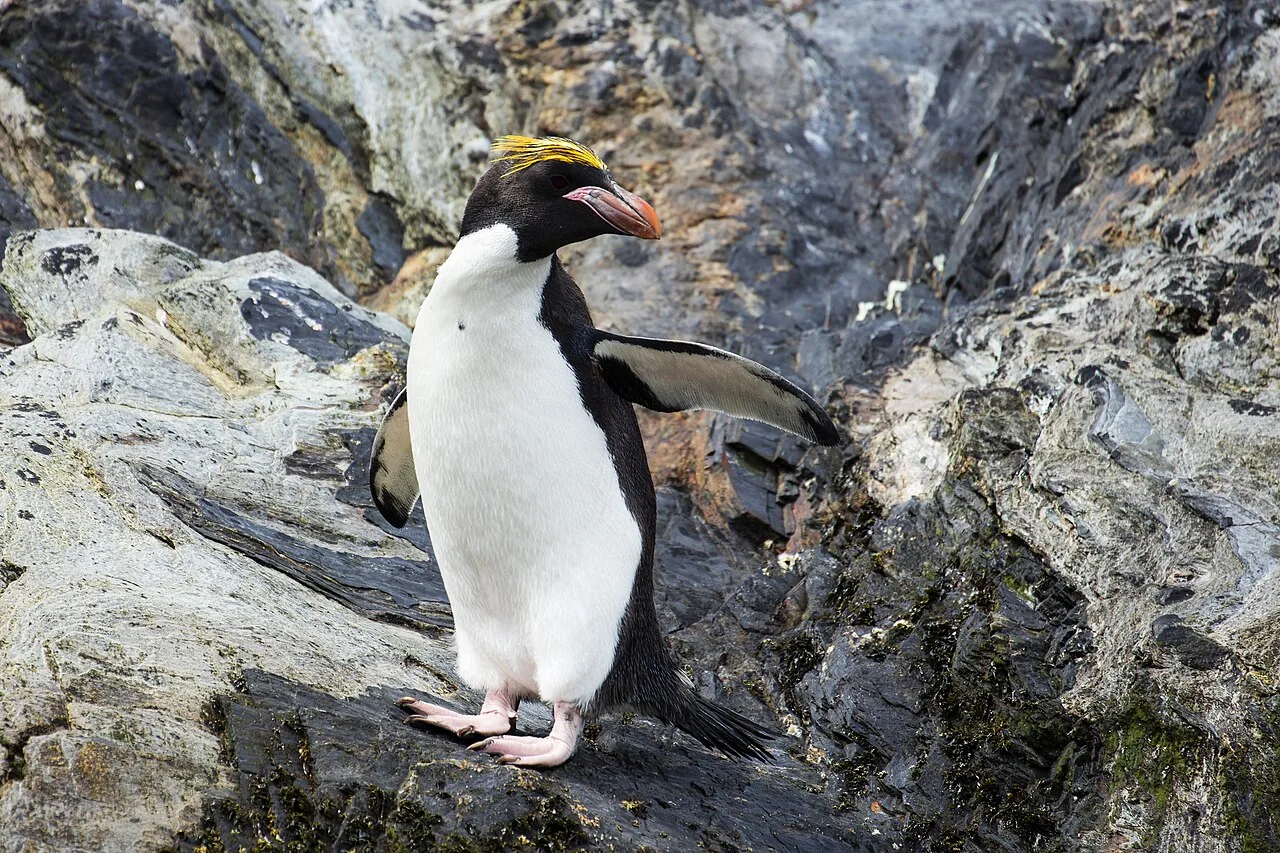
The first thing you notice is the crest. The species’ scientific name even means “with a golden crest”. These long feathers sit above the eyes and sweep back over the head. Animal Diversity Web describes the crests as orange, yellow and black, and says they join on top of the head.
The Australian Antarctic Division says macaroni penguins stand about 70 centimetres (28 inches) tall. That is more than two school rulers laid end to end. They weigh 4 to 7 kilograms (9 to 15 pounds).
The rest of the bird is dark on top and pale underneath. Animal Diversity Web says the bill is red, and the chin, face and throat are covered in solid black feathers. Why such a wide range for weight? The Australian Antarctic Division explains that it depends on the bird’s sex and its stage of breeding. Falklands Conservation adds that males are heavier than females.
Sources do not agree exactly on size. Falklands Conservation gives a height of 61 to 69 centimetres and a weight of 3.5 to 5.5 kilograms. Animal Diversity Web, run by the University of Michigan, gives about 71 centimetres and 5 to 6 kilograms. Different teams measured different birds, so small gaps are normal.

What the name means
The scientific name is Eudyptes chrysolophus. The Australian Antarctic Division says it comes from Greek. Eudyptes means “good diver”. Chrysolophus means “with a golden crest”.
Both parts fit well. The crest is the macaroni’s most famous feature. The diving, as you will see below, is just as impressive.
The macaroni shares the first part of its name with its close relatives, the rockhopper penguins. Scientists use the second word to tell each species apart.
Where macaroni penguins live
The Australian Antarctic Division says macaroni penguins are found all the way round the Southern Ocean. Most breed on sub-Antarctic islands. These are cold, windy islands between the Antarctic continent and the warmer oceans to the north.
Only one colony is known on the Antarctic Peninsula itself. That surprises many people, who expect every penguin to live on Antarctic ice.
Animal Diversity Web, run by the University of Michigan, lists breeding places near Chile, the Falkland Islands, South Georgia and the South Sandwich Islands. It also mentions sub-Antarctic islands south of Africa.
The Australian Antarctic Division also describes a large colony near Cape Lockyer on Heard Island, an Australian World Heritage site. There the birds nest on surprisingly steep slopes. South Georgia matters most. Falklands Conservation says the main colonies are there, with a population of more than 3 million. That single island group holds a large share of all the macaroni penguins on Earth.
The Falkland Islands sit at the northern edge of the macaroni’s range. Only a few breed there. Falklands Conservation counts just 24 pairs, spread over 12 different sites.
These few birds do something unusual. They nest among southern rockhopper penguins, on cliff tops or steep cliff sides.
Compare the Falklands with South Georgia. One has 24 pairs. The other has more than 3 million birds. The same species can be rare in one place and very common in another.
What macaroni penguins eat
Macaroni penguins eat mostly krill. Krill are small, shrimp-like animals that swarm in huge numbers in the Southern Ocean. The Australian Antarctic Division says macaronis eat lots of Antarctic krill and a variety of fish.
Animal Diversity Web, run by the University of Michigan, goes further. It says they live almost entirely on krill, with squid making up to five per cent of the diet. Fish and small crustaceans called amphipods fill in the rest.
The menu changes from place to place. In the Falklands, Falklands Conservation says macaronis feed mostly on lobster krill and squid. They eat small fish less often.
Because they depend so heavily on krill, anything that changes the amount of krill in the sea affects them. Scientists watch this link closely.
Diving and long fishing trips
The Australian Antarctic Division says macaroni penguins can dive more than 220 metres (720 feet) deep. That fits the first half of its scientific name, “good diver”.
Most of their dives are much shallower, though. The same source says most go to between 15 and 50 metres (50 to 165 feet). The very deep dives are the exception, not the rule. Animal Diversity Web says macaronis usually come back up to breathe after two or three minutes. Under water they steer with their webbed feet and use their tails like a rudder.
Some fishing trips are short. Others are very long. The Australian Antarctic Division says a macaroni’s trip to sea can last from 24 hours to three weeks.
Three weeks is a long time to be away from the colony. The Australian Antarctic Division says a trip can cover anything from 50 kilometres to more than 2,000 kilometres (30 to 1,240 miles), depending on the stage of breeding. The length of a trip depends on how easily the bird finds krill and fish.
Life in a macaroni colony
Macaroni penguins breed in some of the biggest penguin colonies anywhere. Animal Diversity Web, run by the University of Michigan, says a single colony can hold up to 2.5 million birds.
All of those birds gather in one place to lay eggs and raise chicks. Colonies this size are one reason the species once seemed so safe.
Falklands Conservation gives the Falklands timetable. The two white eggs are laid in mid-November. By the end of April the birds have left for the winter.

Two eggs, but one chick
Macaroni penguins do something most birds would find odd. The Australian Antarctic Division says they lay two eggs each breeding season, unlike most penguins. The second egg is bigger than the first. It is usually the only one that hatches.
Animal Diversity Web, run by the University of Michigan, says the first egg is much smaller and less likely to develop. Only one chick is usually raised.
Why lay the first egg at all? Scientists are still not sure. The sources used for this guide describe the pattern but do not explain it.
The eggs need warmth for a long time before they hatch. Animal Diversity Web, run by the University of Michigan, gives an incubation period of 33 to 37 days. That is about five weeks of sitting still in all weathers.
How macaroni chicks grow up
As the chicks grow, they gather with other chicks in small groups called crèches. A crèche is a bit like a nursery, where the young birds wait together.
Animal Diversity Web, run by the University of Michigan, says the parents feed them every one to two days. The chicks eat krill carried back from the sea.
The chicks are ready to leave when they are about 60 to 70 days old. Both The Australian Antarctic Division and Animal Diversity Web agree on that figure. At that point they head out to sea alone.
When they breed and how long they live
Young macaronis do not breed straight away. The Australian Antarctic Division says females first breed at five years old and males at six. Falklands Conservation gives the same range of five to six years.
How long they live is less clear. The Australian Antarctic Division says their lifespan is not well known, but estimates it at 20 years or more.
Falklands Conservation gives a shorter figure of 10 to 15 years in the wild. The two sources disagree, and neither gives a firm answer. Tracking wild seabirds for decades is hard, so scientists are still collecting the evidence.
Nests and courtship
Macaroni nests are simple. Animal Diversity Web says they are scrapes in mud or gravel among rocks. A scrape is a shallow hollow in the ground.
Timing matters more than comfort. The Australian Antarctic Division says breeding within a colony is highly synchronised. That means most pairs lay their eggs at about the same time. Animal Diversity Web says adults arrive late in October and lay in early November.
Before laying, pairs spend time displaying to each other. Animal Diversity Web lists head and flipper waving, calling, bowing and preening. Preening means cleaning and tidying feathers with the bill.
The loudest display is the one scientists call ecstatic. A male pumps his chest, stretches his head upwards and holds his flippers out. Then he makes a harsh, loud braying sound.
Macaroni penguins and people
People have not always left macaronis alone. Animal Diversity Web says whalers and seal hunters in the nineteenth century visited some colonies for meat and eggs.
There was also a penguin oil industry. By the early twentieth century, Animal Diversity Web says, it was no longer profitable.
Today most visitors come to watch or study the birds instead. Animal Diversity Web mentions ecotourism, research and education as the ways people now benefit from macaroni colonies. It says the penguins cause no known harm to humans.
The same source names people as the biggest threat now. It points to overfishing of krill, along with pollution and global warming. That fits the uncertain picture given by Falklands Conservation, described in the section on threats below.
What hunts macaroni penguins
At sea, macaroni penguins are hunted by large animals. Animal Diversity Web, run by the University of Michigan, names killer whales and leopard seals. The Australian Antarctic Division lists fur seals and leopard seals as hunters of adults.
On land, the danger comes from the air. Animal Diversity Web, run by the University of Michigan, says skuas, which are large seabirds, take macaroni chicks from the colony. The Australian Antarctic Division adds sheathbills and giant petrels, which take both eggs and chicks.
So the dangers change with age and place. Chicks face hunters from the sky while they wait in the colony. Adults face hunters below the waves while they feed.
How many macaroni penguins are left
The Australian Antarctic Division says the global population was estimated at 6.3 million breeding pairs in 2013. It calls this a rapid decline from previous decades.
Animal Diversity Web, run by the University of Michigan, gives an older figure of about 9 million birds. It even calls the population stable. That figure is older than the 2013 estimate, and it counts birds rather than pairs, so the two numbers cannot be compared directly.
Millions of birds sounds like a lot. But conservation lists judge how fast a population is falling, not only how big it is. A steep fall in a big population is still a warning sign. That is why The Australian Antarctic Division and Falklands Conservation both list the macaroni as Vulnerable.
Why their numbers are falling
Nobody is sure exactly why macaroni penguins are declining. Falklands Conservation says the main causes are uncertain.
It suggests two possible reasons. One is climatic variation, meaning changes in weather and ocean conditions over time. The other is competition for food with commercial fisheries.
Both ideas link back to food, and macaronis rely heavily on krill. Scientists have not yet shown which factor matters most, so the honest answer for now is that the causes are still being studied.
Penguins of other kinds face similar questions. The emperor penguin, for example, depends on sea ice rather than rocky islands, but it too is watched closely as the Southern Ocean changes.
Three things people get wrong
Myth: macaroni penguins raise two chicks. They lay two eggs, but the first egg is much smaller. The Australian Antarctic Division says the second, bigger egg is usually the only one that hatches.
Myth: macaroni penguins live on Antarctic ice. Most breed on sub-Antarctic islands such as South Georgia. The Australian Antarctic Division knows of only one colony on the Antarctic Peninsula.
Myth: with millions of them, macaronis are safe. There were about 6.3 million breeding pairs in 2013, but that followed a rapid decline. The species is listed as Vulnerable.
Did you know? A macaroni penguin’s fishing trip can last anything from 24 hours to three weeks, according to the Australian Antarctic Division.
Try it
Hold your breath while you slowly count to ten, then breathe. A penguin has to do something like this on every dive, coming back up for air each time. Now imagine doing it hundreds of times a day to catch food.
Knowledge check
Which of a macaroni penguin’s two eggs usually hatches?
Show answer
The second egg, which is bigger than the first.
Where are the largest macaroni penguin colonies?
Show answer
On South Georgia, where the population is more than 3 million, according to Falklands Conservation.
Frequently asked questions
Why are macaroni penguins Vulnerable?
Macaroni penguin numbers have fallen fast in recent decades. Falklands Conservation says the causes are uncertain but may include climate variation and competition with fisheries for food.
How many macaroni penguins are there?
The global population was estimated at about 6.3 million breeding pairs in 2013, according to the Australian Antarctic Division, down sharply from earlier decades.
What do macaroni penguins eat?
Macaroni penguins eat mostly Antarctic krill. They also eat fish, squid and small crustaceans, and the mix changes depending on where they live.
How big is a macaroni penguin?
An adult macaroni penguin stands about 70 centimetres (28 inches) tall and weighs 4 to 7 kilograms (9 to 15 pounds), with males heavier than females.
Where do macaroni penguins live?
Most macaroni penguins breed on sub-Antarctic islands, especially South Georgia. Smaller numbers breed in the Falklands and near Chile, with one colony on the Antarctic Peninsula.
How long do macaroni penguins live?
Estimates differ between sources. The Australian Antarctic Division suggests 20 years or more, while Falklands Conservation gives 10 to 15 years in the wild.
Sources
- Australian Antarctic Division: Macaroni penguin — size, weight, 2013 population, status, range, diet, diving, fishing trips, eggs, breeding age, lifespan and the scientific name
- Falklands Conservation: Macaroni penguin — Falklands numbers, nesting with rockhoppers, egg-laying dates, diet, South Georgia population and possible causes of decline
- Animal Diversity Web (University of Michigan): Eudyptes chrysolophus — colony size, diet detail, incubation, crèches, fledging age and predators


