
Muscular system quick facts
- Nearly 85% of the heat your body makes comes from your muscles contracting.
- Muscles can only pull, never push, so they work in pairs to bend and straighten your joints.
- The smallest muscle in your body, the stapedius in your ear, is about 3 mm long.
- The heart is the only organ that is also a muscle, and it beats about 100,000 times a day.
- Goosebumps are made by tiny smooth muscles in your skin that pull your hairs upright.
Muscular system at a glance
The muscular system is every muscle in your body working together. It moves you, holds you upright, keeps you warm and keeps your heart beating. You have more than 600 muscles. Here are the main facts in one place.
| Fact | Detail |
|---|---|
| Number of muscles | More than 600 |
| Share of body weight | Up to about 40% |
| Three types | Skeletal, smooth and cardiac |
| Biggest muscle | Gluteus maximus, in your bottom |
| Longest muscle | Sartorius, across the front of your thigh |
| Smallest muscle | Stapedius, in your middle ear, about 3 mm long |
| Hardest-working muscle | The heart, about 100,000 beats a day |
| Heat made by muscles | Nearly 85% of your body heat |
What does the muscular system do?
The muscular system moves your body, holds it steady and keeps it working. Nearly every movement you make comes from a muscle tightening, or contracting. That includes walking, blinking, smiling, breathing and swallowing. Some muscles you control. Others work all day without you thinking about them.
Muscles also hold you up. When you sit or stand, your muscles keep making tiny changes so you do not slump or topple over. Tendons from your muscles cross your joints, helping to keep knees and shoulders steady.
Muscles even keep you warm. Nearly 85% of the heat your body makes comes from muscles contracting, says the US National Cancer Institute. That is why you shiver when you are cold. Shivering makes your muscles tighten and relax quickly, which warms you up.
Inside your body, muscles push food through your gut, help your lungs fill with air and pump blood. Your nervous system sends the signals that tell them when to work.
How many muscles do you have?

You have more than 600 muscles in your body, and together they make up as much as 40% of your weight. That makes muscle one of the heaviest things you carry around. Each muscle is made of thousands, sometimes tens of thousands, of tiny threads called fibres.
Muscle names often describe the muscle. “Biceps” means two heads, because the muscle starts in two places. “Deltoid” means shaped like a triangle. “Maximus” means large, and “rectus” means straight. Once you know a few of these words, you can guess what many muscles look like.
Muscle mass changes through life. People slowly lose muscle as they get older. On average, males have more skeletal muscle than females.
The three types of muscle
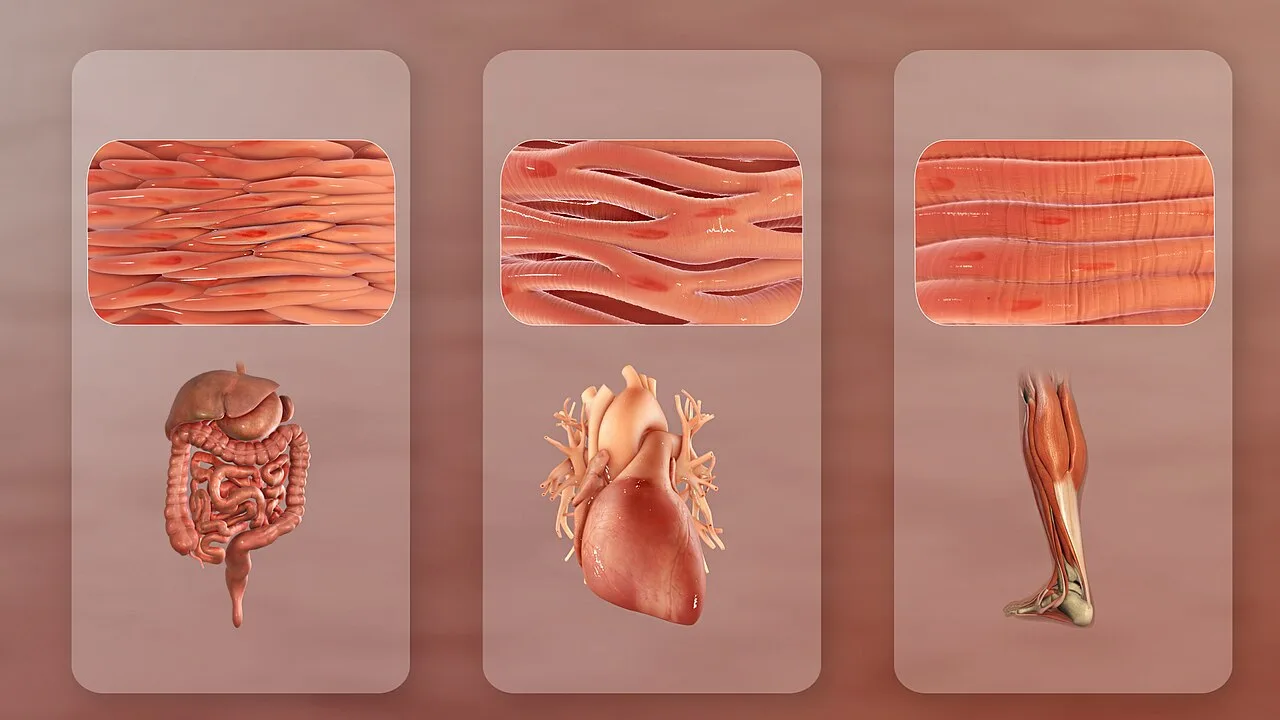
There are three types of muscle: skeletal, smooth and cardiac. Each type is built differently and does a different job. Only one type is under your control. The other two work automatically, day and night, even while you sleep.
| Type | Where it is | Do you control it? | Under a microscope |
|---|---|---|---|
| Skeletal | Attached to bones | Yes | Striped |
| Smooth | Walls of the gut, blood vessels, bladder, eyes and skin | No | Not striped |
| Cardiac | Only in the heart | No | Striped |
Skeletal muscle is the kind attached to your bones. It moves your arms, legs, face and everything else you decide to move. Under a microscope it looks striped. Each fibre is one very long cell with many control centres, called nuclei.
Smooth muscle lines hollow parts of the body, such as your blood vessels, gut and bladder. It got its name because it looks smooth, not striped. Tiny smooth muscles in your skin make your hairs stand up when you get goosebumps. Others change the size of the dark centre of your eye.
Cardiac muscle is found in only one place: the heart. The heart is the only organ that is itself a muscle. A special group of cells, the heart’s pacemaker, sets its beat.
How do muscles work?

Muscles work by getting shorter and pulling. A muscle is fixed to bones by tough cords called tendons, and it usually crosses a joint. When it contracts, it pulls on one bone while the other stays still, and part of your body moves.
A muscle cannot do anything until it gets a message. Each muscle fibre waits for a signal from a nerve cell. The signal starts in your brain or spinal cord and travels down a nerve. When it arrives, the fibre contracts.
Here is the surprising part. Muscles can pull, but they cannot push. So how does your arm straighten again after you bend it? Muscles work in pairs. One muscle pulls a joint to bend it, and a partner muscle on the other side pulls it straight again.
The muscles that bend a joint are called flexors. The ones that straighten it are called extensors. When one of the pair contracts, the other relaxes. Your biceps, at the front of your upper arm, is a flexor. A muscle at the back of your arm pulls it straight.
Tendons and ligaments
Tendons and ligaments are both tough bands, but they join different things. Tendons join muscles to bones. Ligaments join bones to other bones, holding joints together. A tendon can be a thick, rope-like cord or a wide, flat sheet.
Most muscles have a tendon at each end. When the muscle contracts, its tendons pass the pull on to the bones, and the joint between them moves.
Record-breaking muscles
Your body’s record-breaking muscles are found in some surprising places. The biggest one is in your bottom, the longest is in your thigh, and the smallest is hidden deep inside your ear. The hardest-working muscle of all never takes a rest.
The gluteus maximus, the big muscle in each buttock, is the biggest muscle in your body. Cleveland Clinic calls it the strongest too. You use it to stand up, walk, run and climb stairs.
The sartorius is a long, thin muscle that runs across the front of your thigh. It is the longest muscle in your body. The stapedius, in your middle ear, is usually called the smallest. In one study it was only about 3 mm long, smaller than a grain of rice.
The heart is the hardest worker. It beats about 100,000 times a day and more than 2.6 billion times in a lifetime. Every minute it pumps nearly 5.7 litres (1.5 gallons) of blood around your circulatory system. A child’s heart is about the size of their fist.
Muscles in your face and chest

Your face has about 20 flat muscles, and they are different from most others. They start on bone but end in your skin. So when they contract, they move your skin, not a bone. That is how you smile, frown, raise your eyebrows and make dozens of other faces.
A ring of muscle around your mouth closes your lips. Another ring around each eye closes your eyelids. Your tongue is a group of muscles fixed at only one end, which is why it can move in so many directions.
The diaphragm is a thin, dome-shaped muscle under your lungs. When you breathe in, it tightens and flattens, pulling air into your chest. When you breathe out, it relaxes and rises again. It keeps doing this all day and all night, without you noticing.
Fast and slow muscle fibres
Muscle fibres come in two main kinds: slow-twitch and fast-twitch. Slow-twitch fibres are built to keep going for a long time. Fast-twitch fibres are built for short bursts of power. Most muscles have a mix of both, which is set mostly by your genes.
Slow-twitch fibres power walking, jogging and everyday movement. They use oxygen carried in your blood to make energy, so they tire slowly. Fast-twitch fibres power sprinting and jumping. They use fuel already stored in the muscle, so they are quick but tire fast.
Your diaphragm is a good example of a slow worker. In one study, about half of its fibres were slow-twitch, compared with just over a third in a thigh muscle. That helps it keep breathing for you all day and all night.
How do muscles get stronger?
Muscles get stronger when you use them, but not in the way many people think. Exercise does not give you lots of new muscle fibres. Scientists have mostly ruled that out. Instead, the fibres you already have grow bigger, especially in adults who train regularly.
Children are different. Before puberty, young people can get stronger with exercise without their muscles getting bigger, says KidsHealth. After puberty, a hormone called testosterone helps muscles grow.
Hard exercise can make tiny tears in muscle fibres. As the body repairs them, the muscle grows. That is one reason you might feel stiff a day or two after a big game. Doctors call it delayed onset muscle soreness, and it rarely lasts more than five days.
Keeping your muscles healthy
You keep your muscles healthy by moving every day, eating well and sleeping enough. The UK’s NHS says children and young people aged 5 to 18 should average at least 60 minutes of activity a day across the week, including activities that strengthen muscles and bones.
The US Centers for Disease Control and Prevention (CDC) gives similar advice for ages 6 to 17: at least 60 minutes a day, with muscle-strengthening activities on at least 3 days a week. You do not need weights. Climbing, gymnastics, jumping and playing on a climbing frame all count.
Food and sleep matter too. The NHS Eatwell Guide says to eat some beans, pulses, fish, eggs, meat and other protein foods. The CDC says children aged 6 to 12 need 9 to 12 hours of sleep a day.
Stay safe: warm up with gentle movement before hard exercise. If a muscle hurts badly, swells, or a cramp will not go away, tell a parent, teacher or coach. This guide is for learning, not medical advice.
Three things people get wrong
“Muscles push and pull.” Muscles can only pull. To move a bone back, a partner muscle on the other side of the joint pulls it. That is why muscles work in pairs.
“Exercise makes you grow new muscle cells.” Muscles grow mainly because the fibres you already have get bigger. Scientists have largely ruled out new fibres as a big part of muscle growth.
“No pain, no gain.” A workout can be useful even if you do not feel sore afterwards, says Cleveland Clinic. Real pain, or a pop during exercise, is a reason to stop and get checked, not to keep going.
Did you know? Your facial muscles are fixed to your skin, not just to bone. That is why they can move your skin into dozens of different expressions, and why a tiny change can turn a smile into a frown.
Try it
Put one hand on the front of your upper arm and slowly bend your elbow. Feel the biceps get shorter and harder. Now straighten your arm and feel it relax while a muscle at the back of your arm does the work.
Knowledge check
Why do muscles work in pairs?
Show answer
Muscles can only pull, not push. One muscle pulls a joint to bend it, and its partner on the other side pulls it straight again.
Which type of muscle is only found in the heart?
Show answer
Cardiac muscle. It is striped like skeletal muscle but works automatically, without you having to think about it.
Frequently asked questions
How many muscles are in the human body?
There are more than 600 muscles in the human body. Together they make up as much as 40% of a person’s weight, according to the US National Cancer Institute.
What are the three types of muscle?
The three types of muscle are skeletal muscle, attached to bones; smooth muscle, in the walls of organs such as the gut and blood vessels; and cardiac muscle, found only in the heart.
What is the biggest muscle in the body?
The biggest muscle in the body is the gluteus maximus, the large muscle in each buttock. It helps you stand up, walk, run and climb stairs.
What is the smallest muscle in the body?
The smallest muscle is usually said to be the stapedius, in the middle ear. In one scientific study it was only about 3 millimetres long.
How do muscles move bones?
Muscles are joined to bones by tendons. When a muscle gets a signal from a nerve, it contracts and pulls on the bone, moving the joint it crosses.
How can kids keep their muscles healthy?
Kids keep muscles healthy by being active for about 60 minutes a day, including climbing, jumping or gymnastics, eating protein foods such as beans, eggs and fish, and getting enough sleep.
Sources
- National Cancer Institute (NIH), SEER Training: Muscular system — what muscles do, body heat, the three types, structure and naming; the NIH National Library of Medicine papers on the stapedius, muscle growth and the diaphragm were also used
- Cleveland Clinic: Muscle — how many muscles, the three types and the heart as a muscle; its pages on skeletal and smooth muscle, the glutes, thigh, face, diaphragm, chills, muscle soreness and heart facts were also used
- Nemours KidsHealth: Your muscles — muscle pairs, tendons and ligaments, the face and tongue; its heart and strength-training pages were also used
- NHS: Physical activity guidelines for children and young people — 60 minutes of activity a day for ages 5 to 18; its leg cramps page and Eatwell Guide were also used
- Centers for Disease Control and Prevention: Physical activity for children — activity and muscle-strengthening advice for ages 6 to 17; its sleep page was also used
- Nebraska Medicine: Fast-twitch and slow-twitch muscle fibres — how the two fibre types work and what decides your mix


