
Northwest Coast Native Americans quick facts
- The western red cedar was the key natural resource: houses, canoes, poles and clothing all came from it.
- Makah whalers could paddle for days out of sight of land in canoes carved from single cedar trunks.
- The word “totem” is not from the Northwest Coast at all. It comes from the Ojibwe language near the Great Lakes.
- Canada banned the potlatch from 1885 to 1951, but many communities kept holding them in secret.
- Lewis and Clark bought cedar bark hats from the Chinook and Clatsop because their own clothes were rotting in the rain.
Where is the Northwest Coast?
The Northwest Coast is the long, rainy strip of land along the Pacific Ocean in the far north-west of North America. It runs from south-east Alaska, down the coast of British Columbia in Canada, and on through Washington and Oregon to the mouth of the Columbia River.
It is a land of thick forests, rocky shores and islands. Winters are wet. Giant western red cedar trees grow here, some of them as old as 1,000 years. Rivers full of fish run down to the sea, and the sea itself is full of seals, whales and shellfish.

The nations of the Northwest Coast
Many nations share this coast. Each has its own language, history and way of doing things. A few of them are listed here, from north to south.
| Nation | Where they live |
|---|---|
| Tlingit, Haida and Tsimshian | South-east Alaska and northern British Columbia |
| Kwakwaka’wakw and Nuu-chah-nulth | The coast and islands of British Columbia |
| Coast Salish | Southern British Columbia and western Washington |
| Makah, Quileute, Hoh and Quinault | The Olympic Peninsula in Washington |
| Chinook | The lower Columbia River |
The cedar tree: the most important natural resource
If you remember one thing about the Northwest Coast, make it the red cedar. NOAA, the US ocean agency, says the nations here are famous for how expertly they used wood for tools, homes and boats. Their ocean canoes were carved from red cedar, and the Canadian Encyclopedia says plank houses were usually built from red cedar too.
Cedar is more than a building material. The Canadian Encyclopedia explains that the Coast Salish consider the red cedar and the salmon sacred. They matter for spiritual reasons as well as for everything they provide. For the Kwakwaka’wakw, the red cedar used for houses was believed to carry supernatural qualities.
What the Coast Gave
- Red cedar trunks — Houses, dugout canoes and carved poles
- Cedar bark — Water-resistant clothing and hats
- Salmon — The main food, caught in rivers and at sea
- Sea otters — Skins for warm, water-resistant robes
- Coast Salish view of cedar and salmon — Sacred as well as useful
| Natural resource | What it was used for |
|---|---|
| Red cedar trunks | Houses, dugout canoes, carved poles |
| Cedar bark | Water-resistant clothing and hats |
| Salmon and other fish | The main food, caught in rivers and at sea |
| Whales and seals | Food for the Makah and other ocean hunters |
| Sea otters | Skins for warm, water-resistant robes |
| Shellfish, berries and roots | Extra food through the year |
Homes: cedar plank houses
Northwest Coast families lived in plank houses. These were big, square or rectangular buildings with a frame of heavy posts and beams, covered with wide planks of cedar. An extended family lived inside: grandparents, parents, children, aunts, uncles and cousins together.
Plank houses stood in winter villages. In summer, families moved out to fish, hunt and gather berries. Sometimes they took the planks off the winter house and carried them along to cover the frame of a summer house. Think of it as a house you could pack.
Every nation built its own style, and the Canadian Encyclopedia describes some of the differences.
| Nation | Their kind of plank house |
|---|---|
| Coast Salish | Shed-roofed houses. Some villages joined them end to end in lines about 46 metres (150 feet) long |
| Nuu-chah-nulth | Gabled roofs in the north, shed roofs in the south, sometimes 30 metres (100 feet) long |
| Kwakwaka’wakw | Almost square, 12 to 18 metres on each side, in rows facing the ocean |
A plank house was also a way of showing who you were. Houses carried carvings of the family’s crests, and their painted fronts told of the family’s history and ancestors. In winter, the inside became a stage for dances and plays, and for the great gift-giving feasts called potlatches.
Plank Houses
- What covered the heavy post-and-beam frame of a Northwest Coast plank house?
- Who lived together inside one plank house?
- Why is a plank house described as 'a house you could pack'?
- Besides carvings of the family’s crests, what told the story of a family on a plank house?

Food: salmon, whales and the sea
Most Northwest Coast food came from the water. Salmon was one of the most important foods of all. Fishing was, and still is, an important part of Coast Salish life, and fruit, vegetables and nuts added to their diet.
The Makah, on the tip of the Olympic Peninsula, went further out. NOAA says they got most of their food from whaling and sealing. They also ate fish, shellfish, water birds and land animals. Berries, roots and young shoots were only a small part of what they ate.
Canoes
With so much of life on the water, boats mattered enormously. The nations of the Northwest Coast were known for their ocean-going dugout canoes, each carved from a single huge cedar trunk.
The Makah were the boldest sailors. NOAA says they could paddle for days out of sight of land to hunt whales. Imagine setting off into the Pacific in a boat made from one tree, with no land in sight, to hunt a whale.
Food and Canoes
- How was an ocean-going dugout canoe of the Northwest Coast made?
- Which nation, on the tip of the Olympic Peninsula, got most of its food from whaling and sealing?
- How far could Makah canoeists travel when hunting whales?
Clothing
On such a wet coast, clothing had to keep people dry. The National Park Service describes what the Chinook wore on the lower Columbia River. Their clothes were made from water-resistant materials: sea otter skins, cedar bark and beargrass.
The explorers Lewis and Clark spent a wet winter there. They admired these clothes, partly because their own were rotting on their backs. Clark badly wanted a sea otter robe. They bought cedar bark hats from the Chinook and Clatsop, then had a Clatsop woman measure them and make them hats that fitted.
Totem poles
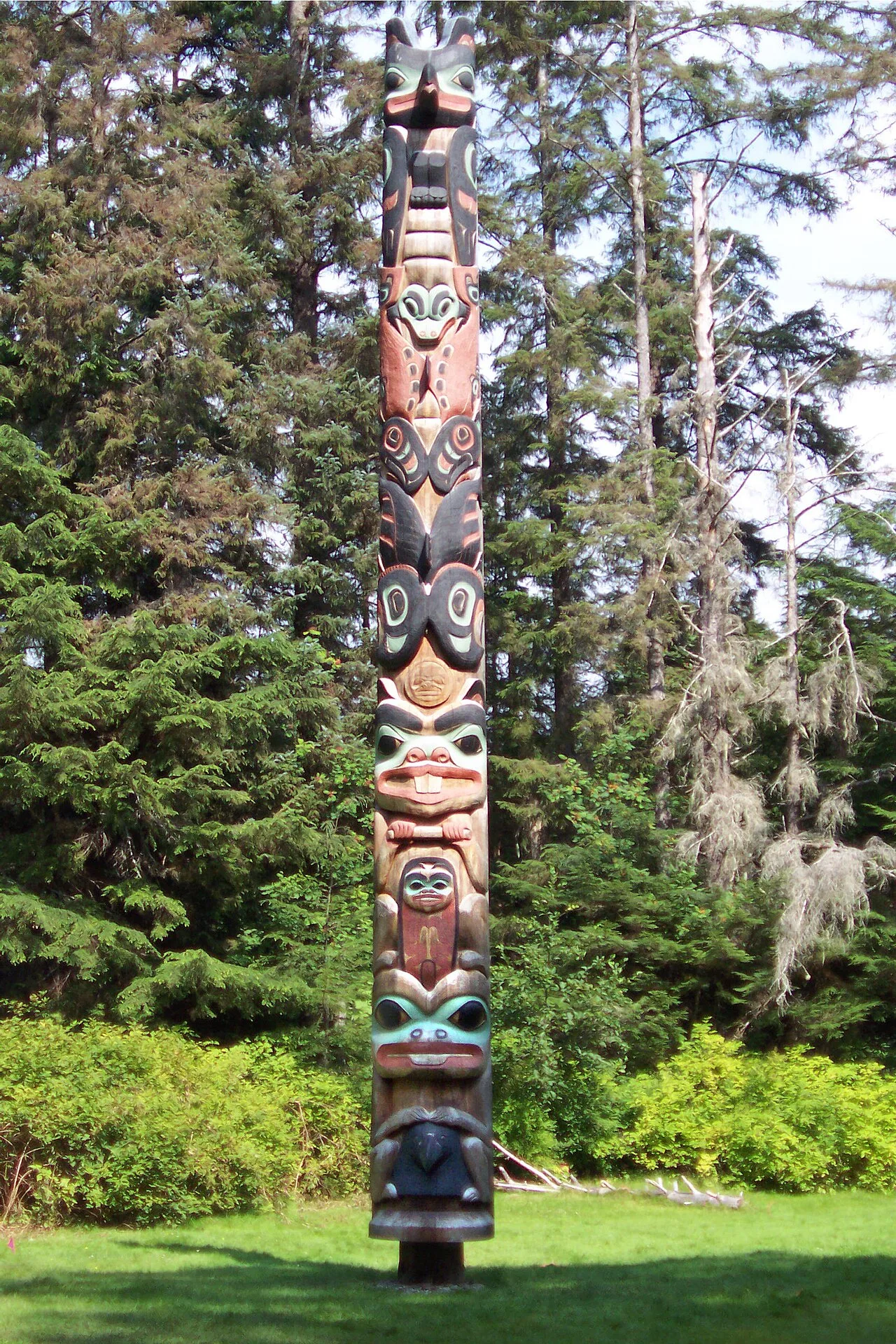
The carved poles of the Northwest Coast are famous around the world. But the name “totem pole” is not a Native phrase. A University of Washington essay explains that the word “totem” comes from the Ojibwe language, which is spoken thousands of kilometres away, near the Great Lakes.
The figures on a pole are not gods. They usually show a family’s ancestors and the supernatural beings connected to the family’s history, a bit like a coat of arms carved in wood.
Kinds of Pole
- House frontal pole — Stood against the front of a house, sometimes with the door at its base
- Interior house post — Held up the roof beams inside
- Memorial pole — Stood in front of a house to honour a chief who had died
- Mortuary pole — Held the coffin of an important person in a space at the top
| Kind of pole | What it did |
|---|---|
| House frontal pole | Stood against the front of a house, sometimes with the door through a hole at its base |
| Interior house post | Held up the roof beams inside |
| Memorial pole | Stood in front of a house to honour a chief who had died |
| Mortuary pole | Held the coffin of an important person in a space at the top |

The potlatch
A potlatch is a great ceremony held by many Northwest Coast nations. It usually marks an important event, and it can last for several days. There is feasting, dancing, singing and theatre. The host family gives gifts to the guests.
A potlatch is far more than a party. It shares out wealth, shows each family’s rank, and settles who has the right to certain names and to hunting and fishing places. The guests act as witnesses. Chief Bill Cranmer of the Kwakwaka’wakw explains that people kept their history alive by remembering what they witnessed at a potlatch.
Society on the coast was ranked. Large villages had wealthy chiefs and nobles, ordinary people, and enslaved people who were counted outside society altogether. Nobles owned most of the houses and used carved posts and painted fronts to show their standing.
The Potlatch
- What happens at a potlatch?
- What job do the guests do at a potlatch?
- Which of these is something a potlatch settles?
The potlatch ban
This part of the story is hard to read, and it is fine to feel upset about it. In Canada, the government made the potlatch illegal from 1885 to 1951. It wanted Indigenous people to give up their own ways and live like the settlers. The Canadian Encyclopedia says the ban is now recognised as part of an attempt to destroy Indigenous cultures.
For years the law was hardly used, but in 1922 police arrested 45 people who had taken part in a potlatch. Some were sent to prison, and hundreds of treasured ceremonial objects were taken away. Many communities simply carried on holding potlatches in secret.
The Northwest Coast nations today
The nations of the coast are still here, and potlatches are still important to them. Plank houses still stand in some communities, used mostly for gatherings and ceremonies.
Many Coast Salish nations are working on treaties and land claims with the Canadian government, and working towards governing themselves. Some Coast Salish languages are endangered, because of past government policies such as residential schools.
Want to compare the coast with other regions? Start with our Native American facts.
The Coast Today
- What are plank houses mostly used for in communities where they still stand?
- What are many Coast Salish nations working on with the Canadian government?
Three things people get wrong
“Totem poles were worshipped.” They were not. The figures show a family’s ancestors and history, like a carved family crest. Even the word “totem” was borrowed from a language on the other side of the continent.
“Every Northwest Coast nation carved tall totem poles.” Tall poles with many figures were first made only by the northern nations, the Haida, Tlingit and Tsimshian, in south-east Alaska and British Columbia. Nations further south used carved house posts and welcome figures instead.
“The potlatch died out.” Canada banned it for 66 years, but people kept it going in secret. The potlatch is still held today.
Did you know? Families sometimes took the cedar planks off their winter house and carried them to their summer fishing camp, to cover the frame of a summer house. It was a house you could pack.
Try it
Draw a pole for your own family. Choose three figures: one for a grandparent, one for something your family is known for, and one for a place that matters to you. Then explain it to someone, the way a pole tells a family’s story.
Knowledge check
Why were Northwest Coast clothes made of cedar bark and sea otter skin?
Show answer
Because the coast is very wet. Cedar bark, sea otter skins and beargrass are water-resistant, so they kept people dry and warm through the rainy winters.
What do the figures on a totem pole show?
Show answer
Usually a family’s ancestors and the supernatural beings connected to the family’s history, a bit like a coat of arms. They were not worshipped.
Frequently asked questions
Who were the Northwest Coast Native Americans?
They are the nations of the Pacific coast from south-east Alaska, through British Columbia, to the Columbia River in Washington and Oregon. They include the Tlingit, Haida, Tsimshian, Kwakwaka’wakw, Nuu-chah-nulth, Coast Salish, Makah and Chinook.
What kind of homes did the Northwest Coast tribes live in?
They lived in plank houses: big square or rectangular buildings with a post-and-beam frame covered in wide cedar planks. Extended families lived together in them in winter villages, and many houses carried carved and painted family crests.
What did the Northwest Coast tribes eat?
Most of their food came from the water. Salmon was one of the most important foods, and the Makah got most of theirs from whaling and sealing. They also ate shellfish, water birds, berries, roots and land animals.
What did the Northwest Coast tribes wear?
Clothes had to keep out the rain. The Chinook made them from water-resistant materials: sea otter skins, cedar bark and beargrass. Woven cedar bark hats were so good that the explorers Lewis and Clark bought some.
What is a totem pole?
It is a tall carved cedar pole showing a family’s ancestors and history. There are house front poles, poles that hold up the roof inside, memorial poles for chiefs who died, and mortuary poles. The word totem comes from the Ojibwe language.
What is a potlatch?
A potlatch is a great ceremony with feasting, dancing, singing and gifts from the host family. It shares out wealth, shows each family’s rank and settles rights to names and fishing places, with the guests acting as witnesses.
Was the potlatch banned?
Yes. Canada made the potlatch illegal from 1885 to 1951, to push Indigenous people to give up their own ways. In 1922, 45 people were arrested after a potlatch. Many communities kept holding potlatches in secret, and they are still held today.
Sources
- NOAA Olympic Coast National Marine Sanctuary: Original peoples — the Makah, Quileute, Hoh and Quinault, red cedar canoes, and Makah whaling and food
- The Canadian Encyclopedia: Plank house — how plank houses were built, winter villages, the differences between nations, and ranked society
- The Canadian Encyclopedia: Potlatch ban — what a potlatch is, the ban from 1885 to 1951, the 1922 arrests, and Chief Bill Cranmer’s words
- The Canadian Encyclopedia: Coast Salish — salmon and red cedar as sacred, fishing, the purposes of the potlatch, and the Coast Salish today
- University of Washington Libraries: Totem poles, heraldic columns of the Northwest Coast — where the word totem comes from, what the figures show, and the kinds of pole
- National Park Service: Chinook clothing — water-resistant clothing, and what Lewis and Clark saw and bought
Northwest Coast Native Americans Final Quiz
- Which tree was the most important natural resource of the Northwest Coast?
- Which description best fits the Northwest Coast?
- Which nations first made tall totem poles with many figures?
- Which nation lived on the lower Columbia River?
- Why did Lewis and Clark buy cedar bark hats from the Chinook and Clatsop?
- Which of these is NOT something the Makah ate?
- Do Northwest Coast nations still hold potlatches today?
- Where did the word ‘totem’ come from?


