
Orcas quick facts
- Orcas are the largest dolphins, not true whales in the usual sense.
- A male orca’s dorsal fin can be 1.8 metres (6 feet) tall, and it has no bones in it.
- The oldest known orca, Granny (J2), was thought to be well over 90 years old.
- Some Antarctic orcas make waves together to wash seals off floating ice.
- Orcas are one of only six kinds of animal known to go through menopause, along with humans.
Orcas at a glance
Orcas, also called killer whales, are the biggest members of the dolphin family. They live in every ocean, hunt in teams and stay with their mothers for life. Some are led by grandmothers more than 90 years old. Here are their main facts in one place.
| Fact | Detail |
|---|---|
| Scientific name | Orcinus orca |
| Family | Dolphins (Delphinidae), the biggest member |
| Length | Males up to 9.75 m (32 ft), females up to 8.5 m (28 ft) |
| Weight | Up to about 10 tonnes (11 US tons) |
| Dorsal fin | Up to about 1.8 m (6 ft) tall on males |
| Lifespan | Females about 50 years on average, males about 30 |
| Where they live | Every ocean in the world |
| World population | About 50,000 |
What is an orca?
An orca is the largest member of the dolphin family, even though it is often called a whale. Its scientific name is Orcinus orca. Like all dolphins, it is a toothed whale. It has real teeth, not the baleen plates that giant filter-feeding whales use.
So is it a whale or a dolphin? Both, in a way. All dolphins are toothed whales, and some big dolphins, such as pilot whales, have “whale” in their names. You can compare orcas with their smaller cousins in our guide to dolphins.
An orca has 40 to 56 cone-shaped teeth, each about 7.5 cm (3 in) long. The teeth lock together like a zip. Orcas use them for gripping and tearing, not for chewing.
How big are orcas?

Orcas are big. Adult males can grow to about 9.75 m (32 ft) long, as long as a bus. They can weigh up to about 10 tonnes. Females are smaller, reaching about 8.5 m (28 ft). Males also have bigger flippers, tails and dorsal fins.
A male’s dorsal fin can stand up to 1.8 m (6 ft) tall, the largest fin of any sea mammal. It may be taller than your dad. Females have shorter, more curved fins. Surprisingly, the fin and the tail have no bones in them at all. They are made of tough, dense tissue.
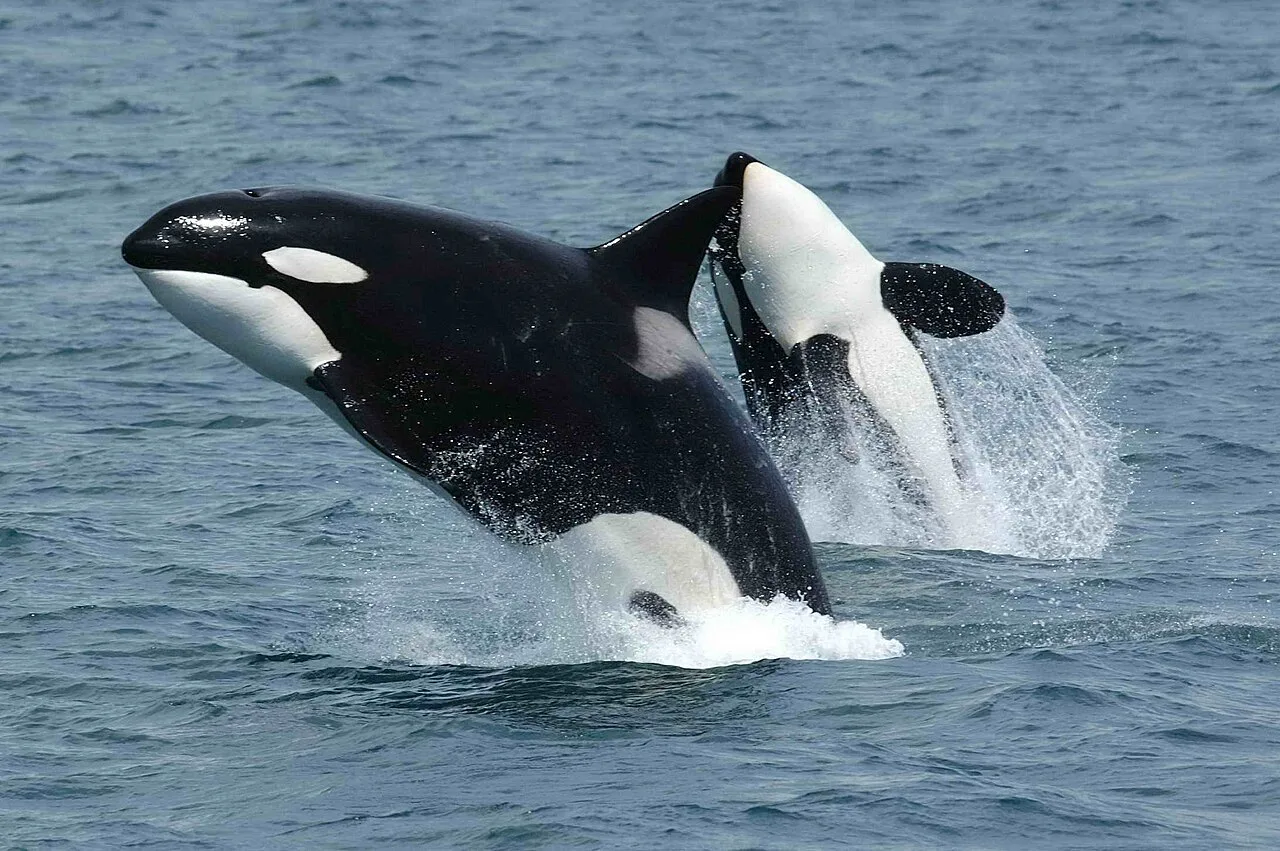
Orcas are black on top and white underneath, with white patches near their eyes. This is called countershading. From above, the dark back blends into the deep water. From below, the pale belly blends into the bright, sunlit surface.
Behind the fin is a grey patch called the saddle patch. Each orca’s saddle patch is different, like a fingerprint, the Natural History Museum says. Scientists use it, along with nicks in the fin, to tell orcas apart.
Where do orcas live?
Orcas live in every ocean in the world. You can find them in icy polar seas and in warmer waters too. NOAA, the US ocean agency, estimates there are about 50,000 orcas worldwide.
The Southern Ocean around Antarctica is home to many of them. The Australian Antarctic Division estimates about 70,000 orcas in Antarctic waters, though nobody knows the exact number. Orcas even live deep inside the pack ice in midwinter. Small calves seen there in winter suggest they are the only whales that breed in Antarctic waters.
In Antarctica, a thin film of tiny algae can tint an orca’s white patches yellowish-brown. You can read more about this frozen continent in our guide to Antarctica.
Different kinds of orca
Not all orcas are the same. Groups that live in different places have different shapes, calls and food, and scientists call them ecotypes. In the North Pacific there are three: Residents, Bigg’s (once called Transients) and Offshores. They do not mix or breed with each other.
| Ecotype | Main food | Pod size |
|---|---|---|
| Resident | Fish, especially salmon | 9 to 60 |
| Bigg’s (Transient) | Seals, sea lions, dolphins and other whales | 2 to 5 |
| Offshore | Fish, including sharks | 30 to 60 |
In March 2024, NOAA scientists proposed that Residents and Bigg’s whales were so different they should be two separate species. The two groups probably split apart more than 300,000 years ago. In June 2025, experts voted instead to make them two subspecies. For now, all orcas are still one species.
Scientists think other groups may one day be split off too. NOAA names the rarely seen “Type D” orcas of the Southern Ocean as a possible future species.
What do orcas eat?

Orcas eat almost anything in the sea. But each group sticks to its own foods. Some eat only fish. Others eat seals, penguins and even other whales. An orca eats about 3 to 4% of its body weight every day. For a big male, that is hundreds of kilograms of food.
Around Antarctica, orcas eat fish, squid, Adélie and emperor penguins, several kinds of seal and minke whales. Bigg’s orcas in the Pacific are known to eat 22 kinds of animal, including seals, dolphins, seabirds and even moose.
Orcas are the only known hunters of great white sharks. Their prey around the world can even include blue whales, the biggest animals on Earth.
How do orcas hunt?

Orcas hunt in teams, a bit like wolves. They plan, share the work and pass their tricks on to their young. Hunting methods are taught from one generation to the next, so each pod has its own style. Females seem to teach the young how to hunt.
In Antarctica, a group called the B1 pack ice orcas has a clever trick. They poke their heads up to spot a seal resting on an ice floe. Then they swim at it side by side to make a wave. The wave washes the seal into the water. This is called wave-washing.
In Patagonia and on the Crozet Islands, orcas chase seal pups right to the water’s edge, sometimes sliding up onto the beach to grab them. Fish-eating orcas herd fish into a tight ball. Seal-hunting orcas stay silent, because seals can hear their calls.
Orca families and grandmothers
Orcas live in close family groups called pods. In many pods, the members are all related through their mothers. Sons and daughters often stay with their mother for life. Many big males over 30 still swim beside their mums.
Grandmothers are in charge. When food is scarce, the pod follows its oldest female, probably because she knows the best places to find fish. The oldest known orca, nicknamed Granny (J2), was thought to be well over 90 years old.
Female orcas usually stop having calves in their 30s or 40s, but they can live for decades afterwards. Only six kinds of animal are known to do this: humans and five toothed whales. A 2019 study from the University of Exeter found that grandmothers help their grandcalves survive, especially in years when salmon is scarce.
Mothers look after their sons too. They often bite a salmon in two and give half to a grown-up son. A 2023 Exeter study found sons with an older mother nearby had 35% fewer tooth-rake marks from fights.
Orca calves
An orca calf is born after a very long pregnancy of 15 to 18 months, longer than a human’s. Usually just one calf is born at a time. Females have their first calf when they are about 10 to 13 years old. In some groups they have one about every five years.
Calves drink their mother’s milk for at least a year. They stay close to her for at least their first two years, learning how to hunt and which calls to make.
How orcas talk and find food

Orcas make clicks, whistles and pulsed calls. Each population has its own set of calls, learned from its family. NOAA says it is like a dialect or accent. Orcas use calls to keep in touch with each other and to work together when they hunt.
They also find food with sound. An orca sends out quick clicks through the rounded bump on its forehead, called the melon. The clicks bounce off fish and other objects, and the echoes come back through its jawbone. This is called echolocation.
Orcas also have to think about breathing. They decide when to take each breath, opening a muscle flap over the blowhole on top of the head. When it closes, it seals tight.
The Southern Residents: orcas in danger
The Southern Resident orcas are a small, endangered population that spends summer and autumn near Seattle, in Washington State, USA. They live in three pods, called J, K and L. The Center for Whale Research has counted every birth and death in these families since 1976.
Their numbers fell after many young orcas were captured for marine parks in the 1960s and 1970s. By 1974 only 71 were left. They grew to about 98 in the mid-1990s, then fell again. They were listed as endangered in the United States in 2005.
On 1 July 2025 there were 74 Southern Residents: 27 in J pod, 14 in K pod and 33 in L pod. The July 2026 count lists 76, but that figure is still provisional. NOAA names three main threats: too few Chinook salmon to eat, pollution in the water, and noise and disturbance from boats.
Some of their stories are sad. In 2018, a mother called Tahlequah (J35) lost her newborn calf and carried it with her for at least 17 days. In December 2024 she lost another calf and carried it again for at least 11 days.
The orcas that bump boats
Since the summer of 2020, a small group of orcas off the coasts of Spain and Portugal has been bumping into boats. Spain’s environment ministry and the International Whaling Commission are studying why.
These orcas follow the Atlantic bluefin tuna they feed on. Spain lists the population as vulnerable. Scientists have fitted satellite tags to six of them and share maps with sailors, so boats can keep away from places where the orcas are likely to be.
Three things people get wrong
“Killer whales are whales, not dolphins.” Orcas belong to the dolphin family and are its biggest member. All dolphins are toothed whales, so the name is not wrong, but their closest relatives are dolphins.
“All orcas eat the same food.” Each group specialises. Residents eat salmon, Bigg’s orcas eat seals and other mammals, Offshores eat fish and sharks, and some Antarctic orcas wash seals off the ice.
“Orcas are all exactly the same animal.” In 2024 scientists proposed splitting two North Pacific types into separate species. They are now subspecies, and experts are still studying how many kinds of orca there really are.
Did you know? Each orca’s grey saddle patch, behind its dorsal fin, is a different shape. Scientists use it like a fingerprint to recognise individual orcas year after year.
Try it
Measure 9.75 metres along a playground or corridor. That is how long a big male orca can grow. Then mark 1.8 metres up a wall: the height of his dorsal fin.
Knowledge check
What is wave-washing?
Show answer
A hunting trick used by some Antarctic orcas. They swim together at an ice floe to make a wave that washes a resting seal into the water.
Why do orcas have black backs and white bellies?
Show answer
It is called countershading. From above, the dark back blends into deep water, and from below, the white belly blends into the bright surface.
Frequently asked questions
Is an orca a whale or a dolphin?
An orca is the largest member of the dolphin family. All dolphins are toothed whales, so orcas are a kind of toothed whale too, but their closest relatives are dolphins.
How big do orcas get?
Male orcas can grow to about 9.75 metres (32 feet) long and weigh up to about 10 tonnes. Females are smaller, reaching about 8.5 metres (28 feet).
What do orcas eat?
Orcas eat fish, squid, seals, sea lions, penguins, seabirds, sharks and even other whales. Each group specialises: some eat only salmon, while others hunt mammals.
How long do orcas live?
Female orcas live about 50 years on average and can reach 90 or more. Males live about 30 years on average and can reach at least 60, according to NOAA.
Where do orcas live?
Orcas live in every ocean in the world. They are common around Antarctica, where about 70,000 may live, and some even stay in the pack ice through winter.
Why are Southern Resident orcas endangered?
Southern Resident orcas are endangered because they have too few Chinook salmon to eat, pollution builds up in their bodies, and boat noise disturbs them. In July 2025 there were 74 of them.
Sources
- NOAA Fisheries: Killer whale — classification, size, lifespan, ecotypes, diet, calls, calves and the Southern Residents; NOAA’s Southern Resident, species-proposal and Ocean Today pages were also used
- Center for Whale Research: Orca population — the July 2025 and July 2026 Southern Resident counts and J35 Tahlequah
- University of Exeter: Grandmother orcas boost survival of grandcalves (2019) — menopause and grandmothers; its 2021 and 2023 studies on menopause and mothers and sons were also used
- Australian Antarctic Division: Killer whale — size, Antarctic population, prey, hunting and teaching young
- Natural History Museum, London: Granny knows best — grandmother leaders, Granny J2 and saddle patches; its pages on what orcas eat and on wave-washing were also used
- Spanish Ministry for the Ecological Transition (MITECO): Orcas — the Iberian orcas and boats, satellite tags and advice to sailors


