
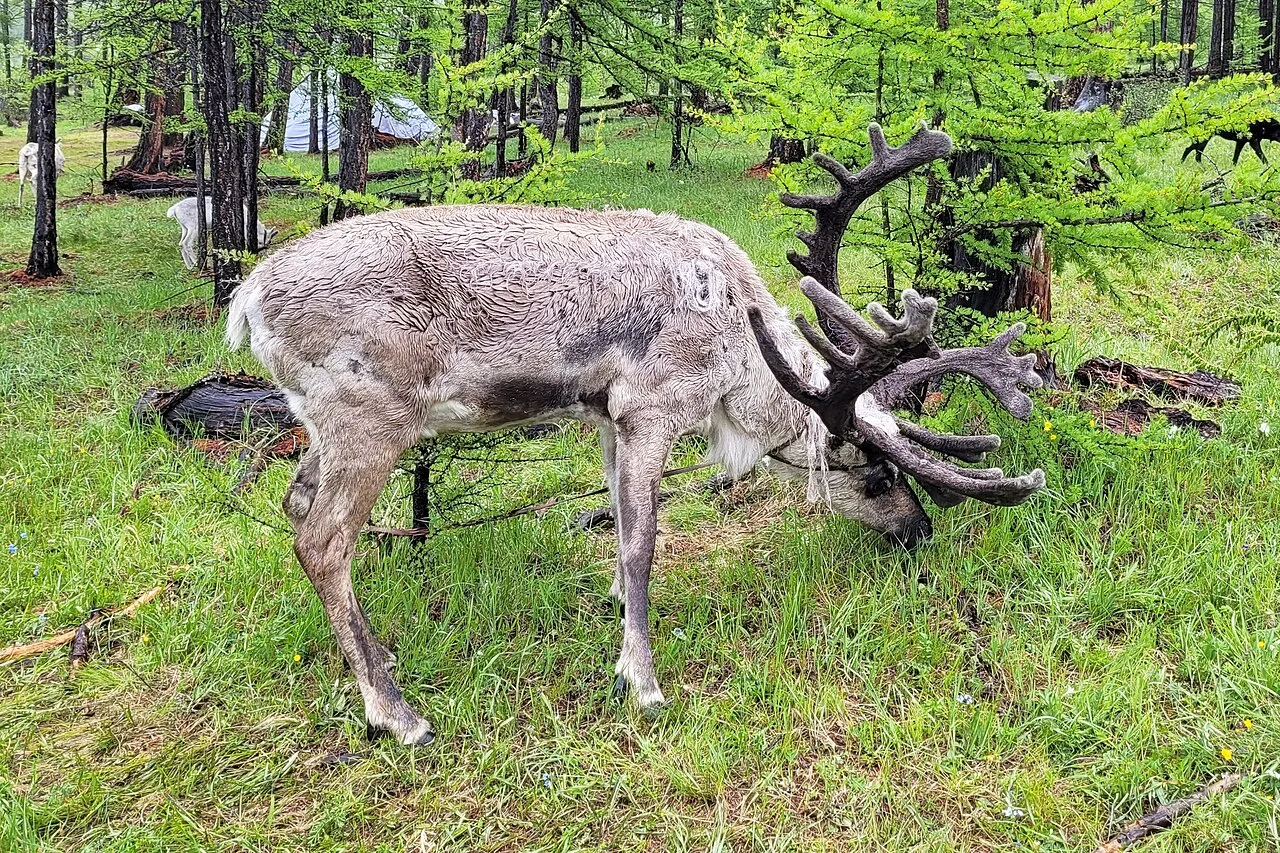
Reindeer quick facts
- Big male reindeer drop their antlers in late autumn, but pregnant females keep theirs until spring, so a reindeer with antlers on Christmas Eve is probably female.
- The shiny layer at the back of a reindeer’s eye is gold in summer and turns blue in winter, helping it see in the long Arctic dark.
- A reindeer calf can outrun a person when it is just one day old.
- Reindeer are the only deer with hair covering the whole nose.
- In 2022 a scientist proposed splitting reindeer and caribou into several species, but most experts still count just one.
Reindeer and caribou: one animal, two names
Reindeer and caribou are the same animal. Scientists call it Rangifer tarandus. In Europe and Asia, people say reindeer. In North America, the wild ones are usually called caribou.
There is one twist. In North America, reindeer that people herd and look after are still called reindeer. So the name tells you where an animal lives, and sometimes whether people care for it.
Reindeer live all the way around the Arctic, the cold region at the top of the world. Wild caribou roam Canada and Alaska. Herders keep reindeer in ten countries, from Norway, Sweden and Finland to Russia, Mongolia and China. Greenland has reindeer too, and so does Scotland.
Scientists have argued about the name for a long time. The last full check of the reindeer family tree was made in 1961. In 2022, a scientist named Lee Harding suggested splitting reindeer and caribou into several separate species. They included the Svalbard reindeer, the Greenland caribou and the woodland caribou.
Not everyone agrees. Most experts and big reference books still count just one species. They split it into subspecies instead. A subspecies is a group within a species that looks a little different because it lives somewhere else. This guide follows that usual view.
Antlers on males and females
Reindeer are the only members of the deer family in which both males and females grow antlers. In every other kind of deer, the females go without.
A male’s antlers can reach 130 cm (51 inches) long. That is about as tall as a nine-year-old child. A female’s antlers reach about 50 cm (20 inches). For their body size, reindeer have the largest and heaviest antlers of any deer alive today.

Antlers are not horns. Horns stay on for life, but antlers fall off and grow back larger every year. They are made of bone.
A growing antler is covered in velvet. Velvet is soft, furry skin full of blood vessels, which feed the bone while it grows. When the antler is finished, the velvet dries up. The reindeer rubs it off against rocks or trees, and the hard bone shows underneath.
Males start growing new antlers in February, and females in May. Both finish at about the same time. Then they drop them at very different times of year.
Big males drop theirs first, in late October or November. Young males, and females that are not expecting a calf, keep theirs until about April. Pregnant females hold on longest of all. Their antlers stay on until their calves are born in late May or early June.
Antlers are useful all year. Reindeer use them to fend off predators. Males use theirs to impress females in autumn. Females use theirs to clear snow away from food in winter, which is exactly when they need it most.
A body built for the Arctic cold
The Arctic winter is long, dark and bitterly cold. Nearly every part of a reindeer’s body helps it cope.
Start with the nose. Inside a reindeer’s nostrils are thin bones that curl round like the inside of a seashell. Freezing air warms up and gets damp as it passes over them on its way to the lungs. That saves the reindeer heat and water on a cold day.
Reindeer are also the only deer with hair covering the whole nose. Their sense of smell is sharp enough to find food hidden under the snow.
Their coat has two layers. Underneath is soft, woolly fur. On top are stiff guard hairs, which are hollow and trap air. Trapped air holds heat in, a bit like the stuffing in a padded coat.
Even the hooves change with the seasons. In summer, the pads underneath get softer and spongier. That gives a good grip on wet, marshy ground. In winter, the hooves harden, so they can dig into ice and snow without slipping.
The hooves are large, wide and hairy. They spread out like snowshoes, so a reindeer does not sink into soft snow. They work like shovels for scraping snow off food. In water, they work like paddles.
Listen to a reindeer walking, and you may hear it click. The sound comes from a tendon slipping over a bone in its foot. A tendon is the tough cord that joins a muscle to a bone.
Eyes that change colour
Reindeer eyes hold a surprise. At the back of each eye is a shiny layer that bounces light back through it. It is the same kind of layer that makes a cat’s eyes glow in torchlight.
In reindeer that live in the far north, this layer changes colour. It is gold in summer. By winter it has turned blue.
The gold layer reflects most of the light straight back out of the eye. That works well in bright summer. The blue layer scatters more light around inside the eye instead. In the long darkness of an Arctic winter, the extra light helps a reindeer spot predators before they get close.
What reindeer eat through the year
In summer, reindeer eat almost any green plant they can find. They munch grasses, herbs, ferns and mushrooms, and the leaves of willow and birch trees.
Winter is much harder. Around September, reindeer switch to lichen. Lichen is a tough living thing that grows slowly on the ground, on rocks and on trees. One kind matters so much to them that people call it reindeer moss.
In winter, lichen can make up 40 to 90 percent of a reindeer’s food. Reindeer also eat lichen that hangs from trees, and other plants buried under the snow.

To reach it, a reindeer scrapes the snow away with its hooves. A special substance in its stomach, called an enzyme, helps it break the lichen down. Lichen is full of energy, and reindeer are unusually good at getting that energy out.
An adult reindeer eats about 4 to 8 kilograms (9 to 18 pounds) of plants a day. That is about the weight of one or two pet cats, in leaves and lichen, every single day.
Reindeer are ruminants, like cows and sheep. They swallow their food, bring it back up later and chew it again. This helps them get the most out of tough plants.
Herds, calves and long journeys
Reindeer live in herds. A herd usually has between 10 and a few hundred animals. In spring, herds can join into super herds of 50,000 to 500,000 reindeer.
Many herds migrate, which means they travel between summer and winter homes. When food is hard to find in winter, some herds walk as far as 1,600 km (1,000 miles). That is further than from London to Rome.
In Alaska, big herds travel up to 640 km (400 miles) between their summer and winter ranges. Once they set off, caribou can cover up to 80 km (50 miles) in a day. That is almost two marathons. The distance depends on the herd, and on how the journey is measured, so books often give different numbers.
Rivers do not stop them. Reindeer are strong swimmers and paddle across at 6 to 10 km/h (4 to 6 mph). On land they can run at up to 80 km/h (50 mph).

In spring, pregnant females head for the same calving grounds their herd uses every year. Most calves are born in May and June, all within about ten days of each other. A mother usually has just one calf.
A newborn calf weighs about 2.5 to 9 kilograms (5 to 20 pounds). It can stand an hour after it is born, and follow its mother after five to seven hours. By one day old, it can outrun a person. By two weeks old, it has doubled its weight.
Speed matters, because calves are the reindeer most at risk from predators. Depending on where they live, reindeer must watch out for golden eagles, grey wolves, brown bears, lynx and even Arctic foxes. A healthy adult in a big herd is usually safe, because so many eyes are watching for danger.
Wild caribou and herded reindeer compared
Some reindeer are wild. Others live with people who herd them. The table shows how their lives differ.
| Wild caribou and reindeer | Herded reindeer | |
|---|---|---|
| What people in North America call them | Caribou | Reindeer |
| Where they live | Arctic North America, Greenland, northern Europe and Russia | Ten countries, including Norway, Sweden, Finland, Russia, Mongolia, China and Scotland |
| Who decides where they go | The herd itself, following the food | Herders, who move them between summer and winter pastures |
| Winter food | Lichen dug out from under the snow | Mostly lichen, with hay or other feed when ice covers the ground |
| How many | About 1.88 million in the 13 biggest migratory herds (2024) | Cared for by about 100,000 herders |
Herded reindeer are not tame in the way a pet dog is. Experts call them semi-domesticated, which means partly tamed. They graze freely for most of the year and keep many wild habits.
The people who herd reindeer
People have lived alongside reindeer for thousands of years. At first they hunted them. Later, peoples of the far north began to tame and herd them.
Nobody knows exactly when herding began. The International Centre for Reindeer Husbandry says cave paintings point to about 2,000 to 3,000 years ago. San Diego Zoo Wildlife Alliance says at least 3,000 years ago, and perhaps as long as 7,000. The experts do not fully agree.
Reindeer are still the only deer that people herd in large numbers. Today about 100,000 people herd reindeer across the far north. They belong to around 24 different peoples, in ten countries.

In Norway, Sweden and Finland, herding is organised through families, districts and Sámi villages. The Sámi are an Indigenous people of northern Europe. For many Sámi families, reindeer are a central part of life and culture, not just a job. These countries also have special laws about who may herd and where.
In Russia, herding is often run by large collective farms that date from Soviet times. Families still do much of the day-to-day work.
Out on the open tundra, herders mostly raise reindeer for meat. In the northern forests, called the taiga, reindeer are used mainly for transport and for milk. Across the north, reindeer give people food, clothing, shelter and a way to travel.
Herding is getting harder in some places. When the ground freezes over with a layer of ice, reindeer cannot dig down to the lichen. Then herders may have to bring in hay or other food to keep their animals alive.
Why wild reindeer are declining
Wild reindeer and caribou are in trouble. The clearest picture comes from the big herds that migrate across the Arctic tundra. Scientists have counted them for decades.
NOAA’s Arctic Report Card follows 13 of these migratory herds. Together they have fallen by about 65 per cent since their peak in the 1990s and early 2000s. That is a drop from roughly 5.5 million animals to about 1.88 million (2024).
More than three million animals have gone in about thirty years. Those 13 herds are not every wild reindeer on Earth. They are the ones counted most carefully, and they are the ones falling fastest.
Counting herds spread across huge, empty lands is hard. These numbers are careful estimates, and scientists update them as new counts come in.
There is no single cause. Swarms of biting insects can stop reindeer from feeding, so they fail to store enough fat for winter. Oil drilling, industry, aircraft and snowmobiles disturb herds. Wild reindeer can also breed with herded ones, which may change wild herds over time.
Climate change adds to the pressure. It can make it harder for both wild and herded reindeer to find the food they need.
Santa’s reindeer and real reindeer
Every Christmas, reindeer appear on cards, jumpers and decorations, pulling Santa’s sleigh through the sky. The stories and the real animals have more in common than you might think.
In the stories, Santa’s reindeer fly. Real reindeer keep their hooves on the ground, but they are champion travellers all the same. They cross rivers, walk through deep snow and cover hundreds of kilometres in a season.
Pulling a sleigh is real, too. Reindeer have carried people and their belongings across the far north for a very long time, and in some places they still do.

Now look closely at the antlers on a Christmas card. By December, most big males have already dropped theirs. So if Santa’s reindeer have antlers on Christmas Eve, they are probably female. Some people say the same must be true of Rudolph.
Rudolph’s shining red nose belongs to the story. A real reindeer’s nose is covered in fur. All winter long, it quietly warms icy air before it reaches the lungs.
Three things people get wrong
1. Only male reindeer have antlers. Both males and females grow them, which makes reindeer different from every other deer. A female’s antlers are smaller, but many females keep theirs all winter, long after the big males have dropped their own.
2. Reindeer moss is a moss. It is really a lichen, not a moss at all. Reindeer dig it out from under the snow, and in winter it can make up most of what they eat.
3. Reindeer and caribou are different animals. They are the same species, and the name mostly depends on where the animal lives. Some scientists now want to split the species up. Even then, they would divide it by region and type, such as Svalbard reindeer and woodland caribou, not simply into reindeer and caribou.
Did you know? A big male reindeer’s antlers can weigh up to 15 kilograms (33 pounds). That is about as heavy as a three-year-old child, carried on his head every day from summer until late autumn.
Try it
Measure a reindeer’s antlers. Use a tape measure or a piece of string to mark out 130 cm on the floor. That is how long a big male’s antlers can grow. Then mark 50 cm for a female’s. Lie down next to the longer line and see whether you are taller or shorter than a reindeer’s antler.
Knowledge check
Why do many female reindeer keep their antlers through the winter?
Show answer
Pregnant females keep them until their calves are born in late spring. They use their antlers to clear snow away from food when food is hardest to find.
What is reindeer moss?
Show answer
Reindeer moss is not a moss at all. It is a lichen, and it is the main winter food of reindeer.
Frequently asked questions
Are reindeer and caribou the same animal?
Reindeer and caribou are the same species, Rangifer tarandus. People in Europe and Asia say reindeer, while wild ones in North America are usually called caribou. Some scientists have proposed splitting the species, but most experts still count one.
Do reindeer really fly?
Real reindeer cannot fly, although they are strong travellers. Reindeer can run at up to 80 km/h (50 mph), swim across rivers at 6 to 10 km/h, and some herds walk up to 1,600 km in search of winter food.
Do female reindeer have antlers?
Female reindeer do grow antlers, and reindeer are the only deer where both sexes do. A female’s antlers reach about 50 cm, and pregnant females keep theirs until their calves are born in late May or early June.
What do reindeer eat?
Reindeer eat grasses, herbs, mushrooms and leaves in summer. In winter they dig through the snow for lichen, often called reindeer moss, which can make up 40 to 90 percent of their food.
How long do reindeer live?
Reindeer usually live for 15 to 18 years. A calf can stand an hour after birth, can outrun a person at one day old, and doubles its weight in two weeks.
Are reindeer endangered?
Wild reindeer and caribou are declining across the Arctic. NOAA’s Arctic Report Card tracks 13 migratory tundra herds, and their combined total has fallen about 65 per cent since the 1990s, from roughly 5.5 million animals to about 1.88 million in 2024.
Who herds reindeer?
About 100,000 people from around 24 different peoples herd reindeer, in ten countries including Norway, Sweden, Finland, Russia, Mongolia and China. In northern Europe, many herders are Sámi.
Sources
- San Diego Zoo Wildlife Alliance: reindeer (caribou) — the two names, antler size, growth and shedding months, velvet, hooves, the clicking tendon, the furry nose, winter lichen, daily food, herd sizes, migration distance, swimming and running speeds, calves, predators, lifespan, domestication and threats
- Alaska Department of Fish and Game: caribou species profile — both sexes growing antlers, when bulls, cows and pregnant females shed them, hooves as snowshoes and paddles, the September switch to lichen and Alaska migration distances
- U.S. Fish and Wildlife Service: caribou keep it cool in the cold — the eye layer that turns from gold to blue, the seashell-shaped nose bones, hollow guard hairs and hooves that change with the seasons
- Harding (2022), ZooKeys: available names for Rangifer species and subspecies — the 1961 revision, the 2022 proposal to split reindeer and caribou into several species, and the fact that most authorities still recognise one
- NOAA Arctic Report Card 2024: Migratory tundra caribou in a warmer climate — the 65 per cent fall across 13 monitored migratory herds, from about 5.5 million animals at their peak to about 1.88 million
- International Centre for Reindeer Husbandry: what is reindeer husbandry? — the ten herding countries, about 24 herding peoples and 100,000 herders, Sámi villages, collective farms in Russia, uses of reindeer, winter lichen, icing and extra feed, and the age of reindeer herding


