
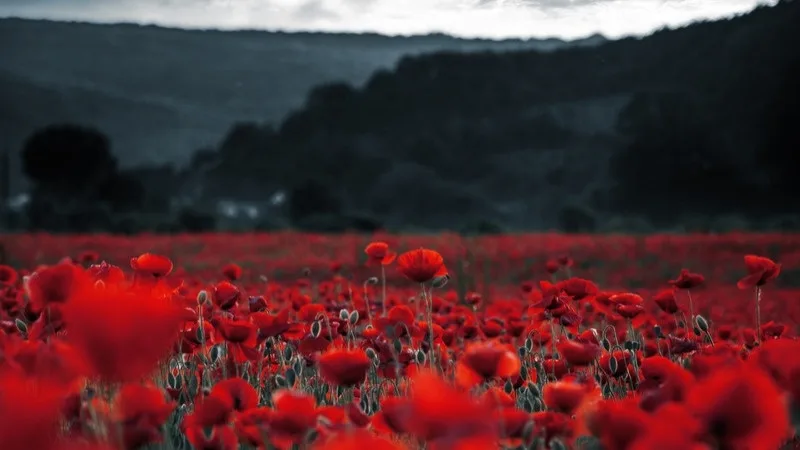
Remembrance Day quick facts
- The Armistice was signed at 5.10am on 11 November 1918, but the guns only fell silent six hours later, at 11am.
- More than a million people filed past the Unknown Warrior’s grave in the week before it was sealed.
- The Unknown Warrior’s grave is the only one in Westminster Abbey that nobody walks on.
- Scottish poppies have four petals and no leaf.
- Since 2023 the Royal British Legion’s poppy has been made entirely of paper, with no plastic at all.
A note before you start: Remembrance Day is about war, and about people who died. Some parts of this guide are sad. If you feel upset while reading, that is a normal way to feel. Talk to a parent, a teacher or another grown-up you trust. They would much rather hear your questions than have you carry them on your own.
What is Remembrance Day?
Remembrance Day is a time to remember the people who served and died in wars. It began after the First World War, which lasted from 1914 to 1918. Today it also remembers the Second World War and every conflict since.
In the UK there are really two days. Armistice Day is always 11 November, whatever day of the week it lands on. Remembrance Sunday is the second Sunday in November. Both have a two-minute silence at 11am.
In 2026, Remembrance Sunday falls on 8 November. Armistice Day comes three days later, on Wednesday 11 November.
Many people use the name Remembrance Day for either one. In Canada and Australia, Remembrance Day is simply the name for 11 November.
Poppies usually go on sale in late October. So in the UK they start to appear on coats and school jumpers around the same time as Bonfire Night on 5 November.
The Armistice: 11am on 11 November 1918
The First World War was fought mostly in Europe, but people from all over the world were caught up in it. By the autumn of 1918, Germany’s armies were being pushed back. Its allies had given up one after another.
German officials travelled to meet French and British commanders at a railway siding in a forest near Compiègne, north-east of Paris. The talks took place in a railway carriage. At 5.10am on 11 November the Germans signed the Armistice.
An armistice is an agreement to stop fighting. The word comes from Latin and means “to stand arms still”, or to put weapons down.
The guns did not fall silent at once. The Armistice came into force six hours later, at 11am. That is why people talk about the eleventh hour of the eleventh day of the eleventh month.
By then the fighting had gone on for 1,567 days without a break. The Western Front, the long line of trenches across Belgium and France, stretched for about 760 km (470 miles). That is longer than the drive from London to Edinburgh.
When the news arrived, crowds cheered in London, Paris and New York. Many families did not feel like cheering. They were thinking of people who would never come home.
The Armistice was a ceasefire, not the end of the story. The war officially ended with the Treaty of Versailles, signed in France on 28 June 1919.

The two-minute silence
The first national two-minute silence was held on 11 November 1919, one year after the Armistice. King George V asked people everywhere to stop what they were doing at 11am and stand still.
The silence has been kept every year since. Today it happens at 11am on Armistice Day and again at 11am on Remembrance Sunday, at war memorials and in public places across the UK and the Commonwealth.
At the Cenotaph in London, the silence begins as Big Ben strikes eleven. A single gun is fired at the start and again at the end. Then buglers play a call named the Last Post.
The Last Post was once the bugle call that marked the end of a soldier’s day. At remembrance services it has become a way of saying goodbye.
Two minutes can feel long when a whole school is quiet. Some people think about a name they know. Others simply stand still and listen. There is no wrong way to spend it.
The Cenotaph and the Unknown Warrior
The Cenotaph is a tall, plain stone monument in the middle of Whitehall, a street in central London. Its name comes from Greek words meaning “empty tomb”. Nobody is buried there. It stands for everyone who died.
The architect Sir Edwin Lutyens designed it. The first Cenotaph was put up for Peace Day, a parade in July 1919. It was a temporary monument made of wood.
People cared about it so much that a permanent one was built in Portland stone. King George V unveiled it on 11 November 1920.
That same morning, a coffin stood beside the new Cenotaph. Inside was a British serviceman who had died in the war. Nobody knew who he was. That was the whole point.
The idea came from an army chaplain, the Reverend David Railton. In 1916 he noticed a grave in a garden in France. Its rough cross said “An Unknown British Soldier”. In 1920 he wrote to the Dean of Westminster with a suggestion.
The Unknown Warrior was chosen from unknown servicemen brought from four battle areas in France and Belgium. At the Cenotaph, the King laid a wreath of red roses and bay leaves on the coffin. It was then carried to Westminster Abbey and buried near the great west door, among the kings and queens.
A guard of honour of 100 holders of the Victoria Cross, Britain’s highest award for bravery, lined the way. The grave was filled with earth brought from the battlefields.
Today a slab of black Belgian marble covers it. It is the only grave in the Abbey that nobody walks on. Because no one knows who he was, any family who lost someone with no known grave could imagine he might be theirs.
France honoured an unknown soldier of its own at the same time. He lies beneath the Arc de Triomphe in Paris, where a flame is relit every evening.

Remembrance Sunday and Armistice Day
On Remembrance Sunday, the National Service of Remembrance is held at the Cenotaph. The King, members of the Royal Family, government leaders and representatives of Commonwealth countries lay wreaths of poppies at its base.
Then about 10,000 veterans march past. A veteran is someone who has served in the armed forces. Some are very old. Others are young people who served only a few years ago.
Similar services take place at local war memorials in towns and villages, and in places of worship of every faith. Many of these memorials were built in the 1920s. They list the names of local people who died, sometimes several from the same street or family.
Armistice Day is usually quieter. It is normally a working day, so the silence happens in classrooms, shops, offices and railway stations as well as at memorials.
Why do we wear poppies?
We wear poppies because red poppies grew on the battlefields of the First World War. The Royal British Legion, the UK charity that runs the Poppy Appeal, tells the story like this.
In Belgium and France, the ground was churned up again and again by millions of shells. Poppy seeds that had been buried were brought up to the surface. In the light, they began to sprout.
Soon, millions of bright red poppies covered the ruined land. Soldiers noticed them. Some picked them as keepsakes and tucked them into letters home.
A Canadian army doctor, John McCrae, saw them in May 1915. He had just lost a friend in the fighting. He wrote a poem that begins “In Flanders fields the poppies blow”. Flanders is the old name for a region of Belgium and northern France.
The poem, “In Flanders Fields”, was printed in Punch magazine in December 1915. It quickly became one of the best-known poems of the war.
Two women turned the flower into a symbol. In 1918 an American teacher, Moina Michael, wrote a reply to the poem and began campaigning for people to wear a poppy. In France, Anna Guérin was selling poppies made by French women to raise money for children in areas the war had wrecked.
In 1921 Guérin visited the newly founded British Legion. The Legion ordered a million poppies from her, then eight million more from British makers. They sold out almost at once. That first Poppy Appeal raised more than £100,000, a huge sum at the time, to help veterans find homes and jobs.
In 1922 the Legion set up its own Poppy Factory, where ex-servicemen with disabilities made the poppies. In Scotland, Lady Haig opened a poppy factory in Edinburgh in 1926. Scottish poppies still have four petals and no leaf.
The poppy has changed over the years. Since 2023 the Royal British Legion’s poppy has been made entirely from red and green paper, with no plastic, so it can go in the recycling. More than four miles (about 6.5 km) of paper is made for it every year.
The Legion says the red poppy remembers the sacrifices of those who served, shows support for today’s armed forces community and stands for hope for a peaceful future. Wearing one is a personal choice.
How the Poppy Became a Symbol
- Churned ground Buried poppy seeds reach the light on the battlefields of Belgium and France, and bright red flowers appear.
- A doctor's poem John McCrae, a Canadian army doctor, writes In Flanders Fields after losing a friend.
- In print Punch magazine prints the poem, and it becomes one of the best-known poems of the war.
- A campaign Moina Michael, an American teacher, writes a reply and starts asking people to wear a poppy.
- The first appeal The British Legion sells millions of poppies and raises more than 100,000 pounds to help veterans.
- A factory The Legion opens its own Poppy Factory, where ex-servicemen with disabilities make the poppies.
- No plastic The poppy is made entirely from red and green paper, so it can go in the recycling.

White and purple poppies
Not everyone wears a red poppy, and some people wear more than one. Two other colours are the ones you are most likely to see.
White poppies were first made in 1933 by the Co-operative Women’s Guild. Many of its members had lost family and friends in the First World War. Today they are sold by the Peace Pledge Union. It says the white poppy remembers all victims of war, including civilians, and stands for a commitment to peace.
Purple poppies remember animals. The charity Animal Aid launched a purple poppy in 2006 for animals that suffered in war. In 2015 it swapped it for a purple paw badge. Other charities still sell purple poppies.
Millions of animals worked in the First World War. Horses and mules pulled guns and carts. Dogs carried messages, and pigeons flew notes back from the front line. The author Michael Morpurgo wrote about one of those horses in his novel War Horse.
People sometimes argue about which poppy to wear. This guide does not tell you which one to choose. Each is a way of remembering, and choosing not to wear one is allowed too.
The people who helped
War is not only about fighting. Huge numbers of people spent the war saving lives and looking after others. Remembrance is for them too.
Nurses worked in hospitals near the front line and on ships that carried injured soldiers home. Doctors like John McCrae treated patients in tents and dugouts. Stretcher-bearers carried injured men to safety, often in great danger themselves.
At home, women took on jobs in factories, on farms and on buses. Volunteers knitted socks, packed parcels and raised money for soldiers and their families.
Some of the most important helpers are still at work today. After the war, the Imperial War Graves Commission took on the job of building and caring for permanent war cemeteries around the world. Today it is called the Commonwealth War Graves Commission, or CWGC.
Its cemeteries became places of pilgrimage. Presidents visit them, and so do ordinary families looking for one name. Many soldiers had no known grave. Their names were carved on large monuments instead, so that they would not be forgotten.

How other countries remember
Many countries remember the same war, but not always on the same day or with the same flower.
| Country | Main day | Date | Symbol |
|---|---|---|---|
| United Kingdom | Remembrance Sunday and Armistice Day | Second Sunday in November, and 11 November | Red poppy |
| Canada | Remembrance Day | 11 November | Red poppy |
| Australia | Anzac Day, and Remembrance Day | 25 April, and 11 November | Red poppy, and rosemary on Anzac Day |
| New Zealand | Anzac Day | 25 April | Red poppy |
| France | Armistice Day | 11 November | Blue cornflower (bleuet) |
| United States | Veterans Day, and Memorial Day | 11 November, and the last Monday in May | US flag, and red poppy on Memorial Day |
In Australia and New Zealand, the biggest day of remembrance is Anzac Day on 25 April. ANZAC stands for the Australian and New Zealand Army Corps. On 25 April 1915 its soldiers landed at Gallipoli, in what is now Türkiye. The first Anzac Day was held a year later, in 1916, and many people now go to a service at dawn.
Australians mark Remembrance Day on 11 November too. The Australian War Memorial asks people to pause at 11am for one minute’s silence.
In Canada, Remembrance Day is 11 November, and red poppies are worn just as in the UK. John McCrae’s poem is still read at ceremonies there more than a century after he wrote it.
In the United States, 11 November is Veterans Day. President Woodrow Wilson proclaimed the first Armistice Day in November 1919. In 1954 the name was changed to Veterans Day, so that the day could honour American veterans of all wars.
Veterans Day thanks everyone who has served, including people who are still alive. Memorial Day, on the last Monday in May, is when Americans remember those who died in service.
In France, 11 November is a public holiday. People there wear a small blue cornflower, the bleuet. Young French soldiers in new sky-blue uniforms were nicknamed bleuets. Cornflowers, like poppies, also grew on the churned-up battlefields.
Remembrance Around the World
- United Kingdom — Remembrance Sunday, the second Sunday in November
- Australia and New Zealand — Anzac Day on 25 April
- France — A small blue cornflower called the bleuet
- United States — Veterans Day, thanking everyone who has served
- Canada — Red poppies, and John McCrae's poem read at ceremonies
Why we still remember
Nobody who served in the First World War is still alive. The last of its veterans died more than ten years ago.
So why keep remembering? Partly because it is a way of saying that the people who died mattered. Partly because the armed forces still serve today, and some of them are hurt or killed.
At many services, someone reads four lines from a poem called “For the Fallen”, written by Laurence Binyon in 1914. Everyone answers with its closing words: “We will remember them.”
Learning about war can bring up big feelings, especially if someone in your family serves in the forces. That is normal. Talk to a grown-up about anything that worries you. You could also ask whether anyone in your family’s past served. Many families have a story waiting to be shared.
Three things people get wrong
1. Remembrance is only about the First World War. It began with the Armistice of 1918, but it now covers the Second World War and every conflict since. The Royal British Legion says its Armistice Day service remembers everyone who has given their life in service since 1914.
2. The red poppy celebrates war. The Royal British Legion, which runs the Poppy Appeal, says the red poppy is a symbol of remembrance and of hope for a peaceful future. The money it raises helps veterans and their families, just as the first appeal did in 1921.
3. Remembrance Day is a bank holiday in the UK. Neither Armistice Day nor Remembrance Sunday is a bank holiday in England, Wales, Scotland or Northern Ireland. Armistice Day is usually an ordinary school day, which is why so many classrooms fall silent at 11am.
Did you know? The Unknown Warrior’s coffin was made from an oak tree that grew in the garden of Hampton Court Palace. A 16th-century sword from the Tower of London’s collection was fixed to its lid before it crossed the Channel on the warship HMS Verdun.
Try it
Find your nearest war memorial. It might be in a park, a churchyard, a village green or even a railway station. Read the names slowly and choose one. Then, with a grown-up, look that name up on the Commonwealth War Graves Commission’s free online records to find out where the person served and where they are remembered. Some names can feel sad, so do this with someone you can talk to.
Knowledge check
What does the word armistice mean?
Show answer
An agreement to stop fighting. The word comes from Latin and means to stand arms still, or to put weapons down.
Why is the Unknown Warrior’s name not known?
Show answer
He was chosen on purpose from servicemen whose names were unknown, so that he could stand for everyone who died with no known grave. Any family could imagine he might be theirs.
Frequently asked questions
What is Remembrance Day?
Remembrance Day is when people in the UK and the Commonwealth remember those who served and died in wars. Remembrance Day falls on 11 November, the date the fighting of the First World War stopped in 1918, and in the UK it is marked with a two-minute silence at 11am.
Why do we wear poppies on Remembrance Day?
Red poppies grew on the churned-up battlefields of Belgium and France during the First World War. A Canadian doctor, John McCrae, wrote about them in his 1915 poem “In Flanders Fields”, and the British Legion began selling poppies in 1921 to help veterans. The Royal British Legion says the poppy stands for remembrance and hope for a peaceful future.
Why is the two-minute silence held at 11am?
The two-minute silence is held at 11am because the Armistice that ended the fighting of the First World War came into force at 11am on 11 November 1918. The first national silence was held a year later, in 1919, at the request of King George V.
Is Remembrance Day a bank holiday in the UK?
No. Neither Armistice Day on 11 November nor Remembrance Sunday is a bank holiday anywhere in the UK. Armistice Day is usually an ordinary school and working day, so the silence is kept in classrooms and workplaces.
When is Remembrance Sunday in 2026?
Remembrance Sunday in 2026 is on 8 November, the second Sunday of the month. Armistice Day falls three days later, on Wednesday 11 November 2026.
What is the difference between Remembrance Day and Veterans Day?
Remembrance Day and Veterans Day both fall on 11 November and both began as Armistice Day in 1919. Remembrance Day in the UK and the Commonwealth mainly remembers those who died in wars, while Veterans Day in the United States honours everyone who has served, including living veterans.
What does a white poppy mean?
White poppies were first made in 1933 by the Co-operative Women’s Guild. The Peace Pledge Union, which sells them today, says they remember all victims of war, including civilians, and stand for a commitment to peace. Some people wear a white poppy, some wear a red one, and some wear both.
Sources
- Royal British Legion: the poppy and Remembrance — why poppies grew on the battlefields, John McCrae’s poem, Moina Michael, Anna Guérin, the first Poppy Appeal in 1921, the Poppy Factory, Scottish poppies, the paper poppy and what the poppy means
- Royal British Legion: Armistice Day — the Armistice at 11am, what the word means, the two-minute silence and the National Service of Remembrance on the second Sunday in November
- Westminster Abbey: the Unknown Warrior — how the Unknown Warrior was chosen and buried, his grave and coffin, and the unveiling of the Cenotaph on 11 November 1920
- Australian War Memorial: the Armistice of 11 November 1918 — the signing at Compiègne at 5.10am, the ceasefire at 11am, the 1,567 days of fighting and the length of the Western Front
- Imperial War Museums: remembrance and the First World War — the first two-minute silence in 1919 at King George V’s request, the temporary Cenotaph of 1919, the million people who filed past the Unknown Warrior, and the war graves commission’s cemeteries
- US Department of Veterans Affairs: history of Veterans Day — the first Armistice Day in 1919, the Treaty of Versailles and the change to Veterans Day in 1954
Remembrance Day Quiz
- What marks the start of the silence at the Cenotaph in London?
- What does the name Cenotaph mean?
- Who first had the idea of an Unknown Warrior?
- What did the Last Post mean to soldiers before it became part of remembrance services?
- Which of these was a way people at home helped during the First World War?
- What job did stretcher-bearers do?
- What does a purple poppy remember?
- How is a Scottish poppy different from the Royal British Legion's poppy?
- What does the Royal British Legion say about wearing a poppy?
- If learning about war leaves you worried, what is a good thing to do?


