
Rockhopper penguins quick facts
- All rockhoppers together fell from more than 5.5 million breeding pairs to fewer than 1.5 million in the twentieth century.
- The second egg is about 139 per cent the weight of the first, and usually only its chick survives.
- Eastern rockhoppers on Campbell Island fell by about 95 per cent between 1942 and 2012.
- About 36 per cent of the world’s southern rockhoppers bred in the Falkland Islands in 2010.
- An eastern rockhopper has been recorded living to 23 years old.
Rockhopper penguins at a glance
Rockhopper penguins are small crested penguins with spiky yellow feathers above their eyes. They breed on rocky islands in the Southern Ocean. For a long time scientists called them one species. Today they count three: the southern, the northern and the eastern rockhopper. All three are in trouble.
| Species | Scientific name | Main breeding places | Red List status | Breeding pairs |
|---|---|---|---|---|
| Southern rockhopper | Eudyptes chrysocome | Falkland Islands and southern South America | Vulnerable | About 320,000 in the Falklands alone (2010) |
| Northern rockhopper | Eudyptes moseleyi | Tristan da Cunha, Gough, Amsterdam and St Paul islands | Endangered | About 200,000 (2026 paper) |
| Eastern rockhopper | Eudyptes filholi | New Zealand’s subantarctic islands, Macquarie and southern Indian Ocean islands | Vulnerable (recommended by BirdLife, 2026) | Roughly 420,000 |
The numbers in that table come from different years and different teams. Counting penguins on remote islands is hard, so every figure has a date beside it.
One name, three kinds of penguin
Until recently, all three rockhoppers were treated as a single species. Cornell Lab of Ornithology’s Birds of the World says they are now recognised as three separate species. New Zealand Birds Online explains that genetic research showed the eastern rockhopper was different enough to stand on its own.
The three look very alike. The easiest way to tell them apart is by where they live. Northern rockhoppers breed on islands in the South Atlantic and Indian oceans. Southern rockhoppers breed around the tip of South America. Eastern rockhoppers breed on islands south of New Zealand and Australia, and across the southern Indian Ocean.
Why does the split matter? When three species are counted as one, a big population in one place can hide a crash in another. Splitting them lets conservation groups give each one its own warning level. That is exactly what happened. The northern rockhopper is now listed as Endangered, a step worse than the other two.
What rockhopper penguins look like
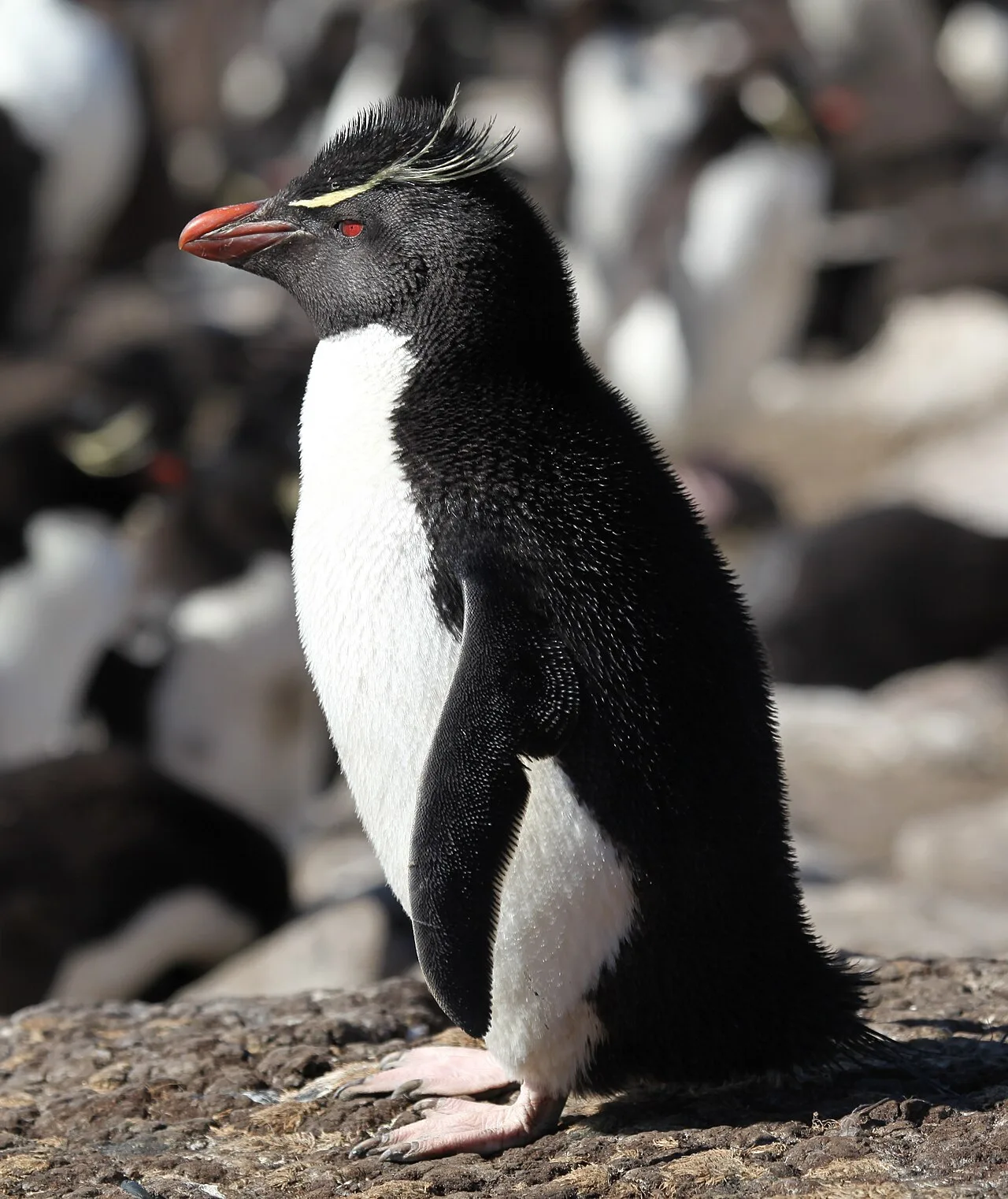
New Zealand Birds Online describes the eastern rockhopper as a stocky black-and-white penguin. It has a black back, a white front and an orange-brown bill. Spiky yellow crest feathers stick out on each side of its head. Its eyes are red.
Rockhoppers are among the smaller penguins. Falklands Conservation gives the southern rockhopper a height of 48 centimetres (19 inches) and a weight of 3.5 to 4 kilograms (7.7 to 8.8 pounds). New Zealand Birds Online says eastern rockhoppers are 45 to 55 centimetres (18 to 22 inches) long. They weigh 2 to 4 kilograms (4.4 to 8.8 pounds).
Notice that the two sources measure in different ways. One gives height and the other gives length. That means the two sets of numbers are not measuring quite the same thing.

Why they are called rockhoppers
The name describes how they move. Falklands Conservation says they are named for hopping up steep cliffs with both feet together. Many of their colonies sit on rocky slopes above the sea. To reach their nests, the birds bounce from rock to rock.
Most people picture penguins waddling across flat ice. The name rockhopper tells you that hopping is the move people noticed first. Their homes are rocky islands, not ice.
The southern rockhopper
The southern rockhopper is the one most visitors see. Falklands Conservation says about 320,000 pairs bred in the Falklands in 2010. That was around 36 per cent of the whole world’s southern rockhoppers. Birds of the World places the species in southernmost South America.
There are 35 colonies in the Falklands. Seven in every ten birds nest at just three sites: Steeple Jason, Grand Jason and Beauchene Island. If something went wrong at one of those islands, a large share of the population would be hit at once.
The Falklands once held far more of them. Falklands Conservation says at least a million southern rockhoppers lived there before the 1930s. The IUCN Red List now lists the species as Vulnerable because of rapid declines.
The northern rockhopper
The northern rockhopper is the rarest of the three. A 2026 scientific paper on its genetics says about 200,000 breeding pairs remain. Around nine in every ten of them breed in the Atlantic.
Its Atlantic homes are the islands of Tristan da Cunha and Gough, far out in the South Atlantic. The same paper gives Gough Island about 64,700 pairs and the main island of Tristan about 3,600 pairs. Nightingale, Middle and Inaccessible islands hold more. A smaller group breeds on Amsterdam and St Paul islands in the Indian Ocean.
The IUCN Red List classes the northern rockhopper as Endangered. The 2026 paper explains why. The Atlantic population fell by more than half between 1975 and 2005.
The eastern rockhopper
The eastern rockhopper has the widest range of the three. Birds of the World says it breeds on New Zealand’s subantarctic islands and on islands in the southern Indian Ocean. It puts the total at roughly 420,000 pairs, with most in the Indian Ocean.
In New Zealand its Māori name is tawaki piki toka. New Zealand Birds Online lists it as Nationally Vulnerable there. It breeds on Campbell Island, the Auckland Islands and the Antipodes Islands. It also breeds on Macquarie Island, which belongs to Australia.
In February 2026, BirdLife International recommended that the eastern rockhopper be listed as Vulnerable on the IUCN Red List. In winter some young birds wander a long way. They have turned up on the coasts of South Africa, New Zealand and Australia.
What rockhopper penguins eat
Rockhoppers eat small sea animals. Falklands Conservation says southern rockhoppers in the Falklands mostly catch crustaceans. These are animals with hard outer shells, such as krill and a small red animal called lobster krill. They also take squid and some fish.
Eastern rockhoppers around New Zealand eat a slightly different mix. New Zealand Birds Online lists small fish, especially a species called southern blue whiting. They also eat squid, octopus and krill-like crustaceans.
The menu depends on what the nearby sea holds. That is important for their survival. A change in the ocean can therefore matter a great deal, as the section on threats explains.
Life in a rockhopper colony
Rockhoppers nest in crowds called colonies. Falklands Conservation describes the yearly timetable in the Falklands. Males arrive at the colony in early October. Females follow about a week later.
The colony then works to a tight timetable. Eggs arrive in early November. Chicks gather in groups in January. Young birds leave by February. The next sections follow each step.
After the chicks leave, the adults have one more job on land. Between mid-March and April they moult. That means they shed their old feathers and grow a new set. Falklands Conservation places the moult at the very end of the breeding season.

Two eggs, one chick
Rockhoppers lay two eggs, but they rarely raise two chicks. The eggs are laid a few days apart. New Zealand Birds Online says eastern rockhoppers lay them four to five days apart.
The odd part is that the second egg is bigger. New Zealand Birds Online says the second egg weighs about 139 per cent of the first. In other words it is roughly two-fifths heavier. Usually only the chick from the second egg survives to leave the colony.
Why a penguin lays a small egg it rarely raises is a question the sources for this guide do not answer. The timing is clearer. In the Falklands, Falklands Conservation says incubation takes 32 to 34 days. Around New Zealand, the bigger egg hatches after about 33 and a half days. The small egg takes about 39.
How rockhopper chicks grow up
Once a chick hatches, it needs constant care. Falklands Conservation says the male broods the chick for about 24 days. Brooding means keeping it warm and safe under his body.
After that the chick is big enough to join a crèche. A crèche is a group of chicks gathered together in one place. In the Falklands this starts in January. By February the young birds fledge, which means they leave the colony for the sea. New Zealand Birds Online says eastern rockhopper chicks leave at around 65 days old.
How long rockhoppers live
Falklands Conservation says southern rockhoppers live about 10 to 15 years in the wild. They start breeding at around four years old.
Some live much longer. New Zealand Birds Online gives a record age of 23 years for an eastern rockhopper. That is well above the usual range of 10 to 15 years.
How much the numbers have fallen
The long-term picture is worrying. New Zealand Birds Online says all rockhoppers together fell from more than 5.5 million breeding pairs to fewer than 1.5 million during the twentieth century.
Campbell Island shows the scale most clearly. Around 800,000 pairs of eastern rockhoppers bred there in 1942. By 2012 there were about 33,200. That is a drop of roughly 95 per cent in seventy years.
Not every count is bad news. In 2011, a team led by Brad Robson published new counts from Tristan da Cunha. They found about 160,000 to 175,000 pairs there in 2009. Numbers had been fairly steady for about thirty years. They also said about 80 per cent of the world’s northern rockhoppers live at Tristan da Cunha and Gough.
The 2009 counts give a clear picture of where the birds are. Robson’s team found about 83,000 pairs on Middle Island and 54,000 on Inaccessible Island. Nightingale Island had about 25,000 pairs. The main island of Tristan had about 6,700.
That Tristan figure is higher than the 3,600 pairs given in the 2026 paper. The two numbers come from different years, so it is not clear whether the island lost birds or was counted differently. Scientists would need a new count to be sure.
Eastern rockhoppers have their own local counts. New Zealand Birds Online gives about 37,500 pairs on Macquarie Island in 2007. The Antipodes Islands held about 2,900 pairs in 2011. Both are small next to the 800,000 pairs once found on Campbell Island.
What threatens rockhopper penguins
There is no single cause. The 2026 northern rockhopper paper names several. Changes in the ocean linked to climate affect how much food the penguins can find. Fur seals hunt them. On Amsterdam Island, outbreaks of a bird disease called avian cholera have killed penguins.
People have caused harm too. In 2011 a ship called the MS Oliva spilled about 300,000 gallons of heavy fuel oil at Nightingale Island. The 2026 paper says the oil reached nearby islands too.
Sudden events can hit hard. Falklands Conservation says the Falklands lost about 88,000 pairs between 2000 and 2005 after a harmful algal bloom. That is a sudden spread of tiny living things in the sea, some of which make poisons.
Some islands have been helped. The 2026 paper describes removing feral cats, brown rats and house mice from some breeding islands, as well as feral cattle. These are invasive species, which means animals brought in from somewhere else.
How scientists count rockhoppers
Most rockhopper colonies are on remote islands that are hard to land on. Falklands Conservation runs a full census of the Falklands’ penguins about once every ten years.
Counting is harder than it sounds. That is why the Tristan da Cunha estimate is given as a range, not an exact number. A good estimate says how unsure it is.
Genetics now adds a new tool. The 2026 paper looked at the DNA of northern rockhoppers from different islands. Knowing whether birds from different islands mix helps scientists understand each group.
Three things people get wrong
Myth: the rockhopper is one species. It used to be treated that way, but scientists now recognise three: the southern, northern and eastern rockhopper. Each has its own range and its own Red List status. The northern one is Endangered, while the other two are Vulnerable.
Myth: rockhoppers raise two chicks each year. They lay two eggs, and the second is much bigger than the first. New Zealand Birds Online says that usually only the chick from the bigger second egg survives to leave the nest.
Myth: rockhoppers live on Antarctic ice. They breed on rocky islands in the Southern Ocean, well north of the Antarctic continent. Their name comes from hopping up cliffs, not sliding on ice. The emperor penguin is the one that breeds on sea ice.
Did you know? The smaller first egg takes longer to hatch than the second. Around New Zealand it needs about 39 days, while the bigger egg hatches after about 33 and a half.
Try it
Stand with your feet together and do five small hops on the spot without separating your feet. Now imagine doing that up a rocky cliff straight out of the sea. That is how rockhoppers reach their nests.
Knowledge check
Which of the three rockhopper species is listed as Endangered?
Show answer
The northern rockhopper. Its Atlantic population fell by more than half between 1975 and 2005.
Which egg usually produces the chick that survives?
Show answer
The second egg, which is bigger than the first.
Frequently asked questions
How many species of rockhopper penguin are there?
Scientists now recognise three species of rockhopper penguin: the southern, the northern and the eastern. They were once treated as a single species.
Are rockhopper penguins endangered?
The northern rockhopper is listed as Endangered. The southern rockhopper is Vulnerable, and BirdLife International recommended Vulnerable for the eastern rockhopper in 2026.
Where do rockhopper penguins live?
Rockhoppers breed on rocky islands in the Southern Ocean, including the Falklands, Tristan da Cunha, Gough, Macquarie and New Zealand’s subantarctic islands.
What do rockhopper penguins eat?
Rockhoppers eat small sea animals such as krill and other crustaceans, squid, octopus and small fish. The exact mix depends on where they live.
How big is a rockhopper penguin?
A southern rockhopper stands about 48 centimetres (19 inches) tall and weighs 3.5 to 4 kilograms (7.7 to 8.8 pounds), according to Falklands Conservation.
Why are rockhopper penguins called rockhoppers?
The name comes from the way they move on land. Falklands Conservation says they hop up steep cliffs with both feet together to reach their nests.
Sources
- Falklands Conservation: Rockhopper — southern rockhopper size, Falklands population and history, breeding timetable, diet, colonies, lifespan and the name
- New Zealand Birds Online: Eastern rockhopper penguin — eastern rockhopper appearance, size, New Zealand status, Campbell Island decline, eggs, chicks, diet and lifespan
- Genetic population structure in the Endangered northern rockhopper penguin (2026) — northern rockhopper status, population, breeding islands and threats
- Bird Conservation International: Revised population estimate for the Northern Rockhopper Penguin at Tristan da Cunha (2011) — the 2009 Tristan da Cunha counts and the share of the world population
- Cornell Lab of Ornithology, Birds of the World: Eastern Rockhopper Penguin — the three-way split, eastern range, population and winter wandering
- BirdLife International: Eastern Rockhopper Penguin Red List assessment (2026) — the 2026 recommendation of Vulnerable for the eastern rockhopper


