
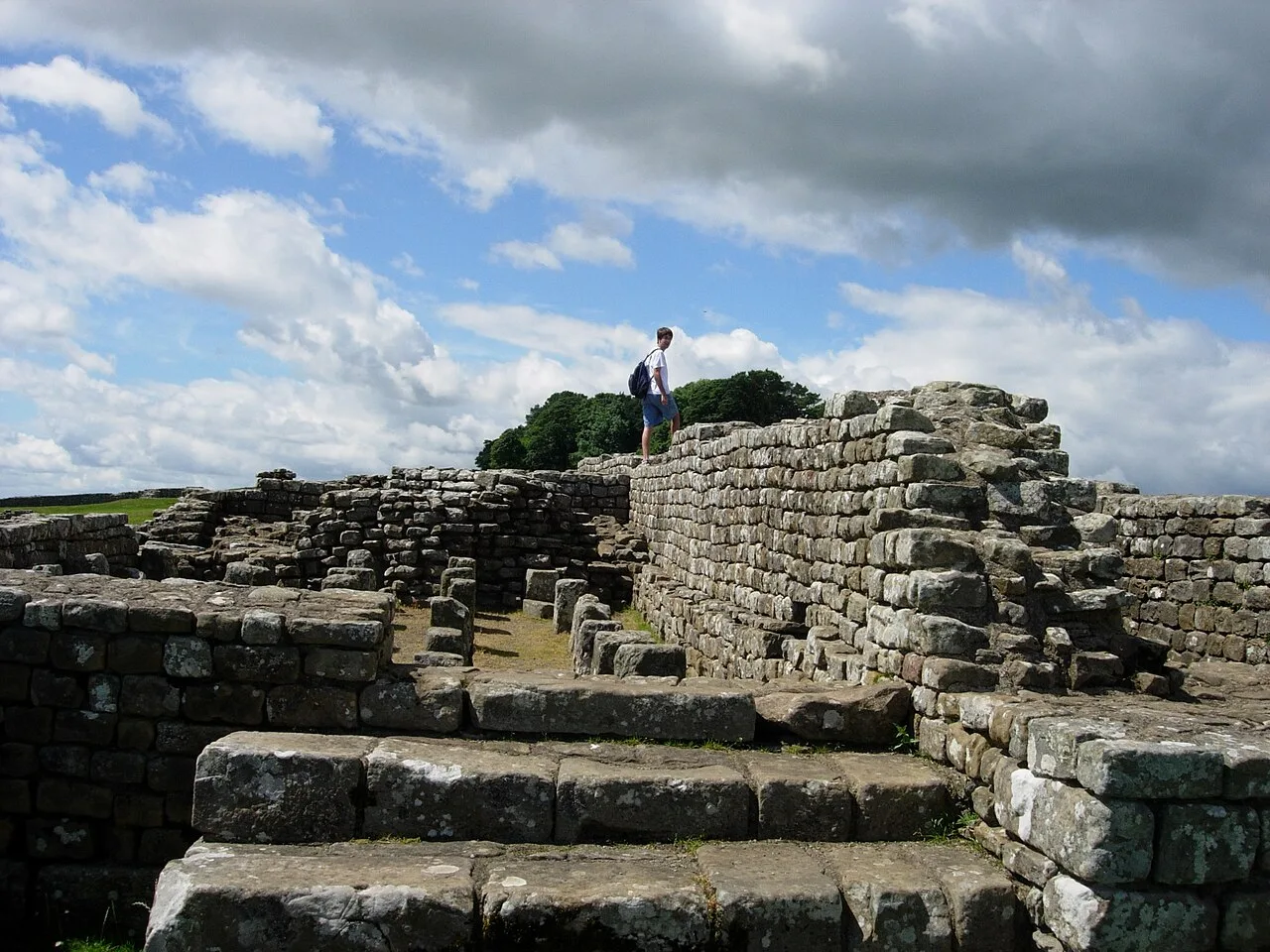
Roman quick facts
- Most people living in Roman Britain were not from Italy. They were mostly descendants of the Britons who lived here before the Romans came.
- Hot water at 46°C rises from the Sacred Spring in Bath, about 1,170,000 litres of it every day, just as it did in Roman times.
- People threw more than 12,000 Roman coins into the Sacred Spring at Bath as gifts to the goddess Sulis Minerva.
- The newest coins found on Hadrian’s Wall were made in AD 403 to 406, only a few years before Roman rule in Britain ended.
- About 10,000 people lived in Londinium by AD 60, and by AD 150 about 30,000 did. Before the Romans, there was no big town there at all.
Who were the Romans?
The Romans were the people of Rome, a city on the River Tiber in Italy. Over hundreds of years they built one of the biggest empires the world has ever seen.
By AD 100, the Roman Empire held up to 100 million people. They lived in lands that are now about 50 different countries. It stretched across Europe, from Britain in the north to Morocco in the south and Iraq in the east. Most of North Africa was part of it too.
The Romans spoke Latin. Their language, their roads and their calendar are still with us today. So are some of their towns. London began as a Roman town.
You will see two short labels on dates in this guide. BC means before the year 1, so bigger BC numbers are further back in time. AD means after it. Julius Caesar came to Britain in 55 BC. Nearly a hundred years later, in AD 43, the Roman army came to stay.
The legend of Romulus and Remus
The Romans told a famous story about how their city began. It is a legend, not history, but they loved it.
In the story, twin baby boys called Romulus and Remus were the sons of Mars, the god of war. A king who felt threatened by them ordered them to be left on the bank of the River Tiber. The babies survived. Local people were kind to them, and a she-wolf gave them shelter and milk. When they grew up, the brothers founded a city there. The legend says this happened in 753 BC. It also says Romulus then quarrelled with his brother and killed him.
Romans put the wolf and the twins on statues, coins and ornaments all over the empire. The British Museum has a small bronze one, just over 6 cm wide. It was probably made more than 700 years after the story was first told. It may have sat in a family’s shrine at home.
So what really happened? Archaeologists, who study the past by digging up what people left behind, tell a quieter story. In the 8th century BC, the same century as the legend’s date, a group of small villages sat on the hills beside the Tiber. The river was a busy trade route. Slowly, the villages grew into an important town. The British Museum calls the story of the twins a myth.
Kings, the Republic and the emperors
Rome changed the way it was ruled three times.
First came kings. In 616 BC, Tarquinius Priscus became the first of three kings from the Etruscans, a people who lived north of Rome. Under these kings, the scattered villages became one city. Stone buildings replaced wooden huts. A marshy valley was drained and became the Roman Forum, the busy heart of the city.
Next came the Republic. The Romans threw out their last king in about 509 BC. After that, citizens voted to choose officials to run Rome, led by two consuls who shared the top job. A council called the Senate, with 300 or more members from rich families, held most of the power. Less wealthy citizens were called plebeians. Over time the Republic won control of all of Italy, and then lands far beyond it.
The Republic ended in civil wars between powerful generals. The most famous was Julius Caesar. He won battles in Gaul, which is now France, and in Egypt. He was made dictator for life, and many Romans feared he wanted to be king. On 15 March 44 BC, a day the Romans called the Ides of March, a group of senators killed him.
Then came the emperors. Caesar’s adopted son Octavian won the next war. In 27 BC he became the first Roman emperor and was given the title Augustus. From then on, one man ruled the whole empire.
Julius Caesar’s visits to Britain
Before the Romans came, Britain was in the Iron Age. It was not one country. It was split between many tribes, each with its own rulers. The long ages before that, the Stone Age and the Bronze Age, had left behind farms, tools and great monuments, but no written history.
Julius Caesar crossed the sea to Britain twice while he was fighting in Gaul. The first trip, in 55 BC, was really a scouting raid to see what was there. The second, in 54 BC, was a serious attack. His army beat the biggest tribes in the south-east.
But Caesar did not stay, and he did not conquer Britain. Some tribes may have become friendly with Rome afterwards. For almost a hundred years, British rulers in the south traded across the Channel with the Roman world.
The Roman invasion of Britain in AD 43
The real invasion came in AD 43, ordered by the emperor Claudius. He had only just become emperor and needed a big win to show he was strong.
There was also an excuse. A powerful tribe called the Catuvellauni had driven out Verica, a British king who was friendly with Rome. Claudius could say he was helping a friend.
An army of about 40,000 soldiers landed in the south-east in the summer. English Heritage says the fleet came ashore at Richborough in Kent. The soldiers fought their way inland. Claudius himself came to Britain to claim the victory. Colchester, which the Romans called Camulodunum, became their first capital.
Conquering the rest took much longer. By AD 47 the Romans held the south and east, up to a line running from Exeter to the River Humber. Later they pushed into Wales, northern England and Scotland. In AD 83 a Roman general won a battle as far north as Mons Graupius, somewhere in Scotland. Even so, Scotland was never fully conquered.
Boudica’s revolt
Not every Briton accepted Roman rule. The most famous rebel was Boudica, a queen of the Iceni tribe in East Anglia.
The Romans had taken control of the Iceni and their lands, and Boudica set out to throw them off. Her followers attacked three Roman towns: Colchester, St Albans, which was then called Verulamium, and London. All three were burned to the ground. This part of the story is a sad one, and nobody knows how many people died. The London Museum thinks many Londoners probably had time to escape.
Historians do not agree on the year. English Heritage puts the revolt in AD 60, the British Museum says London and Colchester were attacked in AD 61, and the London Museum says it happened between 60 and 61. That is why this guide says AD 60 or 61.
One clue may come from a river in Suffolk. In 1907, a bronze head of the emperor Nero was found in the River Alde. It had probably come from a statue in Colchester. It may have been hacked off and carried away during Boudica’s attack. In the end, the Roman army defeated the rebels and took back control.
Romans in Britain timeline
Here are the big dates in order, starting with Rome itself and ending when Britain stopped being Roman.
| Date | What happened |
|---|---|
| 753 BC | The legend says Romulus founds Rome |
| 8th century BC | Small villages on Rome’s hills grow into a town |
| about 509 BC | The last king is thrown out and the Republic begins |
| 55 and 54 BC | Julius Caesar’s two expeditions to Britain |
| 44 BC | Julius Caesar is killed on the Ides of March |
| 27 BC | Augustus becomes the first emperor |
| AD 43 | Claudius’s army invades Britain |
| AD 60 or 61 | Boudica’s revolt; Colchester, St Albans and London are burned |
| AD 83 | A Roman army wins the battle of Mons Graupius in Scotland |
| AD 122 | Hadrian visits Britain and work on his wall begins |
| about AD 142 | The Antonine Wall is built further north, in Scotland |
| around AD 200 | Britain is split into two Roman provinces |
| AD 306 | Constantine is proclaimed emperor at York |
| AD 313 | Christians are allowed to worship freely |
| AD 409 to 411 | Roman rule in Britain comes to an end |
| 1987 | Hadrian’s Wall becomes a World Heritage Site |
Some of these dates are exact. Others are careful estimates. When two good sources give different years, as they do for Boudica, this guide shows both.
The Roman army and its legions

Rome’s army was split into two kinds of soldier.
Legionaries were heavily armed foot soldiers, and every one was a Roman citizen. They served in large units called legions. A legion had about 5,000 men, though English Heritage also gives a figure of 4,800, because the size changed over time. Britain had three legions. Each had a permanent fortress, at York, Chester and Caerleon in south Wales.
Auxiliaries were soldiers who were not citizens. They came from the lands Rome had conquered. They served in smaller units of about 500 or 1,000, on foot or on horseback. Most of the soldiers on Hadrian’s Wall were auxiliaries. Many came from the north-west of the empire, and some from much further away.
At its biggest, the Roman army in Britain had up to 50,000 soldiers. That is about as many people as a large football stadium holds. Soldiers did far more than fight. They built roads, forts and walls. They also collected taxes and guarded the frontier.
Hadrian’s Wall
The emperor Hadrian visited Britain in AD 122. He ordered a wall to be built right across the country, from sea to sea, to mark the edge of the empire. Work probably began that year and took at least six years.
Hadrian’s Wall is 73 miles (about 117 km) long, which the Romans measured as 80 Roman miles. It ran from Wallsend on the River Tyne in the east to Bowness-on-Solway in the west.

Most of the Wall was stone, but the western part was first built of turf. The stone wall was 10 Roman feet (3 metres) wide, wide enough for a path along the top. In front of it lay a deep ditch.
There was a gate every Roman mile, guarded by a small fort called a milecastle. Between each pair of milecastles stood two watchtowers, called turrets. That gave a lookout point about every third of a mile. Before the building was finished, the plan changed. Fourteen bigger forts were added along the Wall, and a wide earthwork called the Vallum was dug behind it.
Legionaries built most of the Wall, but auxiliaries guarded it. With so many gates, the Wall was not simply a barrier. It let the army control who crossed and move out quickly when it needed to.
After Hadrian died in AD 138, the next emperor moved the frontier north and built a turf wall in Scotland, the Antonine Wall. It lasted only about 20 years. Then the army came back to Hadrian’s Wall, which stayed in use for nearly 300 years. Later, people took its stones to build castles, churches and farms. It became a World Heritage Site in 1987.
Roman roads and towns
The Romans built roads almost as soon as they arrived. The first ones joined their capital at Colchester to the ports on the south-east coast. Soon a network linked towns, ports and forts right up to the northern frontier.

Good roads let soldiers and supplies move quickly. Some roads are still known by name. Dere Street was the road from the south that met Hadrian’s Wall. The Stanegate ran from Corbridge to Carlisle and linked forts along the frontier before the Wall was built.
The biggest change the Romans brought was towns. Before them, most Britons lived on farms and in small villages. Roman towns had straight streets laid out in a grid. At the centre was the forum, an open market square, next to a large hall called a basilica. Towns also had baths, temples, shops and taverns. A few had theatres or amphitheatres for shows.
London is the best example. Before the Romans, there was no big settlement there. They chose a spot on the north bank of the River Thames, where low hills kept homes safe from floods and ships could sail in from the North Sea. They built a timber bridge across the river. They called their new town Londinium.
By AD 60 about 10,000 people lived there. Many had come from across the empire. After Boudica’s attack it was rebuilt, and it became the capital of Roman Britain. By AD 150 about 30,000 people lived there. The Romans later surrounded it with a stone wall 3 km long, and pieces of it can still be seen in the City of London today.
Aquae Sulis: the baths at Bath
In Bath, in Somerset, hot water bubbles out of the ground by itself. It comes out at 46°C, hotter than a very hot bath at home. About 1,170,000 litres rise every day. That is enough to fill more than 10,000 bathtubs at home.
People once believed this hot spring was the work of the gods. The Romans built a temple beside it for the goddess Sulis Minerva, who was thought to have healing powers. Around the spring they built a huge bathing complex. The town that grew up there was called Aquae Sulis. Visitors came from across the Roman Empire.

The centrepiece was the Great Bath, a big pool of warm spa water 1.6 metres deep, with steps on every side. It once stood inside a huge vaulted hall about 20 metres high. For many visitors, it may have been the biggest building they had ever been inside.
The bath house had much more than one pool. There was a round cold plunge pool, and there were hot rooms warmed from underneath by a heating system called a hypocaust. Lead pipes carried the water around the site, and the Roman drain still carries water to the River Avon, 400 metres away.
The Roman Baths were used for about 400 years. Later they were hidden under the town that grew on top. They were not found and explored again until the late 1800s.
Villas and mosaics
Most people in Roman Britain still lived in the countryside, on farms. But a new kind of country house appeared, called a villa. A villa was a Roman-style house, often at the centre of a large farming estate.

The grandest villas had underfloor heating, their own bath-houses and painted walls. Their floors were covered in mosaics, pictures and patterns made from thousands of tiny pieces of stone and tile set into the floor. A mosaic floor was a sign of a wealthy home. One fine example, a pattern of shapes, comes from a house at Aldborough in North Yorkshire.
Who lived in these villas? Often it was the families of the old British tribal leaders. They had taken up the Roman way of life. Much of the hard work on their estates was done by poor farm workers and by slaves.
Roman gods and religion
The Romans worshipped many gods. Jupiter was king of the gods, Juno was his wife, and Mars was the god of war. People honoured them at temples and at small shrines in their homes.
The Romans did not usually force people to give up their own gods. Instead, they often joined a Roman god with a local one. At Bath, the Roman goddess Minerva was joined with Sul, a local British god, to make Sulis Minerva. Soldiers from far-off parts of the empire brought their own gods too. One of them was Mithras, a god popular with soldiers. The remains of a temple to Mithras have been found in London.
Some people asked the gods for help in unusual ways. At Bath, they scratched messages called curse tablets onto thin sheets of lead or pewter. Then they rolled them up and threw them into the spring. They include the earliest prayers known from Britain, and UNESCO now lists them as world-class documents.
A new religion arrived too. For a long time Christianity was banned, and Christians could be punished. In AD 313 the emperors allowed people to follow any religion they chose. A year later, there is a record of a bishop from London.
Latin words and the months we still use
You use Roman words every year, every time you say a month. The British Museum says we can thank the Romans for most of them.
- January is named after Janus, a god with two faces who could look into the past and the future. He was also the god of doors.
- February comes from Februa, a Roman festival of cleansing.
- March is named after Mars, the god of war. The Roman year once started in March.
- April may come from the Latin word aperire, which means to open, as flowers do in spring.
- June is named after the goddess Juno.
- July is named after Julius Caesar, and August after the emperor Augustus. They used to be called Quintilis and Sextilis, the fifth and sixth months.
- September to December come from the Latin words for seven, eight, nine and ten. They were once the seventh to the tenth months.
May is the odd one out. It is named after Maia, a goddess from Greece. And the word month itself is linked to the Moon, because a month first measured one cycle of the Moon.
Roman place names are another clue. Londinium became London. Aquae Sulis is Bath, Camulodunum is Colchester and Verulamium is St Albans. The Romans called the whole province Britannia.
The Romans also wrote numbers using letters, such as V for five and X for ten. You can still see these Roman numerals on clock faces, and after the names of kings and queens.
What the Romans left us
Roman Britain ended more than 1,600 years ago, but a great deal of it is still here.
| What the Romans left | Where you can find it today |
|---|---|
| Hadrian’s Wall | across northern England, from Wallsend to Bowness-on-Solway |
| The Roman Baths and Sacred Spring | in Bath, where the hot water still rises every day |
| London’s Roman city wall | in pieces around the City of London |
| Towns | London, Colchester, St Albans and Bath all grew from Roman towns |
| Roads | routes such as Dere Street and the Stanegate, still known by their names |
| Month names | on every calendar, from January to December |
| Coins, curse tablets and mosaics | in museums across Britain |
Some finds are quite recent. In 2007, the Beau Street Hoard was discovered in Bath. It is more than 17,000 Roman coins buried together, and it is now on show at the Roman Baths.
The end of Roman Britain
Roman rule did not end in a single day. It faded over about 50 years.
From the AD 300s, raiders attacked Britain from several sides. Picts came from the north, beyond Hadrian’s Wall. Raiders from Ireland struck the west coast, and Saxons sailed in from northern Europe. At the same time, the empire had wars and troubles of its own. Soldiers were taken away from Britain to fight elsewhere. Several generals in Britain tried to make themselves emperor and took the best troops with them.
By the early 400s, Britain was left without an army or proper government. The British Museum says the Roman government was thrown out of Britain in AD 409. English Heritage says Britain was fully cut off from Rome by AD 411. Many books use AD 410. The emperor Honorius would not send help to defend it.
Without Rome, town life fell apart. Buildings were left empty and began to crumble. London was mostly empty by AD 450. People from Britain’s own communities carried on living in the countryside, and Saxons from northern Europe began to settle. A new chapter of history had begun.
Three things people get wrong
1. Julius Caesar did not conquer Britain. He came twice, in 55 and 54 BC, won some battles and then left. The Roman conquest began almost a hundred years later, in AD 43, under the emperor Claudius.
2. Most people in Roman Britain were not Romans from Italy. There was never a huge flood of settlers. English Heritage says most people were descendants of the tribes who lived here before, and most still lived in the countryside. Soldiers and officials came from all over the empire, not just Italy.
3. The Romans did not all pack up and leave in AD 410. Roman rule faded over many years. The last coins found on Hadrian’s Wall were made between AD 403 and 406, and different historians give AD 409, 410 or 411 for the end. Most of the people of Roman Britain simply stayed where they were.
Did you know? September comes from the Roman word for seven. It used to be the seventh month, because the Roman year once began in March.
Try it
Make a Roman mosaic. Cut or tear old magazines or coloured paper into small squares, about the size of your fingernail. Draw a simple picture, such as a dolphin or a border of squares, on a sheet of card. Then glue the squares on one by one, leaving a tiny gap between each, until the whole picture is filled.
Knowledge check
Why did the emperor Hadrian order a wall across northern Britain?
Show answer
He visited Britain in AD 122 and wanted a strong, guarded frontier at the north-west edge of the Roman Empire, with a gate every mile so people crossing could be watched.
Which two months are named after Roman leaders?
Show answer
July, named after Julius Caesar, and August, named after Augustus, the first Roman emperor.
Frequently asked questions
When did the Romans invade Britain?
The Romans invaded Britain in AD 43, when the emperor Claudius sent an army of about 40,000 soldiers. Julius Caesar had visited twice before, in 55 and 54 BC, but he did not stay.
Who was Boudica?
Boudica was a queen of the Iceni, a British tribe in East Anglia. In about AD 60 or 61 she led a revolt against Roman rule, and her followers burned Colchester, St Albans and London before the Romans defeated them.
How long is Hadrian’s Wall?
Hadrian’s Wall is 73 miles (about 117 km) long, or 80 Roman miles. The Roman army began building it in about AD 122, and it ran from Wallsend on the River Tyne to Bowness-on-Solway.
What was the Great Bath in Bath?
The Great Bath was the centrepiece of the Roman baths in Bath: a big pool of warm spa water 1.6 metres deep, with steps on every side, inside a vaulted hall about 20 metres high. The Roman Baths were used for about 400 years.
When did the Romans leave Britain?
Roman rule in Britain ended in the early 400s AD. The British Museum dates the end of Roman government in Britain to AD 409, English Heritage says the break was complete by AD 411, and many books use AD 410.
Was Rome really founded by Romulus and Remus?
Romulus and Remus belong to a legend that says Rome was founded in 753 BC. Archaeology shows that Rome really grew from a group of small hilltop villages in the 8th century BC.
Sources
- English Heritage: Introduction to Roman Britain — Caesar’s expeditions in 55 and 54 BC, the AD 43 invasion and landing at Richborough, Boudica’s revolt, the legions at York, Chester and Caerleon, the size of the army and population, towns, villas, mosaics, religion and the end of Roman rule by AD 411
- English Heritage: History of Hadrian’s Wall — the Wall’s start in AD 122, its length, height and width, milecastles, turrets and forts, who built and guarded it, the Antonine Wall, the latest coins and its World Heritage status
- The Roman Baths, Bath: a walk through the site — the Sacred Spring’s temperature and flow, the Great Bath, the temple of Sulis Minerva, curse tablets, offerings of coins, the Beau Street Hoard and Roman plumbing
- British Museum: Introduction to ancient Rome — the Romulus and Remus legend and what really happened, the Etruscan kings, the Republic and Senate, Julius Caesar’s death, Augustus, the size of the empire, Hadrian, Boudica’s attack in AD 61 and the end of Roman government in Britain in AD 409
- London Museum: A timeline of Roman London — the founding of Londinium, its population, Boudica’s attack between AD 60 and 61, the city wall, the Mithras temple, Christianity and London’s decline after the Romans left
- British Museum: What’s in a name? Months of the year — where the names of the months come from, including Janus, Mars, Juno, Julius Caesar and Augustus


