
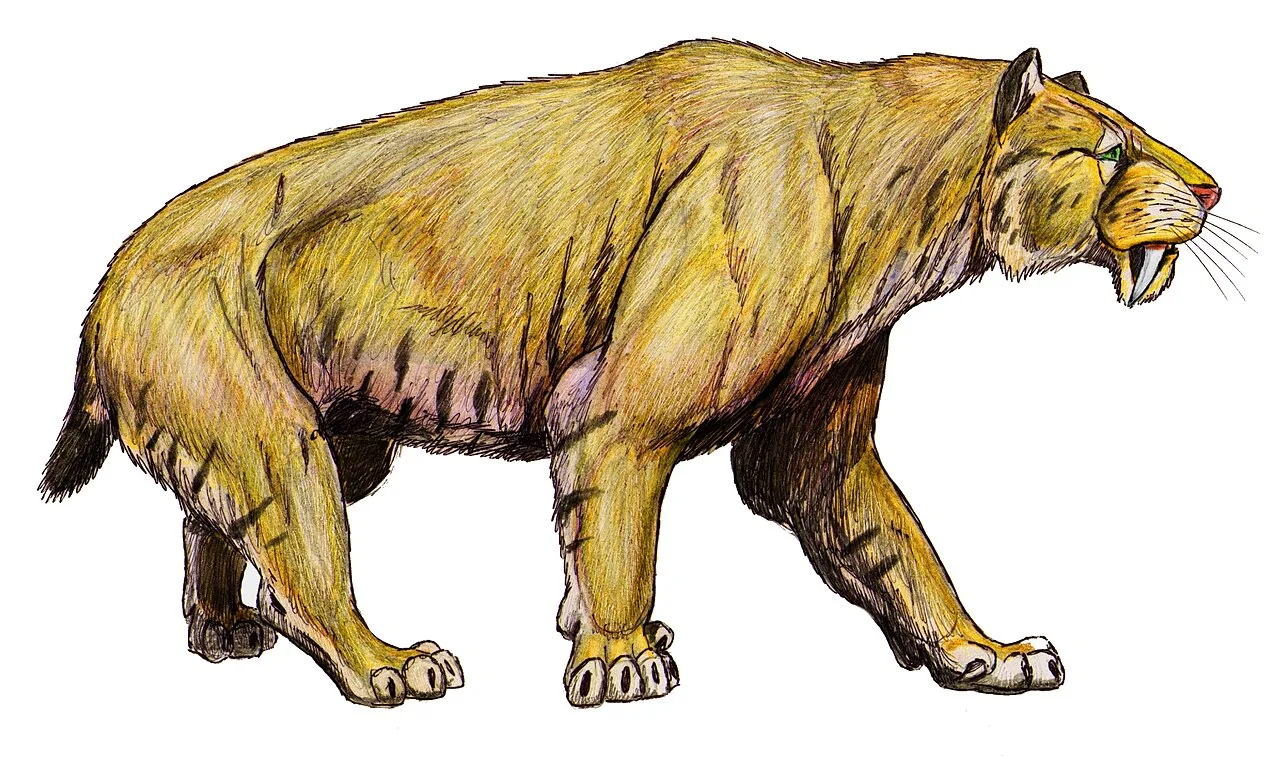
Saber-tooth tiger jokes quick facts
- Calling it a saber-tooth tiger is wrong, which makes it the easiest joke on this page.
- Its teeth really did break. Thousands of broken sabre teeth have come out of the La Brea tar pits.
- Smilodon had a weaker bite than a lion, and used its arms to hold prey still.
- It could not roar like a lion, and probably could not purr like a house cat either.
- More than 2,000 individual Smilodon have been dug out of the tar pits in Los Angeles.
How to use this page
Every joke here comes with the real fact underneath it.
That pairing is deliberate. Tell somebody a joke about a saber-tooth tiger’s teeth snapping and they will groan. Tell them that thousands of snapped sabre teeth have actually been dug out of a tar pit in Los Angeles, and now you have their attention.
Full details of the animal itself are in our saber-toothed tiger guide. This page is for the jokes, and for the facts that make them work.

Jokes about the name
- Why was the saber-tooth tiger thrown out of the tiger club?
Because it was never a member in the first place.
The fact: the saber-tooth tiger was not a tiger. Its proper name is Smilodon, and it belonged to a separate branch of the cat family called the machairodonts. Tigers, lions and leopards are on a different branch, and that one still has living members. Smilodon’s branch has none left at all.
- What do you call a saber-tooth tiger that is not a tiger?
Correct.
The fact: museums and scientists say Smilodon, or sabre-toothed cat. The word tiger stuck because early writers reached for the biggest cat they could think of, and the name has been wrong ever since.
- How many kinds of sabre-tooth were there?
Enough that they kept inventing it.
The fact: big stabbing teeth evolved separately at least four times in different groups of mammals. One of them, Thylacosmilus, lived in South America and was not even a cat. Evolution kept arriving at the same answer.
Jokes about the teeth
- Why did the saber-tooth tiger go to the dentist?
Because his teeth were 18 centimetres long and he had absolutely no idea what to do about it.
The fact: the longest Smilodon canines reached about 18 centimetres, which is roughly the length of a school ruler. Only part of that stuck out below the lip.
- What did the saber-tooth tiger say after the hunt?
Nothing. He had snapped a tooth again.
The fact: this is the most useful joke on the page, because the fact behind it is genuinely surprising. Sabre teeth broke constantly, and thousands of broken canines have come out of the La Brea tar pits. The teeth were long and flattened side to side, which is superb for slicing and terrible for resisting a sideways twist.
- Why did the saber-tooth tiger never win a staring contest?
Everyone kept looking at his teeth.
The fact: those teeth were doing more than frightening people. Because they were so fragile, Smilodon could not simply bite and hang on the way a lion does. It had unusually powerful front legs and shoulders, and most researchers think it used them to pin prey still before making one careful, precise bite.

Jokes about the tar pits
- Why did the saber-tooth tiger get stuck?
He saw a free lunch and did not read the small print.
The fact: the La Brea tar pits in Los Angeles are natural asphalt seeps. Sticky black asphalt oozes to the surface and is often hidden under dust, leaves or a film of water. A plant-eater would wander in, get stuck and begin calling out. Predators heard an easy meal, came to take it, and were caught in turn.
- How many saber-tooth tigers does it take to get stuck in a tar pit?
At La Brea, more than two thousand.
The fact: that is not an exaggeration. More than 2,000 individual Smilodon have been recovered there. The trap worked so well that the pits hold far more predators than plant-eaters, which is the reverse of any living ecosystem.
- What is the slowest trap in the world?
One that took 50,000 years and still caught everything.
The fact: only a handful of animals needed to get stuck each decade to produce the enormous number of fossils found there. A very slow trap, running for a very long time, adds up.
Jokes about being extinct
- Why should you never lend money to a saber-tooth tiger?
You will never get it back. He has been extinct for 10,000 years.
The fact: Smilodon died out roughly 10,000 years ago, at the end of the last ice age, along with mammoths, giant ground sloths and a long list of other large animals.
- Why did the saber-tooth tiger lose his job?
Cuts.
The fact: why they vanished is still argued over. A changing climate shrank the habitats they hunted in, their large prey animals disappeared, and humans had arrived in the Americas. Most researchers now think several of those pressures worked together rather than one doing it alone.
- Did the saber-tooth tiger and the woolly mammoth get on?
They had a lot in common. Neither of them is here.
The fact: both belonged to the ice age group of large animals often called megafauna, and both disappeared at roughly the same time.

Jokes about how it lived
- What noise does a saber-tooth tiger make?
Nobody knows, and that is the honest answer.
The fact: roaring depends on particular structures in a cat’s throat, and purring depends on others. Researchers disagree about which ones Smilodon had, because the parts involved are soft tissue and soft tissue does not fossilise. Any film that gives it a lion’s roar is guessing.
- Why was the saber-tooth tiger bad at arm wrestling?
He was not. That was the one thing he was excellent at.
The fact: Smilodon was built like a wrestler rather than a sprinter. Heavy bones, enormous shoulder and neck muscles, short powerful legs. It was not fast over distance, and it did not need to be.
- Why did the injured saber-tooth tiger survive?
Somebody brought him dinner.
The fact: this is the most interesting one here, and it is not a joke about kindness for its own sake. Many Smilodon fossils show serious injuries that healed: broken bones knitted back together, badly worn hip joints, damaged jaws. An animal that cannot hunt normally starves within weeks. Some researchers argue these cats lived in groups and shared food, which would explain the healing. Others think a big cat can survive longer on scraps than we assume. The bones themselves are certain, but the explanation for them is not.

Riddles
- I have a tiger’s name, a cat’s body, a bear’s arms and a lion’s reputation. What am I?
Misnamed.
- I am famous for two teeth. Both of them keep breaking. What am I?
Smilodon, and also fairly annoyed.
- Thousands of us are buried in one small place in a big city. What are we?
The Smilodon of La Brea, under Los Angeles.
- I look like a sabre-tooth cat and I am not one. I did not even live on the same continent. What am I?
Thylacosmilus.

Three things people get wrong
Myth: it was a tiger. It was not, and it was not closely related to one. Tigers sit with lions and leopards. Smilodon sat on a separate branch of the cat family with no living members, which is why the correct name is sabre-toothed cat.
Myth: those huge teeth meant a huge bite. The truth is the opposite. Smilodon’s bite force was weaker than a lion’s, and its teeth snapped easily. Its strength was in its arms and shoulders, which held prey still so the bite could be short and exact.
Myth: it roared like the ones in films. Nobody knows what noise it made. The throat structures that decide whether a cat roars or purrs are soft tissue, and soft tissue does not fossilise. Every roar you have heard in a film was invented in a sound studio.
Did you know? A great many Smilodon fossils show healed injuries: broken bones that mended, worn hips, damaged teeth. Animals with wounds that bad usually starve, so some researchers think these cats were fed by others in their group while they healed.
Try it
Pick your favourite joke from this page and tell it to somebody. When they groan, hit them with the real fact underneath it. That is the whole trick: the joke gets their attention and the fact is what they remember.
Knowledge check
Why is ‘saber-tooth tiger’ the wrong name?
Show answer
Smilodon was not a tiger. It belonged to a separate branch of the cat family that has no living members.
Did saber teeth really break?
Show answer
Yes, often. Thousands of broken canine teeth have been recovered from the La Brea tar pits.
Frequently asked questions
What is a good saber-tooth tiger joke?
Try this one: why should you never lend money to a saber-tooth tiger? Because you will never get it back, and it has been extinct for 10,000 years. It works because Smilodon really did die out around the end of the last ice age.
Why is calling it a saber-tooth tiger wrong?
Smilodon was not a tiger and was not closely related to one. Tigers belong to the group that includes lions and leopards. Smilodon belonged to a separate branch of the cat family, the machairodonts, which has no living members at all.
Did saber-tooth tigers really break their teeth?
Yes, frequently. Thousands of broken sabre teeth have been recovered from the La Brea tar pits in Los Angeles. The teeth were long and flattened, which made them excellent at slicing and easy to snap sideways.
Could a saber-tooth tiger roar?
Probably not. Roaring depends on particular structures in the throat, and researchers disagree about which ones Smilodon had. The safest answer is that nobody knows, and that it likely sounded nothing like a lion.
How did saber-tooth tigers get stuck in tar pits?
Sticky asphalt seeped to the surface and was often hidden under dust, leaves or water. A plant-eater would wander in and become trapped, and its distress attracted predators, who then became trapped too. That is why the pits hold so many meat-eaters.
How many saber-tooth tigers have been found at La Brea?
More than 2,000 individual Smilodon have been recovered from the La Brea tar pits, which makes it one of the richest fossil sites of its kind anywhere in the world.
Sources
- La Brea Tar Pits and Museum — the number of Smilodon recovered, the broken sabre teeth, and how animals became trapped in asphalt seeps
- Natural History Museum: Discover — background on the cat family, extinction at the end of the last ice age, and how fossils are interpreted
- Communications Biology: Seeing through the eyes of the sabertooth Thylacosmilus atrox (Gaillard, MacPhee and Forasiepi, 2023) — the separate South American sabre-tooth, used here for the joke about there being more than one kind


