
Shark quick facts
- A Greenland shark 5 metres long was estimated in 2016 to be 392 years old, give or take 120 years.
- A shark’s eyes may be more than ten times as sensitive to light as yours.
- Nurse sharks and Port Jackson sharks can lie still on the sea floor and keep breathing.
- A shark can find a stingray buried in sand by sensing its weak electric field.
- Every angel shark species living around the coasts of the UK and Europe is critically endangered.
Sharks were swimming in the sea before the first trees grew on land. This guide covers how sharks are built, how they find their food and how many kinds there are. Where a figure changes over time, it gives the year it comes from.
Sharks have a scary name. The real animals are far more varied than the film version. Some are about the length of a pencil. The two biggest eat nothing larger than plankton.
What is a shark?
A shark is a fish. It lives in water, breathes through gills and swims with fins, just like a cod or a goldfish.
What sets sharks apart is inside. Instead of bone, a shark’s skeleton is made of cartilage. Cartilage is the tough, bendy material that gives shape to the end of your nose and to your ears.
Sharks belong to a group of fish called the elasmobranchs, together with skates and rays. All of them have skeletons of cartilage. They also have five or more gill slits on each side of the head. Most other fish have just one gill opening.
Shark skin feels like sandpaper. It is covered in tiny scales shaped like teeth, called dermal denticles. Most sharks have one more trick. Their upper jaw is not fixed to the skull, and that lets them bite bigger prey.
How many sharks are there?
Nobody knows how many sharks are alive in the sea. Counting every one would be impossible. Instead, scientists count the different kinds, which they call species.
That number keeps changing. In 2021, a team of experts checked every known shark, ray and chimaera, a close cousin of both. They listed 536 species of shark. In 2022 the Florida Museum of Natural History gave a figure of about 520. New species are described all the time. So a fair answer is somewhere around 500 to 540 kinds.
To make sense of so many, scientists sort sharks into nine big groups called orders. The largest order, the ground sharks, has 296 species. It includes the tiger shark. It also includes the hammerhead shark, which has its eyes on the ends of a wide, flat head.
The mackerel sharks are a much smaller order, with about 15 species. They include the great white shark and the basking shark. Many mackerel sharks are partly warm-blooded. That keeps them active even in cold water.
The carpet sharks hold some of the smallest sharks and also the largest, the whale shark. One carpet shark, the epaulette shark, can walk. It pushes itself along with its strong fins, across coral reefs at low tide and even over land.
The smallest order, the bramble sharks, has only two species. Their bodies and fins are covered in large denticles that look like thorns.
Sharks by size, diet and home
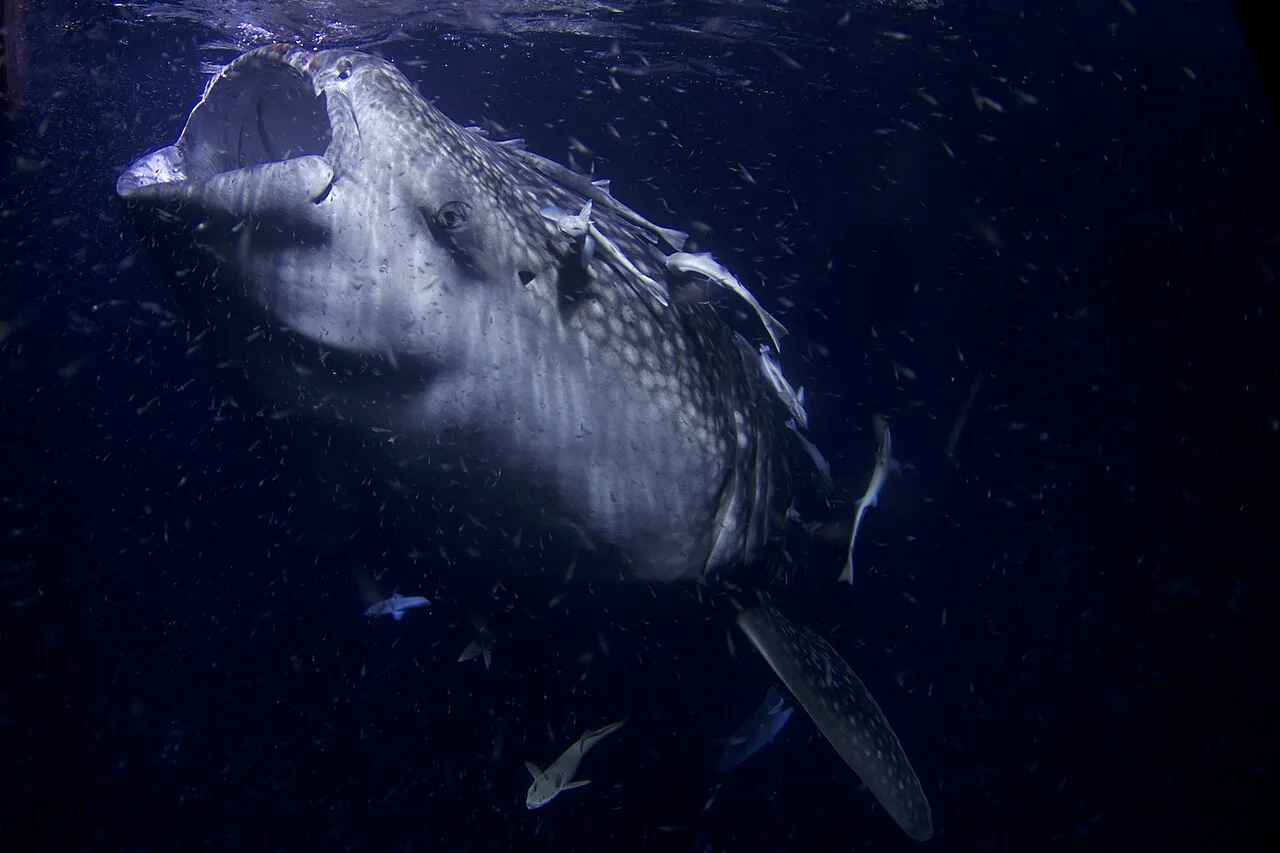
The biggest shark is the whale shark. It can grow to more than 18 metres (60 feet). That is about as long as four family cars parked in a row. It is the largest fish of any kind, yet it feeds on plankton, the tiny living things that drift in the sea.
The smallest is the dwarf lanternshark. An adult can be less than 20 centimetres (8 inches) long, shorter than a school ruler. It lives in deep water. The pygmy shark is only a little bigger, at about 25 centimetres (10 inches).

Most sharks sit somewhere in between. This table compares seven more, from the largest to the smallest.
| Shark | Length | What it eats | Where it lives |
|---|---|---|---|
| Basking shark | up to 12 m (39 ft) | plankton | near coasts and out at sea, including British waters |
| Great white shark | usually 4 to 5 m (13 to 16 ft); some over 6 m (20 ft) | mostly seals and sea lions | coasts where seals gather, and the open ocean |
| Tiger shark | about 5 m (16 ft) | fish, sea birds and turtles, alive or dead | murky coastal waters, river mouths and harbours |
| Nurse shark | about 4 m (13 ft) | shellfish | the seabed in warm parts of the Atlantic and Pacific |
| Frilled shark | about 2 m (6.5 ft) | mostly squid, plus fish and other sharks | deep, dark water |
| Saw shark | about 1.5 m (5 ft) | fish, and small animals without backbones | deep water off the edges of continents |
| Cookiecutter shark | about 50 cm (20 in) | round bites of flesh from large fish and whales | warm seas all over the world |
Look down the food column and one thing stands out. Sharks do not all feed the same way. The basking shark swims with its mouth wide open. It strains plankton from the water with parts of its gills called gill rakers.
The cookiecutter shark is stranger still. It clamps on to a much larger animal with its lips. Then it twists its body round and carves out a plug of flesh. The wound it leaves is round, as if someone had used a biscuit cutter.
Why a skeleton of cartilage helps
Cartilage is much lighter than bone, and that matters in the sea. A heavy fish sinks. Many bony fish stop themselves sinking with a swim bladder, a bag of gas inside the body. Sharks do not have one.
Instead, sharks rely on three things. The light skeleton is the first. The second is a huge liver full of oil, which is lighter than water. The third belongs to only a few species. A sand tiger shark can gulp air and hold it in its stomach, a little like a rubber ring.
Together these help a shark stay at the depth it wants without sinking or bobbing up. Scientists call this being neutrally buoyant.
Teeth that never run out
A shark’s teeth sit in layers, one row behind another. If a front tooth breaks off, a new sharp one takes its place straight away.
That happens again and again. A shark can shed thousands of teeth during its life. This is why shark teeth are often found washed up on beaches.

The shape of the teeth depends on the food. Nurse sharks have thousands of small, jagged teeth for crushing shellfish.
Bullhead sharks carry two kinds of teeth in the same mouth. Sharp, pointed teeth at the front grip their prey. Flat teeth at the back work like your back teeth, crushing crabs and sea urchins.
The frilled shark has several rows of long, sharp teeth. Each tooth has three points. Most of what the frilled shark catches is squid, which is soft and slippery.
Smell, sight and hearing
Sharks find food with a whole set of senses. Smell is one of the strongest.
A shark can pick up the scent of a dead fish, bird or turtle from very far away. It then follows the trail of scent through the water to where it starts. It is a bit like following the smell of baking all the way to the kitchen.
Sharks see well in dim light. Research suggests their eyes may be more than ten times as sensitive to light as ours. Great white sharks hunting seals near the coast seem to rely mostly on their eyes. They often attack from below, taking the seal by surprise.
Sharks hear very well too. You cannot see their ears, because they sit inside the head, one on each side.
The lateral line and the electric sense
Sharks have two senses that people do not. The first is the lateral line.
The lateral line is a series of tiny tubes just under the skin. It runs along each side of the body, from the head to the tail. When an animal swims nearby, it pushes the water about. The tubes pick up those movements and changes in pressure. So a shark can feel prey it cannot see. All fish have a lateral line, not just sharks.
The second is an electric sense. Living prey gives off very weak electric fields. Sharks can detect them.

The sense organs are called the ampullae of Lorenzini. They open through tiny pores around the snout. With them, a shark can find a stingray buried in the sand, even though it cannot see or smell it.
Hammerhead sharks carry these sense organs across their wide heads. Scientists think the unusual shape gives them an advantage when they search for hidden prey.
How sharks breathe
Like all fish, sharks take oxygen from water as it flows over their gills. The water has to keep moving for this to work.
Many sharks do it by swimming with their mouths open, so water is forced in and over the gills. Some species need to swim all the time.
Others can stop. Nurse sharks have spiracles, small extra openings that push water across the gills while the shark rests. The Port Jackson shark from Australia can pump water through its gills as well. It can lie on the ocean floor for long periods, and it can even eat and breathe at the same time.
Do sharks sleep? Not the way you do. They have active times and restful times instead.
Fast, deep and warm-blooded
The fastest shark is the shortfin mako. It has been recorded swimming in short bursts at up to 70 km/h (43 mph). That is as fast as a car on a main road.
A few sharks leap right out of the water. The highest jumps reach about 3 to 4.5 metres (10 to 15 feet). Great whites do it in only some places, usually while hunting seals.
Other sharks stay deep. The goblin shark lives between 270 and 960 metres down. The bottom of that range is nearly three times the height of the Eiffel Tower.
Most sharks live only in salty seawater. Two kinds, the bull shark and the speartooth shark, can survive in fresh water for long periods. Even they keep a link to the sea. Neither lives in lakes that are cut off from it.
Most sharks are cold-blooded, which means their bodies stay about as warm as the water around them. Five kinds of mackerel shark are different. They can keep their bodies warmer than the sea.
A shark that may live for centuries
The Greenland shark lives in cold water, in the Arctic Ocean and the North Atlantic. It can reach around 6 metres (20 feet) long. It swims very slowly to save energy.
Working out a wild shark’s age is hard. In 2016, a team of scientists led by Julius Nielsen tried a new method. They studied the eyes of 28 female Greenland sharks.
The team measured radiocarbon in the centre of each eye lens. Radiocarbon is a form of carbon that scientists can use like a clock to date things. Nuclear bomb tests left a burst of extra radiocarbon in the ocean in the early 1960s. Only the smallest sharks, 2.2 metres long or less, carried it. So every bigger shark was born before then.

The biggest shark in the study was 5.02 metres (16.5 feet) long. The team estimated its age at 392 years, give or take 120. That means it could be as young as 272 or as old as 512.
That uncertainty is important. The study’s main finding was that Greenland sharks live for at least 272 years. A shark that age in 2016 was born around 1744. That is longer than any other animal with a backbone that we know of.
Growing up takes a very long time too. The scientists estimated that females become adults only when they are at least 156 years old, give or take 22 years.
Older than trees and dinosaurs
Sharks have a very long history. The Natural History Museum in London says they have been around for about 450 million years. The Florida Museum says the ancestors of modern sharks were swimming more than 400 million years ago. The figures differ a little, but both put sharks a very long way back in time.
Sharks came first. They were in the sea before trees grew on land, and long before the first dinosaurs. They have survived several mass extinctions, times when most kinds of living things died out. They outlived the dinosaurs too.
Some kinds have changed very little. Angel sharks are flat sharks that lie hidden in the sand or mud of the sea floor. Their fossils show their skeletons have hardly changed in 140 million years.
Shark babies: eggs or live birth
Some sharks lay eggs. Others give birth to live young, called pups. In every species, the eggs are fertilised inside the mother’s body.
Live-bearing sharks feed their young in different ways. In some, the pups live off a yolk sac, like the yolk of a hen’s egg. In others, the pups are fed through a link to their mother, a little like a human baby. In a few species, the growing pups eat eggs that were never fertilised.
How often do sharks bite people?
Shark bites make big news, but they are rare. The International Shark Attack File, run by the Florida Museum, checks reports from all over the world every year.
In 2025 it looked into 105 possible cases. It confirmed 65 unprovoked bites. Unprovoked means the bite happened in the shark’s own home, with nobody bothering the shark first. Nine of those bites killed the person. Another 29 bites were provoked, which means a person had disturbed the shark first.
That total was about normal. From 2020 to 2024 there were 61 unprovoked bites a year on average, and about eight deaths a year.
The United States had the most bites in 2025, with 25. Florida alone had 11, and California had 5. Australia came next with 21.
Most bites happened to people swimming or wading, 46 in every 100. Surfers and other board riders made up 32 in every 100, and snorkellers 15. The Florida Museum describes the number of bites worldwide as extremely low. Remember that 65 is the figure for the whole planet, for a whole year.
Why sharks are in trouble
Sharks face a much bigger threat from people. In 2021, scientists published a new check on every known shark, ray and chimaera, 1,199 species in all. The first global check had been in 2014.
They found that 391 species were threatened with extinction. Some species are too little studied to judge. Allowing for those, the team estimated that 37.5% of the whole group is threatened, more than one in three. In 2014 the figure had been about one in four.
Sharks on their own did a little better than rays. Of 536 shark species, 167 were threatened, or 31.2%. For rays the figure was 36%.
The cause is overfishing. That means catching fish faster than they can breed and replace themselves. Overfishing affects every one of the threatened species. For about two in three, it is the only threat. The others also suffer from damaged habitats, climate change or pollution.

Much of the catch is not even meant. Most threatened sharks and rays are caught by accident, in nets and on hooks set for other fish. This is called bycatch.
Nearly all the threatened species that are kept end up as food. Some deep-water and coastal sharks are also caught for the oil in their livers. It is used in health supplements and even as fuel. The pressure on sharks grew from around 1980, when demand for shark fins rose.
Some sharks close to home are in serious danger. Every species of angel shark living around the coasts of the UK and Europe is now critically endangered.
Losing sharks matters. Many are apex predators, which means they sit at the top of the food chain and have few or no natural enemies. By eating other animals, they help keep their ecosystems in balance.
Three things people get wrong
1. “Sharks must keep swimming or they die.” This is true for some species only. Nurse sharks use spiracles to push water over their gills while they rest. Port Jackson sharks can lie still on the ocean floor for long periods. The Florida Museum puts it plainly: some sharks do need to swim all the time, but not all of them.
2. “Sharks are mindless man-eaters.” In 2025 the whole world had 65 confirmed unprovoked shark bites. Sharks eat plankton, shellfish, squid, fish and seals. The two biggest sharks of all, the whale shark and the basking shark, eat only plankton. Nor are sharks mindless. They hunt using at least five different senses, including two that people do not have.
3. “Sharks are not real fish, because they have no bones.” Sharks are fish. They breathe with gills and belong to the cartilaginous fishes, whose skeletons are made of cartilage instead of bone. Most other fish are bony fish. Dolphins look a little like sharks, but they are mammals that breathe air. And the whale shark is a fish, not a whale.
Did you know? Bull sharks have been caught about 3,480 km (2,100 miles) up the Amazon River, far from the sea.
Try it
Feel the water like a shark’s lateral line. Fill a sink or a bath, close your eyes and rest your fingertips flat on the surface. Ask someone to stir the water gently with a spoon at the far end, without telling you when. Can you feel the ripples arrive, and tell which side they came from?
Knowledge check
What is a shark’s skeleton made of?
Show answer
Cartilage, a tough, bendy material that is much lighter than bone.
What does a shark’s lateral line let it feel?
Show answer
Movements and changes in pressure in the water, such as those made by a fish swimming nearby.
Frequently asked questions
How many species of shark are known?
About 500 to 540 kinds of shark are known. A 2021 global assessment listed 536 shark species, the Florida Museum of Natural History gave about 520 in 2022, and new species are described all the time.
What is the biggest shark in the world?
The whale shark is the biggest shark and the largest fish of any kind. Whale sharks can grow to more than 18 metres (60 feet), yet they feed on plankton.
What is the smallest shark?
The dwarf lanternshark is the smallest known shark. Adults can be less than 20 centimetres (8 inches) long, and they live in deep water in the Caribbean Sea.
Do sharks have bones?
Sharks have no true bones. Their skeletons are made of cartilage, which is much lighter than bone and helps a shark stay afloat without a swim bladder.
How long do sharks live?
Shark lifespans vary a great deal by species. A smooth dogfish may live about 16 years, while a 2016 study found that Greenland sharks live at least 272 years.
Are sharks dangerous to humans?
Shark bites are very rare. In 2025 the International Shark Attack File confirmed 65 unprovoked bites in the whole world, and 9 of them were fatal.
Why are sharks endangered?
Overfishing is the main reason sharks are endangered. A 2021 study found that 31.2% of shark species were threatened, mostly because they are caught by accident in nets and on hooks set for other fish.
Sources
- Florida Museum of Natural History: sharks FAQ — the species count (about 520, page updated 2022), the largest and smallest sharks, how long sharks have existed, bones, skin, eyesight, hearing, teeth, sleep, which sharks must keep swimming, the shortfin mako, breaching, the goblin shark’s depth, the cookiecutter shark and lifespans
- Florida Museum of Natural History: shark biology — buoyancy and the oily liver, smell, the lateral line, the ampullae of Lorenzini, sharks in fresh water, eggs and live birth, warm-blooded mackerel sharks and apex predators
- Natural History Museum, London: meet the nine types of sharks in the ocean — the nine orders, gill openings, denticles, jaws, sizes, diets and homes of the sharks in the table, the epaulette and Port Jackson sharks, teeth of bullhead, nurse and frilled sharks, angel sharks, and sharks being older than trees and dinosaurs
- University of Copenhagen: Nielsen and others (2016), Science — eye lens radiocarbon reveals centuries of longevity in the Greenland shark — the eye-lens method, the bomb pulse, a life span of at least 272 years, the largest shark’s age of 392 ± 120 years and maturity at 156 ± 22 years
- Dulvy and others (2021), Current Biology: overfishing drives over one-third of all sharks and rays toward a global extinction crisis — the 1,199 species assessed, the share of sharks and rays threatened, overfishing and bycatch, what caught sharks are used for, the rise in demand for fins and the 536 shark species
- Florida Museum of Natural History, International Shark Attack File: 2025 worldwide summary — the 105 cases investigated in 2025, 65 unprovoked and 29 provoked bites, 9 deaths, the 2020 to 2024 averages, the countries and activities involved


