
Skara Brae quick facts
- A storm stripped the sand off it in 1850 and handed archaeologists a village nobody knew was there.
- The furniture is made of stone, because Orkney had almost no trees to make it out of wood.
- No weapons have ever been found there, and the village sits in a spot that would be hard to defend.
- The houses were deliberately built inside mounds of old rubbish, which worked as insulation.
- It is older than the stone circle at Stonehenge and older than the pyramids at Giza.
Skara Brae at a glance
Skara Brae sits on the west coast of Mainland, the largest island in Orkney. Orkney lies off the north coast of Scotland. Here are the main facts in one place.
| Fact | Detail |
|---|---|
| Where | Bay of Skaill, Mainland, Orkney, Scotland |
| What it is | A Neolithic, or late Stone Age, village |
| Age | About 5,000 years old |
| Village life ended | Around 2500 BC |
| Found | 1850, uncovered by a storm |
| Room size | About 40 square metres, one room per house |
| Furniture | Stone dressers, box-beds, hearths and floor tanks |
| Weapons found | None |
| World Heritage Site | Yes, since 1999 |
| Looked after by | Historic Environment Scotland |

The storm that found a village
In the winter of 1850 a fierce storm hit Orkney. It stripped the grass and sand off a large mound near the Bay of Skaill.
Underneath were the walls of stone houses.
Nobody had known anything was there. The mound had simply been a grassy hump beside the shore for as long as anyone could remember. The storm that uncovered it was the same kind of weather that had buried it in the first place.
Local people began to dig. More careful excavation followed over the next century, and what came out of the sand was a whole village that had been sealed since the Stone Age.
Older than the pyramids
People lived at Skara Brae for roughly 600 years. Village life seems to have ended around 2500 BC.
Those dates are worth stopping on. When the last family walked away from Skara Brae, the huge stones at Stonehenge had only just gone up. The Great Pyramid of Giza had not been built.
This was the New Stone Age, when people across Britain had recently changed from hunting and gathering to farming. Skara Brae shows what that life looked like from the inside.
Why the furniture survived
Almost every Stone Age house in Britain has lost its contents. Wood and straw both rot away. After 5,000 years you are usually left with post holes in the soil and nothing else.
Skara Brae is different, and the reason is that Orkney had almost no trees.
Without timber, the villagers built with what the islands had plenty of: flat slabs of sandstone that split cleanly into sheets. They used it for the walls, and then they used it for the furniture too.
So the beds are stone and so are the shelves. Five thousand years later they are still standing exactly where they were put, and you can look into a room and see how someone arranged their home.
A shortage of wood turned out to be the luckiest thing that ever happened to this village.

Inside one of the houses
Every house has a single room of about 40 square metres. That is roughly the size of a large classroom, for one family.
The layout repeats from house to house, which tells you these people agreed on how a home should be arranged.
| What it is | Where it sits | What it was probably for |
|---|---|---|
| Hearth | Middle of the floor | Heat, light and cooking, with everything arranged around it |
| Dresser | Facing the door | Shelves, perhaps to store and show off special objects |
| Box-beds | Two, one either side | Sleeping, probably packed with bedding and skins |
| Floor tanks | Set into the stone floor | Possibly soaking limpets to use as fishing bait |
The dresser faces you as you come in, lit by the fire. Whatever the family owned that was worth looking at, that is where it went.
One structure at the end of the village breaks the pattern. It has a different kind of hearth and no box-beds at all. Archaeologists think it may have been a workshop rather than a home.
Houses built inside a rubbish heap
The houses were not built on open ground. They were set into large mounds of midden.
Midden is old household waste: ash, broken shells, animal bone, food scraps, all packed down over years into a dense material.
That sounds unpleasant, and it was also clever. Packed midden holds heat, blocks wind and supports the walls, which matters a great deal on an island where the weather comes in off the Atlantic with nothing to slow it down.
Low covered passages ran between the houses. On a bad night you could get from one home to another without ever stepping outside.
What they left behind
Excavations have turned up a long list of objects: pottery, stone and bone tools, necklaces, beads, pendants and pins. There were gaming dice as well.
There are also richly carved stone objects covered in spirals and patterns. Nobody is sure what they were for. Many archaeologists think they were used in ceremonies.
One category is missing, and its absence says a lot. No weapons have ever been found at Skara Brae.
The village is not in a defendable spot either. It sits low, near the water, with no wall or ditch around it. Taken together, those two facts suggest the people here were not expecting to be attacked.
They were farmers, hunters and fishers who made fine, complicated things with very simple tools.
The village has moved, without going anywhere
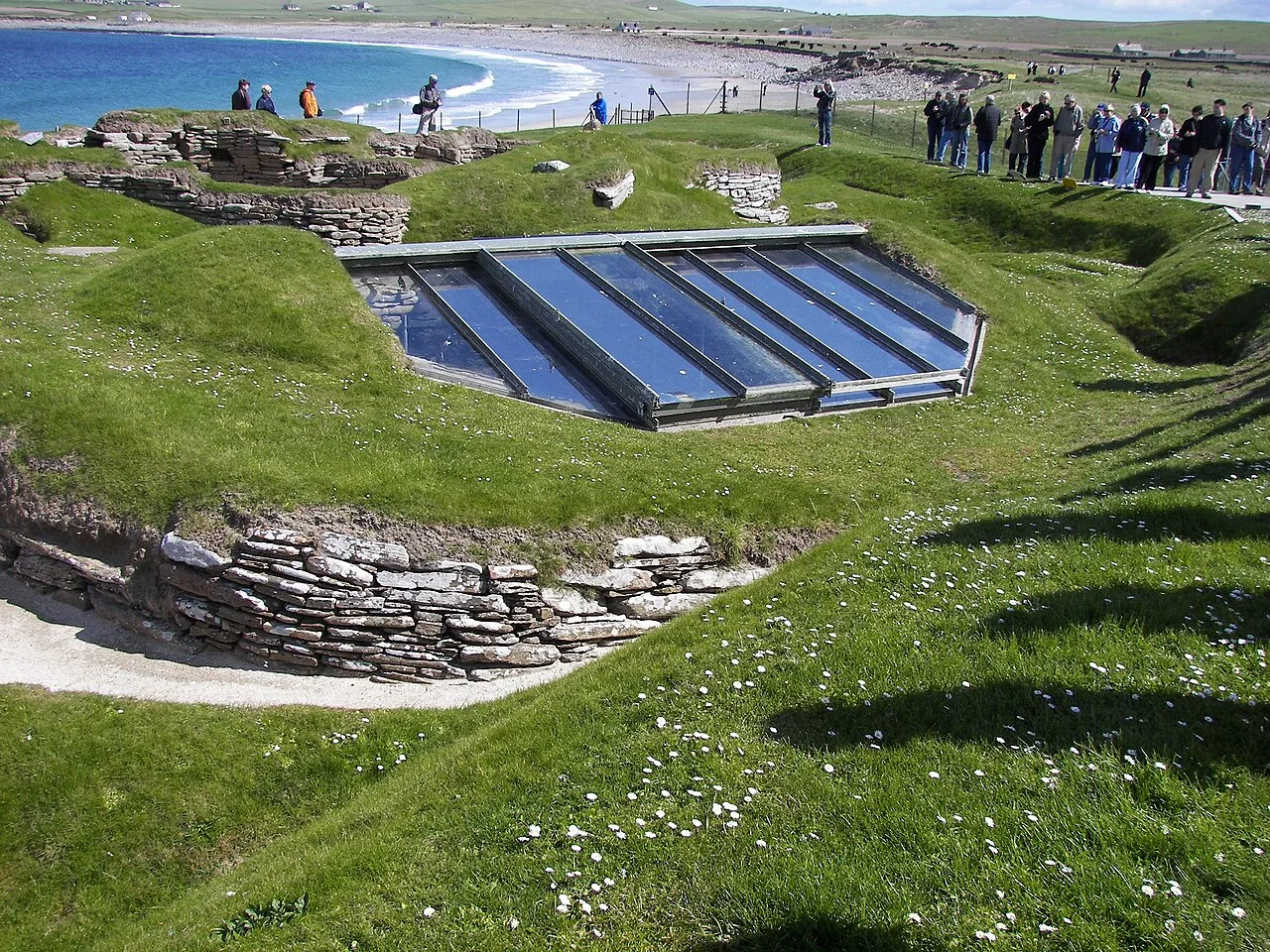
Photographs of Skara Brae always show the sea just beyond the houses. It looks like a fishing village perched on the shore.
It was not built that way. When people lived there, Skara Brae stood inland, beside a freshwater loch. The coast was further off.
Over 5,000 years the sea has eaten into the land and arrived at the village’s front door. That is also why the site is at risk now, and why a sea wall protects it.
Why everybody left
This is the honest bit: nobody knows.
One idea is dramatic: a huge sandstorm swept in and buried the village so fast that people fled, leaving their things behind.
The other explanation is quieter. Families drifted away over many years, one household at a time, until nobody was left and the sand slowly did the rest.
Historic Environment Scotland sets out both and does not pick one. What is clear is the timing. As Skara Brae was emptying, big new monuments were going up elsewhere on Orkney: the tomb at Maeshowe, the Ring of Brodgar and the Stones of Stenness. Something about how people lived on these islands was changing.
Archaeologists are still digging nearby, at the Links of Noltland on Westray and at the Ness of Brodgar. More villages from the same period are coming out of the ground.

Visiting Skara Brae
Historic Environment Scotland runs the site, and it is open to visitors. You walk a path around the top of the houses and look down into the rooms, which is how you can see the furniture laid out.
There is also a full-size replica house you can go inside, built so people can see what the room looked like with a roof on and a fire lit.
Since 1999 Skara Brae has been part of a World Heritage Site called the Heart of Neolithic Orkney, along with Maeshowe, the Ring of Brodgar and the Stones of Stenness.
Three things people get wrong
Myth: Skara Brae was always a seaside village. It was built inland, beside a freshwater loch. The sea has moved in over 5,000 years and now runs along the edge of the site, which is why it needs a sea wall to protect it.
Myth: Stone Age people lived in bare, empty shelters. The houses at Skara Brae have fitted furniture, a set layout, storage, decorated objects and jewellery. Somebody chose where the dresser went so it faced the door and caught the firelight.
Myth: the village was destroyed in a disaster. The sandstorm story is one explanation, not a proven fact. Many archaeologists think the village emptied gradually instead. Historic Environment Scotland presents both and says nobody knows.
Did you know? Skara Brae is not where it started. When people lived there it stood inland, beside a freshwater loch. The sea has moved in since, and the village now sits right on the shore.
Try it
Look around the room you are in and pick out the furniture. Now imagine building all of it out of flat stone slabs, because there is no wood on your island. Which pieces would you keep, and which would you decide you could live without?
Knowledge check
How was Skara Brae found?
Show answer
A storm in 1850 blew away the sand and grass covering it, exposing the stone houses underneath.
Why is the furniture made of stone?
Show answer
Orkney had almost no trees, so there was very little wood. Stone was what the villagers had, and it is why their furniture survived.
Frequently asked questions
What is Skara Brae?
Skara Brae is a Stone Age village on the west coast of Mainland Orkney, in Scotland. A group of stone houses sits linked together by covered passages, with stone furniture still inside them. Historic Environment Scotland calls it the best-preserved Neolithic settlement in western Europe.
How old is Skara Brae?
Skara Brae is about 5,000 years old. Village life there seems to have ended around 2500 BC, after roughly 600 years. That makes it older than the stone circle at Stonehenge and older than the Great Pyramid of Giza.
How was Skara Brae discovered?
A severe storm hit Orkney in 1850 and tore the grass and sand off a large mound near the Bay of Skaill. Stone walls appeared underneath. Until then nobody knew a village was buried there at all.
What is inside the houses at Skara Brae?
Each house has a single room of about 40 square metres, with a hearth in the middle. Around it stand a stone dresser with shelves, two stone box-beds, and small tanks set into the floor that may have been used to prepare fish bait.
What did the people of Skara Brae eat?
The villagers farmed, hunted and fished. They kept cattle and sheep, grew barley, gathered shellfish and caught fish from the sea and the loch. Pottery, tools and animal bones found at the site show all of this.
Why did people leave Skara Brae?
Nobody knows. One idea is that a huge sandstorm buried the village quickly. Another is that people simply drifted away over many years. Historic Environment Scotland sets out both explanations and says the question is still open.
Sources
- Historic Environment Scotland: Skara Brae history and stories — the house layout and 40 square metre rooms, the dressers, box-beds, hearths and floor tanks, the finds, the absence of weapons, and the end of the village around 2500 BC
- Historic Environment Scotland: Skara Brae — the storm of 1850 that uncovered the site, and the replica Neolithic house built for visitors
- UNESCO World Heritage Centre: Heart of Neolithic Orkney — the 1999 World Heritage listing that covers Skara Brae, Maeshowe, the Ring of Brodgar and the Stones of Stenness


