
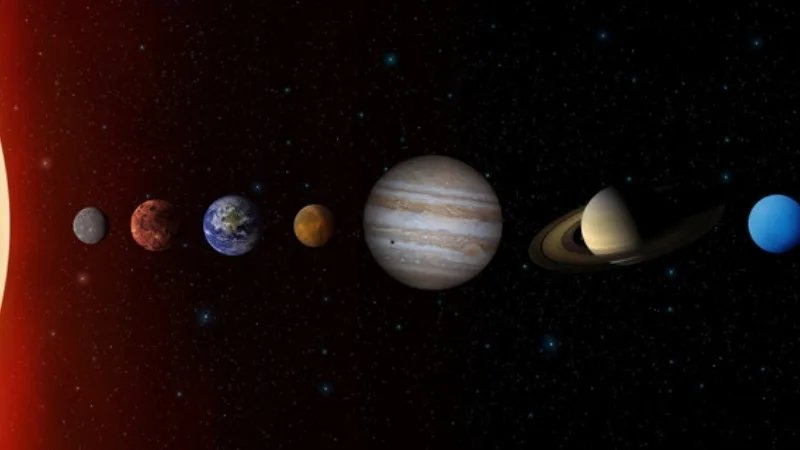
Solar system quick facts
- All the asteroids in the asteroid belt put together have less mass than our Moon.
- Nobody has ever seen the Oort Cloud. Scientists predict it from maths and from the comets that come from it.
- Voyager 1 is due to be one light-day from Earth on 18 November 2026, the first human-made object to get that far.
- The Sun is about 100 times wider than Earth, and it would take more than 330,000 Earths to match its mass.
- Sunlight reaches Mercury in about 3 minutes, but takes about 4 hours to reach Neptune.
What is the solar system?
The solar system is our Sun and everything that travels around it. That means eight planets, five officially named dwarf planets, hundreds of moons, about 1.4 million asteroids and about 4,000 comets.
The word “solar” comes from solis, the Latin word for Sun. So the name simply means the Sun’s system. Other stars have planets too, but ours is the only system where we know life exists.
The Sun sits in the middle, and it is by far the biggest thing here. It holds 99.8% of all the mass in the solar system. Every planet, moon, asteroid and comet put together makes up the last 0.2%. You can find out more about our star in our Sun facts for kids.
Our solar system is only one small part of the Milky Way galaxy. You can explore the rest of it in our space facts for kids.
The eight planets in order
Going outwards from the Sun, the planets are Mercury, Venus, Earth, Mars, Jupiter, Saturn, Uranus and Neptune.
A silly sentence helps you remember them. Take the first letter of each word in “My Very Easy Method Just Speeds Up Naming”. You get M, V, E, M, J, S, U and N, which is the order of the planets.
The table shows how far each planet is from the Sun. It uses astronomical units, or AU for short. One AU is the distance from the Sun to Earth, about 150 million km (93 million miles). So Jupiter, at 5.2 AU, is just over five times as far from the Sun as we are.
| Planet | Kind of planet | Average distance from the Sun | One trip round the Sun |
|---|---|---|---|
| Mercury | rocky | 0.4 AU | 88 Earth days |
| Venus | rocky | 0.72 AU | 225 Earth days |
| Earth | rocky | 1 AU | 365 days |
| Mars | rocky | 1.5 AU | 687 Earth days |
| Jupiter | gas giant | 5.2 AU | about 12 Earth years |
| Saturn | gas giant | 9.5 AU | about 29 Earth years |
| Uranus | ice giant | about 19 AU | about 84 Earth years |
| Neptune | ice giant | 30 AU | about 165 Earth years |
A planet’s year is how long it takes to go once around the Sun. Neptune is so far out that it has gone round only once since astronomers discovered it in 1846.
Put the Planets in Order
- Mercury The rocky planet nearest the Sun.
- Venus Rocky, with a year of 225 Earth days.
- Earth Rocky, and exactly 1 AU from the Sun.
- Mars The last of the four rocky planets.
- Jupiter The first of the two gas giants.
- Saturn The second gas giant.
- Uranus The first of the two ice giants.
- Neptune The last ice giant, and the farthest planet from the Sun.
Planet facts for kids: rocky planets and giants
The planets come in three kinds. The four closest to the Sun are rocky. The next two are gas giants, and the last two are ice giants.
Mercury, Venus, Earth and Mars are called terrestrial planets. Terrestrial means “like Earth”. They are small worlds with solid, rocky surfaces you could stand on.

Jupiter and Saturn are gas giants. They are made mostly of hydrogen and helium, the same two gases as the Sun, and they have no hard surface to land on. Jupiter is the biggest planet by far. If it were a hollow shell, about 1,000 Earths could fit inside.
Uranus and Neptune are ice giants. Like the gas giants, they have no solid surface, just swirling gases above a core. They are smaller than Jupiter and Saturn, and colder.
Why are the rocky planets on the inside? When the solar system was young, it was very hot near the Sun. Only rocky material could survive that heat, so only rocky planets could form there. Further out it was cold enough for ice to last, and gravity gathered ice, gas and dust into giant worlds.

All four giant planets have rings, and so does at least one asteroid. None of the others come close to Saturn’s. Its rings are the ones you can see through a small telescope from your back garden.
Venus and Uranus, the two odd ones out
Venus is the hottest planet, even though Mercury is closer to the Sun. Its thick atmosphere traps heat. Venus is almost as wide as Earth: 12,104 km across, against Earth’s 12,756 km. After the Moon, it is the brightest thing in the night sky.
Time on Venus is strange. One day there lasts 243 Earth days, which is longer than its whole year of 225 days. Venus also spins backwards compared with Earth. So on Venus the Sun would rise in the west and set in the east.
Uranus spins on its side. It is tipped over by nearly 90 degrees, so it rolls around the Sun like a ball. Uranus is four times wider than Earth, has 13 faint rings, and takes about 84 Earth years to go round the Sun. Its moons are named after characters from the works of William Shakespeare and Alexander Pope.
Most of what we know about Uranus up close comes from one visit. NASA’s Voyager 2 flew past it in 1986, on a grand tour of all four giant planets, before heading out towards the stars.
Which Planet Is It?
- Mercury — Goes round the Sun in just 88 days
- Venus — Spins backwards, so the Sun rises in the west
- Earth — The only place where we know life exists
- Mars — Takes 687 Earth days to go round the Sun
- Jupiter — Just over five times as far from the Sun as Earth
- Saturn — Has the most spectacular rings
- Uranus — Tipped over so it rolls around the Sun on its side
- Neptune — Has gone round the Sun only once since it was found in 1846
How big is the solar system?
Pictures of the solar system squash it to fit on a page. The real thing is mostly empty space. Its distances are hard to imagine, so a model helps.
Imagine the Sun is a football about 22 cm across. The real Sun is about 1.4 million km wide, and about 100 times wider than Earth. So on this scale, Earth is a speck about 2 mm wide, like the head of a pin.
That pinhead Earth would sit about 24 metres from the football. Jupiter, about the size of a grape, would be about 120 metres away. That is further than the length of a football pitch. Neptune would be about 700 metres away.
And the Oort Cloud, the solar system’s far edge? On the same scale, it would start about 120 km from the football. Its outer edge would be more than 2,000 km away, further than from London to Rome.
Size is one thing. Weight is another. It would take more than 330,000 Earths to match the mass of the Sun.
How long sunlight takes to reach each planet
Light is the fastest thing there is. Even so, it needs time to cross the solar system. The further out a planet is, the longer sunlight takes to get there.
| Planet | Sunlight takes about |
|---|---|
| Mercury | 3.2 minutes |
| Venus | 6 minutes |
| Earth | 8 minutes |
| Mars | 13 minutes |
| Jupiter | 43 minutes |
| Saturn | 80 minutes |
| Uranus | 2 hours 40 minutes |
| Neptune | 4 hours |
So the Sun you see in the sky is the Sun as it was about 8 minutes ago. From Neptune, you would see it as it was 4 hours ago.
Radio signals travel at the speed of light too. That is why nobody can steer a spacecraft near Neptune like a remote-control car. Every command would take hours to arrive, and the reply would take hours to come back.
How Long Does Sunlight Take?
- Mercury — About 3 minutes
- Venus — About 6 minutes
- Mars — About 13 minutes
- Saturn — About 80 minutes
- Uranus — About 2 hours 40 minutes
- Neptune — About 4 hours
Moons: hundreds and still counting
A moon is a natural object that orbits a planet. Our solar system has hundreds of them. Even some asteroids and dwarf planets have moons.
Mercury and Venus have no moons at all. Earth has one, the Moon. Mars has two small, potato-shaped moons called Phobos and Deimos.
The giant planets have far more. Saturn has the most: as of August 2026, NASA counts 293 confirmed moons around it. Jupiter, Uranus and Neptune have many moons too.

These numbers keep changing. Most new finds are tiny, and telescopes keep getting better at spotting them, so any count is only true on the day it was made.
So many small moons are being found that the International Astronomical Union has changed its rules. The smallest ones will no longer be given names from myths, unless they are important to science.
Dwarf planets and what happened to Pluto
For 76 years, Pluto was called the ninth planet. The astronomer Clyde Tombaugh discovered it in 1930. Then astronomers began finding other icy worlds far beyond Neptune, and some were a lot like Pluto. That raised a hard question. What exactly is a planet?
In August 2006, the International Astronomical Union (IAU) voted on an answer at a meeting in Prague. The IAU is the world organisation of astronomers, and it names objects in space. It said a planet must do three things:
- orbit the Sun
- be big enough for its own gravity to pull it into a round shape
- have cleared its path, so no other objects of a similar size share its neighbourhood
Pluto passes the first two tests but fails the third. It shares its part of space with many other icy objects. So the IAU made Pluto a dwarf planet, which was a brand-new kind of object.

There are five officially named dwarf planets. In order from the Sun they are Ceres, Pluto, Haumea, Makemake and Eris. Ceres is the odd one out. It is the largest object in the asteroid belt, and the only dwarf planet in the inner solar system. The IAU says more than a hundred dwarf planets may still be waiting to be found.
In July 2015, NASA’s New Horizons spacecraft flew past Pluto and sent back the first close-up pictures. Pluto has five moons. The biggest, Charon, is about half Pluto’s size. That makes it the largest moon compared with its parent world anywhere in the solar system.
The asteroid belt, the Kuiper Belt and the Oort Cloud
Besides planets and moons, the solar system has three great zones full of smaller objects.
The asteroid belt lies between Mars and Jupiter. Asteroids are rocky leftovers from when the planets formed. Jupiter’s strong gravity stopped them from ever joining together into a planet.
The belt holds between 1.1 and 1.9 million asteroids wider than 1 km (0.6 miles), plus millions of smaller ones. The biggest, Vesta, is about 530 km (329 miles) across. Even so, all the asteroids put together have less mass than our Moon.
The Kuiper Belt (say “KY-per”) is a huge, doughnut-shaped region of icy bodies beyond Neptune. Pluto lives here, along with most of the known dwarf planets and some comets. There may be millions of icy worlds in it. Only one spacecraft has visited. New Horizons flew past a small Kuiper Belt object called Arrokoth on 1 January 2019.
The Oort Cloud is further out still. Scientists think it is a giant, thick shell of icy objects wrapped around the whole solar system. Some of those objects are bigger than mountains. The cloud may stretch as far as 1.6 light-years from the Sun.
Nobody has ever seen the Oort Cloud directly. It is too far away. Scientists predict it is there from mathematical models, and from comets that seem to come from it. It is our best explanation, not a photograph.
Solar System: Fact or Myth?
- All the asteroids put together have more mass than our Moon.
- Scientists have photographed the Oort Cloud.
- Jupiter's gravity stopped the asteroid belt from becoming a planet.
- The Kuiper Belt lies between Mars and Jupiter.
- A day on Venus is longer than a year on Venus.
- Ceres is a dwarf planet in the asteroid belt.
- Charon is tiny compared with Pluto.
- Gas giants have hard, rocky surfaces you could land on.
How the solar system formed
About 4.6 billion years ago there was no Sun, just a huge cloud of gas and dust. Something made the cloud collapse. It may have been the shock wave from a nearby exploding star, called a supernova, but scientists are not certain.
As it collapsed, the cloud became a spinning, swirling disc called the solar nebula. Gravity pulled most of the material into the centre. There the pressure grew so great that hydrogen began to join together into helium, releasing a huge amount of energy. The Sun had switched on.
Further out, dust and ice clumped together. The clumps smashed into each other and grew. Some became big enough for their own gravity to make them round, and those became planets, dwarf planets and large moons. The rest stayed as asteroids, comets and small, lumpy moons.
How the Solar System Formed
- Cloud A huge cloud of gas and dust floats in space.
- Collapse Something, perhaps a supernova's shock wave, makes the cloud collapse.
- Disc The cloud becomes a spinning disc called the solar nebula.
- Sun Pressure at the centre starts fusion, and the Sun switches on.
- Clumps Further out, dust and ice clump together and smash into each other.
- Worlds The biggest clumps become round planets, dwarf planets and large moons.
Voyager 1, the farthest spacecraft
More than 300 robotic spacecraft have travelled beyond Earth’s orbit. People have not gone nearly so far. Twenty-four American astronauts have travelled to the Moon. Today astronauts live on the International Space Station, which circles close to Earth.
The spacecraft that has gone furthest is Voyager 1. NASA launched it in 1977, the same year as its twin, Voyager 2. Voyager 1 flew past Jupiter and Saturn and just kept going.
In 2012, Voyager 1 left the heliosphere. That is the giant bubble blown around the Sun by the solar wind, a stream of charged gas pouring out in every direction. Voyager 2 followed in 2018. The two Voyagers are the only spacecraft ever to work in interstellar space, the space between the stars.

Now Voyager 1 is closing in on a new record. On 18 November 2026, NASA expects it to be one light-day from Earth. That is the distance light travels in 24 hours: about 25.9 billion km (16.1 billion miles). A radio message from Earth will need a whole day to reach it.
Even that is only a start. It will be many thousands of years before either Voyager makes it out of the Oort Cloud.
Three things people get wrong
1. Spacecraft do not have to dodge asteroids. Films show the asteroid belt as a crowded field of tumbling rocks. Diagrams make it look crowded too, because they squash it to fit. The real belt is spread around a ring that circles the Sun, and the asteroids are very far apart. Voyager 1 crossed it on the way to Jupiter, and New Horizons crossed it on the way to Pluto.
2. Pluto was not deleted. Pluto is still there, and scientists still study it. In 2006 the IAU moved it into a new group, the dwarf planets, because it has not cleared its path. New Horizons visited it nine years later. Pluto got a new label, not a goodbye.
3. The Sun is not yellow. Sunlight is all the colours of the rainbow mixed together, and our eyes see that mix as white. Pictures taken from space show a white Sun. From the ground it can look yellow or orange, especially near sunset, because our air scatters some of the blue and violet light away. That scattering is also why the sky is blue. NASA still calls the Sun a yellow dwarf star, but that is the name of its type of star. The light itself is white.
Did you know? The whole solar system is on the move. It travels around the centre of the Milky Way at about 828,000 km/h (515,000 mph), and one lap takes about 230 million years.
Try it
Make a toilet-roll solar system in a long hallway. Let one sheet stand for 1 AU, the distance from the Sun to Earth. Put a ball at one end for the Sun. Then unroll the paper and mark each planet: Mercury at less than half a sheet, Venus at about three quarters, Earth at 1, Mars at 1 and a half, Jupiter at 5, Saturn at 9 and a half, Uranus at 19 and Neptune at 30. See how crowded the four rocky planets are, and how empty the rest is.
Knowledge check
Which two planets are ice giants?
Show answer
Uranus and Neptune. Jupiter and Saturn are the gas giants.
Why did the rocky planets form closest to the Sun?
Show answer
When the solar system was young it was very hot near the Sun, and only rocky material could survive the heat there.
Frequently asked questions
How many planets are in the solar system?
The solar system has eight planets: Mercury, Venus, Earth, Mars, Jupiter, Saturn, Uranus and Neptune. The International Astronomical Union settled on eight in 2006, when Pluto became a dwarf planet.
What is the biggest planet in the solar system?
Jupiter is the biggest planet in the solar system. Jupiter is about 11 times wider than Earth, and about 1,000 Earths could fit inside it if it were hollow.
What is the hottest planet in the solar system?
Venus is the hottest planet in the solar system, even though Mercury is closer to the Sun. The thick atmosphere of Venus traps heat, making the surface hot enough to melt lead.
Which planet has the most moons?
Saturn has the most moons of any planet, with 293 confirmed moons as of August 2026. Astronomers keep finding more small moons, so the count is likely to rise again.
How old is the solar system?
The solar system is about 4.6 billion years old. The solar system formed when a huge cloud of gas and dust collapsed into a spinning disc, with the young Sun at its centre.
Is Pluto still a planet?
Pluto is a dwarf planet, not a planet. The International Astronomical Union reclassified Pluto in 2006 because it has not cleared other objects of a similar size from its path around the Sun.
Sources
- NASA Science: Solar system facts — the solar system’s age and formation, why the rocky planets are on the inside, the Kuiper Belt, the never-observed Oort Cloud, the Voyagers leaving the heliosphere, rings, moons, Jupiter’s size and Venus as the hottest planet
- NASA Science: About the planets — the eight planets in order, the inner and outer planets, gas giants and ice giants, and the five named dwarf planets
- NASA Science: Sun facts — the Sun’s 99.8% share of the solar system’s mass, its width and its mass compared with Earth
- NASA Science: Saturn’s moons — Saturn’s 293 confirmed moons as of August 2026, the most of any planet
- NASA Science: Where are Voyager 1 and Voyager 2 now? — Voyager 1 reaching one light-day from Earth on 18 November 2026
- Stanford Solar Center: What colour is the Sun? — why sunlight is white, and why the Sun looks yellow or orange from the ground
Solar System Final Challenge
- What is one astronomical unit (AU)?
- Sunlight takes about 8 minutes to reach Earth and about 43 minutes to reach Jupiter. How many minutes longer does it take to reach Jupiter?
- If the Sun were a football, what would Earth be?
- About how much of the solar system's mass is in the Sun?
- Where did astronomers vote on the definition of a planet in 2006?
- Which of these is NOT a dwarf planet?
- Which small world did New Horizons fly past on 1 January 2019?
- What colour is sunlight really?
- Which spacecraft is the farthest from Earth?
- Why can nobody steer a spacecraft near Neptune like a remote-control car?


