
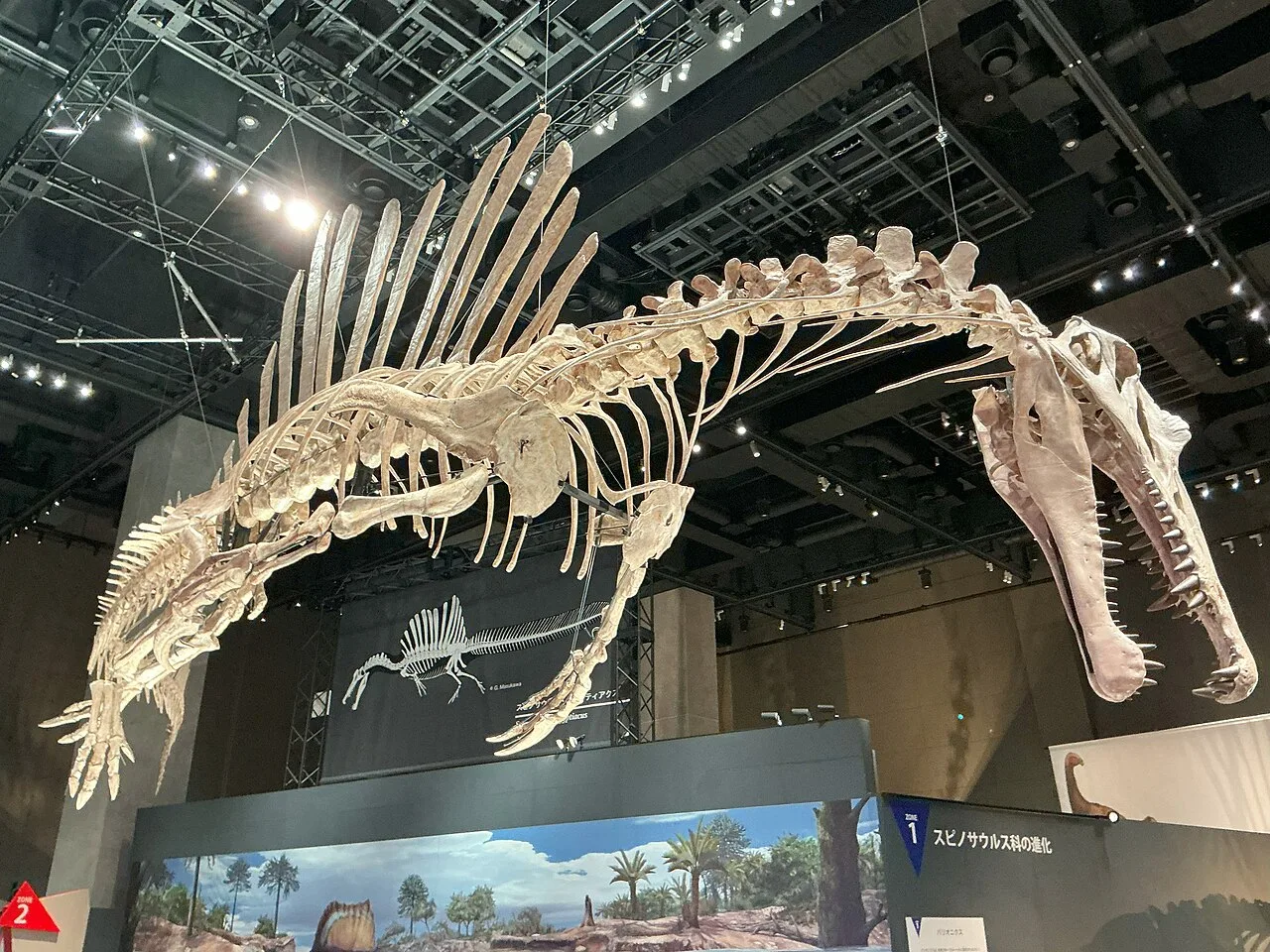
Spinosaurus quick facts
- The first Spinosaurus bones ever found were destroyed when bombs hit a museum in Munich, Germany, on 25 April 1944.
- Some of the spines that held up the sail on its back were about a metre (3 feet) long.
- A 2022 computer model found that Spinosaurus had air spaces inside its body, which would have made it float in deep water.
- Spinosaurus mirabilis, described in February 2026, is the first clear new species of Spinosaurus in more than a century.
- The newest Spinosaurus fossils come from old river beds in Niger, 500 to 1,000 km (300 to 600 miles) from the nearest sea.
What was Spinosaurus?
Spinosaurus was a huge, meat-eating dinosaur that lived in North Africa about 95 million years ago. It walked on two legs and ate mostly fish. Along its back ran a tall sail, held up by long spines of bone.
Its full scientific name is Spinosaurus aegyptiacus. Spinosaurus means “spine lizard”, after those spines. Aegyptiacus means “from Egypt”, where the first bones were found.
Spinosaurus was a theropod. Theropods were the two-legged group of dinosaurs that included most of the meat-eaters. Within that group, it belonged to the spinosaurids, a family of long-snouted fish-eaters. One of its relatives was Suchomimus, an older cousin that also lived in Africa.
It is one of the most argued-about dinosaurs of all. Scientists agree that it caught fish. They do not agree on how.
| Spinosaurus fact file | |
|---|---|
| Name means | spine lizard from Egypt |
| When it lived | about 95 million years ago, in the Late Cretaceous |
| Where it lived | North Africa: fossils from Egypt, Morocco and Niger |
| Length | just under 14 m (46 ft), by a 2022 estimate |
| Weight | about 7.4 tonnes |
| Food | mainly large fish |
| Named by | Ernst Stromer, in 1915 |
| Newest species | Spinosaurus mirabilis, described in 2026 |
The first skeleton, lost in 1944
The story begins in Egypt’s Western Desert. In January 1911, a German palaeontologist called Ernst Stromer found the first dinosaur bones ever dug up in Egypt. Palaeontologists are scientists who study fossils. Stromer was working at the Bahariya oasis, about 320 km (200 miles) south-west of Cairo.
The next year, Stromer’s fossil collector, Richard Markgraf, found a partial skeleton at the same place. It had a lower jaw, many teeth and some backbones. Spines of bone up to a metre (3 feet) long stuck straight up from the backbones, as if they held up a sail.
Stromer described the new dinosaur in 1915 and named it Spinosaurus aegyptiacus. There were no leg bones. Even so, he could tell it was enormous. He thought it was longer than Tyrannosaurus rex, which had only recently been found in North America.
The bones went on display in a museum in Munich, Germany. During the Second World War, Stromer begged the museum’s director to move the collection somewhere safe. The director, a supporter of the Nazi party, refused.
On 25 April 1944, hundreds of British bombers attacked Munich. The museum building took a direct hit, and every one of Stromer’s Egyptian fossils was destroyed. At the time, they were the only Spinosaurus bones known anywhere in the world.
Luckily, Stromer had already published drawings and descriptions of the bones. For decades after the war, scientists had little more than his pages to go on.

New fossils from Morocco and Niger
Over the last 30 years or so, more Spinosaurus bones have turned up in Morocco. They come from rocks of about the same age as the ones in Egypt.
The most important is a partial skeleton from a group of rocks called the Kem Kem beds. In 2014, scientists made it the new “name-bearing” specimen for Spinosaurus, called a neotype. A neotype is chosen when the original fossil of a species has been lost.
Nizar Ibrahim, who led the work on it, went back to the site in 2018. His team dug up much of the tail, which turned out to be one of the strangest tails of any dinosaur.
Spinosaurus fossils have been found in Niger, too, much further inland. Those fossils matter a great deal to the argument about how it lived, as you will see.
How long and heavy was Spinosaurus?
In 2022, a team led by Paul Sereno of the University of Chicago built a digital Spinosaurus. First they CT-scanned the Moroccan bones. A CT scanner takes X-ray pictures from many angles to make a 3D image. The team filled gaps with bones from other fossils, then covered the skeleton in muscle and skin.
Their adult Spinosaurus was just under 14 metres (46 feet) long. That is longer than a London double-decker bus. It weighed about 7.4 tonnes, roughly as much as five family cars.
Older estimates were bigger. Stromer thought it was almost 15 metres (50 feet) long, and the team that described the Moroccan skeleton in 2014 put it at more than 15 metres too. The 2022 model came out over a metre shorter.
The model also showed where its weight sat. Its centre of mass, the balance point of its body, was over its back feet. So on land, Spinosaurus walked on two legs, like other theropods. Its long-clawed arms were not used for walking.
Not everyone agrees about that. The team that dug up the tail in 2018 thought the balance point sat further forward. That would have tipped Spinosaurus forward on land, which fits their idea that it spent much of its life in water.

Jaws and teeth for catching fish
Spinosaurus had long, narrow jaws, a bit like a crocodile’s. Its teeth were cone-shaped, which made them good for gripping rather than slicing.
The newest species, Spinosaurus mirabilis, shows another trick. Its upper and lower teeth slotted between each other when the jaws closed, like the fingers of two hands laced together. That made a trap for slippery fish. Fish-eating crocodiles, flying reptiles called pterosaurs and sea reptiles called ichthyosaurs had teeth like this too.
Spinosaurus fossils are found with the remains of big fish. In Morocco, the new skeleton lay in old river mud alongside coelacanths, large fish that still live in the sea today. Fossil sites in Niger also hold the teeth of sawfish.
Almost every scientist agrees that Spinosaurus fed mainly from the water. Even the experts who think it waded say it probably fed in water more than any other large dinosaur. It may also have snapped up small animals on land.
The sail on its back
The sail is the most famous thing about Spinosaurus. It was held up by spines growing from the backbones, some of them about a metre long. In life, skin probably stretched between them to make a tall fan along the back.
What was it for? Nobody can be sure. The best-supported idea is display. A tall sail would make an animal look bigger, and it could help it show off to rivals or mates.
Some living reptiles have sails of spines over their backs and tails. They use them for display, not for swimming. The crest on the head of Spinosaurus mirabilis probably did the same job. Scientists think it was brightly coloured, like a signpost that others could see from a distance.
The big argument: swimmer or wader?
Since 2014, scientists have argued about how Spinosaurus caught its fish. One side says it swam underwater after its prey. The other says it stood in shallow water and snatched fish, like a huge heron.
Both sides agree that it spent a lot of time in or near water. The argument is about how deep it went and what it did there. The table shows the main studies, in order.
| Year | Study | What it argued |
|---|---|---|
| 2014 | Nizar Ibrahim, Paul Sereno and others, in Science | Spinosaurus was the first truly semiaquatic dinosaur, living partly in water |
| 2020 | Ibrahim and others, in Nature | its tall, fin-like tail drove it through water, so it hunted underwater |
| 2021 | David Hone and Thomas Holtz, in Palaeontologia Electronica | it was more like a giant heron, fishing from the shore and the shallows |
| 2022 | Matteo Fabbri and others, in Nature | its dense bones helped it sink and hunt underwater, like a penguin |
| 2022 | Sereno and others, in eLife | it floated too easily and was too unstable to dive, so it waded |
| 2024 | Nathan Myhrvold, Sereno and others, in PLOS ONE | the method used in the bone study was flawed; Fabbri’s team reran it and stood by its result |
| 2026 | Sereno and others, in Science | a new species found far inland was a wading “hell heron” |
The case for a swimming Spinosaurus
The strongest evidence for swimming is the tail. The tail dug up in Morocco in 2018 was more than 5 metres (16 feet) long. Along its length, the spines grew taller and taller, some reaching about a metre. Together they made a tall, flat fin.
Further down the tail, the bones stopped locking together. That let the tail bend easily from side to side, the way a swimming crocodile’s tail does.
At Harvard University, Stephanie Pierce and George Lauder tested the shape. They cut simple plastic models of different tails and fixed them to a robot that waved them from side to side in water. They compared the Spinosaurus tail with the tails of a crocodile, a salamander and two land-living dinosaurs.
The flat, bendy Spinosaurus tail swam far better than the stiffer tails of the land dinosaurs. “The crocodile is basically the same design,” Lauder said.
Then came the bones. In 2022, Matteo Fabbri and his colleagues measured how solid dinosaur bones were inside. Spinosaurus had very dense bones. Diving animals such as penguins have dense bones too. The extra weight works like a diver’s weight belt, helping them stay under.
Fabbri does not picture Spinosaurus as a dolphin that lived only in water. He thinks it could go underwater sometimes to fish. Crocodiles and hippos spend lots of time both on land and underwater, and he thinks Spinosaurus probably did the same.

The case for a giant heron
The other side sees a very different animal. In 2021, David Hone of Queen Mary University of London and Thomas Holtz of the University of Maryland compared Spinosaurus with living and extinct reptiles. They pictured it as a giant, flightless heron or stork. It would stand at the water’s edge or in the shallows and snatch passing fish.
They pointed out that Spinosaurus was a less efficient swimmer than a crocodile. It had fewer tail muscles than a crocodile, and its great size meant a lot of drag in the water. Yet even crocodiles cannot chase fish down underwater.
The 2022 model from Sereno’s team added more doubts. It found air spaces inside the neck and body of Spinosaurus, as birds have. Its body as a whole was lighter than the same amount of water, so it would float.
In deep water, the model was wobbly and tended to roll onto its side. It could swim at the surface, but slowly, at under 1 metre per second. That is slower than you walk. And it floated far too easily to dive.
Wading was no problem, though. The model only began to float in water deeper than about 2.6 metres (8.5 feet), well over the head of a tall adult. Sereno says Spinosaurus could wade out that far and ambush fish with its claws and jaws, while keeping its toes in the mud.
Sereno also has another explanation for the dense bones. Big, heavy land animals such as elephants have dense bones to carry their weight. Spinosaurus had short back legs holding up a very heavy body, so it needed extra-strong bones.
Where the fossils lie matters too. Some Spinosaurus bones come from Niger, far from any old coastline. They were buried in old river deposits next to long-necked plant-eating dinosaurs, which lived on land.

Why the question is still open
In 2024, the argument moved on to maths. Nathan Myhrvold, Paul Sereno and others checked the method the bone study had used. It was a statistical method that learns from animals whose way of life is known, then sorts new animals into groups.
Myhrvold said the method only works with lots of data and fair, like-for-like comparisons. In his view, the earlier study had neither, so its results did not hold up.
Fabbri’s team reran their numbers, taking the criticism into account. They say their result still stands. By their measurements, Spinosaurus bones were denser than those of any other non-bird dinosaur studied so far.
Part of the problem is words. Scientists do not all use “aquatic” to mean the same thing. To one team it means swimming and diving after prey. To the other, an animal that wades into water to feed is doing something different.
Even confident claims have been overtaken. In 2020, Stephanie Pierce said the new tail “put an end to the debate”. Six years later, it is still going. David Hone said in 2021 that his own study would not be the last word either.
So what should a school project say? It is fair to write that scientists agree Spinosaurus fed mainly on fish and spent a lot of time in water. They still disagree about whether it hunted by swimming underwater or by wading.
Spinosaurus mirabilis, a new species
In February 2026, Sereno’s team described a second species, Spinosaurus mirabilis. The University of Chicago calls it the first indisputable evidence of a new Spinosaurus species in more than a century.
The find began with a local guide. A Tuareg man led the team on his motorbike deep into the Sahara, in Niger, to a field of huge fossil bones. There, in November 2019, they picked up teeth, pieces of jaw and a strange curved bone. At first they did not know what the curved bone was.
They went back in 2022 with a bigger team and found two more. Only then did they realise it was a crest from the top of the head, shaped like a scimitar, a curved sword. In life, it was probably covered in keratin, the material your fingernails are made of.
Where it was found is the big news for the argument. The site lies 500 to 1,000 km (300 to 600 miles) from the nearest sea, in old river sediments. The bones lay close to skeletons of long-necked dinosaurs, in what was once a forest cut through by rivers.
Before this, spinosaurid fossils came mainly from places near old coastlines. That is one reason some scientists thought they lived like sea animals. This find shows that at least one Spinosaurus lived far from the sea.
Sereno imagines Spinosaurus mirabilis as a “hell heron”. He thinks it could wade into two metres of water, but spent most of its time stalking shallower spots for the many large fish of the day.

Three things people get wrong
1. “Scientists have proved that Spinosaurus was a swimmer.” News stories said so in 2014 and 2020. Since then, studies in 2021, 2022, 2024 and 2026 have argued that it waded like a heron instead. The question is still open, and a good project says so.
2. “Spinosaurus fought Tyrannosaurus rex.” The film Jurassic Park III shows the two fighting, but it could never have happened. Spinosaurus lived in North Africa about 95 million years ago. T. rex lived in North America nearly 30 million years later.
3. “Scientists can still study Stromer’s original skeleton.” Those bones were destroyed in Munich in April 1944. Today’s picture of Spinosaurus comes from his drawings and from newer fossils found in Morocco and Niger.
Did you know? During the Second World War, Ernst Stromer begged his museum’s director to move the Spinosaurus bones out of Munich. The director refused. When the museum was bombed in 1944, the only Spinosaurus skeleton known in the world was lost.
Try it
Test the floating question at a sink or in the bath, with a grown-up nearby. Put the lid on an empty plastic bottle and try to push it under the water with one finger. Then half-fill it with water and try again. Air makes things float, and water inside makes them easier to sink. One team of scientists says Spinosaurus had so much air inside its body that it could not dive. Another team says its heavy, solid bones worked like the water in your bottle. Which do you think mattered more?
Knowledge check
Why are Ernst Stromer’s Spinosaurus bones not in any museum today?
Show answer
They were destroyed when bombs hit the museum building in Munich, Germany, on 25 April 1944, during the Second World War.
What is the heron idea about how Spinosaurus caught fish?
Show answer
That Spinosaurus stood at the water’s edge or waded into shallow water on its back legs and snatched fish, like a giant heron, instead of chasing them underwater.
Frequently asked questions
How big was Spinosaurus?
Spinosaurus was just under 14 metres (46 feet) long and weighed about 7.4 tonnes, according to a 2022 digital model built from CT scans of its bones. Older estimates put its length at 15 metres (49 feet) or more.
Could Spinosaurus swim?
Spinosaurus could probably swim to some extent, but scientists disagree about how well. One team argues that its fin-like tail and dense bones made it an underwater hunter, while another says it floated too easily and was too unstable to dive.
What did Spinosaurus eat?
Spinosaurus ate mainly fish. Its long jaws and cone-shaped teeth were built for gripping slippery prey, and its fossils are found with the remains of large fish such as coelacanths and sawfish. Some scientists think it also caught small animals on land.
Where did Spinosaurus live?
Spinosaurus lived in North Africa about 95 million years ago. Its fossils have been found in Egypt, Morocco and Niger, in rocks laid down by rivers and along old coastlines.
What happened to the first Spinosaurus fossils?
The first Spinosaurus fossils were destroyed on 25 April 1944, when British bombers hit the museum in Munich where they were kept. Ernst Stromer’s published drawings and descriptions survived, and newer fossils have since been found in Morocco and Niger.
What was the sail of Spinosaurus for?
Nobody knows for certain what the sail of Spinosaurus was for, but most scientists think it was for display, to show off to rivals or mates. Living reptiles with similar sails of spines use them for display, not for swimming.
Sources
- Linda Hall Library: Scientist of the Day, Ernst Stromer (2020) — the 1911 and 1912 finds at Bahariya, the metre-long spines, the 1915 name, Stromer’s size estimate and the destruction of the fossils on 25 April 1944
- Harvard Gazette: New paper argues the Spinosaurus was aquatic (2020) — the 2018 tail fossils from Morocco, the robot tail experiment, coelacanths in the same rocks, the swimming speed estimate and the claim that the debate was over
- Queen Mary University of London: Spinosaurus as a monstrous heron (2021) — the heron and stork idea, tail muscles and drag compared with a crocodile, feeding mostly from water, and older length estimates
- eLife: Sereno and others, Spinosaurus is not an aquatic dinosaur (2022) — the 14 m length and 7.4 tonne mass, air spaces and floating, the balance point over the hind feet, wading depth, slow surface swimming, the neotype from Morocco, inland fossils in Niger and the sail as display
- University of Chicago News: Did Spinosaurus hunt its prey deep underwater or from shore? (2024) — each study from 2014 to 2024, the bone-density argument on both sides, the 2024 PLOS ONE critique and Fabbri’s reply
- University of Chicago Biological Sciences Division: New scimitar-crested Spinosaurus species discovered in the central Sahara (2026) — Spinosaurus mirabilis, its crest and interlocking teeth, how and when it was found, its inland river setting and the hell heron idea


