
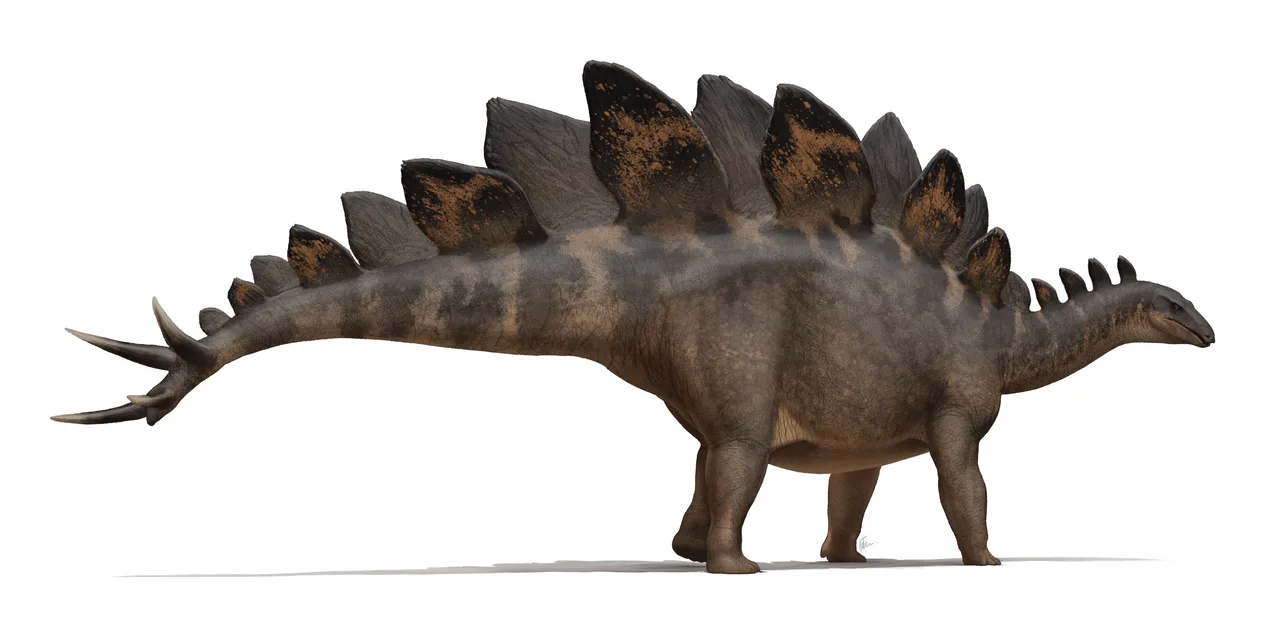
Stegosaurus quick facts
- Stegosaurus and Tyrannosaurus rex lived about 80 million years apart, so T. rex lived closer in time to us than to Stegosaurus.
- The plates were not joined to the skeleton. Their bases sat in the skin.
- Stegosaurus had a bite about as strong as a cow’s or a sheep’s, far stronger than its tiny teeth suggest.
- Nobody has ever found a Stegosaurus egg.
- The Stegosaurus known as Apex has about 254 of its roughly 320 bones, and it sold for $44.6 million in 2024.
What was Stegosaurus?
Stegosaurus was a large plant-eating dinosaur with a double row of bony plates along its back and sharp spikes on its tail. Its name means “roof lizard” or “plated lizard”. It lived about 150 million years ago, in the Late Jurassic, in what is now the western USA.
A fully grown Stegosaurus was about 8 to 9 metres (26 to 30 feet) long. That is about the length of two family cars parked nose to tail. It stood about 2.7 metres (9 feet) tall at the hips, and its tallest plates rose higher still.
Nobody agrees on exactly how heavy it was. The Prehistoric Museum at Utah State University Eastern gives about 3,100 kg (6,800 pounds). A curator at the American Museum of Natural History describes a body of about five tonnes. Working out the weight of an animal from its bones is hard, and different methods give different answers.
Stegosaurus gave its name to a whole group of dinosaurs, the stegosaurs. You can see where they fit among the other groups in our dinosaur facts for kids. Stegosaurs lived from about 170 to 145 million years ago. Their fossils have been found in North America, Europe, Asia and Africa. Most stegosaurs had spikes along their backs. Stegosaurus stands out because it had broad plates instead.

How Stegosaurus was discovered
The American palaeontologist Othniel Charles Marsh named the first species, Stegosaurus armatus, in 1877. A palaeontologist is a scientist who studies fossils. Marsh was in a bitter race with a rival, Edward Drinker Cope, to find and name new dinosaurs. Their feud became known as the Dinosaur Wars.
The best-known species today is Stegosaurus stenops. It was first found in Colorado in 1885. At least two other species have turned up in Utah, Colorado and Wyoming. One Stegosaurus has even been found in Portugal, in Europe.
Although Stegosaurus has been known for well over a century, scientists still know surprisingly little about how it lived. Most skeletons are found in pieces. That is why two nearly complete skeletons, called Sophie and Apex, matter so much. You can read about both of them further down.
The plates on its back
The plates ran in two rows from the neck to the tail. They did not stand in matching pairs. Instead they alternated, so a plate on one side sat between two plates on the other.
The two Utah museums count 17 plates on a Stegosaurus, but Sophie, the skeleton in London, has 19. The biggest were about 75 cm (2.5 feet) tall and just as wide, bigger than a dustbin lid. Their surface was rough, and in life it was covered in keratin, the same material as your fingernails.
Here is something many people do not know. The plates were not joined to the skeleton at all. Their bases were set into the skin, and they were only loosely attached to the back.
So what were they for? Scientists have argued about it since the 1800s, and there are three main ideas.
| Idea | Evidence for it | Evidence against it |
|---|---|---|
| Armour against attackers | the plates are large and cover the back | they are thin and fragile, sit loosely in the skin, and would snap under a strong bite |
| Controlling body heat | the plates are big and flat, and they were full of blood vessels that could carry warm blood to the surface | the American Museum of Natural History thinks display is a more likely reason |
| Display | big, eye-catching shapes help animals show off, as a peacock’s tail does | nobody knows what colour the plates were |
Very few scientists still think the plates were armour. Stegosaurus came from ancestors with spikes along their backs, and those spikes slowly turned into plates. It is unlikely that happened just for protection.
Museums do not all give the same answer about the other two ideas. Roger Benson of the American Museum of Natural History says display is the most likely reason. Stegosaurus may have used its plates to impress mates or to show which animal was in charge. The Natural History Museum in London says display or cooling are both possible. The Prehistoric Museum in Utah suggests the plates did both jobs.

Tail spikes and the thagomizer
The tail was another story. At the end of its flexible tail, Stegosaurus carried four long bony spikes. Each one could be up to 45 cm (18 inches) long, about as long as a grown-up’s arm from elbow to fingertip.
You may have heard the spikes called a “thagomizer”. It is a popular nickname, but it is not the scientific name. Scientists usually just call them tail spikes.
Unlike the plates, the spikes almost certainly were weapons. Stegosaurus probably swung its tail to defend itself, not to attack. Its enemies included meat-eaters such as Allosaurus and Torvosaurus.
We have real evidence for this. An Allosaurus tail bone has a hole punched through it that matches the shape of a Stegosaurus tail spike. Some Stegosaurus spikes also have broken tips that later healed. That means the spikes hit something hard while the animal was alive, and it survived.
Stegosaurus had some protection at the front end too. Small pebbles of bone grew in the skin of its throat. These helped to shield its windpipe from a predator’s bite.

A small brain, but not two
Stegosaurus really did have a small brain. Roger Benson of the American Museum of Natural History says it was about the size of a small lemon or lime. Stegosaurus was probably not very clever.
There is a catch, though. Its whole head was very small too. Next to a body weighing several tonnes, the brain looks tiny. Yet it was not much smaller than the brains of other reptiles with heads that size.
You may also have read that Stegosaurus had a second brain in its hips. It did not. The idea comes from a large space in the backbone above the hips.
Museums explain that space in two slightly different ways. The American Museum of Natural History says it held a large bundle of nerves, which is common in many animals. The Natural History Museum in London says it was a store for food substances that helped the animal survive when food was short. Neither museum thinks it was a brain.

Beak, teeth and a surprising bite
Stegosaurus had no teeth at the front of its mouth. Instead it had a beak for snipping off plants. Further back, both sides of its jaws were lined with small cheek teeth.
Those teeth were tiny, each about the size of your little fingernail. They look a lot like the teeth of a green iguana today. They do not look well suited to grinding up plants, and scientists long puzzled over how such a big animal got enough to eat.
The skeleton called Sophie changed that. Scientists at the Natural History Museum in London scanned her skull and rebuilt her jaw muscles on a computer. They found that Stegosaurus had a bite about as strong as a cow’s or a sheep’s. Its jaws worked very efficiently.
That means Stegosaurus could manage tough food. It probably ate ferns, cycads and ginkgoes, which grew in its world. It also had a large gut to break down the plants it swallowed.

How Stegosaurus moved and lived
Stegosaurus walked on all four legs, but its legs were not the same length. Its front legs were short, and its back legs were long. That is because it came from earlier dinosaurs that walked only on their back legs.
This mismatch made it a slow, clumsy walker. Stegosaurus could not run. It probably walked at about the speed of a walking rhino or elephant, only a few kilometres an hour. Each back foot had three toes with blunt hooves.
Stegosaurus probably did not live in big herds, because its fossils are usually found one at a time, sometimes near giant long-necked dinosaurs. It may have fed alongside other plant-eaters without forming herds of its own.
Some mysteries remain. Nobody has ever found a Stegosaurus egg. The smallest young Stegosaurus found so far were about 1 metre (3 feet) long, so hatchlings must have been smaller still. Its skin was scaly, a bit like a crocodile’s, but its colours are unknown.
Sophie, the Stegosaurus in London
In spring 2003, fossil hunter Bob Simon was digging at Red Canyon Ranch in Wyoming. He found a Stegosaurus skeleton buried at the top of a hill, with its bones still nearly all joined together. Digging it out took three weeks.
The skeleton is 5.6 metres (18 feet) long and 2.9 metres (9.5 feet) tall, about the size of a big 4×4 car. It has more than 300 bones, 19 plates and four tail spikes. That is the most complete set of plates and spikes ever found on one Stegosaurus.

The Natural History Museum in London bought the skeleton with help from 70 donors. It is named Sophie after the daughter of Jeremy Herrmann, one of those donors. Sophie went on show on 4 December 2014. At the time it was the only Stegosaurus in a public collection outside the USA.
Sophie was a young adult, not yet fully grown, when she died. Nobody knows whether Sophie was male or female, even though the name sounds like a girl’s. Her skull bones are all separate and not squashed, so scientists can study how they fitted together.
Apex, the biggest Stegosaurus yet found
In 2022, a commercial fossil hunter called Jason Cooper found another Stegosaurus just outside a town that is really called Dinosaur, in Colorado. The skeleton was named Apex because of its great size.
Apex is about 8.2 metres (27 feet) long and 3.5 metres (11.5 feet) tall. It is around 30% bigger than other Stegosaurus skeletons, and it lived into old age. About 254 of its roughly 320 bones survived. Missing pieces were filled in with 3D-printed and sculpted parts.
| Sophie | Apex | |
|---|---|---|
| Found | 2003, Red Canyon Ranch, Wyoming | 2022, near Dinosaur, Colorado |
| Length | 5.6 m (18 ft) | about 8.2 m (27 ft) |
| Height | 2.9 m (9.5 ft) | about 3.5 m (11.5 ft) |
| Age at death | young adult, still growing | old adult |
| Where to see it | Natural History Museum, London, since 2014 | American Museum of Natural History, New York, on loan from 2024 |
In July 2024, Apex was sold at a Sotheby’s auction for $44.6 million. That made it the most expensive dinosaur fossil ever sold at the time. The buyer, businessman Kenneth Griffin, lent it to the American Museum of Natural History. It went on show on 8 December 2024 for four years.
Scientists there are now studying a slice of one of its thigh bones. Bone grows in rings, a bit like the rings in a tree trunk. Counting them may reveal how old Apex was and how fast Stegosaurus grew.
Apex also has a strange scar. Its shoulder blade has a puncture wound with a fragment of bone from its own tail stuck inside. One idea is that it hurt itself while curling round. Not everyone is happy about the sale. Some scientists worry that fossils sold to private owners may not stay available for study.

Three things people get wrong
1. “Stegosaurus fought Tyrannosaurus rex.” The two never met. Stegosaurus lived about 150 million years ago and T. rex about 70 million years ago. That puts T. rex closer in time to us than to Stegosaurus.
2. “Stegosaurus had a second brain in its hips.” It had only one brain, about the size of a lemon. The space in its hips held nerves or a food store, not a brain.
3. “The plates were armour.” The plates were thin, fragile and only loosely attached, so they would not have stopped a bite. Many experts think they were for display, and perhaps for cooling. The tail spikes were the real weapons.
Did you know? Sophie, the Stegosaurus in London, was found on top of a hill at Red Canyon Ranch in Wyoming in spring 2003. Her skeleton was so complete that only the left arm and the base of the tail were missing.
Try it
Test the heat idea. Take two sheets of kitchen paper of the same size and wet them both. Scrunch one into a tight ball and spread the other out flat. Leave them side by side somewhere warm. Which one dries first? A flat, spread-out shape loses water and heat faster, which is why some scientists think big, flat plates could have helped Stegosaurus cool down.
Knowledge check
Why do most scientists doubt that the plates were armour?
Show answer
The plates were thin and fragile, and they sat loosely in the skin instead of being fixed to the skeleton, so they would not have stopped a strong bite.
What evidence shows that Stegosaurus used its tail spikes to defend itself?
Show answer
An Allosaurus tail bone has a hole that matches a Stegosaurus tail spike, and some Stegosaurus spikes have broken tips that healed.
Frequently asked questions
What does the name Stegosaurus mean?
The name Stegosaurus means “roof lizard” or “plated lizard”, after the big bony plates on its back. The American palaeontologist Othniel Charles Marsh named the first species of Stegosaurus in 1877.
How big was a Stegosaurus?
A fully grown Stegosaurus was about 8 to 9 metres (26 to 30 feet) long and about 2.7 metres (9 feet) tall at the hips. The largest known skeleton, called Apex, is about 8.2 metres (27 feet) long and 3.5 metres (11.5 feet) tall.
What were the plates on a Stegosaurus for?
Nobody knows for certain what the Stegosaurus plates were for. Many experts now think the plates were used for display, to show off to other Stegosaurus, and some think they also helped the animal lose heat. Few scientists still think the plates were armour.
Did Stegosaurus have two brains?
Stegosaurus did not have two brains. A space in its hips was once thought to hold a second brain, but museums now explain it as room for a large bundle of nerves or a store of food substances for hard times.
How big was a Stegosaurus brain?
A Stegosaurus brain was about the size of a small lemon or lime, according to the American Museum of Natural History. That is tiny next to a body weighing several tonnes, but not much smaller than the brains of other reptiles with heads the same size.
Did Stegosaurus live at the same time as T. rex?
Stegosaurus and Tyrannosaurus rex never met. Stegosaurus lived about 150 million years ago and T. rex about 70 million years ago, so about 80 million years separate them.
What did Stegosaurus eat?
Stegosaurus ate plants such as ferns, cycads and ginkgoes. Scientists who modelled the jaws of the Sophie skeleton in London found that Stegosaurus had a bite about as strong as a cow’s or a sheep’s.
Sources
- Natural History Museum, London: World’s most complete Stegosaurus goes on show (2014) — Sophie’s size, bones, 19 plates and four spikes, her separate skull bones, her age, and where, when and by whom she was found
- Natural History Museum, London: A Stegosaurus brought to life — Sophie’s scans, her short front legs and slow walk, the size of the teeth, the cow-strength bite, the diet, the two-brains myth and the ideas about the plates
- American Museum of Natural History: Apex Stegosaurus fossil, with the video 11 questions about Stegosaurus — Apex’s discovery, bones and thigh-bone study, keratin on the plates, stegosaurs around the world, the gap between Stegosaurus and T. rex, the plates and spikes, herds, the brain, eggs, skin, colour, food and teeth
- Smithsonian Magazine: You can now see Apex, the world’s most expensive dinosaur fossil (2024) — Apex’s size, price, sale and loan, who found it and when, the wound in its shoulder blade, and scientists’ worries about fossils sold to private owners
- Natural History Museum of Utah: Stegosaurus armatus — Marsh naming Stegosaurus in 1877, the two alternating rows of up to 17 plates set in the skin, the four tail spikes, broken and healed spikes, the damaged Allosaurus bone, and the Stegosaurus found in Portugal
- Utah State University Eastern Prehistoric Museum: Stegosaurus stenops — the meaning of the name, length, height and weight, the size of the plates and spikes, the bony pebbles in the throat, the beak and cheek teeth, the three-toed feet, and the pierced Allosaurus tail bone


