
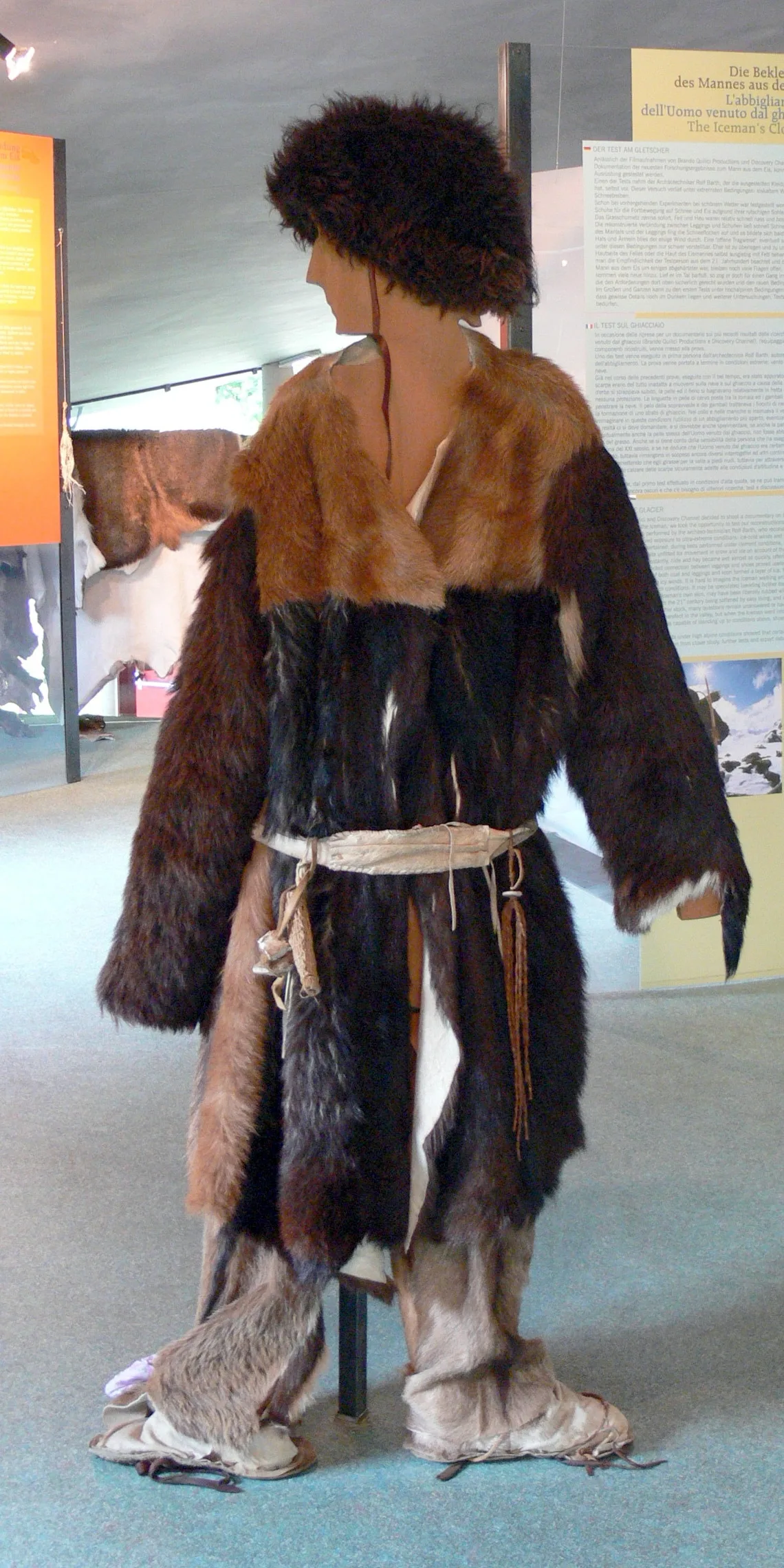
Stone Age clothes quick facts
- Nearly a full Stone Age outfit survives, frozen in the Alps for 5,300 years on a man called Otzi.
- Otzi’s coat was stitched from goat and sheep hide, and his hat was bear fur.
- Studying head lice and body lice suggests people began wearing clothes at least 100,000 years ago.
- Dyed flax fibres from a cave in Georgia are around 34,000 years old, so thread came long before farming.
- Otzi’s shoes were stuffed with grass, which works rather like a modern thermal sock.
The problem with studying Stone Age clothes
Stone tools survive for a million years. Clothes do not survive at all.
Skin, fur, sinew and plant fibre all rot. In ordinary soil they are gone within a few centuries, so almost nothing is left of what Stone Age people actually wore.
Archaeologists get round this in four ways, and it is worth knowing which is which.
| Evidence | What it shows | Example |
|---|---|---|
| Frozen or waterlogged finds | The actual clothing, sometimes nearly complete | Otzi the Iceman, about 3300 BC |
| Tools for making clothes | That people were scraping hides and sewing seams | Flint scrapers, bone awls, eyed needles |
| Fibres and impressions | Thread and cloth, even where the cloth itself is gone | Dyed flax from Dzudzuana Cave, Georgia |
| Lice | Roughly when clothing was invented | Body lice split from head lice |

What head lice tell us about trousers
This is the strangest piece of evidence in the whole subject, and it works surprisingly well.
Humans carry two closely related kinds of louse. Head lice live in hair. Body lice live in clothing, crawling onto skin only to feed.
Body lice cannot exist without clothes, because clothes are their habitat. So they can only have appeared after people started wearing them.
Scientists can compare the DNA of the two kinds and estimate how long ago they split into separate species. The answer keeps being revised, but it puts the invention of clothing at least 100,000 years ago, and quite possibly a good deal earlier.
An insect nobody wants gave us a date that no piece of surviving clothing ever could.
The invention that changed everything
You can make a rough garment without a needle. Punch holes in a hide with a sharp point, thread a strip of leather through and pull it tight, and you have a wrap that will keep some weather off.
What you cannot make is a close-fitting seam.
That changed with the eyed needle, carved from bone or ivory with a hole drilled through one end. The oldest examples are around 40,000 years old. Making one is fiddly, slow work, and people clearly thought it was worth the effort.
The reason is warmth. Clothing keeps you warm by trapping a layer of still air against your skin. A loose wrap lets that air escape every time you move. A fitted, stitched garment holds it in.
Eyed needles turn up at exactly the time modern humans were spreading into some very cold places. That is unlikely to be a coincidence.

One outfit that survived
In 1991 two walkers in the Alps found a body in melting ice near the border between Italy and Austria. They assumed it was a lost climber.
It turned out to be a man who died around 3300 BC. He is now known as Otzi, and because the ice held him for 5,300 years, his clothes came out with him.
This is the most complete Stone Age outfit anyone has ever found.
| Item | Made from | Detail |
|---|---|---|
| Coat | Goat and sheep hide | Strips stitched together, worn with the hair facing out |
| Leggings | Goat hide | Two separate legs, tied to a belt |
| Loincloth | Sheep hide | Worn between the leggings |
| Hat | Bear fur | Round, with a chin strap |
| Cloak | Woven grass | Long, and useful as shelter as well as clothing |
| Shoes | Bearskin soles, deer hide uppers | Stuffed with grass held in place by a bark-string net |
| Belt with pouch | Calf leather | Held a scraper, a drill, a flint flake and dried fungus |
Look at the range of animals there: goat, sheep, bear, deer, cow. Each material was chosen for a job. Bear fur is warm and sheds water, so it went on the head. Grass insulates and can be replaced anywhere, so it went in the shoes.
Otzi’s coat had also been repaired, more than once, with stitching that does not match the original work. Somebody mended his clothes.
How a hide became a coat
A fresh animal skin is not wearable. Left alone it goes stiff, then rots. Turning one into clothing takes several days of hard work.
First the skin is pegged out and scraped. Flint scrapers, which are among the commonest tools found at Stone Age sites, take off the fat and flesh on one side and sometimes the hair on the other.
Then it has to be softened, by rubbing, stretching and working it over and over as it dries. Many groups also smoked hides over a fire, which helps them stay soft after they get wet.
Only then can it be cut. Holes go in with an awl, a sharp bone or flint point, and the pieces are stitched with thread made from sinew, the tough cord that joins muscle to bone. Dried sinew splits into fine strong fibres and swells slightly when wet, which tightens the seam.
The scrapers and awls that did all this are in our guide to Stone Age tools.
Cloth, long before farming
People often assume cloth arrived with farming, because farming gave us flax and wool in quantity. The evidence says otherwise.
In Dzudzuana Cave in Georgia, in the Caucasus mountains, archaeologists recovered flax fibres that had been twisted into thread. They are roughly 34,000 years old, which is deep in the Old Stone Age.
Some of those fibres had been dyed. Several different colours turned up, including black, grey, turquoise and pink.
So people were gathering wild flax, separating out the fibres, spinning them into thread and colouring them, tens of thousands of years before anybody planted a crop.
Buttons, beads and looking good
Stone Age clothing was not only about keeping warm.
Graves turn up beads in their thousands, drilled from shell, bone, ivory and animal teeth. Some are arranged in the positions they would sit if they had been sewn onto clothing, so we can see roughly where the decoration went.
Bone and antler pins are common too, and a pin is how you fasten a cloak before buttons exist. At Skara Brae in Orkney, excavators found pins, beads, pendants and necklaces sitting in Neolithic houses.
Experiments in carving replicas suggest a single ivory bead takes the better part of an hour. A garment covered in them cost months of somebody’s time, spent on something that has nothing to do with staying alive.
The clearest example comes from Sungir in Russia, a site roughly 34,000 years old. Two children were buried there wearing clothing sewn with somewhere around 10,000 mammoth ivory beads between them, along with a nearby adult carrying several thousand more.
Nobody can say exactly how long that took, because we do not know how many people worked on it or how skilled they were. Even at the fastest rate anyone has managed in an experiment, it is thousands of hours of carving and drilling.

Dressing for an ice age
For much of the Old Stone Age, large parts of Europe were far colder than today. People lived through it without wool, without cotton and without anything woven at scale.
What they had was fur, and fur is extremely good. Arctic peoples in recent centuries wore layered skin clothing that outperforms a lot of modern gear: an inner layer with the fur turned inwards against the skin, an outer layer with the fur turned outwards to shed snow.
Nobody has dug up an ice-age fur suit, so we cannot prove Stone Age people did exactly that. What we can say is that they had the needles to make fitted clothing, the scrapers to prepare the hides, and a very strong reason to get it right.

Three things people get wrong
Myth: Stone Age people wore one shapeless fur, off one shoulder. That picture comes from cartoons. Otzi wore a stitched coat, separate leggings, a loincloth, a hat, a cloak and insulated shoes. The eyed needle existed for around 35,000 years before he was born.
Myth: cloth was invented by farmers. Dyed flax thread from Dzudzuana Cave is about 34,000 years old, roughly 20,000 years before farming began. People were spinning and colouring fibre long before they grew it.
Myth: clothing was only about survival. Stone Age graves contain thousands of carefully drilled beads, and single ivory beads take about an hour each to make. People spent months decorating what they wore.
Did you know? Body lice live in clothing rather than on skin, so they could only evolve once people had clothes to live in. Working out when body lice split from head lice gives scientists a rough date for the invention of clothing.
Try it
Push a blunt darning needle through a piece of thick felt or an old leather belt. Now imagine doing it with a needle carved from bone, through a stiff animal hide, using thread you twisted yourself from dried sinew.
Knowledge check
What was Otzi’s hat made of?
Show answer
Bear fur. His coat was goat and sheep hide, and his leggings were goat.
Why did the eyed needle matter so much?
Show answer
It let people sew close, fitted seams, so clothing could hold warm air against the body instead of hanging loose.
Frequently asked questions
What did Stone Age people wear?
Stone Age people wore clothes made from animal skins and furs, and later from plant fibres such as flax. Outfits included coats, leggings, loincloths, shoes, hats and cloaks, sewn together with thread made from sinew, gut or plant fibre.
How did Stone Age people make clothes?
They scraped fat and hair from animal hides with flint scrapers, softened the hide by working it, then cut it to shape. Holes were punched with a pointed tool called an awl, and the pieces were stitched together with sinew thread.
When did humans start wearing clothes?
Nobody can date it exactly, because skins rot away. Studies of body lice, which live only in clothing, suggest people were wearing clothes at least 100,000 years ago and possibly much earlier.
What is the oldest Stone Age outfit ever found?
The clothing found on Otzi the Iceman, a man who died in the Alps around 3300 BC, is the most complete Stone Age outfit known. It includes a hide coat, leggings, a loincloth, a bearskin hat, a grass cloak and shoes.
Did Stone Age people wear shoes?
Yes. Otzi’s shoes had bearskin soles and deer hide uppers, with a net of bark string inside to hold soft grass in place as insulation. Foot bones from earlier sites also show changes that happen when people wear sturdy shoes.
Did Stone Age clothes have colour?
Some did. Flax fibres found in Dzudzuana Cave in Georgia, around 34,000 years old, had been dyed in several colours. People also used red ochre, a natural earth pigment, on objects and on themselves.
Sources
- South Tyrol Museum of Archaeology: Otzi’s clothing — the coat, leggings, loincloth, bearskin hat, grass cloak and shoes, and the materials each was made from
- South Tyrol Museum of Archaeology: Otzi the Iceman — who Otzi was, when he died, and how the ice preserved his belongings
- Historic Environment Scotland: Skara Brae history and stories — the bone pins, beads and tools that show how Neolithic people fastened and decorated what they wore


