
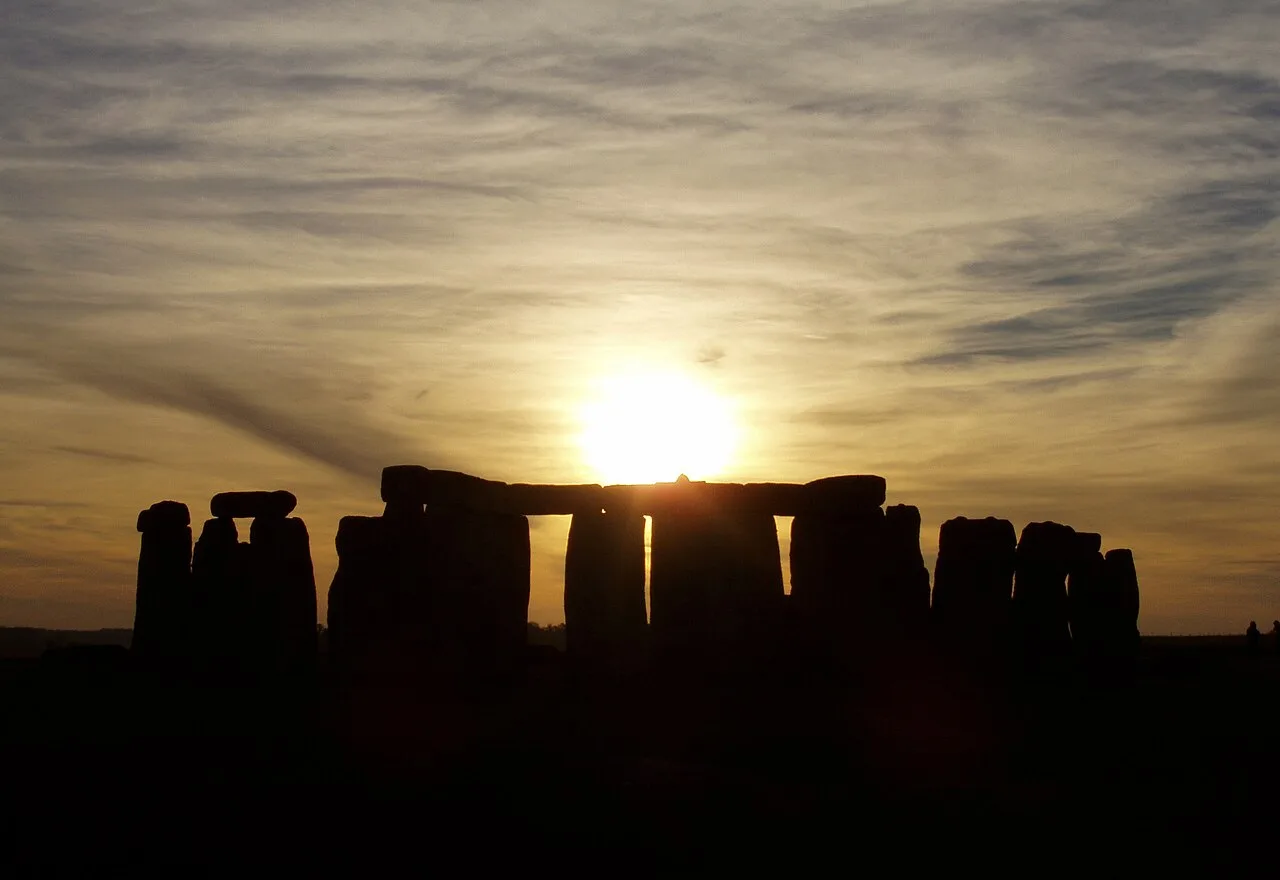
Stonehenge quick facts
- The stone at the centre travelled about 750 kilometres from north-east Scotland, which scientists only worked out in 2024.
- The builders joined stone the way carpenters join wood, using pegs and slots copied from woodwork.
- Druids did not build it. They came along roughly 2,000 years later.
- It was a burial ground first: the burnt remains of around 150 people were buried there.
- The huge sarsen stones came from only about 25 kilometres away, which nobody could prove until 2020.
Stonehenge at a glance
Stonehenge stands on open chalk grassland in Wiltshire, in the south of England. People began work on it about 5,000 years ago and kept changing it for another 1,500 years. Here are the main facts in one place.
| Fact | Detail |
|---|---|
| Where | Salisbury Plain, Wiltshire, England |
| First built | About 3000 BC, as a ditch and bank |
| Stone circle raised | About 2500 BC |
| Last changes | About 1500 BC |
| Biggest stones | Sarsens, around 25 tonnes each |
| Sarsens came from | West Woods, about 25 km away |
| Bluestones came from | Preseli Hills, west Wales, about 250 km |
| Altar Stone came from | North-east Scotland, about 750 km |
| Lines up with | Midsummer sunrise and midwinter sunset |
| Looked after by | English Heritage |

Who actually built it
Farmers built Stonehenge. Not one group of them, either.
Work went on for roughly 1,500 years, which is longer than the time between now and the Vikings. Children who watched the first ditch being dug were long dead before the great stones went up. Whole generations knew the place only half-finished.
The people who raised the biggest stones around 2500 BC lived about three kilometres away, at a settlement called Durrington Walls. Archaeologists have dug up their rubbish there: huge quantities of pig and cattle bone, much of it from midwinter feasts.
Checks on the animals’ teeth show some of those pigs were raised hundreds of kilometres away and walked to the site. People were coming from across Britain to be there.
Three kinds of stone, three different journeys
People often say the Stonehenge stones were dragged a huge distance. The truth is more interesting, because the stones are not all the same and they did not all come from one place.
The sarsens are the giants, the ones you picture. Each stands about seven metres tall above ground and weighs roughly 25 tonnes, about as much as four African elephants. For centuries nobody knew exactly where they came from. In 2020 geologists matched their chemistry to West Woods near Marlborough, only about 25 kilometres away. That is a long way to drag 25 tonnes. It is not, by the standards of this site, very far at all.
The bluestones are the smaller ones inside the circle, weighing 2 to 4 tonnes. They came from the Preseli Hills in west Wales, about 250 kilometres away. Getting them to Salisbury Plain took either an enormous overland haul or a long journey by water.
Then there is the Altar Stone, and its story changed completely in 2024.

The stone that came from Scotland
The Altar Stone is a slab of sandstone five metres long, lying flat at the heart of the monument. Two fallen sarsens rest on top of it, so most visitors never really see it.
For a long time everybody assumed it came from south Wales, like some of the bluestones. Then a team of geologists took tiny fragments and dated the mineral grains inside them.
Minerals carry a chemical fingerprint from the rock they formed in. The fingerprint did not match Wales. It matched a rock formation in north-east Scotland called the Orcadian Basin, which stretches around Orkney and the coast near John o’ Groats.
That puts the stone’s starting point about 750 kilometres from Stonehenge.
Nobody expected it. The researchers published the result in the journal Nature in 2024, and it changed how archaeologists think about Neolithic Britain. Moving six tonnes of rock that far means the people of Orkney and the people of Wiltshire were connected somehow, across the whole length of the island.
How it travelled is still an open question. The land route crosses hills, bogs and thick forest. Most researchers now think it went by sea, around the coast. Nobody has proved it.
Stone joined like wood
Look at the top of a sarsen upright and you will find a stone knob sticking up, carefully shaped. Look at the underside of the stone lying across it and there is a hollow cut to fit.
That is a mortise and tenon joint. Carpenters use it to make chairs and roof beams. The Stonehenge builders copied it into stone so the lintels could not slide off in a gale.
They used a second woodworking joint too. The curved lintels of the outer ring fit into each other end to end, tongue into groove, the way floorboards do.
All of it was cut with stone tools, by people who had no metal. They shaped granite-hard sarsen by battering it with hammerstones, patiently, for a very long time.
Why it points at the sunrise
Stonehenge is not a random ring. It has a clear axis, and that axis is aimed at the sky.
On the longest day of the year, around 21 June, the sun rises in line with the avenue that runs up to the monument. On the shortest day, around 21 December, the sun sets in line with the opposite direction.
Which of the two mattered more to the builders is debated. The feasting evidence at Durrington Walls points heavily at midwinter, so many archaeologists now think the midwinter sunset was the main event.
Either way, the point is the same. A farming people who needed to know when winter would turn built a machine out of rock to tell them. It still works.

A burial ground before it was a circle
The earliest Stonehenge was not stone at all. Around 3000 BC people dug a circular ditch with a bank inside it, using antler picks. Red deer antler, shed naturally and collected off the ground.
Those antlers are why we can date the site so well. Antler is organic, so radiocarbon dating works on it.
Inside the ditch, people dug a ring of pits. Into many of them they placed the burnt bones of the dead. The remains of around 150 people have been found, which makes Stonehenge one of the largest late Stone Age cemeteries known in Britain.
So for its first few centuries, Stonehenge was a graveyard. The stones came afterwards.
You can read more about the people who did this in our guides to the New Stone Age and to Neolithic houses.
What is there today
About half the original stones are still standing. Others have fallen, and some were taken away over the centuries to be used for building.
English Heritage looks after the site now. Visitors walk a path around the circle rather than through it, because millions of feet would wear the ground to bare chalk. Twice a year, at the summer and winter solstices, people are allowed in among the stones.
The wider landscape matters as much as the circle. Within a few kilometres there are hundreds of burial mounds, a second timber monument at Woodhenge, and the huge earthwork at Durrington Walls. Stonehenge was never meant to be looked at on its own.
What nobody knows
A good guide should be honest about the gaps, and at Stonehenge the gaps are large.
Nobody knows what the builders called it. Nobody knows what they believed, because they left no writing. Nobody knows exactly how the sarsens were moved or lifted, though sledges, rollers and timber frames have all been tested and all work.
Nobody knows why the bluestones were brought so far when perfectly good stone lay closer. And nobody yet knows how the Altar Stone made the journey from Scotland.
Those unanswered questions are not a weakness in the story. They are the reason people are still digging.
Three things people get wrong
Myth: Druids built Stonehenge. Druids were priests in Iron Age Britain, around 2,000 years ago. The last work at Stonehenge finished about 1500 BC, roughly 1,500 years before any Druid existed. The idea comes from writers in the 1600s who guessed wrongly, and it stuck.
Myth: all the stones were dragged from Wales. Only the bluestones came from Wales. The huge sarsens came from about 25 kilometres away, and the Altar Stone turned out in 2024 to have come from north-east Scotland, three times further than the Welsh stones.
Myth: it was built all at once. Stonehenge was rebuilt and rearranged for about 1,500 years. Stones were moved, taken out and put back in different places. What stands today is the last version of many, not a single plan carried out by a single group.
Did you know? The builders left a gap at the top of each upright so the stone lying across it could not slide off. That is a mortise and tenon joint, and it is the same joint a carpenter uses to make a chair.
Try it
Stand outside at sunrise and mark where the sun comes up, using a stick pushed into the ground. Do it again a month later. The sunrise point moves along the horizon through the year, and spotting that movement is the whole idea behind Stonehenge.
Knowledge check
How far did the Altar Stone travel to reach Stonehenge?
Show answer
About 750 kilometres, from north-east Scotland. Researchers announced this in 2024.
Did Druids build Stonehenge?
Show answer
No. Stonehenge was finished around 1500 BC, and Druids belong to the Iron Age about 2,000 years later.
Frequently asked questions
Who built Stonehenge?
Farming communities in Neolithic and early Bronze Age Britain built Stonehenge, working in stages over about 1,500 years. No single group did all of it. The people who raised the huge sarsen stones around 2500 BC lived nearby at a settlement called Durrington Walls.
How old is Stonehenge?
The first earthwork ditch and bank at Stonehenge was dug around 3000 BC, which makes the site roughly 5,000 years old. The famous stone circle went up about 500 years later, and the last changes were made around 1500 BC.
Where did the stones come from?
The stones came from three very different places. The big sarsens came from West Woods near Marlborough, about 25 kilometres away. The smaller bluestones came from the Preseli Hills in west Wales, about 250 kilometres away. The Altar Stone came from north-east Scotland, roughly 750 kilometres away.
How heavy are the stones at Stonehenge?
The largest sarsen stones weigh around 25 tonnes, which is about the weight of four African elephants. The bluestones are much smaller, weighing between 2 and 4 tonnes each.
Why was Stonehenge built?
Nobody knows for certain, and archaeologists still argue about it. What is clear is that it was used as a burial ground, that it lines up with the midsummer sunrise and midwinter sunset, and that people travelled a long way to gather there.
Can you still visit Stonehenge?
Yes. English Heritage looks after the site and it is open to visitors all year. Most people walk around the circle on a path rather than among the stones, which protects the ground from wear.
Sources
- English Heritage: Stonehenge history and stories — the building stages and their dates, the sarsen and bluestone sources, the cremation burials and the midsummer and midwinter alignments
- Nature: A Scottish provenance for the Altar Stone of Stonehenge (Clarke and others, 2024) — the mineral dating that traced the Altar Stone to the Orcadian Basin in north-east Scotland, roughly 750 km away
- Historic Environment Scotland: Skara Brae history — what life in Neolithic Britain looked like at the same time Stonehenge was being built


