
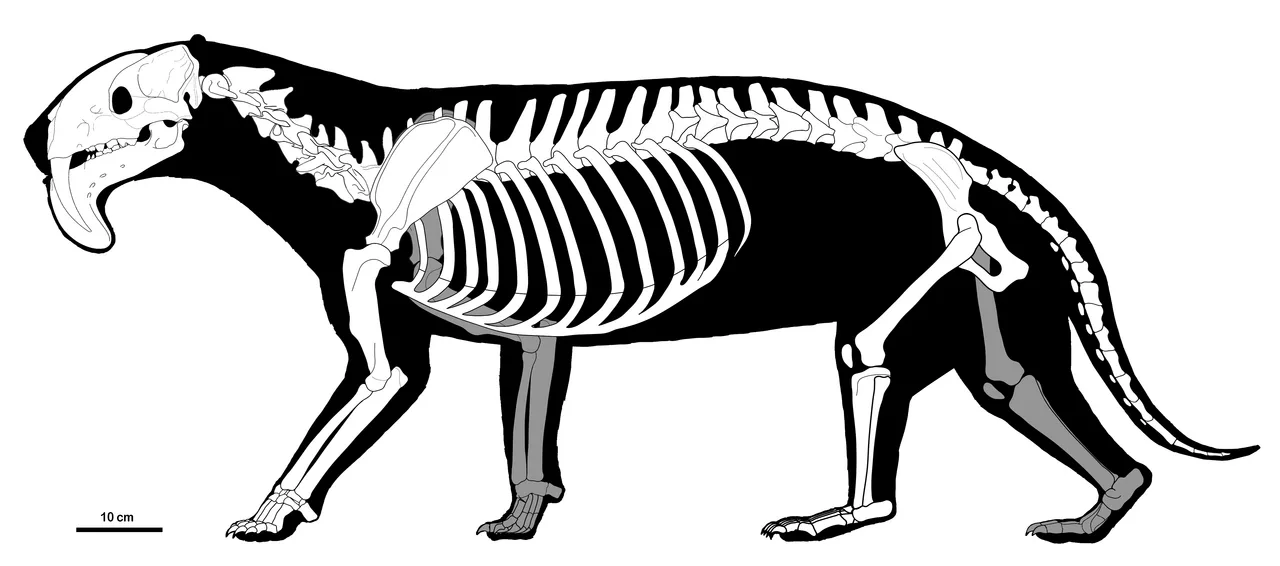
Thylacosmilus quick facts
- Its sabre teeth grew all its life, like a rabbit’s front teeth, instead of wearing down and stopping.
- The roots of those teeth ran back over the top of its skull, above its eyes.
- Its eyes faced sideways, like a cow’s, which is bizarre for a hunter.
- It had a bony flange on its lower jaw that the sabres slotted into, rather like a scabbard.
- It is not closely related to the sabre-tooth cat at all, and the two only ended up looking alike.
Thylacosmilus at a glance
Thylacosmilus lived in South America, millions of years before the sabre-toothed cat everybody knows. Its name is said thy-la-co-SMY-lus. Here are the main facts in one place.
| Fact | Detail |
|---|---|
| Full name | Thylacosmilus atrox |
| Group | Sparassodont, a relative of marsupials |
| Where | South America |
| When | Roughly 9 million to 3 million years ago |
| Size | About the size of a jaguar |
| Sabre teeth | Grew continuously, roots reaching the back of the skull |
| Eyes | Facing sideways, like a hoofed animal’s |
| Lower jaw | Bony flanges that the sabres slid down into |
| Diet | Meat, though exactly how it fed is still argued about |
It was not a cat
Thylacosmilus looks like a cat in every picture you will ever see of it. It was not one, and it was not even a close relative.
It belonged to a group called the sparassodonts, which were South American meat-eaters. Sparassodonts are metatherians, the wider branch of mammals that marsupials also sit on. Scientists usually describe them as relatives of marsupials rather than marsupials themselves.
That is why the popular name, marsupial sabre-tooth, is not quite right. It is close enough to be useful and wrong enough to be worth correcting.
So why does it look so much like a sabre-toothed cat?
Because of something called convergent evolution. When two unrelated animals face the same problem, they often arrive at the same solution. Sharks and dolphins both ended up streamlined. Birds and bats both ended up with wings.
Big stabbing teeth turn out to be a good answer to the question of how to kill large prey, and evolution has produced them at least four separate times in different groups of mammals.
Teeth that never stopped
Here is where Thylacosmilus stops being a copy of anything and becomes genuinely strange.
Your teeth grow to a certain size and then stop. So did the sabres of Smilodon, the famous sabre-toothed cat.
The canines of Thylacosmilus never stopped. They kept growing from the root throughout the animal’s life, the way a rabbit’s front teeth do.
That creates a problem, because a growing tooth needs somewhere to grow into. The roots of those sabres pushed backwards and upwards through the skull until they ran over the top of the eye sockets and reached almost to the back of the head.
Think about that. A tooth that starts in the mouth and finishes above the brain.

The eyes of a cow on the face of a hunter
Look at almost any hunting mammal and its eyes face forwards. A cat, a wolf, a fox, a human. Forward-facing eyes give overlapping vision, and overlapping vision lets you judge distance, which matters if you intend to pounce on something.
Now look at a cow, a horse or a deer. Their eyes sit on the sides of the head. That gives a very wide view, which is what you want if things are trying to eat you.
Thylacosmilus was a hunter with the eye sockets of a plant-eater.
A team of researchers looked into this in 2023 and published the answer in the journal Communications Biology. The reason is the teeth. Those enormous roots filled the space at the front of the skull where a predator’s eye sockets would normally sit, so the eyes were pushed outwards to the sides.
It then did something clever to cope. The eye sockets were tilted to sit almost vertically, which swung the fields of view back towards each other. The team calculated about 70 per cent overlap, which is well short of a cat but plenty to judge a distance.
Their conclusion was that Thylacosmilus could see well enough to hunt, but not well enough to chase prey at speed. It was more likely an ambusher: still, hidden, and waiting.
A scabbard for its own teeth
Sabre teeth come with a practical difficulty. They stick out, and anything that sticks out can get knocked and snapped.
Thylacosmilus had a solution no cat ever evolved. Its lower jaw carried two long bony flanges that hung down at the front, one on each side. When the mouth closed, the sabres slotted down alongside them.
The flanges worked rather like the scabbard on a sword, guarding the blade when it was not in use.
They also tell you how important the teeth were to this animal. Growing a pair of bony guards is not cheap, and evolution does not usually pay for things that do not matter.
The argument about how it ate
Palaeontologists agree Thylacosmilus ate meat. How it got that meat is still being debated, and the debate is worth knowing about because it shows how the science actually works.
Two things make the usual answer awkward. Its bite force was low for a predator of its size. And its sabres had thin, weak enamel compared with a cat’s.
A weak bite and fragile teeth are not what you expect from an animal that wrestles down large prey and bites through hide.
One suggestion is that it used its neck muscles rather than its jaw, driving the sabres down with a stab of the whole head. Another is that it specialised in soft tissue, opening a carcass and feeding on organs rather than tackling bone and tough muscle.
Nobody has settled it. That is normal for an animal known only from bones, and it is more honest than pretending otherwise.
Why South America produced such odd animals
For tens of millions of years South America was an island continent. It was not joined to North America, and nothing could easily walk in or out.
Cut off like that, its mammals evolved on their own. The big meat-eaters there were not cats, dogs or bears, because none of those had arrived. They were sparassodonts, and alongside them lived giant flightless hunting birds.
Then, a few million years ago, the Isthmus of Panama rose from the sea and joined the two continents together. Animals began moving in both directions, an event geologists call the Great American Biotic Interchange.
Thylacosmilus disappeared around this time, roughly 3 million years ago. It is tempting to say the newcomers wiped it out, and some researchers think exactly that. Others point out that the timing does not line up neatly, and that the climate was changing too.

Thylacosmilus compared with Smilodon
| Thylacosmilus | Smilodon | |
|---|---|---|
| What it was | Sparassodont, a marsupial relative | A true cat |
| Where | South America | North and South America |
| When | About 9 to 3 million years ago | About 2.5 million to 10,000 years ago |
| Sabre teeth | Never stopped growing | Grew to full size, then stopped |
| Tooth roots | Reached the back of the skull | Ordinary, inside the upper jaw |
| Eyes | Sideways, about 70% overlap | Forward-facing, like a lion’s |
| Jaw flanges | Yes, guarding the sabres | No |
Our guide to the saber-toothed tiger covers Smilodon in full, including why calling it a tiger is wrong as well.
Three things people get wrong
Myth: Thylacosmilus was a marsupial. It was a sparassodont. Sparassodonts sit on the same broad branch of mammals as marsupials, but researchers describe them as relatives rather than members. The nickname marsupial sabre-tooth is convenient shorthand, not a classification.
Myth: it was an ancestor of the sabre-toothed cat. The two are not descended from one another and did not even live on the same continent for most of their histories. They look alike because evolution solved the same problem twice, which is called convergent evolution.
Myth: its sabres were stronger than a cat’s. They were larger and never stopped growing, but the enamel was thinner and its bite force was low for its size. That is a big part of why researchers still argue about how it fed.
Did you know? A 2023 study found the eye sockets of Thylacosmilus pointed outwards, the way a horse or a cow’s do. The reason seems to be that its enormous tooth roots took up the space at the front of the skull where a predator’s eyes would normally sit.
Try it
Hold two fingers against your top teeth and imagine them growing all the way back over your head, above your eyes. Now work out where your eyes would have to move to. That is the problem Thylacosmilus had to solve.
Knowledge check
Was Thylacosmilus a cat?
Show answer
No. It was a sparassodont, a South American group related to marsupials, and only looked like a cat through convergent evolution.
What was strange about its eyes?
Show answer
They faced sideways, like a plant-eater’s, because its tooth roots filled the front of its skull.
Frequently asked questions
What was Thylacosmilus?
Thylacosmilus was a sabre-toothed meat-eating mammal that lived in South America during the Miocene and Pliocene epochs. It was roughly the size of a jaguar and is often called the marsupial sabre-tooth, although that name is not quite accurate.
Was Thylacosmilus a marsupial?
Not exactly. Thylacosmilus belonged to a group called sparassodonts, which are metatherians, the wider family that marsupials also belong to. Scientists describe sparassodonts as close relatives of marsupials rather than marsupials themselves.
How was Thylacosmilus different from a sabre-tooth cat?
Smilodon was a true cat with teeth that stopped growing. Thylacosmilus was not a cat at all, its canines grew continuously throughout life, and it had bony flanges on its lower jaw that the teeth slid into. The two are only similar because of convergent evolution.
Why did Thylacosmilus have eyes on the side of its head?
Its canine teeth had enormous roots that extended back through the skull, taking up the space where forward-facing eye sockets would normally sit. A 2023 study found its orbits pointed outwards like a hoofed animal’s, and that it still managed some depth perception.
When did Thylacosmilus live?
Thylacosmilus lived in South America from roughly 9 million to about 3 million years ago. It disappeared around the time North and South America joined, when placental predators began arriving from the north.
What did Thylacosmilus eat?
Thylacosmilus ate meat, but exactly how it fed is debated. Its sabres had weak enamel and its bite force was low for a predator of its size, so some researchers think it specialised in soft tissue such as organs rather than tackling bone.
How big was Thylacosmilus?
Thylacosmilus was roughly the size of a jaguar, with a heavy body and a short tail. Estimates put its weight at somewhere between about 80 and 120 kilograms, which is a good deal lighter than the sabre-toothed cat Smilodon.
Sources
- Communications Biology: Seeing through the eyes of the sabertooth Thylacosmilus atrox (Gaillard, MacPhee and Forasiepi, 2023) — the sideways-facing eye sockets, the continuously growing canines whose roots reach the back of the skull, the roughly 70 per cent visual overlap, and the classification of sparassodonts as relatives of marsupials rather than marsupials
- PubMed Central: full free text of the same 2023 study — the same findings, readable in full without a subscription, including the skull measurements and the comparison with cats and hoofed animals
- American Museum of Natural History news release on the 2023 study — the researchers’ own plain-language summary, and their view that Thylacosmilus was an ambush hunter rather than a fast pursuer


