
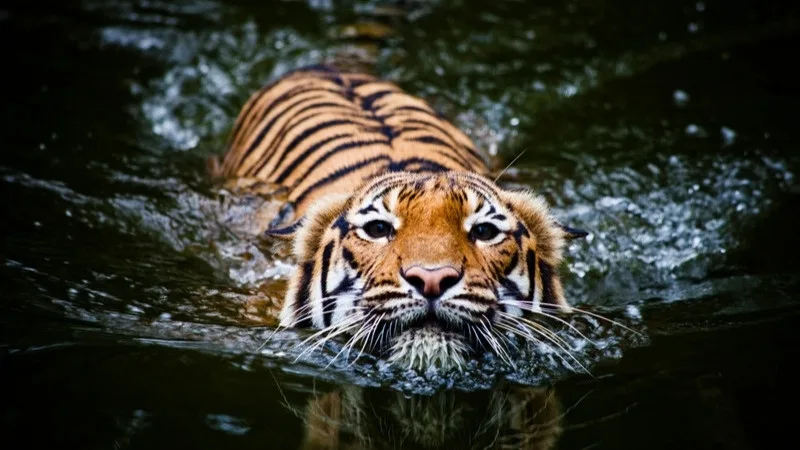
Tiger quick facts
- Deer cannot see red, so to a deer an orange tiger looks green and black, like the leaves around it.
- Since 2017, the IUCN Cat Specialist Group has recognised just two tiger subspecies: mainland tigers and Sunda tigers.
- India’s 2022 survey estimated 3,682 wild tigers, about two in every three wild tigers on Earth.
- Tigers cannot purr on and on like a pet cat. Their throats are built for roaring instead.
- Without its fur, a tiger is hard to tell apart from its closest relative, the lion.
Tigers are the biggest cats on Earth, and they are also among the easiest animals to get wrong. Many facts about tigers for kids still use a count and a list of tiger kinds that experts replaced years ago. This guide uses the newest figures, and it says plainly where scientists still disagree.
What is a tiger?
A tiger is a big cat, a meat-eating mammal from the cat family. Its scientific name is Panthera tigris. It belongs to a group of five big cats called Panthera, together with lions, leopards, jaguars and snow leopards.
Its closest relative is the lion. Take away the fur, and the two are surprisingly hard to tell apart. The striped coat is what really gives a tiger away.
The tiger is the largest cat species alive. It is also the largest land mammal that eats nothing but meat. Tigers are apex predators, which means they sit at the very top of the food chain in the ecosystems where they live.
How big are tigers?
Tigers vary a lot in size. The biggest live in the cold far north of Asia. The smallest live on the island of Sumatra, in Indonesia. Everywhere, females are smaller than males.
A large male Amur tiger can weigh 300 kg (660 pounds). That is about as heavy as four grown men. He can measure 3 metres (10 feet) from his nose to the tip of his tail, about as long as two bicycles parked end to end.
A Sumatran tiger is much smaller. The biggest males reach about 140 kg (310 pounds) and 2.4 metres (8 feet). That is still far heavier than any grown-up you know.
The conservation group Panthera says the heaviest tigers alive today are found in India and in north-east Asia. You can read about the biggest of them all in our Siberian tiger facts.
Stripes that work like fingerprints
No two tigers have the same stripes. A tiger’s pattern is as personal as your fingerprint, and it stays the same all its life.

Scientists use this to count wild tigers. They set up camera traps, which are cameras fixed to trees that take a photo whenever an animal walks past. Then they compare the stripes in each photo to tell one tiger from another.
India’s national tiger survey works this way. In 2022 it recorded 3,080 different tigers, up from 2,461 in 2018.
Stripes also help a tiger hide. They break up its outline in long grass and among tree trunks, so prey struggles to spot it lying in wait.
There is a stranger reason, too. Deer, a tiger’s main prey, cannot see the colour red. To a deer, a bright orange tiger looks green and black, much like the leaves around it.
The rest of the coat matters as well. A tiger’s fur is reddish-orange with black stripes. It has a white belly and white spots on its ears.
Where tigers live today
Wild tigers live only in Asia. Panthera lists ten countries where they still breed: India, Nepal, Bhutan, Bangladesh, Myanmar, Thailand, Malaysia, Indonesia, China and Russia.
They live in very different places. Some hunt in tropical forests and tall grasslands. Others live in mangrove swamps, where trees grow in salty water along the coast. Amur tigers roam cold, snowy forests in the Russian Far East, and a few cross the border into China. You can find out more about where Siberian tigers live in our guide.

Tigers once lived across a far bigger area. Their range stretched from the Caspian Sea and parts of the Middle East to eastern Russia and the islands of Indonesia.
Most of that land has been lost. Panthera says tigers have lost 93% of their old range in the last two centuries. Put another way, they now live on only about 7 parts in every 100 of the land they once roamed.
Big Cats and Where They Live
- How heavy can a large male Amur tiger be?
- Why can a bright orange tiger stay hidden from deer?
- Which of these is NOT a place where wild tigers breed today?
- What is a mangrove swamp?
Two kinds of tiger, or six?
Open an older book or visit a zoo, and you will probably read that there are six kinds of living tiger. These kinds are called subspecies. A subspecies is a group within a species that looks a little different and lives in its own area.
The six usually listed are the Bengal, Amur (or Siberian), Indochinese, Malayan, Sumatran and South China tigers. The Smithsonian’s National Zoo in the United States still describes tigers this way.
In 2017, a team of experts working for the IUCN Cat Specialist Group changed the list. The IUCN is the world conservation body that runs the Red List of threatened animals. The team compared skulls, coats and DNA. It decided that living tigers belong to just two subspecies.
| Mainland tiger | Sunda tiger | |
|---|---|---|
| Scientific name | Panthera tigris tigris | Panthera tigris sondaica |
| Where it lives | mainland Asia, from India to the Russian Far East and the Malay Peninsula | Sumatra; once also Java and Bali |
| Includes the old | Bengal, Amur, Indochinese, Malayan, South China and Caspian tigers | Sumatran, Javan and Bali tigers |
| Body | larger | smaller |
| Coat | paler, with fewer stripes | darker, with more stripes |
So the Siberian tiger and the Bengal tiger now count as the same subspecies. The Sumatran tiger is the last living Sunda tiger. The tigers of Java and Bali were Sunda tigers too, but both are extinct.

Not every scientist agrees. The 2017 report itself notes that some tiger geneticists still keep the longer list. Studies over the years have counted anything from two to nine subspecies. For a school project, it is fair to write that many experts now recognise two, while others still use six.
Tigers that love water
Pet cats usually hate getting wet. Tigers are different. They are strong swimmers, and they slip into rivers and pools to cool down on hot days or to escape biting flies.
A tiger can cross a river or lake up to 8 km (5 miles) wide. That is about 160 lengths of an Olympic swimming pool, without stopping for a rest.

Tigers have even been seen hunting in water. About 100 tigers lived in India’s Sundarbans Tiger Reserve in 2022, among mangrove swamps beside the sea. For them, swimming is simply part of getting around.
Living alone, talking from a distance
Adult tigers live alone. They only spend time with other tigers to mate, or when a mother is raising her cubs.
Each tiger has a home range, an area it knows well and patrols. Some males in north-east Asia roam across 1,000 square kilometres. That is about two thirds the size of Greater London.
Because they live apart, tigers leave messages for each other. They spray scent and scratch tree trunks with their claws. These signs tell other tigers where one home range ends and the next begins.
Tigers use sounds as well. They roar, grunt and make a soft, puffing noise called a chuff. A chuff is a friendly greeting, and it carries no threat at all.
Here is a surprise. Tigers cannot purr on and on like a pet cat. Their throats are built for roaring instead, with a specially shaped voice box and a stretchy support around it.
Tiger Signals and Words
- Claw marks — Scratched on tree trunks to mark a home range
- Scent — Sprayed to show where one home range ends
- Chuff — A soft, puffing sound that means hello
- Roar — A loud call made with a specially shaped voice box
- Home range — An area a tiger knows well and patrols
- Camera trap — A camera that takes a photo when an animal walks past
How tigers hunt and what they eat
Tigers are ambush hunters. Instead of chasing prey over a long distance, a tiger creeps close, waits, and then pounces with a sudden burst of speed.
It pulls its prey to the ground and bites the neck. Most hunting happens at night, or in the early morning and evening, when deer and pigs are most active.
Deer and wild pigs are a tiger’s main food. Tigers also take wild cattle such as the gaur, which can weigh 1,500 kg (3,300 pounds). That is five times the weight of the biggest tiger.
They will eat many other animals too. The list includes monkeys, porcupines, birds, fish, sloth bears, leopards and even crocodiles. Near villages, some tigers kill cattle or goats.
A tiger hunts about once a week. After a kill it can eat up to 34 kg (75 pounds) of meat in one night. That is about the weight of a ten-year-old child.
Swimming and Hunting
- How wide a river or lake can a tiger swim across?
- Why do tigers slip into rivers and pools on hot days?
- What kind of hunter is a tiger?
- When does most tiger hunting happen?
- How often does a tiger usually hunt?
- The gaur is a kind of wild cattle. How does its weight compare with the biggest tiger?
Tiger cubs, from birth to leaving home
A tigress is pregnant for about 100 days. She gives birth to between one and seven cubs, but two to four is usual.
The cubs drink their mother’s milk for their first three to five months. After that they eat meat she brings from her kills.

Life is dangerous for young tigers. About half of all wild cubs die before they reach two years old.
The survivors learn to hunt by following and copying their mother. Most can hunt well by the time they are 18 to 24 months old.
At two to three years old, young tigers leave to find a home range of their own. Young females often settle close to their mother. Young males travel much further.
Even then, the odds are hard. Only about 40 in every 100 young tigers that leave home go on to hold a territory and raise cubs. Females can have cubs of their own from three or four years old, and males are ready at four or five.
Wild tigers usually live 10 to 15 years, and a few in zoos reach 20. Our guide to how long tigers live explains why.
A Tiger Cub Grows Up
- Waiting The mother is pregnant for about 100 days.
- Birth Between one and seven cubs are born, usually two to four.
- Milk The cubs drink their mother's milk for three to five months.
- Learning The cubs follow and copy their mother to learn how to hunt.
- Hunting well By 18 to 24 months old, most can hunt well.
- Leaving home At two to three years old, they leave to find a home range of their own.
- A new family A female can have cubs of her own from three or four years old.
How many tigers are left?
About 5,574 tigers lived in the wild in 2023. That figure comes from the Global Tiger Forum, which brings together the governments of countries with wild tigers. It adds up the latest count from each of those countries.
In 2016, the same kind of count came to 3,890. So the number of wild tigers rose by about 43% in seven years.
| Country | Wild tigers, 2016 | Wild tigers, 2023 |
|---|---|---|
| India | 2,226 | 3,682 |
| Russia | 433 | 500 |
| Indonesia | 371 | 393 |
| Nepal | 198 | 355 |
| Thailand | 189 | 161 |
| Malaysia | 250 | 150 |
| Bhutan | 103 | 131 |
| Bangladesh | 106 | 114 |
| China | more than 7 | more than 60 |
| Myanmar | no data | 28 |
| Laos | 2 | 0 |
| Vietnam | fewer than 5 | 0 |
| Cambodia | 0 | 0 |
| Total | 3,890 | 5,574 |
India has by far the most. Its 2022 survey estimated 3,682 tigers, with the true number somewhere between 3,167 and 3,925. The Indian government says that is almost 75% of the world’s wild tigers. Measured against the Global Tiger Forum total, it is closer to two in every three. Either way, most wild tigers live in India.
Not every expert uses the same number. In 2022 the IUCN Red List, in an assessment led by Panthera, estimated about 4,500 wild tigers. Its previous estimate, in 2015, was 3,200.
Why the gap? Counting a shy, striped cat in thick forest is very hard, and different groups count in different ways. Panthera says part of the rise comes from understanding tiger populations better, not only from there being more tigers.
So how many tigers are left? The honest answer is somewhere between about 4,500 and 5,600. In 2023 the number was rising in several countries.
Did the plan to double tigers work?
In 2010, leaders from the 13 countries with wild tigers met in St Petersburg, Russia. They agreed a plan to save tigers. Its goal, called TX2, was to double the number of wild tigers by 2022.
Some countries got there. In 2023 the Global Tiger Forum reported that India and Nepal had doubled their tigers since 2010. Russia’s tigers had increased too, and numbers in Bhutan and Bangladesh were stable or rising.
Others went the wrong way. By 2023, no tigers were counted in Cambodia, Laos or Vietnam. Malaysia’s count fell from 250 in 2016 to 150.
So TX2 was a success in much of South Asia and a failure in much of South East Asia. The countries have now signed up to a new plan, called the Global Tiger Recovery Program 2.0.
There was good news from Malaysia, too. In 2023 it declared the Al-Sultan Abdullah Royal Tiger Reserve in the state of Pahang. The Global Tiger Forum called it the first tiger reserve in South East Asia.
Why tigers are in danger
Tigers are listed as endangered. The Sumatran tiger is critically endangered, which is one step away from extinct in the wild.
Poaching is one big threat. Poaching means killing animals illegally. Poachers kill tigers for their bones and other body parts, which are sold for use in some traditional medicines.
Habitat loss is the other. When forests are cleared for farms, towns and roads, tigers lose space. They also lose the deer and wild pigs they need to eat.
That pushes tigers and people closer together. A hungry tiger may kill cattle, and some people then kill tigers out of fear or anger. Scientists call this human–wildlife conflict.
What helps? Well-guarded reserves, trained rangers on patrol, and support for families who live near tigers. India began Project Tiger in 1973 with nine tiger reserves. By 2023 it had 53, covering 2.3% of the country.
There is room to grow. Panthera says nearly a million square kilometres of empty tiger habitat could hold tigers again one day. That is about four times the size of the United Kingdom.
What about white tigers?
A white tiger is not a separate kind of tiger, and it is not endangered. Its pale coat comes from a rare pair of genes, a little like red hair in people.
The gene has only been found in Bengal tigers. To get white cubs, breeders have often paired close relatives, such as fathers and daughters. That inbreeding causes eye problems and shorter lives.
In 2011, the Association of Zoos and Aquariums banned its member zoos from breeding white tigers. Underneath the coat they are ordinary tigers, so what white tigers eat is the same meat any tiger needs.
Tigers that have already disappeared
Three groups of tigers are already extinct. Tigers once lived on the islands of Java and Bali, and around the Caspian Sea in western and central Asia. All three have gone.
The South China tiger is thought to be extinct in the wild, or very nearly. A few survive in zoos.
DNA tests found that the lost Caspian tiger was almost identical to today’s Amur tiger. That is one reason the 2017 experts grouped the northern tigers with all the other mainland tigers.
Three things people get wrong
1. “There are six kinds of tiger.” Many books and zoos still say so. Since 2017, though, the IUCN Cat Specialist Group has recognised two subspecies: mainland tigers and Sunda tigers. Some scientists still prefer the old list, so a good project mentions both.
2. “Tigers are jungle animals.” Some are. Others live in mangrove swamps by the sea, in tall grasslands, and in the snowy forests of the Russian Far East, where winters are bitterly cold.
3. “Only about 3,200 tigers are left, and the number keeps falling.” That was the IUCN estimate in 2015. The 2023 count from the Global Tiger Forum was about 5,574, with big rises in India and Nepal. Tigers are still in trouble, though, and they have vanished from Cambodia, Laos and Vietnam.
Did you know? By 2023, India and Nepal had each doubled their wild tigers since 2010. Over the same years, tigers disappeared completely from Laos and Vietnam.
Tigers: Fact or Myth?
- The tiger is the largest cat species alive.
- Tigers avoid water, just like most pet cats.
- Tigers can purr on and on like a pet cat.
- Adult tigers live together in family groups.
- White tigers are a separate, endangered kind of tiger.
- Tigers once lived on the islands of Java and Bali.
- The Sumatran tiger is critically endangered.
- Poaching means hunting animals with a proper permit.
Try it
Be a tiger scientist. Draw three tigers, each with its own stripe pattern, and number them. Copy one of them onto a separate piece of paper without its number. Ask someone to match it to the right tiger using only the stripes. Scientists match camera-trap photos in the same way to count wild tigers.
Knowledge check
How do scientists tell one wild tiger from another?
Show answer
They photograph tigers with camera traps and compare the stripes, because no two tigers have the same pattern.
Why do Amur tigers and Bengal tigers now count as the same subspecies?
Show answer
In 2017 the IUCN Cat Specialist Group grouped all mainland tigers into one subspecies, because their bodies and DNA are so alike.
Frequently asked questions
How many tigers are left in the world?
About 5,574 tigers lived in the wild in 2023, according to the Global Tiger Forum’s country-by-country count. The IUCN Red List gave a lower estimate of about 4,500 in 2022, still well above its 2015 estimate of 3,200.
What is the biggest tiger?
The Amur tiger, also called the Siberian tiger, is the biggest. Large males can weigh 300 kg (660 pounds) and measure 3 metres (10 feet) from nose to tail.
How many subspecies of tiger are there?
Since 2017 the IUCN Cat Specialist Group has recognised two tiger subspecies: the mainland tiger of Asia and the Sunda tiger of Sumatra. Many zoos and books still list six living subspecies, and some scientists still prefer that list.
Can tigers swim?
Tigers are strong swimmers. Wild tigers cool off in rivers and pools, have been seen hunting in water, and can cross rivers and lakes up to 8 km (5 miles) wide.
How long do tiger cubs stay with their mother?
Tiger cubs usually stay with their mother for two to three years. Most can hunt well by 18 to 24 months old, and then they leave to find a home range of their own.
What do tigers eat?
Tigers mainly eat deer and wild pigs. Wild cattle, monkeys, fish and even crocodiles are also on the menu, and a tiger can eat up to 34 kg (75 pounds) of meat in one night.
Why are tigers endangered?
Tigers are endangered mainly because of poaching and habitat loss. Poachers kill tigers for body parts used in some traditional medicines, and forests are cleared for farms, towns and roads.
Sources
- Smithsonian’s National Zoo and Conservation Biology Institute: tiger — size, coat, stripe patterns used to identify tigers, habitats and former range, swimming, solitary life, scent marking, diet, cubs, lifespan, threats, white tigers and the 2010 Tiger Summit
- Panthera: tiger — the 2022 IUCN Red List estimate, lost range, the ten breeding countries, prey, how deer see a tiger’s colour, roaring and purring, and home ranges
- IUCN SSC Cat Specialist Group: A revised taxonomy of the Felidae (Cat News Special Issue 11, 2017) — the two tiger subspecies, where each lives and how they differ, the scientists who disagree, and the extinct Javan, Bali and Caspian tigers
- Global Tiger Forum: press release for International Tiger Day, 29 July 2023 — the 5,574 estimate, each country’s count in 2016 and 2023, which countries doubled or lost their tigers, and Malaysia’s first tiger reserve
- Global Tiger Forum: TX2 Tiger Conservation Award — the TX2 goal, set in 2010, to double the number of wild tigers by 2022
- Government of India, Press Information Bureau: All India Tiger Estimation 2022 — India’s estimate of 3,682 tigers and its range, India’s share of wild tigers, tigers photographed in 2018 and 2022, and Project Tiger’s reserves
Tiger Final Challenge
- What is an apex predator?
- Which animal is the tiger's closest relative?
- How long do wild tigers usually live?
- Why is a white tiger white?
- In 2011, what did the Association of Zoos and Aquariums ban its member zoos from doing?
- Which lost tiger turned out to be almost identical to today's Amur tiger?
- In which year did India begin Project Tiger?
- What was the TX2 goal agreed by the tiger countries in 2010?
- Which of these is NOT a reason tigers are in danger?
- What did Malaysia declare in 2023?


