
Triceratops quick facts
- A baby Triceratops had short, straight stubs for brow horns. In young animals the horns curved backwards, and only adults had horns that curved forwards.
- Triceratops skulls grew from about 38 cm (15 inches) long in babies to about 2 metres (6.5 feet) long in adults.
- Healed injuries are much more common on the side of the Triceratops frill than on the same bone of its cousin Centrosaurus, a clue that Triceratops fought with its horns.
- Triceratops teeth wore down as it chewed into slicing blades with a groove down the middle, which made chewing easier.
- Every Triceratops fossil checked in Canada belongs to just one species, Triceratops prorsus, the younger of the two kinds.
What was Triceratops?
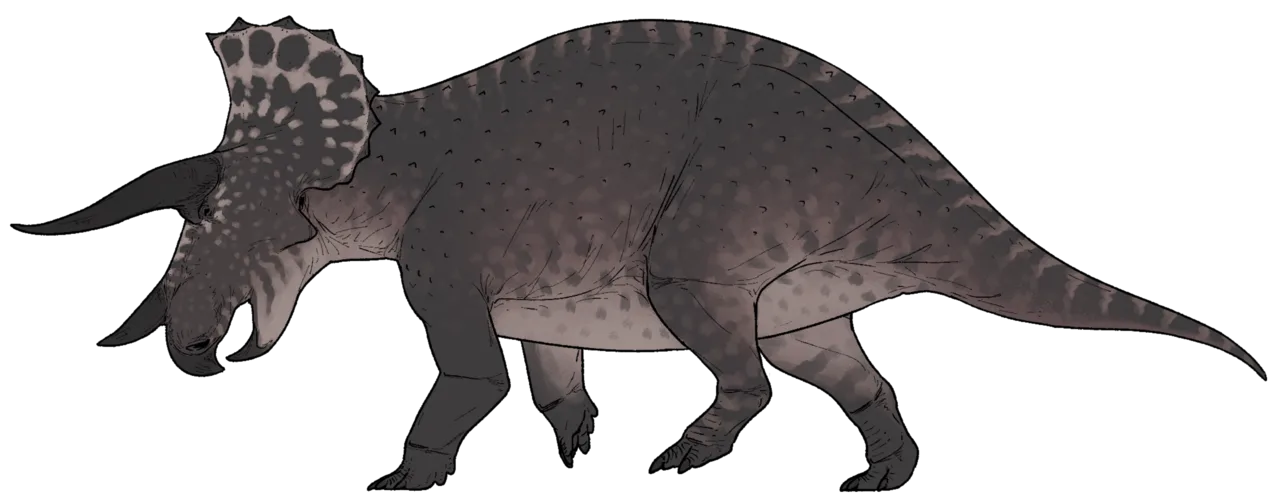
Triceratops was a huge plant-eating dinosaur with three horns on its face. Its name comes from Greek and means “three-horned face”. Two long horns grew above its eyes, and a shorter one sat on its nose.
Behind its head was a wide sheet of bone called a frill. The frill covered the back of the neck like a raised collar. With its horns and frill, an adult’s skull could be about 2 metres (6.5 feet) long. That is taller than most grown-ups.
The whole animal was about 9 metres (30 feet) long. That is roughly the length of two family cars parked nose to tail. It walked on four sturdy legs.
Triceratops belonged to a group called the ceratopsians, or horned dinosaurs. They were among the most successful plant-eaters of the Late Cretaceous, the last part of the age of the dinosaurs. You can meet the other main groups in our dinosaur facts for kids.
When and where Triceratops lived
Triceratops lived in western North America at the very end of the age of the dinosaurs. The older of its two species dates to about 67 million years ago. The younger one dates to about 66 million years ago.
That puts Triceratops among the very last dinosaurs. It was still around when an asteroid hit Earth 66 million years ago and ended the age of the dinosaurs.
The American palaeontologist O. C. Marsh named Triceratops in 1889, basing the name on a skull and horns found in Wyoming. A palaeontologist is a scientist who studies fossils.
Since then, thousands of Triceratops fossils have turned up in Montana, North and South Dakota, Colorado and Wyoming in the USA. Canada has them too, in Saskatchewan and Alberta.
Some of the richest finds come from the Hell Creek Formation, a layer of rock in eastern Montana. A team led by Jack Horner of the Museum of the Rockies spent ten years digging there and collected hundreds of fossils. Forty in every 100 came from Triceratops. Some of the skulls were the size of a football. Others were the size of a small car.

The horns and the frill
The two big horns grew from the bones just behind the eye sockets. As the animal got older, the bone at the base of each horn became partly hollow inside.
The nose horn started life as a separate little bone, which joined onto the nose as the animal grew and became a proper horn. Its shape varied a lot from one Triceratops to the next.
The frill was made from bones at the back of the skull. In a Triceratops it was short and solid, with no holes in it. Along its edge ran a row of small, triangular bony points.
What were the horns and frill for? The evidence points to more than one job. They may have helped other Triceratops tell how old an animal was. They also seem to have been used in fights, as you will see further down.
How the horns changed as Triceratops grew
A baby Triceratops did not look like a small adult. Its skull changed shape again and again as it grew up.
In 2006, Jack Horner and Mark Goodwin studied ten Triceratops skulls of different ages. The smallest came from a baby and was just 38 cm (15 inches) long, a little longer than a school ruler. The biggest adult skulls were about 2 metres (6.5 feet) long.
By lining the skulls up from smallest to biggest, the two scientists could see how a Triceratops head changed with age. They sorted the changes into four growth stages.
| Growth stage | Brow horns | Edge of the frill |
|---|---|---|
| Baby | short, straight stubs | deeply scalloped, like a pie crust |
| Juvenile (young) | curved backwards | 17 to 19 small triangular points appear |
| Subadult (teenager) | straightened out | the points become flatter |
| Adult | curved forwards | the points stretch out, then merge into a smooth edge in old adults |
The brow horns did the most surprising thing. In young Triceratops they curved backwards, over the head. Only in adults did they curve forwards, the way they look in most pictures.
Why would a head change so much? Horner and Goodwin suggested that the changes worked like a badge. One look at the horns and frill would tell another Triceratops whether it was meeting a youngster or an adult ready to breed.

Torosaurus: a separate dinosaur or an old Triceratops?
Another horned dinosaur lived in the same places at the same time. It is called Torosaurus, and Marsh named it in 1891, two years after Triceratops. Its skull looked similar, but its frill was much longer and had two large holes in it.
In 2010, John Scannella and Jack Horner of the Museum of the Rockies made a bold claim. They said Torosaurus was not a separate dinosaur at all. It was simply a Triceratops that had become fully grown.
They looked at more than 50 Triceratops specimens. Under the microscope, the bone in Torosaurus skulls had been rebuilt more times than the bone of even the biggest Triceratops. Heavily rebuilt bone is usually older bone. And none of the Torosaurus skulls they studied came from a young animal.
If they were right, the frill of an old Triceratops must have grown longer and opened up two holes late in life. Scannella also offered a reason why Torosaurus fossils are so much rarer than Triceratops. Perhaps most Triceratops died before they ever reached that final stage.
Not everyone was convinced. In 2012, Nicholas Longrich and Daniel Field of Yale University tested the idea on 36 specimens. They judged each animal’s age by features that have nothing to do with the frill, such as skull bones fusing together.
They found some Torosaurus skulls that came from young animals, and some Triceratops skulls that were very old. That was a serious problem. Neither should exist if every Torosaurus is an old Triceratops. They also showed that thin patches on some Triceratops frills sit in different places from the holes in Torosaurus. So those patches were not holes starting to open.
Longrich and Field concluded that Torosaurus was a separate dinosaur. The Montana team had reached the opposite answer from its own fossils, and palaeontologists still argue about it. For a school project, the honest answer is that the question is not settled.

Evidence of horn fights
Pictures often show Triceratops fighting Tyrannosaurus rex, or two Triceratops locking horns. For a long time, though, nobody had properly tested whether the horns were used as weapons. Some scientists thought they were only for show.
In 2009, Andrew Farke and two colleagues went looking for old injuries. They checked Triceratops skulls for wounds that had healed while the animal was still alive. These show up as mended cracks, or as rough patches of new bone that grew over a knock.
Then came the clever part. They compared Triceratops with Centrosaurus, a cousin with a different set of horns. Triceratops had two long brow horns and a short nose horn. Centrosaurus had one big nose horn and two small brow horns. If both animals fought with their horns, their injuries should turn up in different places.
That is what they found. Triceratops had many more injuries on the squamosal, a bone at the side of the frill, just behind the eye. On the other skull bones, the two dinosaurs showed no real difference.
The squamosal is where a blow would land if two Triceratops pushed their brow horns together. So the study suggests that Triceratops really did fight each other, much as many horned animals do today. It also suggests the frill helped to protect the head in those fights.

Slicing teeth that shaped themselves
Most reptiles cannot chew. Their teeth grab and tear, but the top and bottom teeth do not meet to cut food up. Mammals, including you, are different. Our teeth meet, and they wear into shapes that break food down.
Triceratops was a reptile that could chew. Its cheek teeth sat close together in long rows, and the upper and lower rows sliced past each other. This let it cut up tough, bulky plants. Few reptiles have ever managed that.
A 2015 study led by Gregory Erickson found something clever about these teeth. As Triceratops chewed, each tooth wore down unevenly. A hollow groove formed down the middle of each cutting blade, a little like the groove along a sword. The groove cut down friction, so chewing took less effort.
The trick worked because each tooth was built from several different hard tissues, and they wore away in different ways. The team said the teeth were as complex as the teeth of mammals. They could still test how those tissues wore, in teeth about 66 million years old.

Two kinds of Triceratops, one after the other
Scientists recognise two species of Triceratops. You can tell them apart by the nose horn, the brow horns and the snout.
| Triceratops horridus | Triceratops prorsus | |
|---|---|---|
| Lived | about 67 million years ago | about 66 million years ago |
| Nose horn | short | longer |
| Brow horns | longer | shorter |
| Snout | long | short |
| Found in | the lower, older rocks of the Hell Creek Formation | the upper, younger Hell Creek rocks, and in Canada |
The answer came from the rocks. In 2014, John Scannella and his team sorted Triceratops skulls by the rock layer each one came from. Deeper layers are older. Triceratops horridus came from lower, older rock. Triceratops prorsus came from higher, younger rock.
In the layers between them, the team found skulls with a mix of features from both species. That suggested that one species slowly changed into the other over time, without splitting into branches. Scientists call this kind of change anagenesis.
Canada has added a new clue. Jordan Mallon of the Canadian Museum of Nature and his student Mat Roloson checked every Triceratops fossil known from Canada. They found only Triceratops prorsus, in rocks about 66 million years old. That fits the idea that Triceratops horridus had already changed into Triceratops prorsus by then.
Mallon points out that scientific ideas can always change when new fossils turn up. A single Triceratops horridus skull found in young Canadian rock would reopen the question. That is one reason palaeontologists keep digging.
Three things people get wrong
1. “A baby Triceratops looked like a small adult.” It did not. Young Triceratops had brow horns that curved backwards and a frill with a scalloped edge. Their heads went through four growth stages before they looked like the adults in museums.
2. “Scientists have proved that Torosaurus was just an old Triceratops.” Some scientists think so. Others have found young Torosaurus skulls that do not fit the idea. The question is still open, so a good project mentions both sides.
3. “The horns were only for show.” Showing off may have been one of their jobs. But healed injuries on the side of the frill suggest that Triceratops also used its horns to fight other Triceratops.
Did you know? The first Triceratops fossil reported in Canada was found in Saskatchewan in 1921. The Canadian Museum of Nature keeps a partial skull of Triceratops prorsus dug up in 1929 in what is now Grasslands National Park.
Try it
Sort skulls like a palaeontologist. Draw four Triceratops heads: a baby with tiny stub horns, a young one with horns curving backwards, a teenager with straight horns, and an adult with horns curving forwards. Mix up the drawings and ask someone to put them in order from youngest to oldest. Scientists lined up real Triceratops skulls in the same way to work out how the animal grew.
Knowledge check
Which way did the brow horns of a young Triceratops curve?
Show answer
Backwards. The horns straightened out in older teenagers and only curved forwards once the animal was an adult.
Which part of the Triceratops skull shows the most healed injuries?
Show answer
The squamosal, a bone at the side of the frill. That is where blows would land if two Triceratops pushed their horns together.
Frequently asked questions
What does the name Triceratops mean?
The name Triceratops means “three-horned face” in Greek. The American palaeontologist O. C. Marsh named Triceratops in 1889, from a skull and horns found in Wyoming.
How big was a Triceratops?
A Triceratops grew to about 9 metres (30 feet) long, about as long as two family cars parked end to end. An adult Triceratops skull could be about 2 metres (6.5 feet) long.
When and where did Triceratops live?
Triceratops lived in western North America at the very end of the age of the dinosaurs. Triceratops horridus dates to about 67 million years ago and Triceratops prorsus to about 66 million years ago. Fossils have been found in Montana, the Dakotas, Colorado, Wyoming, Saskatchewan and Alberta.
Was Torosaurus really a grown-up Triceratops?
Scientists still disagree about whether Torosaurus was a grown-up Triceratops. In 2010 John Scannella and Jack Horner argued that Torosaurus skulls came from fully adult Triceratops. In 2012 Nicholas Longrich and Daniel Field found young Torosaurus skulls and very old Triceratops skulls, which points to two separate dinosaurs.
Did Triceratops use its horns to fight?
Triceratops probably did use its horns to fight other Triceratops. A 2009 study found healed injuries were much more common on the side of the Triceratops frill than on the same bone of Centrosaurus, a horned dinosaur with differently shaped horns.
What did Triceratops eat?
Triceratops ate tough, bulky plants. Rows of cheek teeth sliced past each other as it chewed, and a 2015 study found the teeth wore into sharp blades with a groove down the middle that cut down friction.
How many kinds of Triceratops were there?
Most scientists recognise two species of Triceratops: Triceratops horridus and Triceratops prorsus. Triceratops prorsus had a longer nose horn and shorter brow horns, and it lived slightly later than Triceratops horridus.
Sources
- Horner and Goodwin (2006), Major cranial changes during Triceratops ontogeny, Proceedings of the Royal Society B (abstract on Europe PMC) — the growth series of ten skulls from a 38 cm baby to 2 m adults, the four growth stages, how the brow horns, nose horn and frill edge changed, and the idea that the changes signalled age
- Montana State University News: MSU finds Triceratops, Torosaurus were different stages of one dinosaur (2010) — the Scannella and Horner proposal, the ten-year Hell Creek project, Triceratops making up 40% of its specimens, skulls from football-sized to car-sized, remodelled Torosaurus bone and why Torosaurus is rare
- Longrich and Field (2012), Torosaurus is not Triceratops, PLOS ONE — the test of the Torosaurus idea on 36 specimens, young Torosaurus and old Triceratops skulls, the thin patches on Triceratops frills, the features of the two Triceratops species, and Torosaurus being named in 1891
- Farke, Wolff and Tanke (2009), Evidence of combat in Triceratops, PLOS ONE — healed injuries on Triceratops and Centrosaurus skulls, the extra injuries on the Triceratops squamosal, and what that says about horn fights and the frill
- Erickson and colleagues (2015), Wear biomechanics in the slicing dentition of the giant horned dinosaur Triceratops, Science Advances — Triceratops’s 9-metre length, why most reptiles cannot chew, the slicing teeth, the grooves worn into them, and the complex dental tissues in 66-million-year-old teeth
- Canadian Museum of Nature: Never enough Triceratops — the meaning of the name, Marsh naming it in 1889 from Wyoming fossils, where Triceratops has been found, the ages of the two species, one species changing into the other, and the Canadian fossils


