
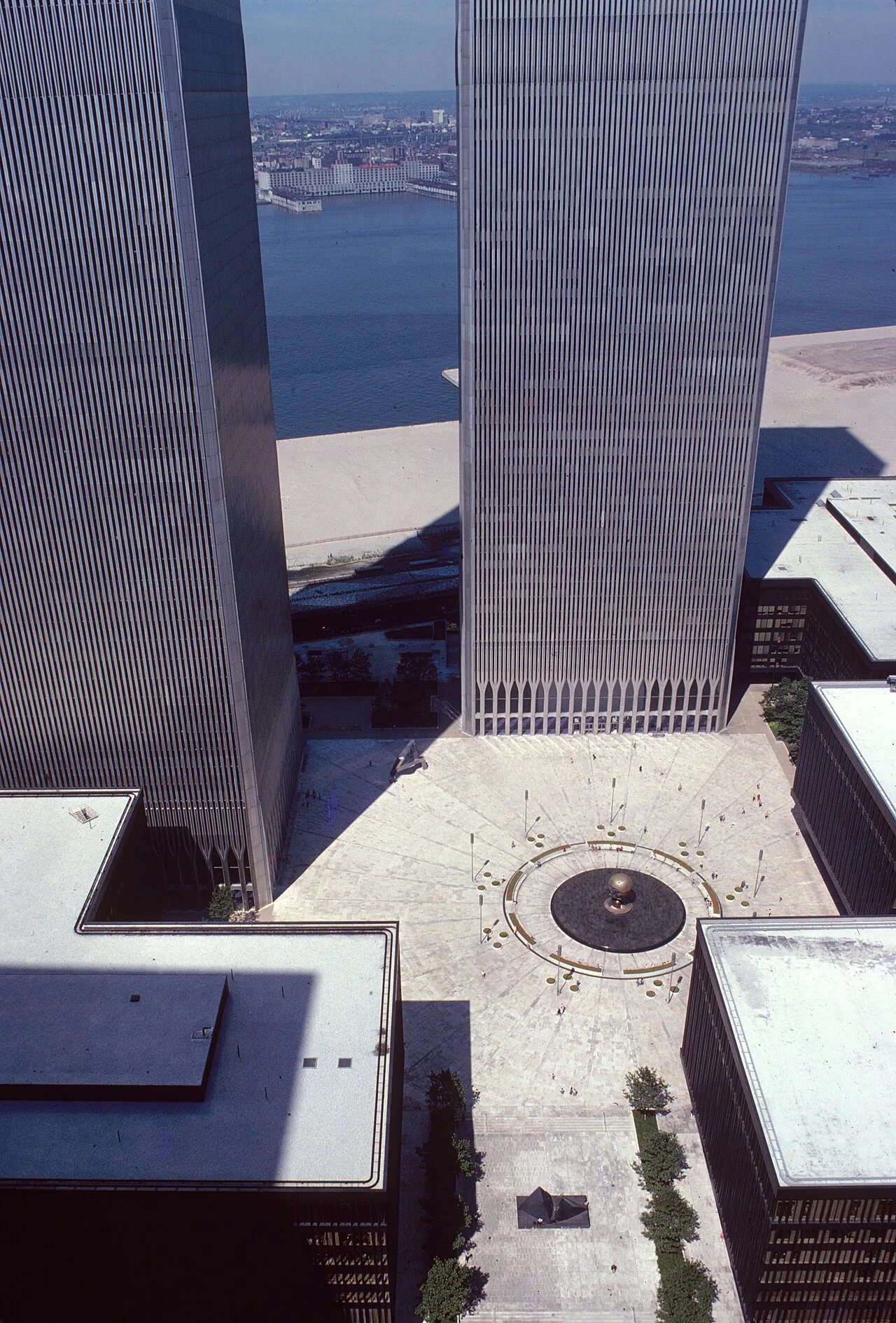
Twin Towers quick facts
- The earth dug out to build the towers was tipped into the Hudson River and became a new neighbourhood, Battery Park City.
- Their steel walls carried the weight, so the office floors inside had almost no columns at all.
- Minoru Yamasaki, the architect who designed them, was afraid of heights.
- Lifts worked like an Underground line: express lifts ran to “sky lobbies” halfway up, and you changed there.
- After 2001, engineers studied the towers so closely that more than 40 building rules were changed worldwide.
The Twin Towers at a glance
The Twin Towers were the two tallest buildings of the World Trade Center in New York City. They stood side by side in Lower Manhattan for 28 years. Here are the main facts in one place.
| Fact | Detail |
|---|---|
| Proper names | 1 World Trade Center (North) and 2 World Trade Center (South) |
| Height | 417 m (1,368 ft) and 415 m (1,362 ft) |
| Storeys | 110 each |
| Architect | Minoru Yamasaki, with Emery Roth and Sons |
| Owner | The Port Authority of New York and New Jersey |
| Building work | 1966 to 1973 |
| Opened | 4 April 1973 |
| Tallest in the world | 1971 to 1973 |
| People who worked there | About 50,000 across the whole complex |
| Destroyed | 11 September 2001 |
This page is about the buildings: how they were made, what it was like inside, and what stands there today. It also covers how they were destroyed. That part is upsetting, and if you find it hard to read, stop and talk to a grown-up about it. Feeling upset by this is normal.

How tall they really were
The North Tower reached 417 metres. In feet that is 1,368. The South Tower was three metres shorter.
Numbers that big are hard to picture. So compare them with something you may already know. The Eiffel Tower is about 330 metres to its tip. The North Tower was roughly 87 metres taller than that.
Each tower had 110 storeys. A normal house has two. You would need to stack about 55 houses to match one tower, and even then you would be short.
One more detail catches people out. The North Tower carried a broadcast antenna on its roof, 110 metres of steel mast that sent out television signals across the city. The South Tower had no mast. That is the quickest way to tell the two apart in an old photograph.
Why the floors had no columns
Most tall buildings of the 1960s were held up by a forest of columns spread through every floor. That is strong. It also means offices full of pillars you have to walk around.
Yamasaki and his engineers tried something different. They put the strength in the outside walls instead.
Each tower was built as a hollow tube. Narrow steel columns stood close together all the way round the outside, almost like the bars of a cage. A second block of columns ran up the middle, carrying the lifts and the stairs. Long steel floor trusses bridged the gap between the two.
The result was a floor you could see straight across. No pillars. Just a wide open space, ringed by tall narrow windows.
Those windows were deliberately slim. Yamasaki was afraid of heights, and he made them narrow enough that a person standing at one could still touch both sides. It was meant to feel safe.

The hole, the wall and the new land
Building the towers meant digging a pit seven storeys deep, right beside the Hudson River. Water pushes hard against a hole that size. Left alone, the river would have filled it.
Engineers solved it with a slurry wall. They dug a narrow trench and kept it filled with a thick clay mixture as they went, so the sides could not fall in. Then they lowered steel cages into the trench and poured concrete, which pushed the clay back out.
What they ended up with was a concrete bathtub, three storeys of wall holding the river out of the basement. Builders on the site called it exactly that.
That left a different problem. More than a million cubic metres of earth and rock had come out of the ground, and it had to go somewhere.
So they tipped it into the river along the shoreline, behind a barrier. When it settled, New York had a strip of brand-new land about the size of 45 football pitches. Flats, schools and parks were built on it. That neighbourhood is called Battery Park City, and thousands of people live there today on ground that came out of the hole next door.
What it was like inside
A building with 110 storeys has a lift problem. If every lift ran from the ground to the top, the shafts would swallow the whole floor.
The answer worked rather like an Underground line. Fast express lifts carried you from the lobby straight to a halfway floor called a sky lobby, on the 44th or the 78th storey. There you got out and changed to a local lift for the last stretch. It meant far fewer shafts and far more office space.
Near the top of the South Tower was an observation deck called Top of the World. On a clear day you could see about 70 kilometres. There was an open-air platform on the roof above it, the highest place in the city you could stand outdoors.
The North Tower had a restaurant on its 107th floor, called Windows on the World. Diners ate above the clouds on grey days.
Both towers moved in the wind. That is normal and it is meant to happen. Engineers fitted thousands of small rubbery pads, called dampers, between the floors and the outside columns to soak up the sway. The Twin Towers were the first skyscrapers in the world built this way.

A small city with its own postcode
People often talk about the Twin Towers as though they stood alone. They did not. The World Trade Center was a complex of seven buildings around a paved square, and the towers were simply the two tallest.
Underneath ran a shopping centre and a station. About 50,000 people worked in the complex, which is more than live in many market towns. It was busy enough to be given its own postcode.
In 1974 a tightrope walker from France, Philippe Petit, and a few friends smuggled a steel cable to the roofs overnight. In the morning he stepped out on it, 400 metres above the street, and walked from one tower to the other. He crossed eight times. The police arrested him when he came down, then dropped the charges in exchange for a free show for children in the park.
11 September 2001
On the morning of Tuesday 11 September 2001, hijackers took control of four passenger aircraft in the United States. They flew one into the North Tower and a second into the South Tower.
Both towers were badly damaged and caught fire. The South Tower fell first, then the North Tower. Both had collapsed within two hours of being struck.
Between 16,400 and 18,000 people were inside the complex that morning. The great majority of them got out. That was partly luck, because the attacks came before most of the day’s workers had arrived, and partly the work of the firefighters and police who went into the buildings while everyone else was leaving.
The attacks of that day killed 2,977 people: 2,753 in New York, 184 at the Pentagon near Washington, and 40 on a fourth aircraft that crashed in a field in Pennsylvania. The people who died came from 90 different countries.
Our guide to 9/11 explains that day itself in more detail, and it is written with the same care as this page.
What engineers learned, and changed
After 2001 the United States government asked its national measurement laboratory, NIST, to work out exactly what had happened to the buildings. It became one of the largest building investigations ever carried out.
Investigators examined hundreds of pieces of the towers’ steel. They tested how that steel behaved when it was heated. They interviewed 1,056 people who had been inside and got out, and 116 emergency responders, to learn how people actually move in an emergency.
The study filled 43 reports and around 10,000 pages. Out of it came more than 40 changes to the rules for building tall.
Those changes are the reason modern skyscrapers have wider staircases, tougher fireproofing and lifts that firefighters can still use in an emergency. If you go up a tall building anywhere in the world today, part of what keeps you safe was learned here.
What stands there now
The site was cleared, and then rebuilt. One World Trade Center opened in 2014. It is 541 metres tall, which in feet is 1,776, chosen to match the year the United States declared independence. Three more office towers and a white winged railway station stand around it.
The part most visitors come for is quieter. Where each tower stood there is now a square pool, sunk into the ground, with water falling down all four sides into a smaller opening in the middle. The pools sit on the exact footprints of the towers.
Around the edge of each pool runs a bronze rail with names cut right through the metal. Every person who died in the 2001 attacks is named there, along with the six who died in an earlier bombing at the Trade Center in 1993. On a person’s birthday, staff place a single white rose in the letters of their name.

The part of the story that is still going
When the towers came down, an enormous cloud of dust settled over Lower Manhattan. It was full of tiny fragments of concrete, glass and burnt material.
Thousands of people breathed that dust in: firefighters, police officers, builders clearing the site, and people who simply lived nearby. Many of them became ill years afterwards.
More than 80,000 people are now known to have an illness linked to the attacks, including lung diseases and more than 50 kinds of cancer. Thousands have died of them, and the number is still rising.
A government programme now pays for their treatment and keeps track of their health. It is the reason people say the story of 11 September did not end that afternoon.

Three things people get wrong
Myth: the Twin Towers were the tallest buildings in the world when they were destroyed. They held that title for only about two years. The North Tower passed the Empire State Building in 1971, and the Sears Tower in Chicago passed it in 1973. By 2001 several buildings in Asia were taller, including the Petronas Towers in Malaysia.
Myth: the two towers were identical. They were built to the same plan, but they were not twins in every way. The North Tower was three metres taller and carried a broadcast mast. The observation deck was in the South Tower and the restaurant was in the North. Even the floor numbering of their sky lobbies differed.
Myth: the World Trade Center was just the two towers. It was seven buildings, plus a shopping centre and a railway station underground. Several of the other buildings were also destroyed or damaged beyond repair in 2001, which is why the rebuilt site has so many new towers on it.
Did you know? In 1974 a French tightrope walker called Philippe Petit strung a cable between the two roofs and walked across, a quarter of a mile above the street. He crossed eight times before he came down.
Try it
Stand a paperback book upright on a table. Now try to push the top sideways. Do it again with the book lying flat. A tall thin shape bends far more easily than a short wide one, and that is the problem every skyscraper engineer has to solve.
Knowledge check
How tall was the North Tower?
Show answer
417 metres, or 1,368 feet. That is about 87 metres taller than the Eiffel Tower.
Where did the earth dug out of the building site end up?
Show answer
In the Hudson River, where it became the land that Battery Park City is built on.
Frequently asked questions
How tall were the Twin Towers?
The North Tower stood 417 metres (1,368 feet) and the South Tower 415 metres (1,362 feet). Both had 110 storeys. The North Tower also carried a 110-metre broadcast antenna on its roof, which the South Tower did not have.
When were the Twin Towers built?
Work started in 1966 and the ribbon was cut on 4 April 1973. People had already been working in the North Tower since late 1970, because the lower floors opened while builders were still finishing the top.
Who designed the Twin Towers?
Minoru Yamasaki, an American architect born in Seattle, designed them with the firm Emery Roth and Sons. Yamasaki tried more than a hundred different layouts before settling on two square towers.
Were the Twin Towers the tallest buildings in the world?
Only for a short time. The North Tower took the title from the Empire State Building in 1971 and lost it to the Sears Tower in Chicago in 1973. By 2001 several buildings in Asia were taller.
What happened to the Twin Towers?
Both towers were destroyed on 11 September 2001, when hijackers flew two passenger aircraft into them. The attacks that day killed 2,977 people in New York, at the Pentagon and in a field in Pennsylvania.
What is on the site now?
One World Trade Center opened there in 2014, along with three other office towers, a transport hub and a memorial. Two square pools sit exactly where the towers stood, with the names of everyone who died cut into the bronze around them.
How many people worked in the Twin Towers?
About 50,000 people worked in the World Trade Center complex, and tens of thousands more visited each day. On the morning of 11 September 2001, between 16,400 and 18,000 people were inside.
Sources
- National September 11 Memorial and Museum: 9/11 FAQs — the death toll of 2,977 across the three sites, the 16,400 to 18,000 people inside the complex, and the numbers now living with 9/11-related illness
- The Skyscraper Museum: World Trade Center — the towers’ heights and 110 storeys, Yamasaki’s hundred-plus layouts, the 80-storey first plan and the hollow-tube structure
- National Institute of Standards and Technology: World Trade Center investigation — the federal study of the buildings, the interviews with 1,056 survivors and 116 responders, and the 40-plus changes to building codes that followed
- National September 11 Memorial and Museum: resources for students and teachers — how the memorial explains the day to children, and the way the site is used for learning now


