
Venus quick facts
- In 2023, scientists reported a volcanic vent on Venus that doubled in size in eight months of 1991. The clue had sat in old radar pictures for more than 30 years.
- Venus has no moon, but a small asteroid called Zoozve travels near it. The name comes from a misread label on a children’s poster.
- The air on the surface of Venus presses down about 93 times harder than Earth’s, like being 930 metres (3,000 feet) under the sea.
- About 50 km (31 miles) above the ground, the temperature on Venus is between 30°C and 70°C, and the air pressure is close to Earth’s.
- The longest-lasting Soviet lander worked on the surface for about two hours before the heat destroyed it.
What kind of planet is Venus?
Venus is the second planet from the Sun and our closest planetary neighbour. It is a rocky planet, like Mercury, Earth and Mars. It has no moon and no rings.
Venus travels around the Sun at an average distance of 108 million km (67 million miles). Sunlight takes about six minutes to get there, compared with about eight minutes to reach Earth.
The planet is named after Venus, the Roman goddess of love and beauty, who was called Aphrodite by the ancient Greeks. It is the only planet named after a female god. Most of its mountains, valleys and craters are named after women, some real and some from myths.
From Earth, Venus looks calm. It shines as a bright, creamy dot. Up close, it is one of the harshest places in the solar system. Its surface is scorching, its air is crushing and its clouds are made of acid.

Earth’s twin, or Earth’s evil twin?
Venus is sometimes called Earth‘s twin. The two planets are almost the same size. Venus is 12,104 km (7,521 miles) wide at its equator, and Earth is 12,756 km (7,926 miles) wide.
Inside, they are built in the same way. Each has an iron core, a hot rocky layer called the mantle, and a thin rocky crust on top. If you could cut both planets in half, they would look very alike.
On the outside, they could hardly be more different. NASA calls Venus Earth’s evil twin. The table shows why.
| Venus | Earth | |
|---|---|---|
| Width at the equator | 12,104 km | 12,756 km |
| Average distance from the Sun | 0.72 AU (108 million km) | 1 AU (about 150 million km) |
| Temperature at the surface | about 467°C, every day of the year | mild enough for liquid water |
| Air pressure at the surface | about 93 times Earth’s | 1 (our normal air) |
| Clouds made of | sulphuric acid | water and ice |
| One spin (a day) | 243 Earth days, backwards | 24 hours |
| One orbit (a year) | 225 Earth days | 365 days |
| Tilt | 3 degrees | about 23 degrees |
| Moons | none | one |
Scientists think the two planets may have started out much more alike. Venus may once have had oceans and a milder climate, perhaps for billions of years. Then its climate changed completely. Finding out how and when is one of the main reasons new missions are heading there.
Why Venus is hotter than Mercury
Mercury is the closest planet to the Sun, but Venus is the hottest. Its surface sits at about 467°C (872°F), which is hot enough to melt lead. A kitchen oven on its highest setting reaches only about 250°C.
The reason is the air. Venus has a thick atmosphere made mostly of carbon dioxide. This gas lets sunlight in but traps the heat, like a greenhouse with the doors locked. Scientists call this a runaway greenhouse effect. The same gas helps to keep Earth warm, but on Venus the warming has run out of control.
There are no cooler seasons to bring relief, either. Earth’s tilt of about 23 degrees gives us summer and winter, but Venus is tilted by only 3 degrees. That is far too little. The heat never lets up.
The air is also very heavy. At the surface, it presses down about 93 times harder than the air on Earth. You would feel the same squeeze 930 metres (3,000 feet) under the sea.
The clouds are no kinder. They are made of droplets of sulphuric acid, not water, and they cover the whole planet. Ordinary cameras cannot see through them. So spacecraft use radar, which can pass through cloud, to map the ground.
What lies under the clouds
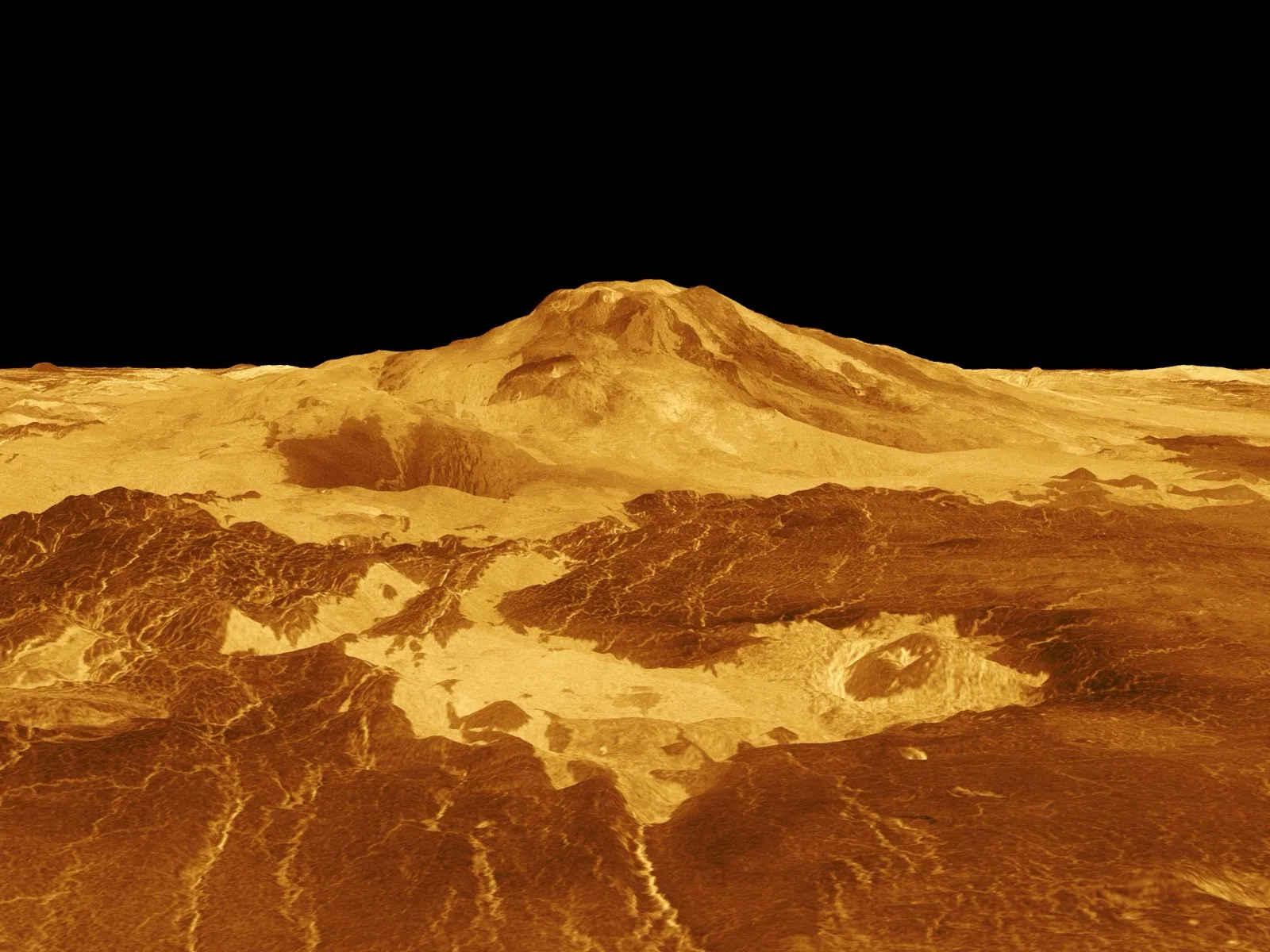
NASA’s Magellan spacecraft spent five years mapping the surface of Venus with radar, until its mission ended in 1994. It found a world shaped by volcanoes.
Venus has thousands of volcanoes. It also has deep valleys and high mountains, and one of its mountains reaches 11 km (36,000 feet), higher than Mount Everest.
There are two big highland areas, a little like continents. Ishtar Terra, near the north pole, is about the size of Australia. Aphrodite Terra stretches across the equator and is about the size of South America.

Some features look very strange. Pancake domes are flat-topped volcanoes up to 62 km (38 miles) wide, probably made by thick, sticky lava. Tick domes have ridges sticking out from their sides, so from above they look like ticks. Other areas, called tesserae, are criss-crossed with ridges and grooves.
Venus has very few impact craters, the scars left when space rocks crash in. Among the rocky planets, only Earth has fewer. Few craters means the surface is young, because lava has covered most of the old ground. Some of it may be only about 150 million years old.
The only photos taken on the ground came from the Soviet Union. Between 1961 and 1984 it sent a series of Venera probes (Venera is Russian for Venus). Ten of them reached the surface. The heat destroyed them quickly. The shortest-lived lasted 23 minutes, and the longest about two hours.
Their photos show a dim, rocky plain. The sky above it is probably a shade of yellow.
Is Venus still erupting?
For a long time, scientists suspected that some volcanoes on Venus were still active. Proving it was much harder.
Robert Herrick, a scientist at the University of Alaska Fairbanks, went back to Magellan’s radar pictures from 1991. He spent about 200 hours comparing pictures of the same places by hand. Then he found one that had changed.
It was a volcanic vent on Maat Mons, one of the biggest volcanoes on Venus. In February 1991 the vent was nearly round and covered about 2.2 square km (less than 1 square mile). By October 1991 it had doubled in size and changed shape. It also looked filled almost to the rim with a lake of lava.
Herrick then worked with Scott Hensley of NASA’s Jet Propulsion Laboratory, using computer models to test other explanations such as landslides. Only an eruption fitted the pictures.

They reported the discovery in 2023. NASA called it the first direct evidence of recent volcanic activity on the surface of Venus. It is still only one vent on one planet, so scientists want to see much more. That is a big part of why new missions are going.
A day that lasts longer than a year
Venus spins very slowly. One full turn takes 243 Earth days, while going once around the Sun takes only 225 Earth days. So on Venus, a day lasts longer than a year.
Venus also spins the opposite way to Earth and most other planets. If you stood on Venus, the Sun would rise in the west and set in the east. Only one other planet spins backwards like this. It is Uranus, which is also tipped over on its side.
High above the ground, things move far faster. At the tops of the clouds, winds race around the planet at up to 360 km/h (224 mph). That is faster than a high-speed train.
Venus has no magnetic field of its own, even though its iron core is about the size of Earth’s. Instead, the solar wind from the Sun wraps a weak magnetic field around it. That field streams out behind the planet like the tail of a comet.
Could anything live in the clouds?
The surface of Venus is far too hot for life as we know it. About 50 km (31 miles) up, things are different. There the temperature is between 30°C and 70°C, and the air pressure is close to Earth’s. Some tough microbes on Earth, called extremophiles, could cope with that heat.
In 2020, a team led by Professor Jane Greaves of Cardiff University said they had found a gas called phosphine in the clouds of Venus. On Earth, phosphine is made by living things and by industry. So the news caused a huge stir.
Then the arguments began. Other observations failed to find the same signal, and many scientists doubted the result. The team kept watching with the James Clerk Maxwell Telescope in Hawaii. They say the signal comes and goes, and seems to be destroyed by sunlight. That could explain why some searches missed it.
In 2024, the same scientists reported a possible sign of ammonia too, another gas that life can make. It is still only a tentative detection.
So is there life on Venus? Nobody knows. The phosphine is still disputed. Even if it is there, something that is not alive could be making it. The team says the only way to settle it is to go there. They have proposed a small probe called VERVE, which would ride to Venus with Europe’s EnVision spacecraft.
There is another mystery in the clouds. Dark streaks soak up ultraviolet light, and nobody can yet explain them. NASA says they are most likely made of fine particles or chemicals. Life is a much less likely idea, but it has not been ruled out.
No moon, but a companion called Zoozve
Venus and Mercury are the only planets without a moon. Venus does have a travelling companion, though. It is a small asteroid called Zoozve, between 200 and 500 metres across.
Zoozve is a quasi-moon. It goes around the Sun, not around Venus, but its path keeps it close to the planet. Astronomers think it may have kept Venus company for at least 7,000 years.
Its name has a funny story. Brian Skiff discovered it at Lowell Observatory in Arizona on 11 November 2002, and it was given the code 2002 VE68. Later, the artist Alex Foster was making a solar system poster for children. He copied “2002 VE” from a list, then misread his own handwriting as “Zoozve”.
A radio show tracked down the mistake and asked Skiff to make the name official. The International Astronomical Union agreed in February 2024. It says Zoozve was the first quasi-moon of a major planet ever identified.
How to spot Venus from Earth
You do not need a telescope. After the Moon, Venus is the brightest object in the night sky, so it is easy to spot with your eyes alone.
Venus’s orbit is inside Earth’s, so from here it never strays far from the Sun. You see it shortly after sunset or shortly before sunrise. The ancient Egyptians and Greeks saw it at both times. Some people even thought it was two different objects, a morning star and an evening star.
Through binoculars or a telescope, Venus shows phases, like the Moon. It can look full, half-lit or like a thin crescent. The whole cycle takes 584 days.
At its closest, Venus is about 38 million km (24 million miles) from Earth. At its furthest, on the far side of the Sun, it is about 261 million km away.

Missions to Venus, past and planned
Venus is a very hard place to explore. Landers get crushed and cooked. The clouds hide the ground from spacecraft in orbit too, yet spacecraft from several countries have studied it.
| Mission | Who sent it | When | What it did or will do |
|---|---|---|---|
| Venera | Soviet Union | 1961–1984 | landed on the surface and took the only photos from the ground |
| Pioneer Venus | NASA | 1978–1992 | orbited Venus and studied it from space |
| Magellan | NASA | 1989–1994 | mapped the surface with radar |
| Venus Express | European Space Agency | 2005–2014 | studied the atmosphere from orbit |
| Akatsuki | Japan (JAXA) | reached orbit in 2015 | orbited Venus |
| VERITAS | NASA | launch no earlier than 2031 | will map the surface in 3D with radar |
| EnVision | European Space Agency, with NASA | launch planned for November 2031 | will study Venus from its core to its upper atmosphere |
| DAVINCI | NASA | no launch date on its mission page yet | will drop a probe through the atmosphere to the surface |
DAVINCI is named after the artist and scientist Leonardo da Vinci. It is really two machines in one. A spacecraft will fly past Venus several times to track its clouds, and then it will release a probe.
As the probe falls, it will measure the gases, temperature, pressure and winds. Below the clouds, it will photograph a mountain region called Alpha Regio. Those rocks may be some of the oldest on Venus.
VERITAS will circle Venus and map its whole surface with radar, in far more detail than Magellan could. Its name means “truth” in Latin. NASA says DAVINCI and VERITAS will be the first American spacecraft to explore Venus since the 1990s.
Europe’s EnVision is being built by the company Thales Alenia Space, which won the contract in January 2025. After launch, it will take about 15 months to reach Venus. It will be the first Venus mission with a radar that can see up to a kilometre below the ground.
Space missions often run late, so these dates could still change. If all three fly, though, Venus will have three new spacecraft studying it at around the same time.
Three things people get wrong
1. “Mercury is the hottest planet, because it is closest to the Sun.” Mercury is closer, but Venus is hotter. Its thick carbon dioxide atmosphere traps heat, so the surface of Venus stays at about 467°C, day and night, all year round.
2. “Venus is always the planet nearest to Earth.” Venus comes closer to us than any other planet, to about 38 million km. But it also spends long spells on the far side of the Sun. NASA points out that Mercury actually spends more time near Earth than Venus does.
3. “Scientists found life on Venus in 2020.” They reported a gas, phosphine, that living things can make. Other scientists could not find it again, and the result is still argued over. Even if the gas is there, it may have a cause that is not alive. No one has found life on Venus.
Did you know? Venus helped to prove that the planets travel around the Sun. Galileo saw through his telescope that Venus has phases, like the Moon. That only makes sense if Venus goes around the Sun, not around Earth.
Try it
Model the phases of Venus. In a dark room, put a lamp on a table in the middle of the room for the Sun. Ask a friend to hold a ball for Venus and walk slowly in a circle around the lamp. Stand still a few steps outside the circle: you are Earth. Watch how much of the ball’s lit side you can see as it goes round. Sometimes it looks full, sometimes half-lit, and sometimes like a thin crescent.
Knowledge check
Why is Venus hotter than Mercury, even though Mercury is closer to the Sun?
Show answer
Venus has a thick atmosphere made mostly of carbon dioxide. The gas traps heat in a runaway greenhouse effect, so the surface stays at about 467°C.
On Venus, in which direction does the Sun rise?
Show answer
In the west. Venus spins backwards compared with Earth, so the Sun rises in the west and sets in the east.
Frequently asked questions
How hot is Venus?
The surface of Venus is about 467°C (872°F), hot enough to melt lead. That makes Venus the hottest planet in the solar system, hotter even than Mercury, which is closer to the Sun.
Why is Venus called Earth’s twin?
Venus is called Earth’s twin because the two planets are close in size and built in a similar way, each with an iron core, a rocky mantle and a thin crust. Venus is 12,104 km wide and Earth is 12,756 km wide. NASA also calls Venus Earth’s evil twin, because its surface is deadly.
Does Venus have a moon?
Venus has no moon and no rings. It does have a quasi-moon called Zoozve, a small asteroid that orbits the Sun while staying near Venus. Zoozve was found in 2002 and was given its official name in 2024.
How long is a day on Venus?
One spin of Venus takes 243 Earth days, which is longer than its year of 225 Earth days. Venus also spins backwards compared with most planets, so on Venus the Sun rises in the west and sets in the east.
Is there life on Venus?
Nobody has found life on Venus. In 2020, astronomers reported a gas called phosphine in its clouds, and on Earth that gas is made by living things and by industry. Other observations could not find the same signal, so scientists still disagree about whether the gas is there at all.
When is the next mission to Venus?
Three new Venus missions are planned. NASA’s VERITAS orbiter is due to launch no earlier than 2031, and the European Space Agency’s EnVision is aiming for November 2031. NASA’s DAVINCI mission, which will drop a probe to the surface, has not yet listed a launch date on its mission page.
Can you see Venus without a telescope?
Venus is easy to see without a telescope. After the Moon, Venus is the brightest object in the night sky. It never strays far from the Sun, so it appears shortly after sunset or shortly before sunrise.
Sources
- NASA Science: Venus facts — size, distance, temperature, air pressure, carbon dioxide and acid clouds, the slow backwards spin, tilt, Zoozve, the surface and its highlands, Magellan and the Venera landers, the conditions high in the clouds, phases and Galileo, and the missing magnetic field
- NASA Jet Propulsion Laboratory: Magellan data reveals volcanic activity on Venus — the Maat Mons vent that changed between February and October 1991, and how Robert Herrick and Scott Hensley showed it was an eruption
- Royal Astronomical Society (July 2025): Life on Venus? UK probe could reveal the answer — the 2020 phosphine report and why it is disputed, the JCMT-Venus findings on a changing signal, the tentative ammonia detection and the proposed VERVE probe
- NASA Science: DAVINCI — the DAVINCI spacecraft and probe, its flybys, its descent through the atmosphere and its pictures of Alpha Regio
- NASA Science: VERITAS mission overview — VERITAS’s launch no earlier than 2031, its orbit and its radar maps of the surface
- European Space Agency: EnVision factsheet — EnVision’s November 2031 launch target, its builder, its cruise, its subsurface radar, Venus’s possible Earth-like past, and the dates of earlier Venus missions


