
Bow and arrow quick facts
- In 2023 a French cave pushed the date of archery in Europe back by more than 40,000 years in a single study.
- There is no evidence Neanderthals ever used bows, although they were good at throwing spears.
- The oldest bows that still exist were found in a Danish bog, which preserved the wood.
- Archaeologists identify arrowheads by the way the tip shatters on impact, which differs from a thrown spear.
- A bow stores the energy of a slow pull and releases it in a fraction of a second, which is why it beats a throw.
The honest short answer
This question has no single date, and anybody who gives you one is hiding something.
The trouble is that a bow is made of wood, and wood rots. In ordinary soil a bow disappears in a century or two. What survives is the stone or bone tip of the arrow, and a tip on its own does not prove a bow existed.
So there are really two answers, depending on what you accept as evidence.
| What counts as evidence | Oldest example | Age | Where |
|---|---|---|---|
| An actual bow you can hold | The Holmegaard bows | About 11,000 years | Denmark |
| Arrow shafts | Stellmoor arrows | About 12,000 years | Germany |
| Stone points with arrow damage | Grotte Mandrin | About 54,000 years | France |
| Bone points with arrow damage | Sibudu Cave | About 64,000 years | South Africa |
The gap between the top and bottom rows is more than 50,000 years, and it exists entirely because of what rots and what does not.

How you spot an arrowhead
Given that the bows are missing, how does anybody know a small stone point was shot rather than thrown?
The answer is damage. When a stone tip hits bone at speed it breaks. How it breaks depends on how fast it was going and how it was mounted.
Archaeologists test this by experiment. They make replica points from the same kinds of stone and mount them on shafts. Then they use them properly: thrusting with a spear, throwing by hand, throwing with a spear-thrower, and shooting from a bow. Afterwards they examine every fracture under a microscope.
Each method leaves its own signature. An arrow shot from a bow travels fast and light. Its tip tends to snap in a particular way, one that a heavy thrusting spear does not reproduce.
Size matters as well. A point weighing only a few grams is too light to do much damage on a thrown spear. If a site is full of tiny points, something must have been launching them.
The cave that moved the date by 40,000 years
Until recently, most textbooks said archery reached Europe around 10,000 BC, at the end of the last ice age.
Then came Grotte Mandrin, a cave in the Rhone valley in southern France.
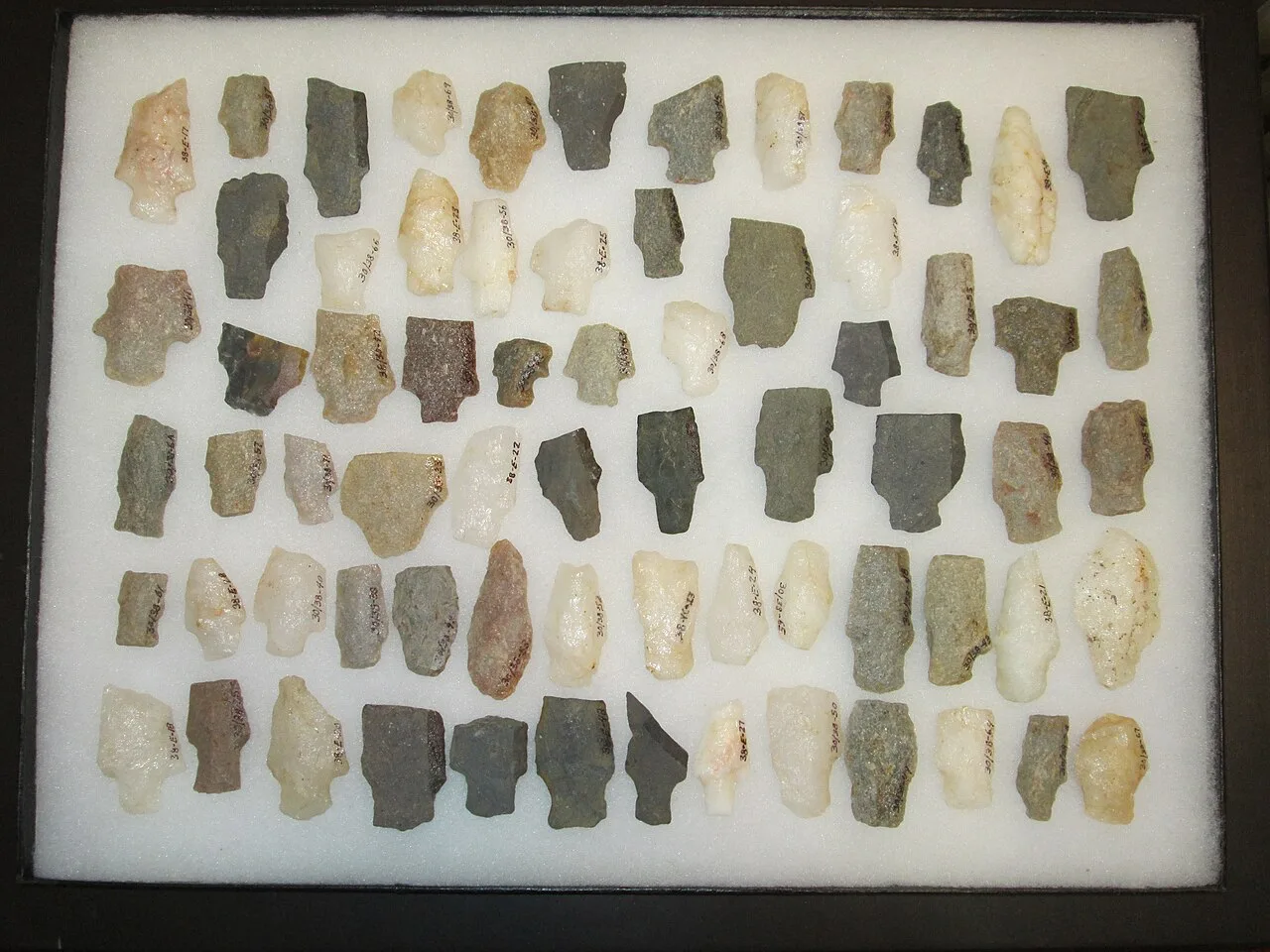
One layer of the cave, known as layer E, held hundreds of very small triangular stone points. They were about 54,000 years old, and they were associated with early modern humans rather than Neanderthals.
A team studied the wear and the impact fractures on those points and compared them with experimental sets. The conclusion, published in 2023, was that the small points had been used as arrowheads.
That single study pushed archery in Europe back by more than 40,000 years.
It also raised a sharper point. Neanderthals lived in Europe for a very long time and left enormous numbers of tools, and among them there is no evidence of bows at all. They hunted with spears, and they were good at it. The bow arrives with somebody else.
Older still, in Africa
Europe is not where the story starts.
At Sibudu Cave in South Africa, archaeologists have found small stone segments and bone points going back around 64,000 years. Several carry the kind of damage that experiments link to arrows, and some still have traces of the glue used to fix them to a shaft.
Further east, a cave in Sri Lanka called Fa-Hien Lena produced bone arrow points roughly 48,000 years old. The people who used them hunted in dense rainforest, where a long throw is useless.
Put those finds beside Grotte Mandrin and a pattern appears. The bow looks like African technology that travelled with modern humans as they spread, rather than something invented separately in Europe much later.
The oldest bows anyone can hold
For an actual bow rather than a broken tip, you have to go to a bog.
Peat bogs are waterlogged, acidic and short of oxygen, which is exactly the combination that stops wood decaying. Things dropped into a bog can come out thousands of years later looking almost new.
At Holmegaard in Denmark, that is what happened. Bows made of elm came out of the peat, around 11,000 years old and still recognisably bows.
They are not crude. The limbs are shaped to bend evenly along their length. The grip is narrowed to fit a hand. Modern bowyers still make copies and shoot them.
Something that well made was not the first attempt. Whoever carved the Holmegaard bows was working in a tradition that had already been going a very long time. That fits neatly with the much older evidence from the stone points.
Why a bow beats an arm
A human arm is a poor launcher. You can only push a spear for as long as your arm is moving forward, which is a fraction of a second. Muscles can only work so fast.
A bow gets round the problem by separating the two halves of the job.
You draw slowly, using your back and shoulders, and every bit of that effort is stored as bend in the wood. Then you let go, and the bow gives it all back in about a hundredth of a second.
The result is an arrow leaving faster than any human could throw it, flying flatter and further. It also means a hunter can shoot from a crouch, from behind cover, without the big wind-up that a throw needs.
For anyone hunting animals that will bolt at the first movement, that is an enormous advantage.
What a Stone Age arrow was made of
An arrow is not one object. It is four, assembled.
| Part | Material | Why |
|---|---|---|
| Shaft | Straight wood, often hazel or viburnum | Light and stiff, and straight shoots can be grown on purpose |
| Tip | Flint, other stone, bone or antler | Sharp enough to penetrate, cheap enough to lose |
| Glue | Birch tar, pine resin or pitch | Holds the tip in the split end of the shaft |
| Binding | Sinew or plant fibre | Wraps the joint so it cannot spread apart |
| Flights | Feathers | Keep the arrow pointing the way it is travelling |
Birch tar is worth pausing on. To make it you have to heat birch bark without letting it burn, which means excluding air, and the result is a black sticky glue that sets hard. People were making it in the Stone Age, and working out how they did it is still a live research question.
The tools used to shape all this are covered in our guide to Stone Age tools, and the later metal versions in Iron Age tools and weapons.
An archer buried near Stonehenge
Jump forward to about 2300 BC and archery is ordinary, and one British grave shows it plainly.
Near Amesbury in Wiltshire, close to Stonehenge, archaeologists found the burial of a man now called the Amesbury Archer. He was buried with flint arrowheads and with stone wrist guards. Those are the flat plates an archer straps on, so the bowstring cannot whip the inside of the forearm.
Chemical tests on his teeth showed he had grown up somewhere in the Alps. He arrived in Britain as an adult, and was buried with more grave goods than almost any other body of his period.

Three things people get wrong
Myth: the bow was invented about 10,000 years ago. That date comes from the oldest surviving wooden bows, which only tells you when bogs started preserving them. Stone points with arrow damage are five or six times older.
Myth: cavemen hunted mammoths with bows. The bow is a weapon for animals you can kill with a small wound and then follow. Very large, thick-skinned animals were hunted with heavy spears and with traps, and often by groups rather than individuals.
Myth: Neanderthals used bows too. No bow, arrow or arrow-damaged point has been linked to Neanderthals. They were skilled hunters with spears. As far as the evidence goes, the bow arrived in Europe with modern humans.
Did you know? Wooden bows almost never survive, so archaeologists mostly hunt for the damage instead. They fire replica stone points from real bows, then compare the fractures with the marks on ancient points.
Try it
Pull an elastic band back slowly between your fingers and let it go. You put the energy in over about a second and it came out in a hundredth of one. That difference is the whole idea behind a bow.
Knowledge check
Why are there so few Stone Age bows in museums?
Show answer
Bows are made of wood, which rots. Only waterlogged sites such as peat bogs preserve them.
How old are the oldest known bows?
Show answer
About 11,000 years. They were found at Holmegaard in Denmark, preserved in a bog.
Frequently asked questions
When was the bow and arrow invented?
There is no single agreed date. The oldest surviving bows are about 11,000 years old, from Denmark. Stone points showing arrow-impact damage push the technology back to around 54,000 years ago in Europe and roughly 64,000 years ago in southern Africa.
What is the oldest bow ever found?
The oldest bows that still exist come from Holmegaard bog in Denmark and are around 11,000 years old. They are made of elm, carefully shaped, and the bog’s waterlogged peat stopped the wood from rotting.
How do archaeologists know a stone point was an arrowhead?
They fire replica points from real bows and study how the tips break. Arrow impacts leave a particular pattern of fractures, different from the damage a thrust or thrown spear makes, and the ancient points are matched against that pattern.
Did Neanderthals use bows and arrows?
No evidence has been found that Neanderthals used bows. They made and used spears, including heavy thrusting spears, and were clearly skilled hunters. The bow appears in Europe alongside early modern humans instead.
Why is a bow better than throwing a spear?
A bow lets you store energy slowly and release it all at once, so an arrow flies faster and further than a person can throw. It also works from a crouch, from cover and with far less body movement to give a hunter away.
What were Stone Age arrows made of?
Stone Age arrows had wooden shafts, tipped with worked stone, bone or antler, and often carried feather flights to keep them straight. The tip was fixed on with plant resin, birch tar or pitch and bound with sinew or plant fibre.
Sources
- Science Advances: Bow-and-arrow technology of the first modern humans in Europe 54,000 years ago at Mandrin, France (Metz and others, 2023) — the 54,000-year-old stone points, the impact-damage method used to identify them, and the absence of evidence for Neanderthal archery
- National Museum of Denmark: the hunters of the Stone Age — the Holmegaard bows, how bog conditions preserved the wood, and Mesolithic hunting equipment
- English Heritage: Stonehenge history and stories — the Amesbury Archer, buried near Stonehenge with flint arrowheads and archer’s wrist guards


