
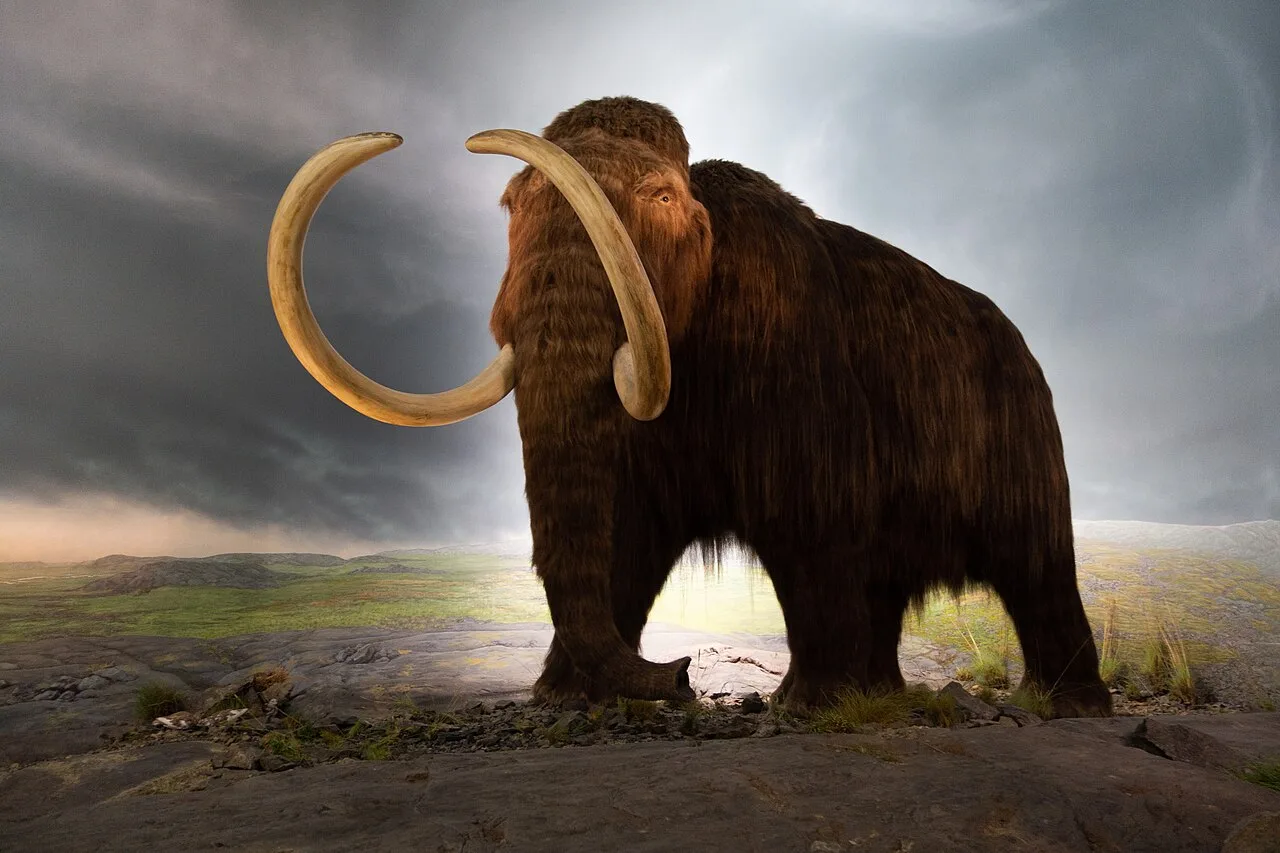
Woolly mammoth quick facts
- The last woolly mammoths were still alive after the Great Pyramid of Giza was built.
- Mammoth tusks twist in a spiral, bending in two directions at once.
- One mammoth’s tusk shows he walked far enough in his life to almost circle the Earth twice.
- The woolly mammoth was smaller than its ancestor, the steppe mammoth, which weighed about 10 tonnes.
- A baby mammoth called Lyuba, found frozen in 2007, is about 42,000 years old and still has her skin and trunk.
Woolly mammoth at a glance
The woolly mammoth was a hairy relative of today’s elephants. It lived through the last Ice Age across the cold grasslands of Europe, Asia and North America. Scientists call it Mammuthus primigenius. Here are its main facts in one place, so you can find each one quickly.
| Fact | Detail |
|---|---|
| Scientific name | Mammuthus primigenius |
| First appeared | About 800,000 to 600,000 years ago, in north-east Siberia |
| Height at the shoulder | About 3 to 3.5 metres (10 to 11.5 feet) |
| Weight | About 4 to 6 tonnes |
| Tusks | Up to about 3.7 metres (12 feet), twisted in a spiral |
| Food | Grasses and other low plants |
| Habitat | The mammoth steppe, a cold, dry grassland |
| Closest living relative | The Asian elephant |
| Died out on the mainland | About 10,500 years ago |
| Last survivors | Wrangel Island, Russia, about 4,000 years ago |
What was a woolly mammoth?
A woolly mammoth was a large, hairy member of the elephant family that lived in cold places during the Ice Age. It was not a dinosaur. The last dinosaurs died about 66 million years before the first woolly mammoth was born. Mammoths lived alongside early humans instead.
There were several kinds of mammoth. The woolly mammoth is the most famous, because so many of its bodies have been found frozen in the ground. It evolved from an older, larger animal called the steppe mammoth.
Its closest living relative is the Asian elephant. That does not make a mammoth an elephant in a fur coat. The two families split apart millions of years ago, and each changed in its own way.
How big was a woolly mammoth?
A woolly mammoth stood about 3 to 3.5 metres tall at the shoulder and weighed about 4 to 6 tonnes. That is about as heavy as four or five family cars. Its back was high at the shoulders and sloped down towards its tail.
Many people picture the woolly mammoth as the biggest mammoth of all. It was not. Its ancestor, the steppe mammoth, could weigh about 10 tonnes. In North America, the Columbian mammoth was taller too.
Being a bit smaller helped in the cold. A smaller body needs less food, and food was hard to find in a long Arctic winter.

How the woolly mammoth’s body beat the cold
The woolly mammoth’s body was built to keep heat in. It had thick, shaggy, chocolate-brown hair, very small ears and a short tail. Small ears and a short tail matter, because thin body parts lose heat quickly and can freeze. A big African elephant’s ears would have been a problem in Siberia.
Even the ears and the tail were covered in hair. Scientists know this because some mammoths have been found frozen whole, with their skin and fur still on.
Here is how a woolly mammoth compares with its living relatives.
| Feature | Woolly mammoth | Asian elephant | African bush elephant |
|---|---|---|---|
| Hair | Thick, long and shaggy | Sparse | Sparse |
| Ears | Very small and hairy | Medium | Very large |
| Tail | Short and hairy | Long | Long |
| Tusks | Very long, twisted in a spiral | Shorter; many females have none | Long and gently curved |
| Home | Cold, dry grassland | Warm forests and grassland | Warm savanna |
| Still alive? | No | Yes | Yes |
Woolly mammoth tusks
Woolly mammoth tusks were very long front teeth that could grow to about 3.7 metres (12 feet). They did not just curve upwards. They twisted in a spiral, bending in two directions at once. That is longer than a family car.
A mammoth used its tusks for fighting rivals, showing off and perhaps sweeping snow away from the grass underneath.
Tusks also hold a secret. A tusk grows in layers, a little like the rings in a tree trunk. Each layer keeps a chemical record of the water the mammoth drank and the places it walked.
In 2021, scientists at the University of Alaska Fairbanks read one tusk layer by layer. It belonged to a male who lived about 17,000 years ago and died at the age of 28. Over his life he walked far enough to almost circle the Earth twice. The researchers called his tusk a diary.

What did woolly mammoths eat?
Woolly mammoths ate grasses and other low-growing plants. They were grazers, like cows and horses, rather than browsers that eat leaves from trees. Their huge back teeth were flat, with hard ridges across the top, which worked like a grater to grind tough grass.
Grinding grass wears teeth down. So a mammoth’s back teeth were replaced as they wore out, with new ones moving forward from the back of the jaw.
Once its last teeth wore down, an old mammoth could no longer chew properly. That was often what ended its life.
Where did woolly mammoths live?
Woolly mammoths lived on the mammoth steppe, a cold, dry grassland that once stretched across Europe and northern Asia. The mammoth steppe has gone. Nothing quite like it exists anywhere on Earth today.
During the Ice Age, so much water was locked up in ice that the sea was lower. Dry land joined Siberia to Alaska. Mammoths could walk from Asia into North America across this land bridge.
Further south in North America lived a different species, the Columbian mammoth. It ranged from southern Canada down to Costa Rica. It was bigger than the woolly mammoth and far less hairy, because it lived somewhere warmer. You can read more about the cold years they lived through in How Long Did the Ice Age Last?
Woolly mammoths and Stone Age people
Woolly mammoths shared their world with Stone Age people for thousands of years. People hunted them, ate them and used their bones, tusks and skins. They also painted and carved pictures of mammoths on cave walls. Those pictures show exactly how mammoths looked to the people who saw them alive.
To find out what else these hunters ate, read Stone Age Food. To see the pictures they left behind, try Cave Paintings in the Stone Age.
Lyuba, the baby mammoth
Lyuba is a baby woolly mammoth found frozen in Siberia in 2007. She is about 42,000 years old and is one of the best-preserved mammoths ever discovered. She was only about one month old when she drowned in mud, which sealed her body and kept it safe.
Most frozen mammoths are found damaged or in pieces. Lyuba is almost complete, which lets scientists study a baby mammoth’s body directly instead of guessing from bones.
Today she belongs to a museum in the Yamal-Nenets region of Russia, close to where she was found.

When and why did woolly mammoths go extinct?
Woolly mammoths died out on the mainland about 10,500 years ago, as the last Ice Age ended. The likely cause was a mix of a warming climate and human hunting. As the world warmed, the mammoth steppe turned into forest and wet tundra, so there was less grass to eat.
Some mammoths lasted much longer on islands. The last of all lived on Wrangel Island, off the north-east coast of Siberia. They survived there until about 4,000 years ago.
That was after the Great Pyramid of Giza had been built.
The Wrangel mammoths began with no more than eight animals. In 2024, scientists studied their DNA and found that the herd stayed steady for about 6,000 years. Inbreeding did not wipe them out. The researchers think a sudden event, such as a disease or a bad storm, probably killed the last of them. Nobody knows for sure.
Could woolly mammoths come back?
Woolly mammoths cannot be brought back yet, and maybe never exactly. A company in the United States, Colossal Biosciences, is trying to edit the genes of Asian elephants. The aim is an elephant with mammoth features, such as thick hair. It would be a hairy elephant, not a true mammoth.
In March 2025 the company showed “woolly mice”. They had changed seven genes in mice, which grew long, thick, golden hair. Other scientists pointed out that the results had not yet been checked by independent experts.
The full story, and the arguments for and against, are in Are Scientists Bringing Back the Woolly Mammoth?
Three things people get wrong
Myth: woolly mammoths lived with dinosaurs. The last dinosaurs died out about 66 million years ago. The woolly mammoth appeared less than a million years ago. Cartoons put them together, but no mammoth ever saw a dinosaur.
Myth: the woolly mammoth was the biggest mammoth. It was about the size of a modern elephant. The steppe mammoth and the Columbian mammoth were both bigger. The woolly mammoth’s smaller size helped it survive on less food.
Myth: all mammoths died out at the end of the Ice Age. Most did, about 10,500 years ago. But a small herd on Wrangel Island lasted until about 4,000 years ago, long after people in Egypt were building pyramids.
Did you know? The last mammoth herd, on Wrangel Island, began with no more than eight animals and lasted about 6,000 years. Their DNA shows inbreeding did not finish them off. Something sudden probably did, and scientists still do not know what.
Try it
Measure 3.7 metres along a corridor or playground with a tape measure or your own footsteps. That is how long the biggest woolly mammoth tusks grew. Now imagine carrying two of them on your head.
Knowledge check
Why did woolly mammoths have small ears and a short tail?
Show answer
Thin body parts lose heat quickly and can freeze. Small ears and a short tail helped a mammoth keep warm in the Ice Age cold.
Where did the very last woolly mammoths live?
Show answer
On Wrangel Island, off the north-east coast of Siberia, until about 4,000 years ago.
Frequently asked questions
How big was a woolly mammoth?
A woolly mammoth stood about 3 to 3.5 metres (10 to 11.5 feet) tall at the shoulder and weighed about 4 to 6 tonnes. That is about the size of a modern elephant. Its ancestor, the steppe mammoth, was bigger, at about 10 tonnes.
What did woolly mammoths eat?
Woolly mammoths ate grasses and other low-growing plants on the cold grassland called the mammoth steppe. Their large back teeth had hard ridges that ground tough grass, and the teeth were replaced as they wore down.
When did woolly mammoths go extinct?
Woolly mammoths died out on the mainland about 10,500 years ago, at the end of the last Ice Age. A small population on Wrangel Island, off Siberia, survived until about 4,000 years ago.
Why did woolly mammoths go extinct?
Scientists think woolly mammoths died out because of a warming climate and human hunting together. As the Ice Age ended, their grassland turned into forest and wet tundra. The island herds lasted longer, and scientists think a sudden event probably finished off the very last herd.
Did woolly mammoths live with dinosaurs?
Woolly mammoths never lived with dinosaurs. The last dinosaurs died about 66 million years ago, and the woolly mammoth appeared less than a million years ago. Mammoths lived alongside Stone Age people instead.
What is the woolly mammoth’s closest living relative?
The Asian elephant is the woolly mammoth’s closest living relative. That is why a company trying to recreate mammoth features is editing the genes of Asian elephant cells.
Who was Lyuba the baby mammoth?
Lyuba is a baby woolly mammoth found frozen in Siberia in 2007. She is about 42,000 years old and was about one month old when she died. She is one of the best-preserved mammoths ever found.
Sources
- Natural History Museum, London: Were all mammoths woolly? — when and where the species appeared, its height and weight, spiral tusks, small ears and short tail, the mammoth steppe, the Asian elephant link, the Columbian mammoth’s range and the mainland extinction about 10,500 years ago
- Cell Press via EurekAlert: The last mammoths on Wrangel Island (2024) — the Wrangel herd’s survival until about 4,000 years ago, its eight or fewer founders and why inbreeding was not the cause
- University of Alaska Fairbanks: a 17,000-year-old mammoth’s tusk — how tusk layers record a mammoth’s life, and the male who walked nearly twice around the Earth
- Australian Museum: The story of baby Lyuba — Lyuba’s discovery in 2007, her age of about 42,000 years and her age of about one month
- National Park Service, Bering Land Bridge: Ice Age wildlife — tusks up to about 12 feet (3.7 metres) long, and the hairy ears and tail
- Natural History Museum of Utah: Mammoths and mastodons — the ridged grinding teeth and grass diet, and the larger, less hairy Columbian mammoth


