Space is everything beyond Earth’s air: a near-empty vacuum holding planets, moons, stars and galaxies. Our solar system formed about 4.6 billion years ago and has the Sun, eight planets, five named dwarf planets and hundreds of moons. It is one small part of the Milky Way, one of billions of galaxies.
space quick facts
- About one million Earths could fit inside the Sun.
- The solar system formed about 4.6 billion years ago.
- One trip around the centre of the Milky Way takes the solar system about 230 million years.
- Flying a plane to Pluto would take more than 800 years.
- Astronauts say space smells like hot metal and burnt steak.
What is space?
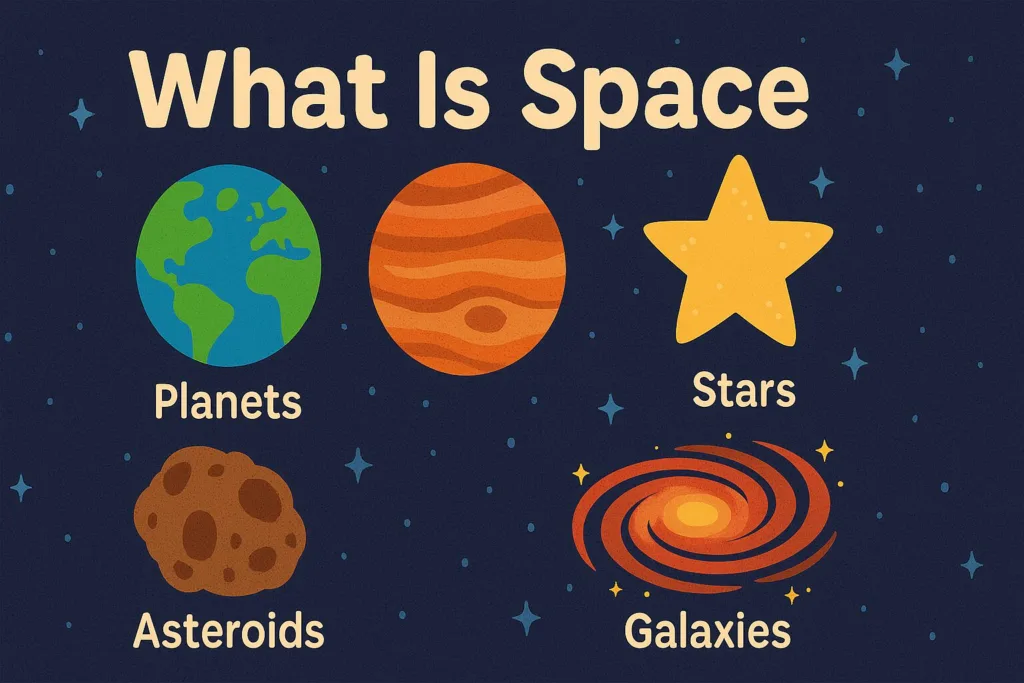
Space is everything beyond Earth’s air. Once you go high enough above the ground, the air gets thinner and thinner until there is almost none left. That is where space begins.
There is no sharp line where the sky ends and space begins. Many scientists say space starts about 100 km above the ground. That is only about as far as a long car journey, but straight up!
Space is very nearly empty. Scientists call it a vacuum. It is not completely empty, though. It holds planets, moons, stars, dust, gas and billions of galaxies, spread across unimaginable distances.
Space is also silent. Sound needs air, or something else, to travel through. With almost nothing to carry it, no sound can travel across space.
Our solar system
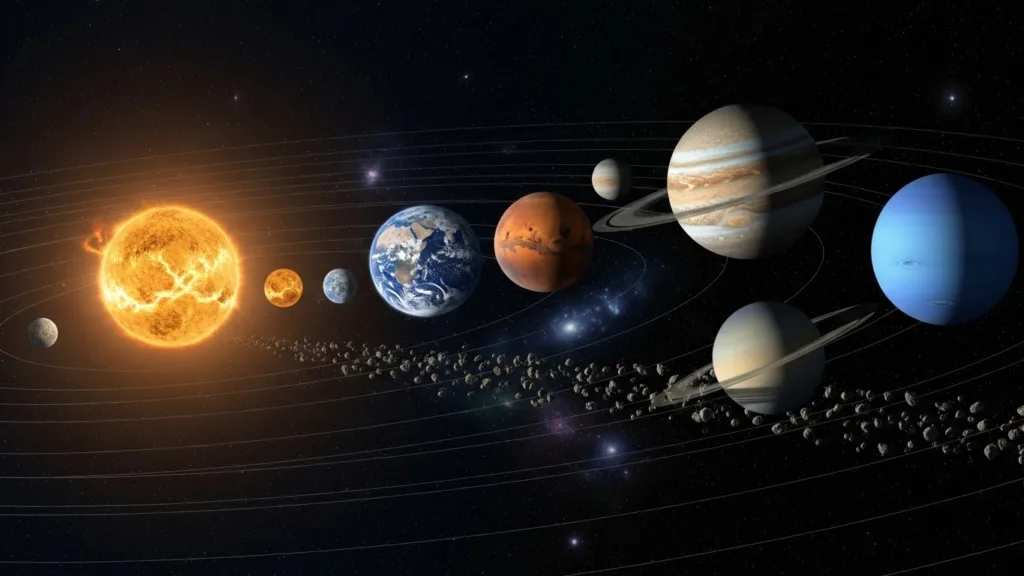
Our home in space is the solar system. It formed about 4.6 billion years ago from a huge cloud of gas and dust.
At its centre is the Sun, a star. Around it travel eight planets, five named dwarf planets, hundreds of moons and thousands of asteroids and comets.
The Sun is enormous. About one million Earths could fit inside it. Yet among all the stars in the universe, it is only an average-sized star.
The eight planets
The planets travel around the Sun in paths called orbits. Here they are, from the closest to the Sun to the furthest away.
| Planet | Worth knowing |
|---|---|
| Mercury | the smallest planet and the closest to the Sun |
| Venus | the hottest planet, wrapped in thick clouds |
| Earth | our home, the only planet known to have life |
| Mars | the red planet, with giant volcanoes |
| Jupiter | the biggest planet, with a giant storm called the Great Red Spot |
| Saturn | famous for its bright rings |
| Uranus | an icy giant that spins on its side |
| Neptune | the furthest planet, cold, dark and windy |
The four planets closest to the Sun are small and rocky. The four furthest away are giants. You couldn’t walk on Jupiter, Saturn, Uranus or Neptune, because they have no solid surface to stand on.
Jupiter is so big that all the other planets could fit inside it. You can find out more in our Jupiter facts for kids.
Dwarf planets, asteroids and comets
Not everything that goes around the Sun is a planet. There are also five officially named dwarf planets. Pluto is the best known. The others are Ceres, Eris, Haumea and Makemake.
Dwarf planets are round, like planets, but they are much smaller, and they share their part of space with lots of other objects.
Asteroids are lumps of rock and metal. Most of them travel around the Sun in a wide ring between Mars and Jupiter, called the asteroid belt.
Comets are balls of ice and dust. When a comet comes close to the Sun, the ice starts to turn into gas, and it grows a long, glowing tail that can stretch for millions of kilometres.
The edge of the solar system
Beyond Neptune lies the Kuiper Belt, a ring of icy bodies. Most are small, but it also holds the dwarf planet Pluto.
Pluto is a very long way away. If you could fly an aeroplane there, the trip would take more than 800 years.
Further out still is the Oort Cloud, a giant, round shell of icy objects surrounding the whole solar system. It may stretch as far as 1.6 light-years from the Sun. A light-year is the distance light travels in a year, which is almost 10 trillion kilometres.
The Sun also blows out a stream of charged gas called the solar wind. It makes a huge bubble in space around the solar system, called the heliosphere.
The Moon
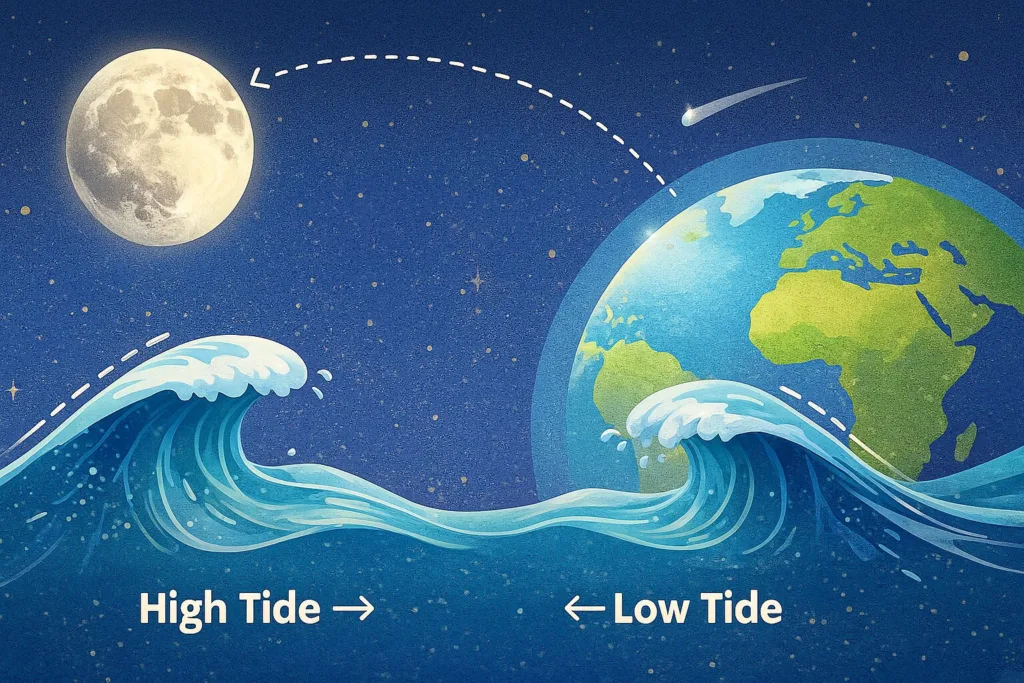
Earth has one natural moon. It is our closest neighbour in space.
The Moon’s gravity pulls on Earth’s oceans, making the water rise and fall along our coasts each day. These rises and falls are called the tides. The Moon has no air, so there is no weather there, and no wind to blow away the footprints the astronauts left behind.
In 1969, the Apollo 11 astronauts became the first people to walk on the Moon. Read about the first of them in our Neil Armstrong facts for kids.
Stars
Stars are huge balls of very hot, glowing gas. They make their own light and heat, which is why they shine.
The Sun is the closest star to Earth. All the other stars you see at night are much further away, which is why they look like tiny points of light.
Stars come in different sizes and colours. Some are much bigger than the Sun, and some are much smaller. The colour of a star tells scientists how hot it is. Blue stars are the hottest, and red stars are cooler.
Our galaxy, the Milky Way
The solar system is part of a huge group of stars called a galaxy. Our galaxy is the Milky Way.
The solar system sits in a small arm of the Milky Way called the Orion Arm. It is travelling around the centre of the galaxy at about 828,000 km/h (515,000 mph).
Even at that speed, the Milky Way is so big that one trip around its centre takes about 230 million years.
On a very dark night, far from city lights, you can see the Milky Way as a faint, milky band stretching across the sky. That band is the light of millions of distant stars. And the Milky Way is only one of billions of galaxies. There are more stars in the universe than there are grains of sand on all the beaches on Earth.
Life as an astronaut
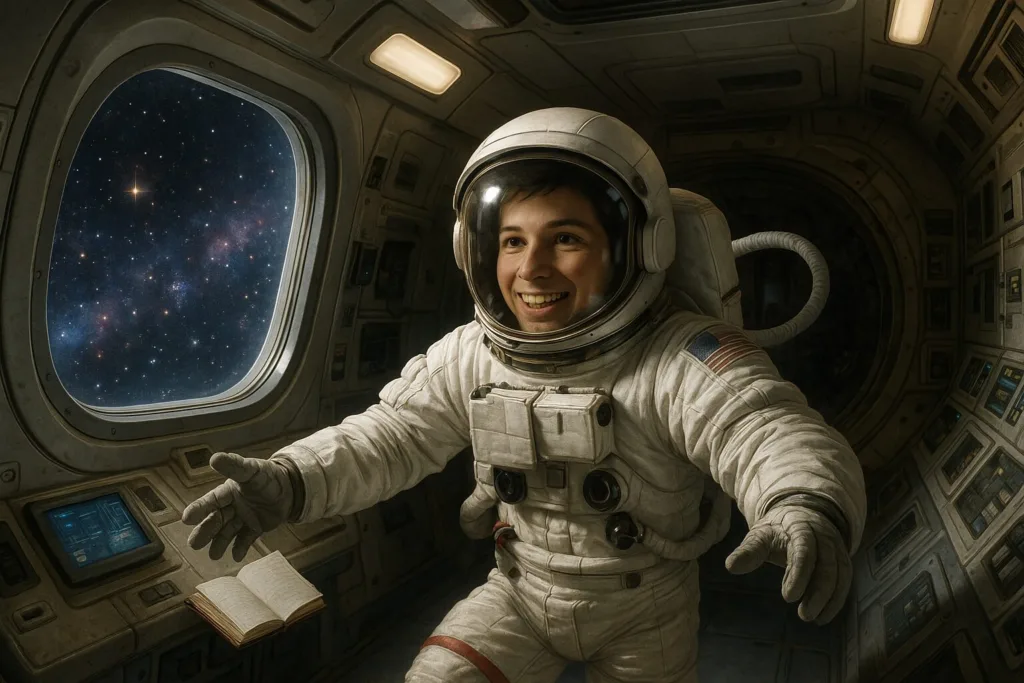
Astronauts are people who travel into space. Because space has no air to breathe, and it is dangerously hot in the sunlight and freezing cold in the shade, they must always be protected.
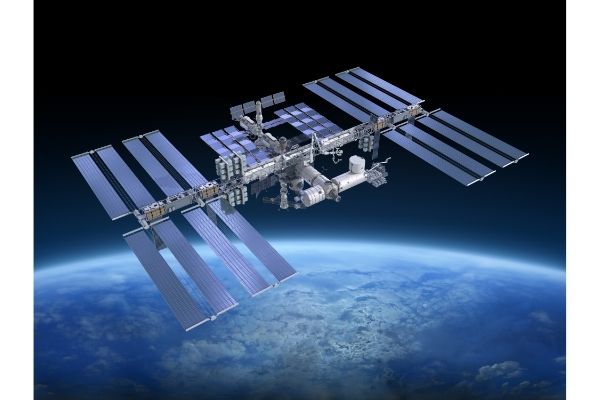
Inside a spacecraft or space station, they breathe air brought from Earth. When they go outside on a spacewalk, they wear a spacesuit, which is like a small spacecraft shaped like a person.
Astronauts in orbit float about inside their spacecraft. That is not because there is no gravity up there. It is because they and their spacecraft are falling around the Earth together, so nothing presses them against the floor. They have to strap themselves into sleeping bags so they don’t drift away in the night. Every meal, and much of their water, has to be brought up from Earth or recycled on board.
Nobody has ever smelled space directly, and lived to tell the tale. But when astronauts come back inside after a spacewalk, they notice a strange smell on their suits.
They have described it as smelling like hot metal, burnt steak, burnt cakes and spent gunpowder. One NASA astronaut, Don Pettit, said it reminded him of the sweet-smelling fumes from welding metal.
Amazing space facts
The tallest mountain known is on an asteroid called Vesta. It is about 22 km high, three times as tall as Mount Everest.
Sunsets on Mars look blue, not orange like ours.
Mars may have water that sometimes flows over its surface, according to evidence found by NASA.
Comets are leftovers from the birth of the solar system, about 4.5 billion years ago. They are made of dust and rock mixed with ice.
Space junk is a growing problem. Scientists think there are about 500,000 pieces of it circling Earth, including bits of old rockets and satellites.
Asteroids hit Earth’s atmosphere more often than you might think. One about the size of a car arrives roughly once a year, but it burns up long before it reaches the ground.
Three things people get wrong
Space is not completely empty. It is very nearly a vacuum, but it still contains a little gas and dust, as well as planets, stars and galaxies.
The Sun is not an unusually big star. A million Earths could fit inside it, but it is only an average-sized star.
You cannot hear explosions in space. Sound needs something to travel through, and space has almost nothing to carry it.
Did you know? The tallest mountain known is on the asteroid Vesta. It is about 22 km high, three times the height of Mount Everest.
Try it
Use a football for the Sun and a peppercorn for Earth, then pace out about 25 big steps between them. That gives you a rough idea of how far Earth is from the Sun compared with their sizes.
Knowledge check
Why can’t you hear sound in space?
Show answer
Because sound needs something to travel through, and space is almost empty.
What is the name of our galaxy?
Show answer
The Milky Way.
Frequently asked questions
What is space?
Space is everything beyond Earth’s atmosphere. It is almost a perfect vacuum, but it contains planets, moons, stars, dust, gas and billions of galaxies.
How many planets are in our solar system?
There are eight planets in our solar system: Mercury, Venus, Earth, Mars, Jupiter, Saturn, Uranus and Neptune. There are also five officially named dwarf planets, including Pluto.
How old is the solar system?
The solar system formed about 4.6 billion years ago, from a dense cloud of gas and dust in space.
How big is the Sun compared with Earth?
About one million Earths could fit inside the Sun. Even so, the Sun is only an average-sized star.
What does space smell like?
Nobody has smelled space directly, but astronauts returning from spacewalks describe a smell on their suits like hot metal, burnt steak, burnt cakes and spent gunpowder.
What is the Milky Way?
The Milky Way is the galaxy our solar system belongs to. The solar system travels around its centre at about 828,000 km/h, and one orbit takes about 230 million years.
Sources
- NASA Science: solar system facts — the age and contents of the solar system, the Kuiper Belt, Oort Cloud, heliosphere and our place in the Milky Way
- National Geographic Kids: ten facts about space — the Sun’s size, Pluto, Vesta, Mars sunsets, comets, space junk and asteroids
- Live Science: what does space smell like? — space as a near vacuum and what astronauts say it smells like