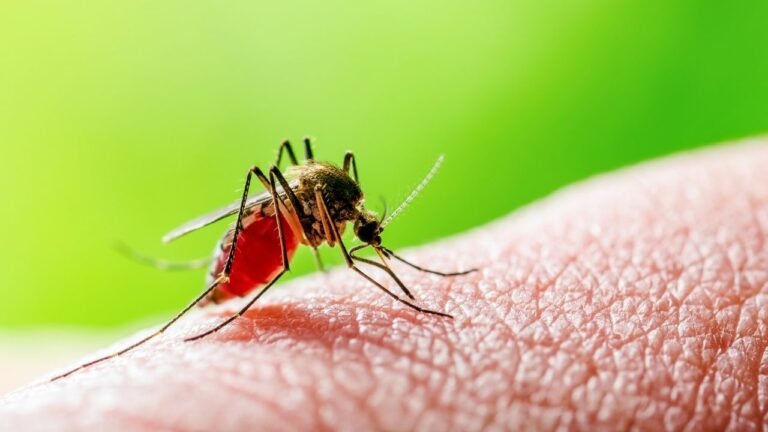
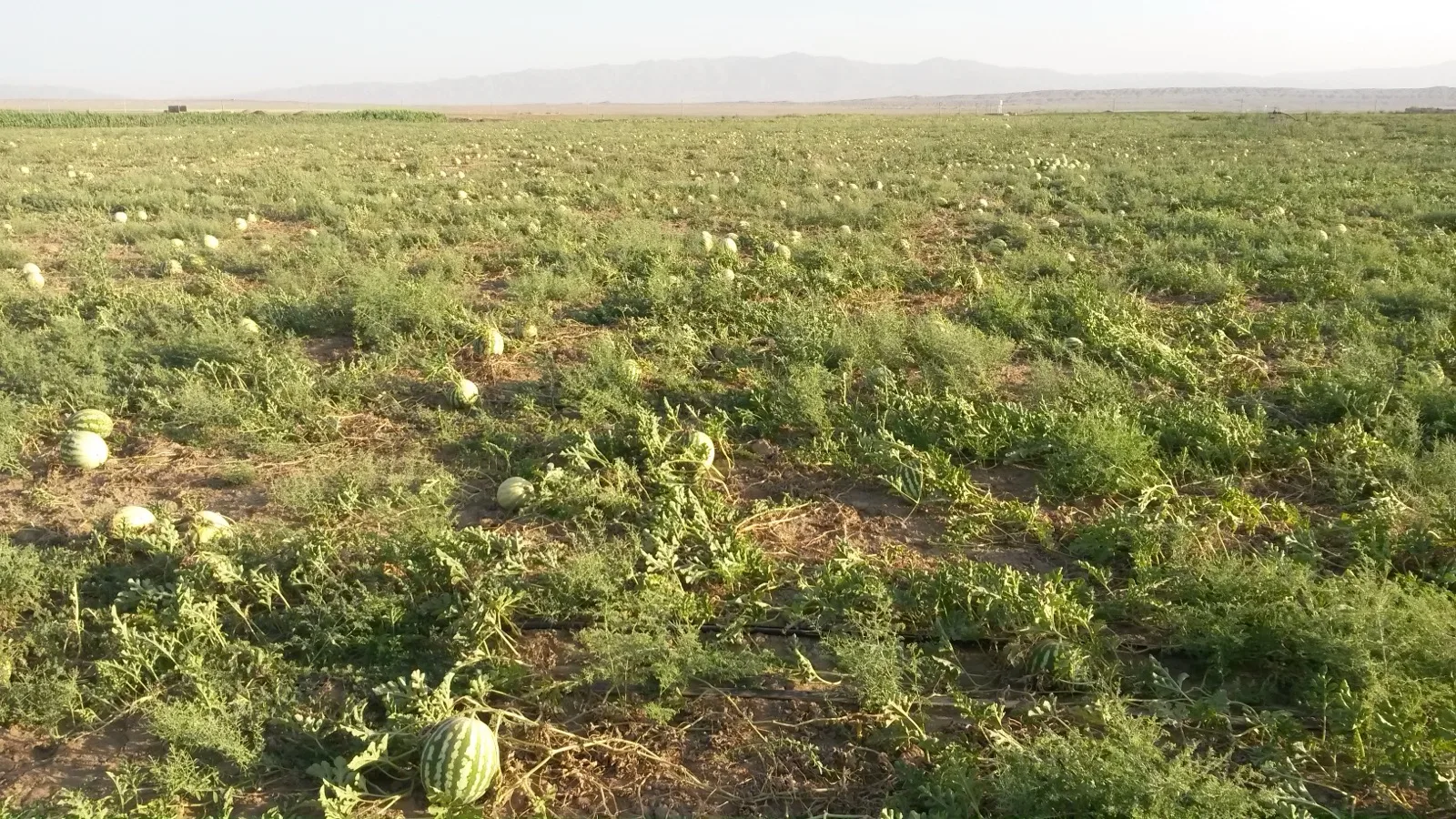
The watermelon plant life cycle takes about 10 to 16 weeks from seed to ripe fruit. A seed sprouts in warm soil in about five days and grows into a long vine. Male flowers open first, then female ones. Bees carry pollen between them, and the fruit ripens 35 to 45 days after flowering.
Watermelon life cycle quick facts
- Watermelon vines grow only male flowers at first. Female flowers, the ones that become fruit, come later.
- A female flower appears at only about every seventh leaf joint, but male flowers grow at every joint.
- Each flower is open for just one day and needs about eight bee visits to make a good fruit.
- Seedless watermelons still need pollen, so farmers plant seeded watermelons in the same field.
- A 2021 genome study found the watermelon’s closest relative is the Kordofan melon of Sudan, which has whitish, non-bitter flesh.
A watermelon starts as a seed smaller than your fingernail. About three months later, the same plant can carry a striped fruit weighing 7 to 11 kg (15 to 25 pounds). This guide follows every stage of the watermelon plant life cycle, with the timings that farmers and gardeners actually use.
Watermelon growth stages at a glance
A watermelon is an annual plant. It grows from a seed, flowers, makes fruit and seeds, and then dies, all in one growing season. Scientists split this life cycle into stages. This guide uses nine, so each one can be matched to a picture or a sentence in a project.
| Stage | What happens | Rough timing in warm weather |
|---|---|---|
| 1. Seed | A seed is sown about 2.5 cm (1 inch) deep in warm soil | day 0 |
| 2. Germination | A root grows down, then a shoot pushes up | about 5 days at 25 °C (77 °F) |
| 3. Seedling | Two seed leaves open, then the first true leaves | weeks 1 to 3 |
| 4. Vine running | The stem creeps along the ground and grows tendrils | weeks 3 to 6 |
| 5. Flowering | Male flowers open first, female flowers later | weeks 6 to 8 |
| 6. Pollination | Bees carry pollen from male to female flowers | the one day each flower is open |
| 7. Fruit set and growth | The baby fruit swells | 35 to 45 days after flowering |
| 8. Ripening | The tendril dries and the ground spot turns yellow | weeks 10 to 16 |
| 9. New seeds | Ripe fruit holds seeds, and the vine dies | end of the season |
The first two stages and the fruit-growing time come straight from university farm guides. The other timings are worked out from them, so treat them as a guide, not a rule. Cool or cloudy weather slows every stage down.
Stage 1: the seed
Every watermelon plant begins as a seed. Inside its hard coat is a tiny baby plant, called an embryo, and a store of food. The food keeps the baby plant alive until it has leaves of its own.
A seed can wait in a packet for months. It does nothing at all until it gets two things: water and warmth.
Gardeners push watermelon seeds about 2.5 cm (1 inch) into the soil. University of Illinois Extension suggests sowing two or three seeds together in a small mound. Later, the weaker seedlings are pulled out so the strongest has room to grow.
Stage 2: germination and soil temperature
Germination is the moment a seed starts to grow. The seed soaks up water and swells. Its coat splits open, and a root pushes down first. Then a shoot pushes up towards the light.
Soil temperature decides how fast this happens. The University of Georgia says watermelon seeds germinate in soil between 20 and 35 °C (68 and 95 °F). Below 21 °C (70 °F), germination is very slow. At 25 °C (77 °F), the seedlings come up in about five days.
That is why gardeners wait. In cold soil, seeds can sit for a long time. Illinois Extension says to sow only after all danger of frost has passed and the soil is warmer than 18 °C (65 °F). A soil thermometer pushed into the ground tells you when it is time.
Seedless watermelon seeds are fussier still. The University of Georgia says they hardly germinate below 27 °C (80 °F). Farmers start them in warm greenhouses instead of sowing them straight into a field.
Stage 3: seedling and first true leaves
The first two leaves to open are not real watermelon leaves. They are seed leaves, called cotyledons. They are smooth and oval, and they were already folded up inside the seed.
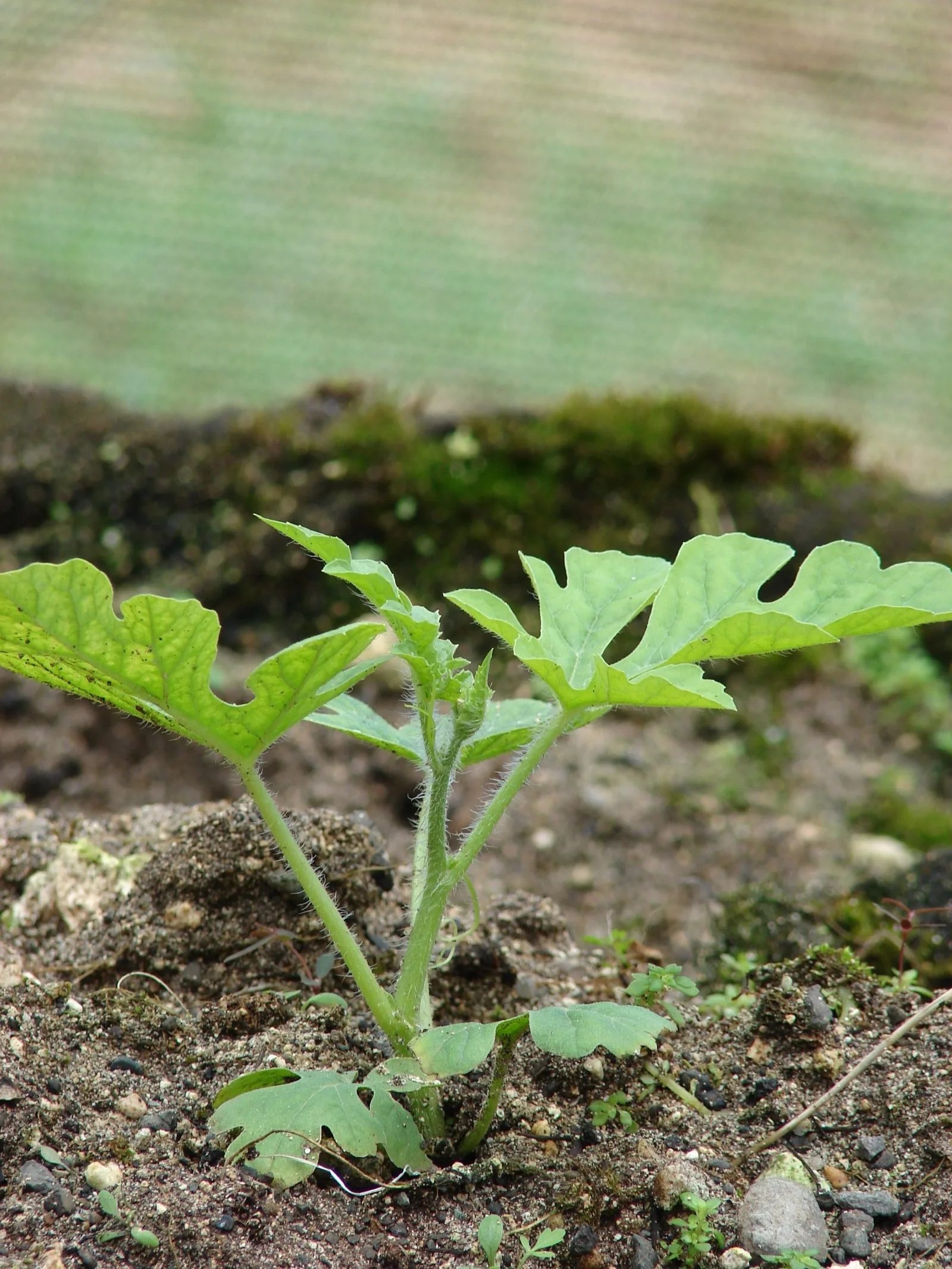
Next come the true leaves. These are rough, slightly hairy and deeply cut into lobes, a bit like a hand with its fingers spread. From now on the plant makes its own food. Its leaves use sunlight, water and carbon dioxide from the air to make sugar. This is called photosynthesis.
Seedlings are tender. A single frost can kill them. Illinois Extension suggests starting seeds indoors about three weeks before planting them outside. Farmers do much the same. Penn State Extension says commercial watermelon plants spend 18 to 24 days in a greenhouse before they go out into the field.
Stage 4: the vine starts to run
Once the plant has a few true leaves, it starts to run. Growers use that word for the moment the stem stops standing up and starts to creep along the ground.
The vine grows fast. The University of Maryland Extension says watermelon vines reach about 1.8 metres (6 feet) on compact bush types and up to 6 metres (20 feet) on large ones. The longest are longer than a family car.
Side shoots branch off the main vine. Thin, curly tendrils grow where the leaves join the stem. A tendril coils around anything it touches, which helps the vine grip the ground and nearby plants.
All this time, the plant is building a food factory. More leaves catch more sunlight and make more sugar. Later on, much of that sugar will end up in the fruit.
Stage 5: male and female flowers
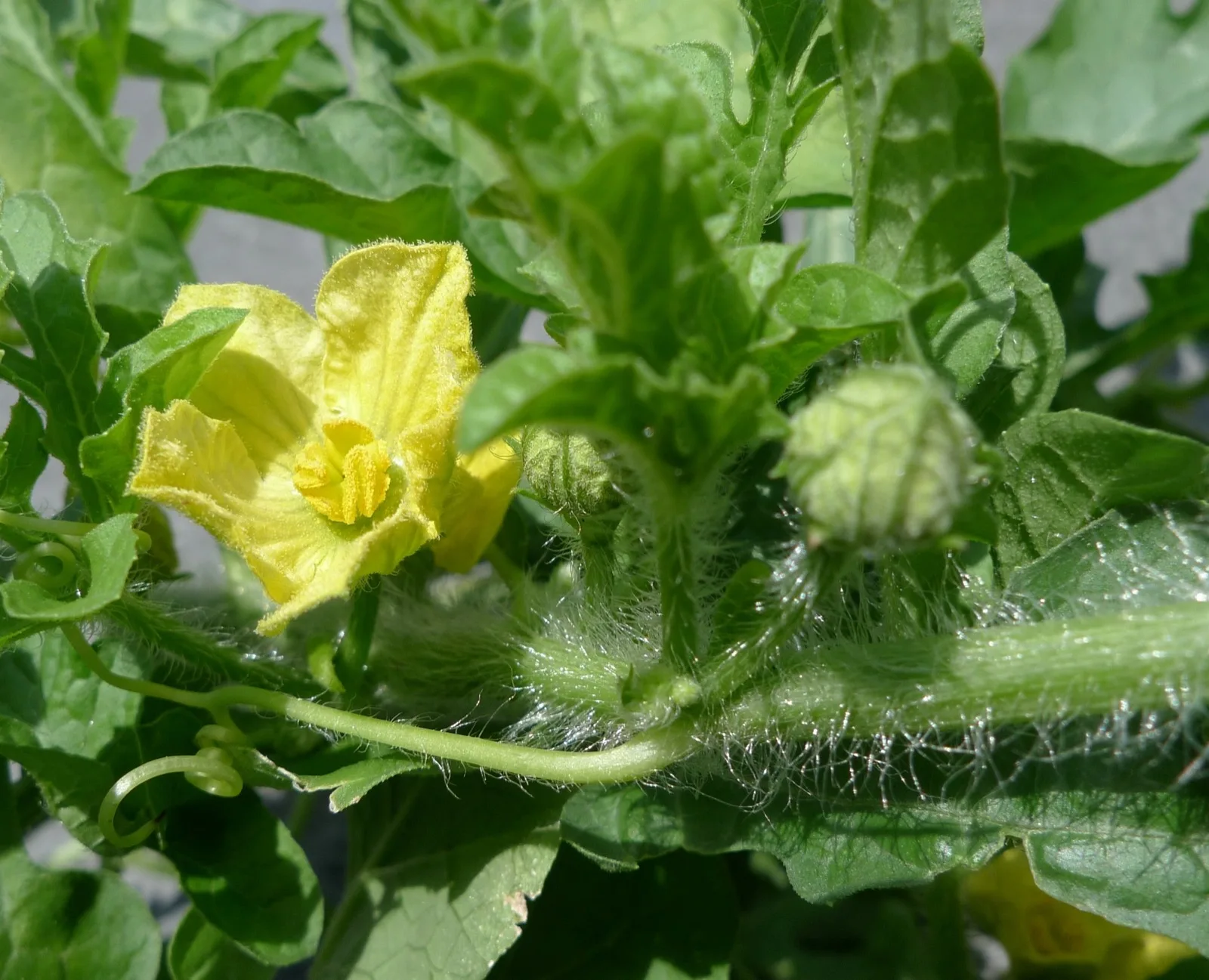
A watermelon plant grows separate male and female flowers. Both are small and yellow. Only the female flower can become a watermelon.
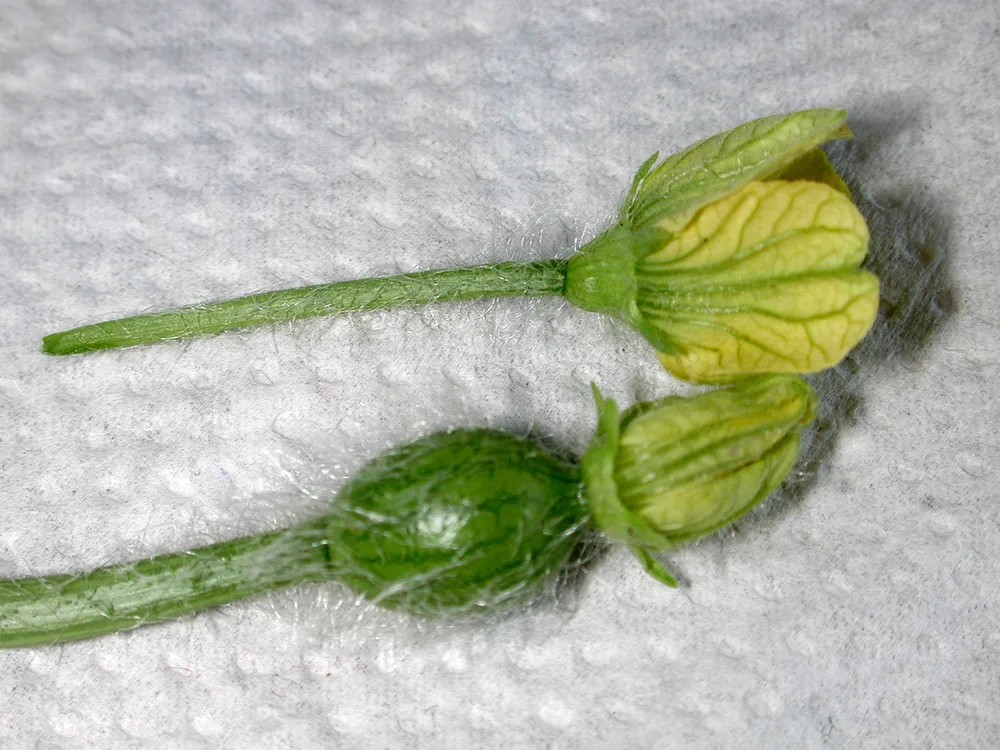
Male flowers come first. The University of Nebraska–Lincoln Extension says watermelons at first produce only male flowers. Female flowers follow later, at particular places along the vine.
Male flowers keep on coming, too. Once flowering begins, a male flower grows at every leaf joint, the University of Georgia says. A female flower grows at only about every seventh joint. So a vine always carries far more male flowers than female ones.
Telling them apart is easy once you know how. A male flower sits on a thin, plain stalk. A female flower has a tiny, hairy baby watermelon just behind its petals. That swelling is the ovary, the part of the flower that holds the seeds before they are fertilised.
New growers often worry when their plant is covered in flowers but no fruit appears. Usually nothing is wrong. The first flowers are all male, so there is nothing yet that can turn into a melon.
Stage 6: pollination by bees
A female flower cannot make a fruit on its own. It needs pollen, the yellow dust made by male flowers. Carrying pollen from a male flower to a female flower is called pollination.
Bees do most of this work. Honey bees and other bees fly from flower to flower, drinking nectar and gathering pollen. Pollen sticks to their hairy bodies and rubs off on the next flower they land on.
One visit is not enough. The University of Delaware says a female flower needs 500 to 1,000 grains of pollen to make a good fruit. That takes at least eight visits from a honey bee.
Time is short as well. The University of Georgia says each watermelon flower lasts for just one day.
The pollen also has to be spread evenly. In the middle of a female flower is the stigma, a sticky tip that catches pollen. The University of Florida says that if one part of the stigma gets too little pollen, the melon grows lopsided.
In a greenhouse, bees may not find the flowers, so gardeners step in. The RHS suggests picking an open male flower, pulling off its petals and pressing it gently into the centre of an open female flower. A small, soft paintbrush does the same job.
Stage 7: fruit set and growth
When pollen lands on the stigma, each grain grows a tiny tube down into the ovary. There it fertilises an unripe seed. Fertilised seeds start to develop, and the ovary around them begins to swell. Farmers call this moment fruit set.
Not every female flower sets fruit. A plant also cannot feed a crowd of melons at once. For melons grown in a greenhouse, the RHS suggests letting each plant keep only four to six fruits.
Once a fruit has set, it grows quickly. Utah State University Extension says watermelon fruits take 35 to 45 days to mature from flowering. Clemson University’s guide gives about 35 days from fruit set to ripe fruit.
During those weeks the leaves pour sugar and water into the fruit. The rind darkens into its full striped pattern. Inside, the flesh slowly changes colour and gets sweeter.
Stage 8: ripening, and how to tell
A watermelon does not keep ripening after it is picked. Illinois Extension is clear about this. Pick one too early, and it will never get any sweeter. So growers watch the plant for clues instead. Patience pays off here.
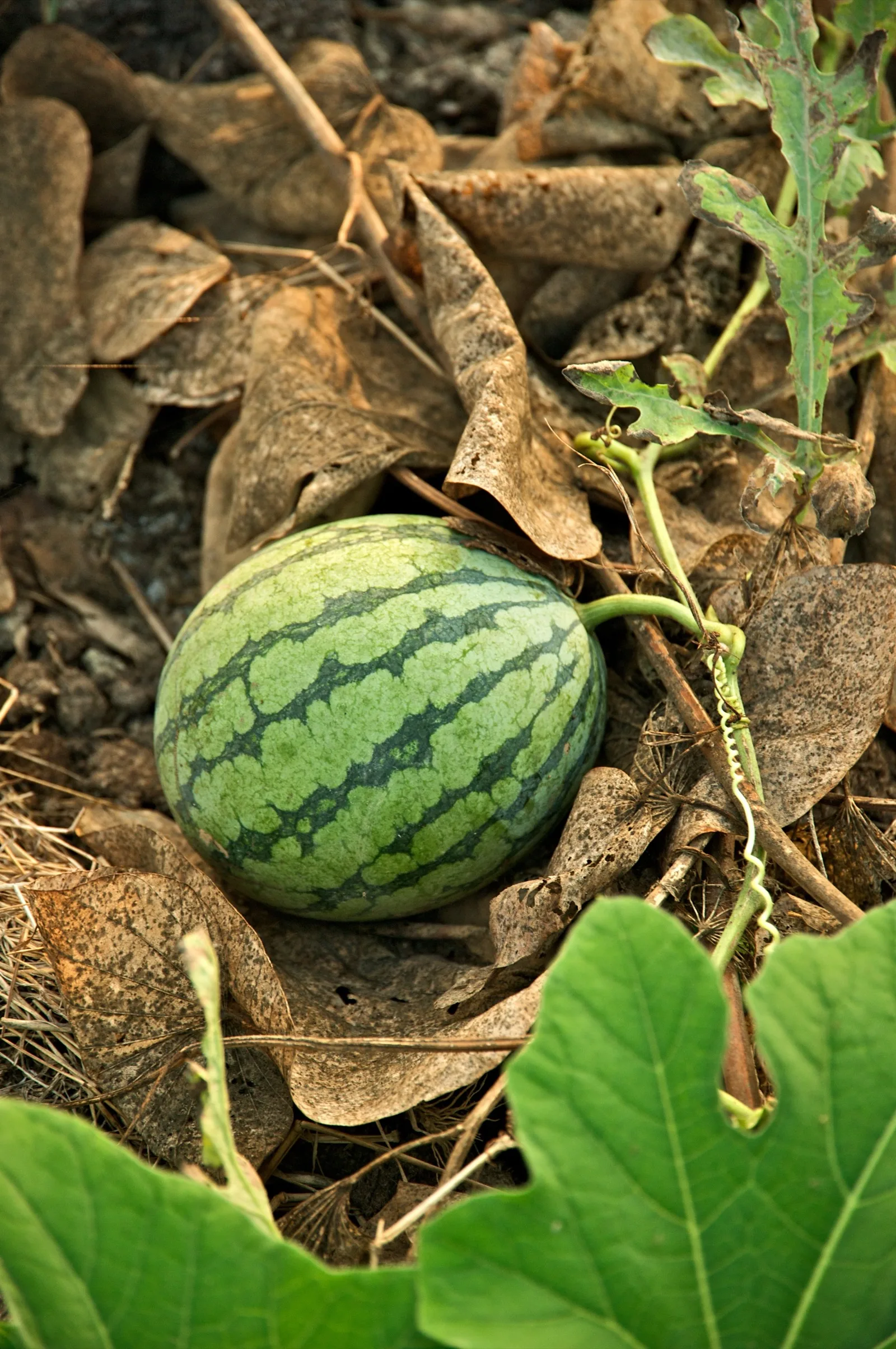
Illinois Extension lists four signs to use together:
- The curly tendril nearest the fruit’s stalk turns brown and dry.
- The patch underneath, where the melon rests on the soil, changes from pale green or white to creamy yellow. Growers call it the ground spot.
- The shiny skin on top turns dull.
- The rind feels rough and is too hard to dent with a thumbnail.
No single sign is perfect on its own. When all four appear together, the melon is very likely ready.
Is It Ripe?
- The tendril near the stalk — Turns brown and dry
- The ground spot — Changes from pale green or white to creamy yellow
- The skin on top — Turns dull instead of shiny
- The rind — Feels rough and is too hard to dent with a thumbnail
- Thumping — Not a reliable test
Stage 9: seeds, and the cycle starts again
A ripe seeded watermelon is packed with black or brown seeds. Each one holds a tiny plant and its own food supply. The cycle has come full circle: seed, plant, flower, fruit and seed again.
In the wild, animals eat the fruit and scatter the seeds. On farms and in gardens, people save seeds to plant the following year.
The parent plant does not survive. Because watermelons are annuals, the vine dies once its fruit is finished or cold weather arrives. Only the seeds carry the life cycle on.
If you want to save seeds, choose a fully ripe fruit. Rinse the seeds, dry them well, and keep them somewhere cool and dry until spring.
A Watermelon’s Life in Order
- The seed A seed is pushed about 2.5 cm into warm soil.
- Germination A root grows down, then a shoot pushes up.
- The seedling Two smooth seed leaves open, then the first true leaves.
- The vine The stem creeps along the ground and grows curly tendrils.
- Flowers Small yellow flowers open along the vine.
- Pollination Bees carry pollen from flower to flower.
- The fruit The fruit swells, ripens and fills with new seeds.
Days from seed to harvest for common varieties
Different kinds of watermelon, called varieties, take different lengths of time. Penn State Extension lists these days to maturity for varieties it recommends to farmers.
| Variety | Type | Days to maturity | Typical fruit weight |
|---|---|---|---|
| Yellow Doll | seeded | 68 | 2.3–3.2 kg (5–7 lb) |
| Millennium | seedless | 78 | 7.3–9.1 kg (16–20 lb) |
| Vanessa | personal (small) | 83 | 2.3–3.2 kg (5–7 lb) |
| Crimson Sweet | seeded | 85 | 6.8–11.3 kg (15–25 lb) |
| Tri-X 313 | seedless | 85 | 6.8–8.2 kg (15–18 lb) |
| Sangria | seeded | 87 | 10–11.8 kg (22–26 lb) |
| Millionaire | seedless | 92 | 8.2–10 kg (18–22 lb) |
Seed packets count days in different ways. Some count from sowing, and others from planting out a young plant. Clemson University’s guide says most varieties take 85 to 90 days from planting out to the first ripe fruit.
Add about three weeks for plants started from seed indoors. The whole journey from seed to harvest then takes roughly 10 to 16 weeks. Weather matters too. The quickest types, such as Yellow Doll, suit places with short summers.
Watermelon Numbers
- 20 to 35 °C — The soil temperatures where watermelon seeds germinate
- About 5 days — How long seedlings take to come up at 25 °C
- About 35 days — How long a fruit takes to ripen after it sets
- 85 to 90 days — How long most varieties take from planting out to the first ripe fruit
- 7 to 11 kg — What a big striped watermelon can weigh
How seedless watermelons are made
Seedless watermelons are made on purpose by plant breeders. Oddly, they still have to be grown from seed.
The method was worked out by Hitoshi Kihara, a scientist at Kyoto University in Japan. The University of Arkansas says he described it in 1951.
It depends on chromosomes, the tiny packages of instructions inside every cell. An ordinary watermelon has two sets. Breeders treat young plants with a chemical called colchicine, which can double the sets to four. Then they cross a four-set plant with a normal two-set plant. The seeds from that cross grow into plants with three sets.
A plant with three sets cannot make working seeds. Its fruit holds only small, soft, white seed coats. You can eat them without noticing.
There is a catch. Most plants drop a fruit that has no seeds in it. The University of Arkansas explains that pollen itself gives off enough of a plant hormone to stop that from happening. So a seedless plant still needs pollen, and its own pollen does not work.
That is why farmers plant ordinary seeded watermelons in the same field. Illinois Extension says anyone growing seedless melons must plant a seeded variety alongside. Clemson’s guide says within 3 metres (10 feet). The bees have to work harder, too. The University of Delaware says a seedless flower needs 16 to 24 honey bee visits.
According to the University of Arkansas, seedless watermelons only began to catch on around 1990, nearly forty years after Kihara described them.
Where watermelons really come from
For most of the last century, books said the watermelon came from southern Africa. That turned out to be a mix-up over a name.
In 1773, a collector linked to the Swedish scientist Carl Linnaeus pressed a melon specimen in South Africa. That dried plant fixed the scientific name Citrullus lanatus. In 2015, the botanists Guillaume Chomicki and Susanne Renner tested its DNA. It was not the sweet watermelon at all, but a different wild melon. Their study found that the watermelon’s closest wild relative lives in West Africa.
Then the story moved again. In 2021, a team led by Renner published a study in the journal PNAS. It read the whole genome, meaning all the DNA, of a melon grown in Sudan called the Kordofan melon. Its flesh is whitish and not bitter. The team found it is the closest known relative of the sweet watermelon, and possibly its ancestor. Scientists from the US Department of Agriculture, the Royal Botanic Gardens, Kew, and the University of Sheffield worked on the study.
The genes tell a story of farming. The Kordofan melon has already lost the bitterness of most wild melons. Red flesh came later. It became fixed only in farmed watermelons. Sweetness crept up gradually over thousands of years.
Art supports the idea. Paintings in ancient Egyptian tombs show striped, watermelon-like fruit. The 2021 study says they suggest people in the Nile Valley ate watermelon as a dessert about 4,360 years ago.
Is the question settled? Not completely. The 2021 team called the Kordofan melon a possible ancestor, not a proven one. A 2019 study of 414 watermelons and their wild relatives found that sweet watermelons share a family line with that West African species. For a school project, the fairest answer is north-east Africa, with Sudan the strongest candidate so far.
Watermelons belong to the cucurbit family, a group of vining plants that also includes pumpkins, squash and cucumbers. The University of Nebraska–Lincoln Extension groups them together because they all rely on bees in the same way.
Growing watermelons where summers are cool
Watermelons love heat. Even so, they can be grown in Britain. The RHS says the best chance of success is a greenhouse or polytunnel. It suggests a variety suited to cooler climates, or a compact one such as ‘Little Darling’. Some melons can fruit outdoors in warm spots or under cloches. A cloche is a small clear cover that traps warmth over a plant.
The RHS suggests sowing melon seeds from mid-April to mid-May, at about 18 to 21 °C (64 to 70 °F). A warm, sunny windowsill works well for the first few weeks.
Inside a greenhouse there may be few bees. That is when hand pollination with a paintbrush makes the difference between flowers and fruit.
Three things people get wrong
1. “A ripe watermelon sounds hollow when you knock on it.” Illinois Extension says many watermelons do not make the famous dull thud when ripe. For those, a dull thud may mean the melon is over-ripe and mushy. The tendril, the ground spot and the dull skin are far better clues.
2. “Seedless watermelons grow without seeds or bees.” Seedless plants grow from special seeds made by crossing two kinds of watermelon. Their flowers still need bees to bring pollen from seeded plants nearby, or the fruit falls off. The method was described in 1951, long before genetic engineering existed.
3. “Watermelons first came from southern Africa.” That idea rested on a melon specimen collected in 1773, which DNA tests later showed was a different plant. The latest research points to Sudan, in north-east Africa, where the Kordofan melon still grows.
Did you know? The heaviest watermelon on record weighed 159 kg (350.5 pounds), about as much as two grown men. It was grown by Chris Kent of Sevierville, Tennessee, and verified by Guinness World Records in 2013.
Watermelons: Fact or Myth?
- A watermelon keeps ripening after it is picked.
- Each watermelon flower is open for just one day.
- Watermelon seeds grow best in cold soil.
- The way to make seedless watermelons was described in 1951.
- Seedless watermelon seeds sprout easily in cool soil.
- Scientists think the watermelon's closest relative is a melon from Sudan.
- The Kordofan melon has bitter flesh.
- Paintings in ancient Egyptian tombs show watermelon-like fruit.
Try it
Next time your family cuts a seeded watermelon, be a plant scientist. First find the ground spot on the rind: is it creamy yellow? Then count the black seeds in one slice and count the slices. Multiply the two numbers to estimate how many seeds the whole melon held. Every black seed could start the life cycle again. If you have a pot of compost, plant three rinsed seeds 2.5 cm deep. Keep them warm and damp, and write down the day each one comes up.
Knowledge check
Which watermelon flower can grow into a fruit, and how can you spot it?
Show answer
The female flower. It has a tiny, hairy baby watermelon just behind its petals, while a male flower sits on a thin, plain stalk.
Why do farmers plant some seeded watermelons among seedless ones?
Show answer
Seedless plants cannot make working pollen. Bees must bring pollen from seeded plants, or the seedless fruit drops off.
Frequently asked questions
How long does a watermelon take to grow from seed?
A watermelon takes about 10 to 16 weeks to grow from seed to ripe fruit in warm weather. Penn State Extension lists varieties that need 68 to 92 days to reach maturity, and cool, cloudy summers add extra days.
What are the stages of watermelon growth?
Watermelon growth has nine stages: seed, germination, seedling, vine running, flowering, pollination, fruit set and growth, ripening, and new seeds. The fruit ripens about 35 to 45 days after its flower opens.
How many times does a bee need to visit a watermelon flower?
A seeded watermelon flower needs about eight honey bee visits to collect the 500 to 1,000 pollen grains it needs. A seedless watermelon flower needs about 16 to 24 visits, because the pollen has to come from other plants.
Why is my watermelon plant flowering but not making fruit?
Watermelon plants grow only male flowers at first, and male flowers cannot become fruit. Female flowers, with a tiny melon behind the petals, come later. If female flowers wither, a common cause is too few bee visits during the one day each flower is open.
How can you tell when a watermelon is ripe?
A ripe watermelon has a brown, dry tendril next to its stalk and a creamy yellow patch where it rests on the soil. Its skin looks dull, and the rind is too hard to dent with a thumbnail. Thumping is not a reliable test.
How are seedless watermelons made?
Seedless watermelons grow from seeds made by crossing a watermelon with four sets of chromosomes and an ordinary one with two sets. The resulting plants have three sets and cannot make working seeds. Hitoshi Kihara of Kyoto University described the method in 1951.
Where did watermelons originally come from?
Watermelons most likely come from north-east Africa. A 2021 genome study found that the Kordofan melon of Sudan is the watermelon’s closest known relative and possibly its ancestor. Older books wrongly said southern Africa.
Sources
- University of Georgia Extension: Commercial Watermelon Production (Bulletin 996, 2017) — germination temperatures and days to emergence, seedless seed germination, male and female flowers along the vine, bee visits per flower and how long a flower lasts
- University of Illinois Extension: watermelon — sowing depth and soil temperature, starting seeds indoors, seedless melons needing a seeded variety alongside, the four ripeness signs and why thumping is unreliable
- Clemson University Home & Garden Information Center: watermelons (2023) — days from planting out to first ripe fruit, time from fruit set to ripening, and how close a seeded pollenizer must be
- Penn State Extension: watermelon production — days to maturity and fruit weights of seeded, seedless and personal varieties, and time spent in the greenhouse
- University of Arkansas Division of Agriculture: seedless watermelon — Hitoshi Kihara’s method, colchicine, why seedless fruit needs pollen, and when seedless watermelons caught on
- Renner and others, PNAS (2021): A chromosome-level genome of a Kordofan melon illuminates the origin of domesticated watermelons — the Kordofan melon as the closest relative of the watermelon, Egyptian tomb paintings, bitterness, red flesh and sweetness
Watermelon Final Challenge
- How deep should watermelon seeds be planted?
- When is it safe to sow watermelons outside?
- How long before planting out can you start seeds indoors?
- Who worked out how to make seedless watermelons?
- About when did seedless watermelons start to catch on?
- Which variety ripens quickest in Penn State's list?