
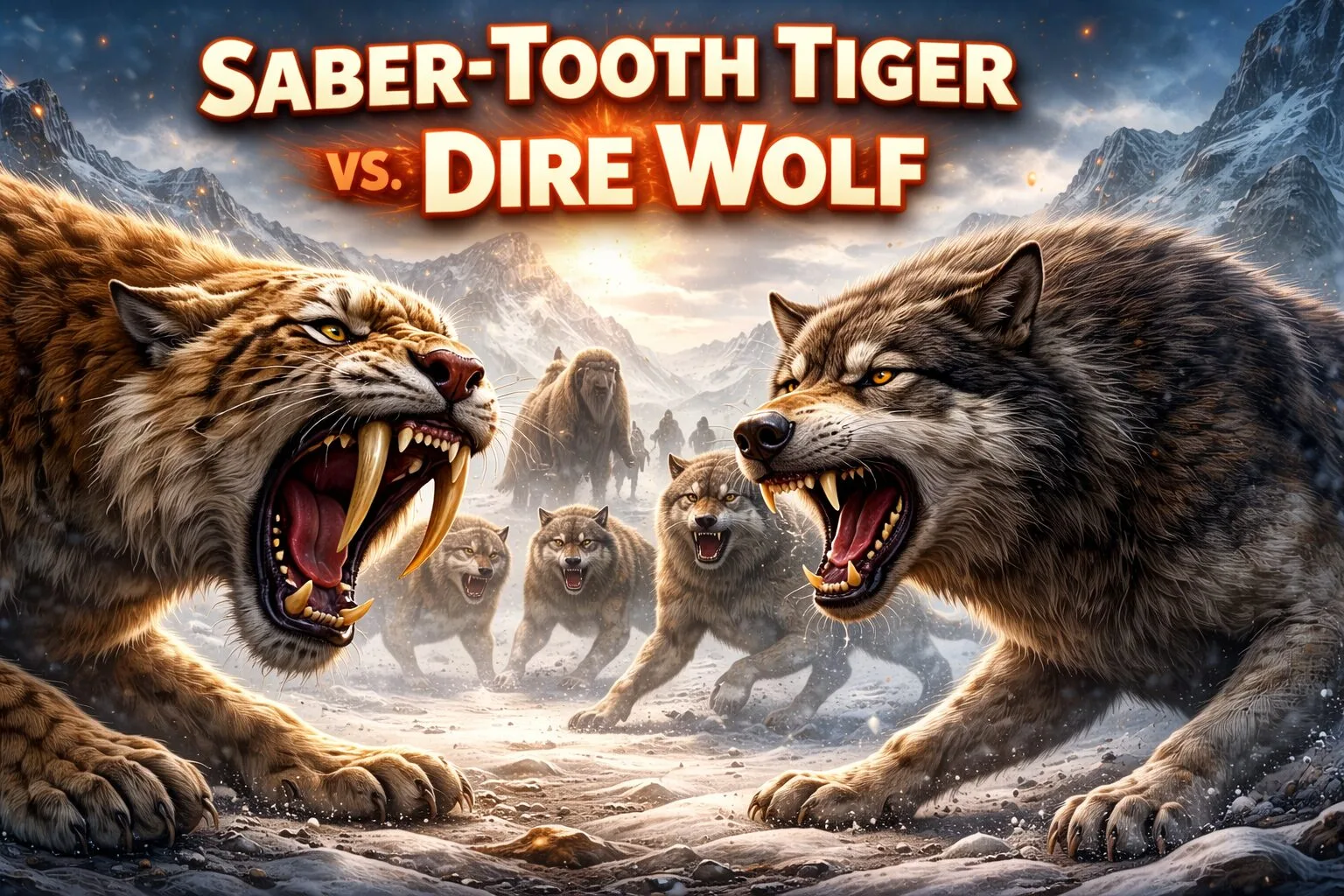
Can you imagine the frozen plains of the Ice Age? Where the two apex predators, the muscular Saber-tooth tiger and the relentless Dire wolf ruled side by side, but who was the true king of the Ice Age? This isn’t just a fantasy but fossil studies show that these creatures did live at the same time and places like La Brea Tar Pits, California. Keep reading to learn the similarities and differences between the Saber-Tooth Tiger and the Dire Wolf.
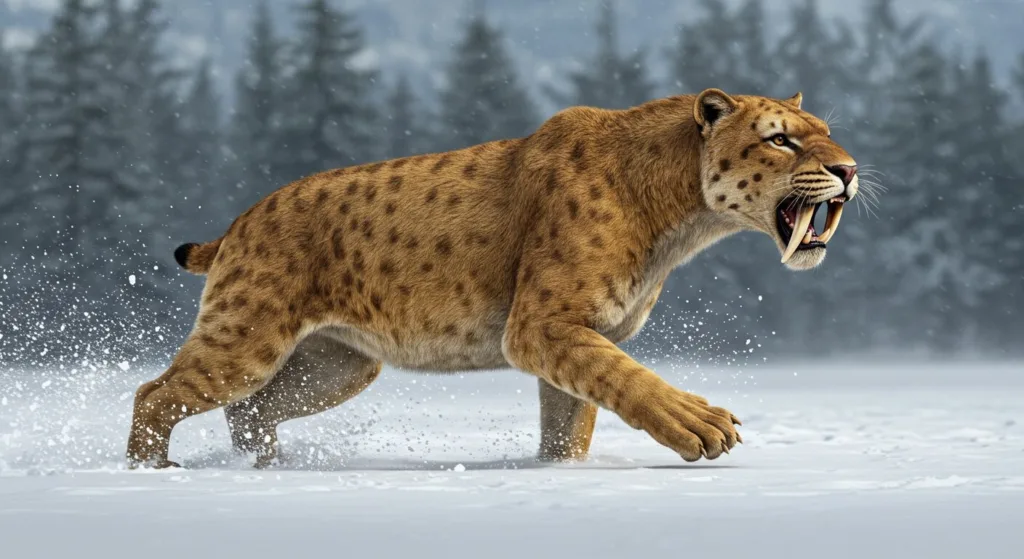
Meet the Saber-Tooth Tiger (Smilodon)
Did you know the Saber-tooth tiger is not related to tigers or lions? Scientifically they belong to a genus called “Smilodon” which belongs to the family Felidae (true cats) and the now-extinct subfamily Machairodontinae. This group included other distinct saber-toothed predators, such as Homotherium and Megantereon, which were not true tigers but shared the distinctive dental adaptation of long, curved canine teeth. There were 3 primary species of Smilodons:
- Smilodon gracilis is referred to as the smallest specie which weighed between 55-100 kilograms (121 to 220 lb)
- Smilodon fatalis weighed between 160 to 280 kg (350 to 620 lb)
- Smilodon populator is referred to as the largest specie which weighed between 220 to 436 kg (485 to 961 lb)
These mighty creatures lived during the Pleistocene and early Holocene epochs (a particular period of time in history) before becoming extinct roughly 10,000 years ago.
Meet the Dire Wolf (Aenocyon Dirus)
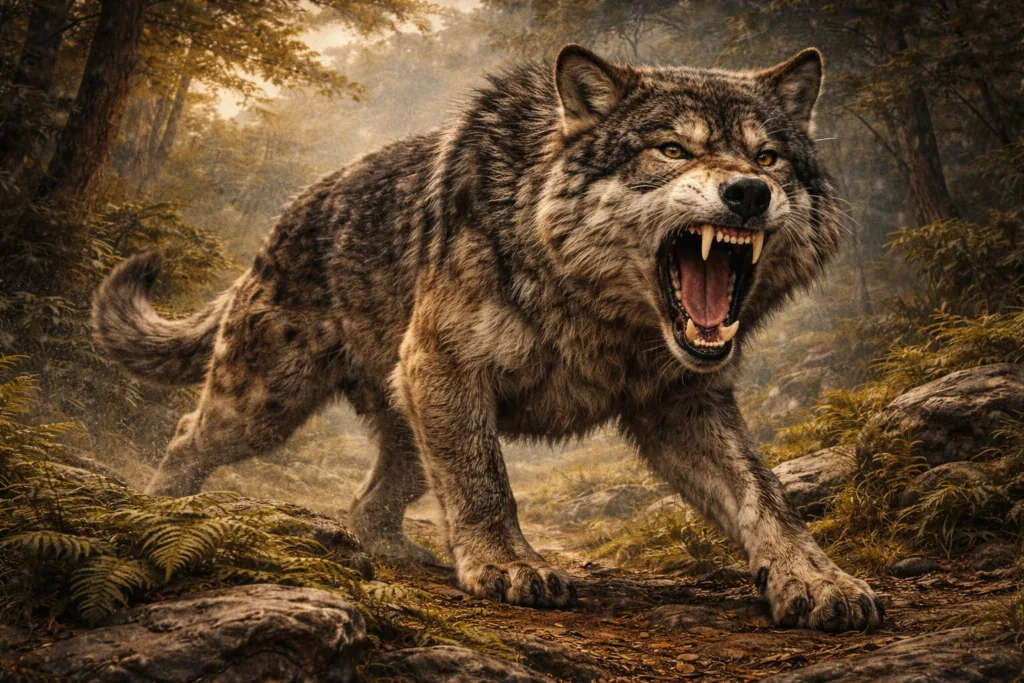
The Dire Wolf (Aenocyon dirus) lived during the Late Pleistocene and Early Holocene epochs (125,000–10,000 years ago) which overlaps with the Smilodons’ existence. The Dire wolf lived in regions of North and South America alongside the Smilodon. So far two subspecies are proposed:
- Aenocyon dirus guildayi, weighed an average 60 kilograms (132 lb)
- Aenocyon dirus dirus, weighed an average 68 kg (150 lb)
Evidence suggests that Dire wolves were sociable creatures that hunted in packs and relied on teamwork and endurance. Their diet consisted of prey like:
- Western horses
- Dwarf pronghorn
- Flat-headed peccary
- Ground sloths, etc.
The Dire wolves had jaws stronger than the Saber-Tooth Tiger with a bone crushing bite of 800-1,500 psi.
Did Saber-Tooth Tigers and Dire Wolves Ever Meet?
Yes, Saber-Tooth Tigers and Dire Wolves coexisted during the late Pleistocene in North America. As fossil evidence from La Brea Tar Pits (Los Angeles, California) show that both species were trapped together, suggesting they scavenged or competed for the same prey. These two creatures likely clashed over carcasses of bison, mammoths, or ground sloths. Though they had different hunting styles (solo vs pack), their territories overlapped which could have caused clashes between them.
Size and Strength Comparison Table
| Features | Saber-Tooth Tiger (Smilodon fatalis) | Dire Wolf (Aenocyon dirus) |
| Length | 1.75–1.9 m | 1.5 m (5ft) |
| Weight | 160-280 kg | 60-70 kg |
| Bite force | 600 psi | 800-1,200 psi |
| Speed | 35 km/h | 50 km/h |
| Canine Length | 28 cm (11 inches) | 5 cm (2 inches) |
| Hunting Strategy | Ambush | Pack Endurance |
Hunting Styles of Saber-Tooth Tiger vs Dire Wolf
Saber-tooth tiger: According to Smilodon’s anatomy they had long saber teeth which were used for slicing soft tissue, not bone. While the creature had a gigantic chest and shoulder muscles for grappling predators bigger than them. Archaeologists studied the fossils found in La Brea Tar Pits in Los Angeles, California, this enabled them to discover that the species had weak jaw hinge strength with a wide gape of 120°. Similar to Dire wolves, Smilodons are predicted to be sociable creatures, but this is not a backed fact by scientists.
Dire wolf: According to Aenocyon Dirus anatomy they had big premolars and molars for crushing bone, strong canines for gripping prey but had a small jaw. The creatures did not weigh more than 68kg, hence they relied on their speed and agility. Dire wolves are known for their specialized pack coordination which surrounded and exhausted prey. Dire Wolves could crush bones and eat remains while Smilodon could not crush bone with their teeth.
If They Fought – Who Would Win?
Can you imagine if one Saber-tooth tiger faced a pack of dire wolves, what would happen? If the Smilodon is in a one-on-one battle with a Dire Wolf, the Saber-Tooth Tiger would win due to its size and strength. While if the Smilodon faces a Dire Wolf pack the wolves would likely be overpowered by teamwork and endurance. Fossil evidence suggests bite marks and bone fractures that shows they may have fought or scavenged from each other.
Ecology and Competition
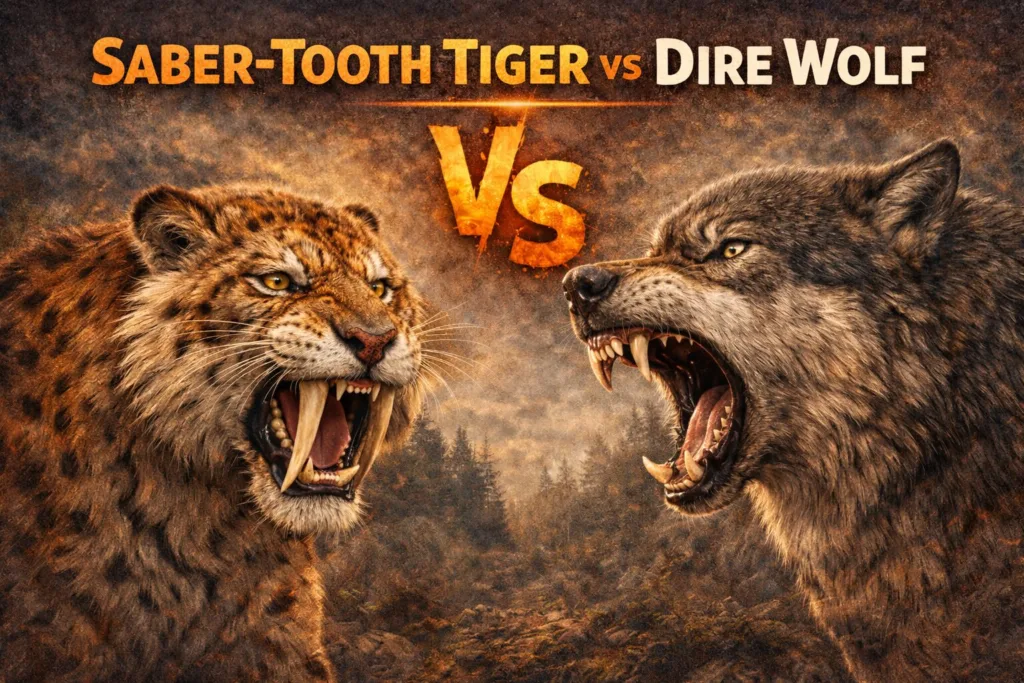
The Saber-tooth tiger and the Dire wolves competed for the same prey as they both targeted large herbivores like bison, woolly mammoths and giant sloths. Dire wolves dominated open plains, while the Smilodon preferred wooded areas though, it is possible that their hunts overlapped and dire wolves may have stolen kills. Stable isotope studies from fossils reveal dietary similarities, which gives us proof of competition between these two creatures.
Why They Both Went Extinct
The Saber-Tooth Tiger and the Dire wolf went extinct 10,000 years for various reasons and scientists have not pinned down a specific one, hence, here are a couple of reasons that are suggested about these species slow extinction:
- Climate Change: According to research the time of extinction of the Smilodon and Dire wolf is close to the time where the Ice age was ending. During the period glaciers and icecaps melted and flooded areas, which meant grasslands and surrounding areas disappeared. This led to the reduction of habitat for the Smilodon, Dire Wolf and the prey it consumed.
- Prey Loss: Relating back to habitat shrinking, other species of animals started to go extinct like woolly mammoths, bison, giant sloths and other megafauna. Predators like the Saber-Tooth tiger and Dire wolves began to starve and die due to the food chain breaking.
- Human Impact: Scientists also predict that the early humans hunted the same prey as the Smilodon and Dire wolves, or possibly hunted and killed the species as well. Human evolution with better weapons and tools could have pushed big predators on the lower level of the food chain and eventually caused extinction. An example of an animal being hunted to extinction is the Dodo Bird.
Fun Facts About Smilodon and Dire Wolves
- Did you know over 4,000 dire wolf fossils were found at La Brea Tar Pits, Los Angeles, California.
- Dire wolves howled, but Smilodons probably couldn’t roar like modern tigers.
- Smilodon’s fangs grew up to 11 inches long!
- Dire wolves had larger heads but smaller brains than gray wolves
- Both creatures lived alongside giant sloths and mammoths.
- Both creates are predicted to be sociable creatures
Conclusion & Key Takeaways
The Saber-tooth tiger (Smilodon) and Dire wolf (Aenocyon dirus) shared Ice Age America. It is certain that the Smilodon was stronger while the dire wolf was smarter due to pack coordination. They likely competed for the same prey and sometimes clashed. Both mighty creatures went extinct around 10,000 years ago when their Ice Age world disappeared. The Ice Age ended, and the last echoes of roars and howls faded into the bones beneath the earth.