
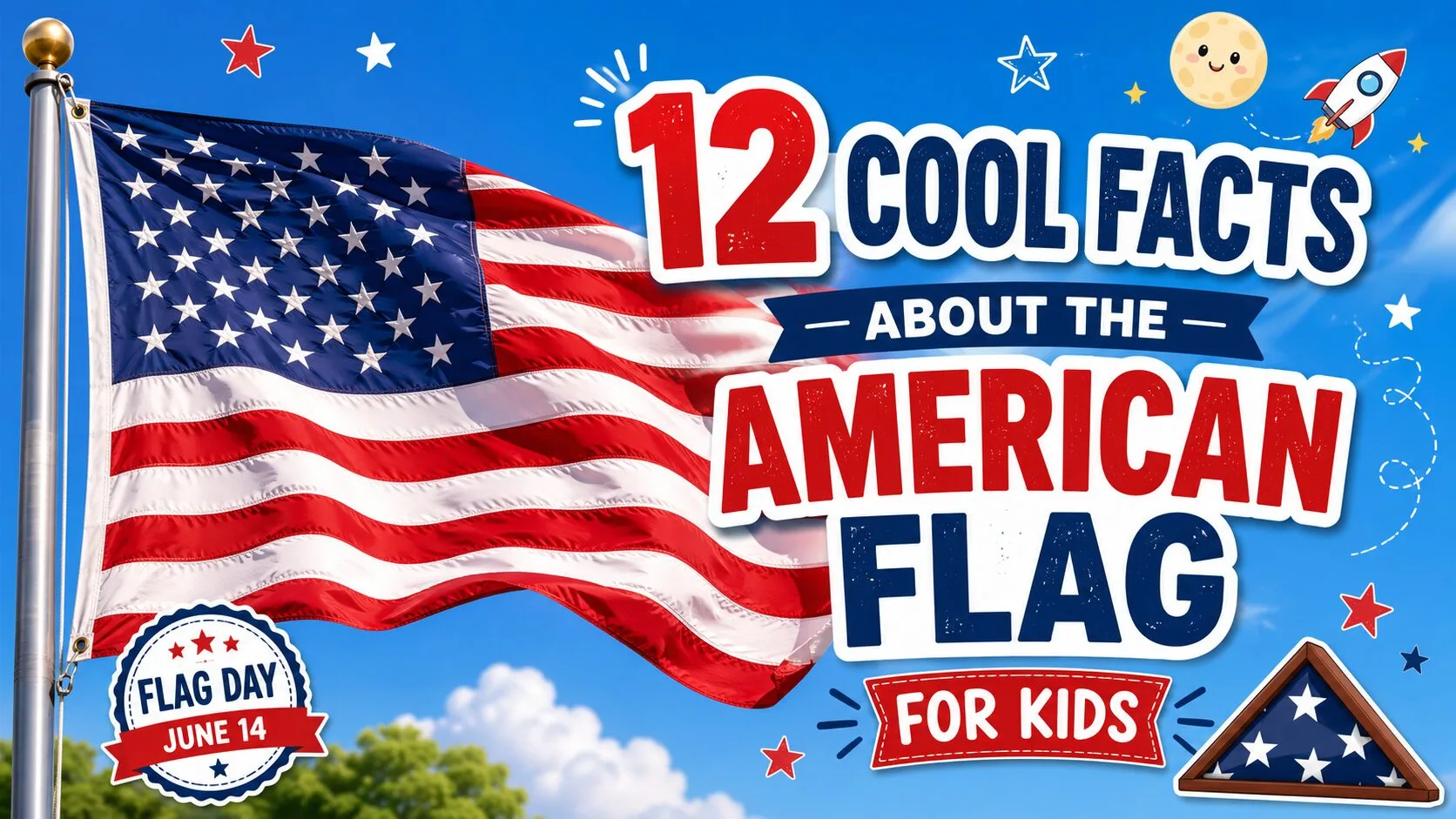
The American flag has 13 red and white stripes for the 13 original colonies and 50 white stars on a blue field for the 50 states. The first official flag was adopted on 14 June 1777, which is now Flag Day. Today’s 50-star design became official on 4 July 1960.
American flag quick facts
- The US law describing the flag still says it has 48 stars.
- The 49-star flag was official for just one year, from July 1959 to July 1960.
- A new star is always added on the 4 July after a state joins.
- The Star-Spangled Banner flag was 30 by 42 feet.
- Five of the six American flags planted on the Moon are still standing.

What the flag stands for
The American flag has 13 stripes, red and white, one for each of the 13 colonies that declared independence from Britain. In the top corner, on a blue field, there are 50 white stars, one for each state.
So the stripes tell you where the country began, and the stars tell you what it is now. The stripes have stayed the same for more than 200 years. The stars have changed again and again. Along with the Statue of Liberty, the flag is one of the best-known symbols of the United States.
The colonies’ fight for independence is its own story. You can read it in our guide to the American Revolution.
1. The first official flag dates from 14 June 1777
On 14 June 1777, the Continental Congress adopted the Stars and Stripes as the official flag of the new country.
That is why 14 June is Flag Day. A US law says the President should issue a proclamation each year, asking officials to fly the flag on all government buildings that day. Twenty days later comes the country’s birthday, which you can read about in our 4th of July facts for kids.
2. The law still says 48 stars
Here is a strange one. The US law that describes the flag says it has thirteen stripes, alternating red and white, and a union of forty-eight stars.
It was never rewritten when Alaska and Hawaii joined. Instead, another part of the same law says that when a new state joins, one star is added. The new star appears on the next 4 July after the state joins.
What the Law Says
- Who adopted the Stars and Stripes as the official flag in 1777?
- What does a US law say the President should do each year for Flag Day?
- How many stars does the US law describing the flag still say it has?
- When does a new star appear on the flag after a state joins?
3. The 49-star flag lasted just one year
Alaska became a state in January 1959, so a 49-star flag became official on 4 July 1959.
But Hawaii joined in August that year. So on 4 July 1960, the 49-star flag was replaced by the 50-star flag after only a year.
| Flag | Stars | Stripes | When |
|---|---|---|---|
| The Star-Spangled Banner at Fort McHenry | 15 | 15 | 1813–1814 |
| The flag described in US law today | 48 | 13 | the law was never rewritten |
| The 49-star flag | 49 | 13 | 4 July 1959 to 4 July 1960 |
| Today’s flag | 50 | 13 | since 4 July 1960 |
4. A president signed today’s star pattern
How should 50 stars fit on the flag? President Dwight D. Eisenhower settled it with an order signed on 21 August 1959. It set out exactly where every star should go and the size of every part of the flag.
The order said the new flag would become the official flag of the United States on 4 July 1960, and it has been ever since.
The Road to 50 Stars
- Stars and Stripes The Continental Congress adopts the first official flag.
- Alaska Alaska becomes a state in January.
- 49 stars The 49-star flag becomes official on 4 July.
- The order President Eisenhower signs an order setting out where every star goes.
- 50 stars The 50-star flag becomes the official flag on 4 July.
5. A teenager says he designed it
In 1958, when there were still 48 states, a high school student in Ohio called Bob Heft had a hunch that two more states were coming. For a history project, he cut up his parents’ 48-star flag, a wedding present, and sewed a 50-star flag. He had never sewn before.
His teacher gave him a B-minus and said the flag had too many stars. If he didn’t like the grade, the teacher said, he should get the design accepted in Washington.
Heft wrote 21 letters to the White House and made 18 phone calls. Two years later, President Eisenhower himself phoned and invited him to Washington for the flag’s official adoption on 4 July. His teacher changed the grade to an A.
Heft kept that grade book for the rest of his life, sealed in plastic and stored in a bank.
Heft told this story to StoryCorps, and his interview is kept in the Library of Congress.
Bob Heft’s School Project
- What did Bob Heft cut up to make his 50-star flag?
- What grade did his teacher first give the project?
- How did Heft try to get his design noticed in Washington?
- What did Heft do with the teacher's grade book?
6. Nobody can prove Betsy Ross sewed the first flag
You have probably heard that Betsy Ross, a Philadelphia upholsterer, sewed the first American flag. The story was first told in 1870 by her grandson, William Canby, in a speech to the Historical Society of Pennsylvania.
There is no written record from 1776 or 1777 that proves it. But historians have found clues. Records show she made bed hangings for George Washington in 1774, and she was paid for making flags for the Pennsylvania State Navy Board on 29 May 1777.
What is certain is that she made flags for the government for more than 50 years. In 1811 alone she made more than 50 large garrison flags.
7. The Star-Spangled Banner was enormous
In the summer of 1813, during the War of 1812, Major George Armistead ordered a huge flag for Fort McHenry in Baltimore. It measured 30 by 42 feet, about 9 by 13 metres. He ordered a smaller storm flag too.
The job went to Mary Pickersgill, a 37-year-old widow who made flags for ships. She did not work alone. Her 13-year-old daughter Caroline helped, along with two teenage nieces, Eliza and Margaret Young, and a 13-year-old African American indentured servant named Grace Wisher. The flag was too big for a house, so they laid it out on the floor of a brewery to sew it together from strips of wool. It was finished on 19 August 1813.
In 1814, after a British attack on the fort, Francis Scott Key saw that flag still flying. It inspired him to write the words that became the national anthem, “The Star-Spangled Banner”.
That flag had 15 stars and 15 stripes, not 13. At the time it was the custom to add a star and a stripe for every new state. Later the stripes went back to 13, and only the stars kept changing. The real flag is kept today at the Smithsonian’s National Museum of American History in Washington, DC.
Who Did What?
- William Canby — First told the Betsy Ross story in 1870
- Betsy Ross — Paid for flags for the Pennsylvania State Navy Board
- George Armistead — Ordered a huge flag for Fort McHenry
- Mary Pickersgill — Was given the job of making the Fort McHenry flag
- Grace Wisher — A 13-year-old who helped sew the great flag
- Francis Scott Key — Wrote the words of the national anthem
8. Five flags are still standing on the Moon
Apollo astronauts planted an American flag at each of their six Moon landing sites. Photographs from NASA’s Lunar Reconnaissance Orbiter show the flags still standing and casting shadows at every site except one.
The exception is Apollo 11, the first landing, in 1969. Astronaut Buzz Aldrin reported that exhaust from the engine blew the flag over when they took off, and the pictures show he was right.
The flags were planted between 1969 and 1972, over six missions. The Moon has no wind, so they have stayed exactly as the astronauts left them, apart from the one that fell.
9. There are rules for how to treat the flag
A part of US law called the Flag Code sets out how to show respect for the flag. These rules are guidance, and they apply to real flags, not to things with a flag pattern printed on them.
The flag should never touch anything beneath it, such as the ground, the floor or water. It should not be used as clothing, bedding or curtains. It should not be carried flat, but always up high and flying free, and it should never be used for advertising.
When a flag is too worn to fly, the code says it should be destroyed in a dignified way, preferably by burning. Many scout groups and veterans’ groups hold special ceremonies to retire old flags.
Fact or Myth? Flags on Earth and the Moon
- Apollo astronauts planted a flag at each of their six Moon landing sites.
- The Moon's wind has slowly blown the standing flags out of place.
- The Flag Code's rules apply to T-shirts and cups with a flag pattern printed on them.
- The Flag Code says the flag should not be used as clothing, bedding or curtains.
- The Flag Code says a worn-out flag should preferably be destroyed by burning.
How to draw the American flag
Drawing the flag is a good way to remember what it means. Start with a big rectangle, about one and a half times as wide as it is tall.
Draw 13 stripes across it. Colour the top one red, then white, then red, and keep going until you have 7 red stripes and 6 white ones. Then colour a blue rectangle in the top left corner.
The real flag has 50 stars, in rows of six and five. For a quick drawing you can use fewer, as long as you remember that each star stands for a state.
If you want your drawing to match the real thing, the stars sit in nine rows. The rows take turns: six stars, then five, then six again, starting and ending with a row of six.
Three things people get wrong
The stars and stripes do not match. The 13 stripes stand for the first 13 colonies, and they never change. Only the stars change, one for each state.
Betsy Ross has not been proven to have made the first flag. She was a real and busy flag maker, but the famous story comes from family memories told almost a century later.
All the Moon flags are not still standing. The Apollo 11 flag was blown over at take-off. The flags at the other five landing sites are still up.
Did you know? The flag that inspired the national anthem was made by Mary Pickersgill, a 37-year-old widow who made flags for ships in Baltimore.
Try it
Count the stars on a real flag or a picture of one. They sit in nine rows, taking turns between six stars and five stars. Can you work out why that adds up to 50?
Knowledge check
What do the 13 stripes on the American flag stand for?
Show answer
The 13 original colonies that declared independence from Britain.
Why does the Apollo 11 flag no longer stand on the Moon?
Show answer
Exhaust from the engine blew it over when the astronauts took off, as Buzz Aldrin reported at the time.
Frequently asked questions
How many stars and stripes are on the American flag?
The American flag has 50 white stars, one for each state, on a blue field, and 13 red and white stripes for the 13 original colonies.
When did the 50-star flag become official?
The 50-star American flag became official on 4 July 1960. President Eisenhower set out the design in an order signed on 21 August 1959, after Hawaii became the 50th state.
Who designed the 50-star American flag?
A high school student in Ohio, Bob Heft, made a 50-star flag for a school project in 1958 and sent it to Washington. He was invited to the flag’s official adoption, and his story is kept in the Library of Congress.
When is Flag Day in the United States?
Flag Day is on 14 June. It marks the day in 1777 when the Continental Congress adopted the Stars and Stripes as the official flag.
Did Betsy Ross make the first American flag?
There is no written proof that Betsy Ross made the first American flag. The story was first told by her grandson in 1870. She certainly made flags for the government for more than 50 years.
Should the American flag touch the ground?
No. The US Flag Code says the flag should never touch anything beneath it, such as the ground, the floor or water.
Sources
- US Code, Title 4, chapter 1 (via Cornell Law School) — what the law says about the stripes and stars, adding new stars, and respect for the flag
- US Code: 36 U.S.C. §110, Flag Day — Flag Day on 14 June and the 1777 adoption of the flag
- National Archives: Executive Order 10834 — the 21 August 1959 order setting the 50-star design from 4 July 1960
- National Park Service: the Great Garrison Flag — the size of the Star-Spangled Banner and who made it
- NPR StoryCorps: designer of the 50-star flag — Bob Heft’s own account of his school project
- Historic Philadelphia: did she or didn’t she? — what is known and unknown about Betsy Ross and the first flag
- Lunar Reconnaissance Orbiter Camera: question answered — which Apollo flags are still standing on the Moon
American Flag Facts Quiz
- Which part of the flag has stayed the same for more than 200 years?
- Which holiday comes twenty days after Flag Day?
- How long did the 49-star flag stay official?
- What was the Star-Spangled Banner flag at Fort McHenry sewn from?
- During which war was the huge Fort McHenry flag ordered?
- Why did the Fort McHenry flag have 15 stripes instead of 13?
- Where is the real Star-Spangled Banner flag kept today?
- Which of these is a clue historians have found about Betsy Ross?
- How do we know five Moon flags are still standing?
- When you draw the 13 stripes, how many are red?


