
Did you know the Hawaiian monk seal is one of the world’s most endangered seals? These adorable creatures only live in Hawaii archipelago and need protection. Keep on reading to learn facts about Hawaiian Monk Seals.
What Is a Hawaiian Monk Seal?
Hawaiian Monk Seals, scientifically known as Neomonachus schauinslandi. These seals only inhabit Hawaii and do not live anywhere else on earth. This animal is called a “monk seal” because the folds on its skin resemble a monk’s cowl. These seals are often solitary or in small groups.
Habitat & Range of Hawaiian Monk Seals
These seals have limited range from the Hawaiian Archipelago (including main Hawaiian Islands and remote Northwestern islands).They use these places for pupping, resting and molting, feeding:
- Beaches
- Coral reefs
- Volcanic rock
- Sandy shores
What Do Hawaiian Monk Seals Look Like?
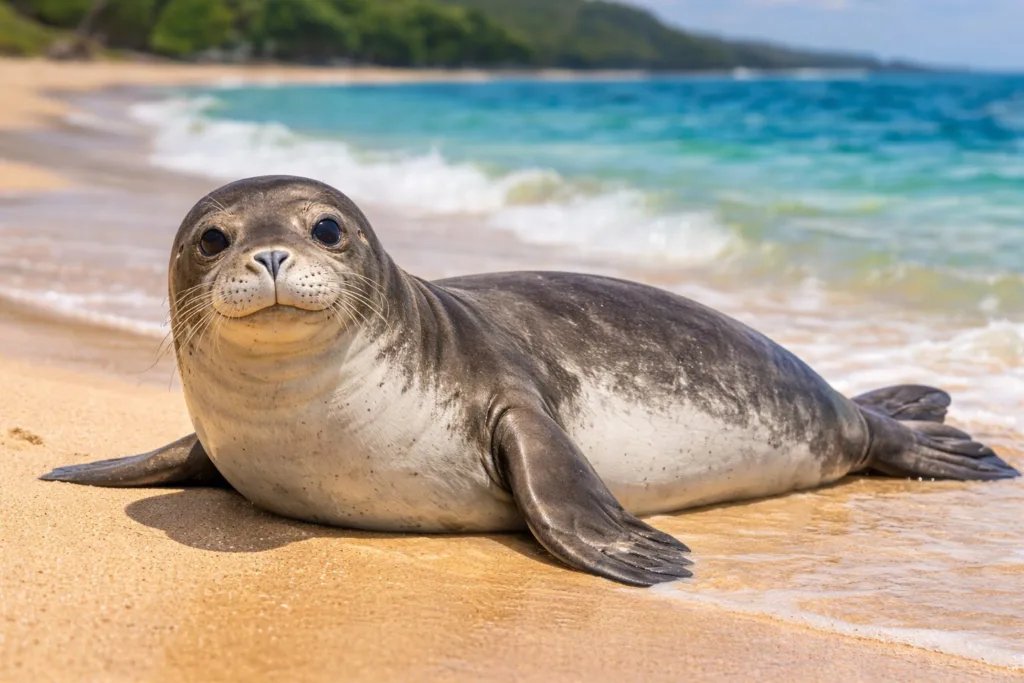
Hawaiian Monk Seals can look different from one another but primarily they:
- Have sexual dimorphism, where females are often slightly larger than males
- Adult Hawaiian Monk Seals grow up to 7 to 7.5 feet (2.1 to 2.2 meters) in length
- Pups weigh only 25 to 35 pounds (11 to 16 kilograms) when born, but grow up into 400- to 600-pound (180 to 270 kilogram) adults
- Go through a process called Molting where they shed their outer skin layer once a year for roughly 10 days. During their molting phase they remain on land.
- Their body shape is sleek and torpedo-like.
- They have powerful flippers that are adapted for swimming.
- Their color changes as exposure to the sun and algae may tint them but primarily they are dark gray or brown shades.
- They have nostrils that can close during dives.
- Many seals have scars from shark attacks or entanglements.
- They have eyes adapted for vision underwater and on land.
Marine & Land Use of Hawaiian Monk Seals
These seals spend two-third of their time at sea, rather than on land and they can dive up to 300-500 meters or more to forage on coral beds and reefs. The Hawaiian Monk Seals use beaches and land during their molting phase of 10 days and they also use land for pupping.
Diet & Foraging of Hawaiian Monk Seals
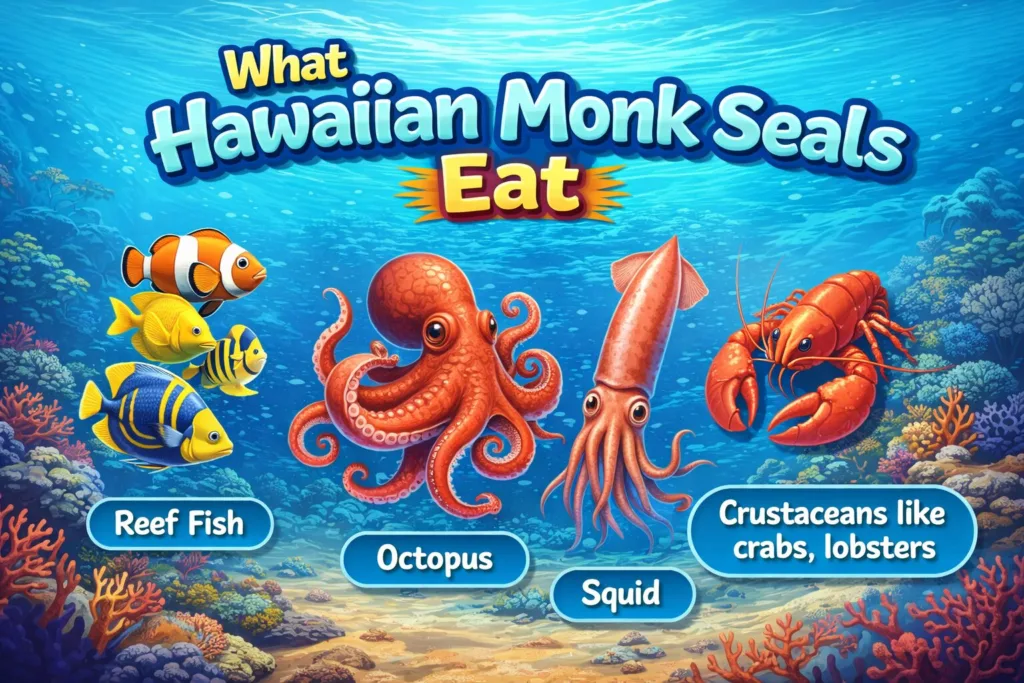
Have you wondered what Hawaiian Monk Seals eat? These seals are carnivores and they feed on food like:
- Reef fish
- Octopus
- Squid
- Crustaceans like crabs, lobsters
Life Cycle, Behavior & Reproduction of Hawaiian Monk Seals
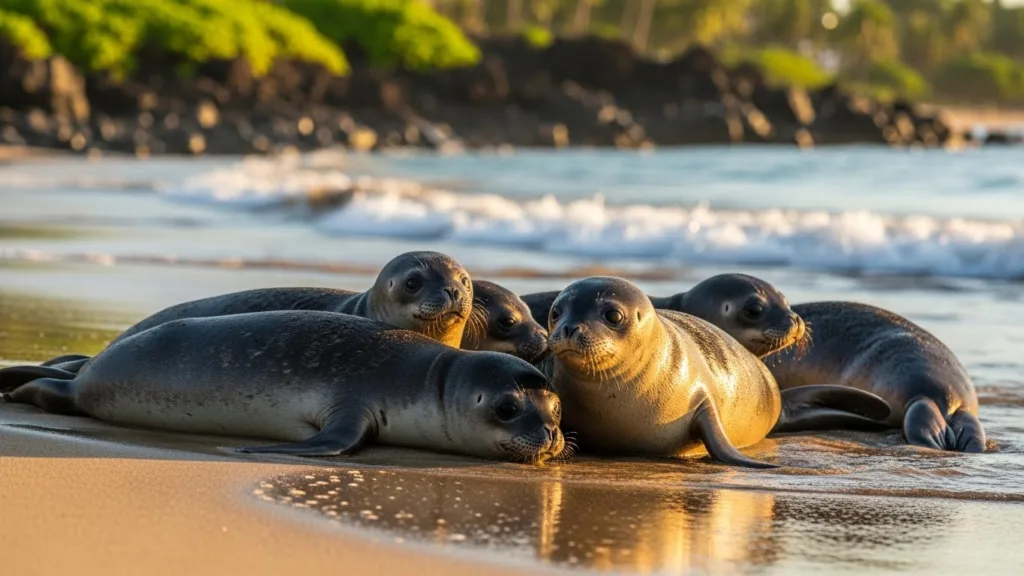
According to many sources, these seals mature from 3-4 years and their lifespan is between 25-30 years (some seals may live longer than that). The prime breeding season is said to be between the months of June & August, while mating occurs in the water. There is a 9-11 month period before a pup is born, and the birth takes place on beaches. The mother nurses the pup for 5-7 weeks and does not leave to forage, while males may show aggression that can injure pups or females. Juvenile Hawaiian Monk Seals face many challenges like:
- Starvation
- Predation (sharks)
- Entanglement
- Disease exposure
Population & Conservation Status of Hawaiian Monk Seals
The Hawaiian Monk Seal is listed as an endangered species under the U.S. Endangered Species Act. The population estimate made in 2022 is close to 1600 Monk Seals. It is very sad that the Caribbean monk seal is extinct, while the Mediterranean monk is currently endangered along with the Hawaiian Monk Seal species that remains.
Major Threats Towards Hawaiian Monk Seals
Here is a list of major threats posed towards the population of Hawaiian Monk Seals:
- Fishing gear entanglements and hook injuries: Monk seals get entangled more than many pinnipeds
- Disease & parasites: Diseases like toxoplasmosis, morbillivirus and leptospirosis, etc. affect the Hawaiian Monk Seal population.
- Shark predation: Young seals are an easy target for sharks and other predators
- Human disturbance: Seals are forced to avoid beaches with repeated disturbance; which causes limitation of safe haul-out and pupping beaches.
- Habitat issues: Pollution and climate change disturb the natural rhythm of these animals as they face many issues for their survival.
Conservation & Recovery Efforts of Hawaiian Monk Seals
Humans are doing their best to safeguard the remaining Hawaiian Monk Seal population and increasing it steadily. The recovery plan action by NOAA Fisheries is:
- Habitat protection
- Reducing entanglements and rehabilitation
- Disease monitoring and Vaccination programs for morbillivirus as a proactive step
- Limiting human disturbance.
Fun Facts About Hawaiian Monk Seals
- Did you know a monk seal can hold its breath underwater for up to 20 minutes?
- The Hawaiian name of the seal is: Ilio holo I ka uaua meaning “dog that runs in rough water.”
- Pups are born black but later molt to silvery gray.
- They are among the few seal species that live in tropical waters.
- Scars: many seals carry marks from shark bites or entanglements.
- During the active molt Hawaiian Monk Seals stay on land.
Frequently Asked Questions
Does the Hawaiian monk seal live all over the Pacific?
The Hawaiian monk seal have limited range including main Hawaiian Islands and remote Northwestern islands.
How long do Hawaiian monk seal pups nurse?
Hawaiian monk seal pups nurse for roughly 5-7 weeks!
Which disease is a big threat towards Hawaiian monk seals?
Diseases like toxoplasmosis, morbillivirus and leptospirosis, etc. affect the Hawaiian Monk Seal population.
External Links
NOAA Fisheries – Hawaiian Monk Seal Population Rounds Out a Decade of Growth