
Dragonflies are fast-flying insects with long bodies, huge eyes and four see-through wings. There are about 3,000 species, living near fresh water on every continent except Antarctica. They catch flying insects such as mosquitoes. Most of a dragonfly’s life is spent underwater as a larva, often for one or two years, before it becomes a flying adult.
dragonflies quick facts
- There are roughly 3,000 species of dragonfly.
- Some dragonflies can see almost all the way around them, close to 360 degrees.
- Dragonfly larvae catch prey with a hinged jaw called a mask.
- Most dragonfly larvae spend one or two years underwater.
- Most adult dragonflies live only a week or two.
What is a dragonfly?
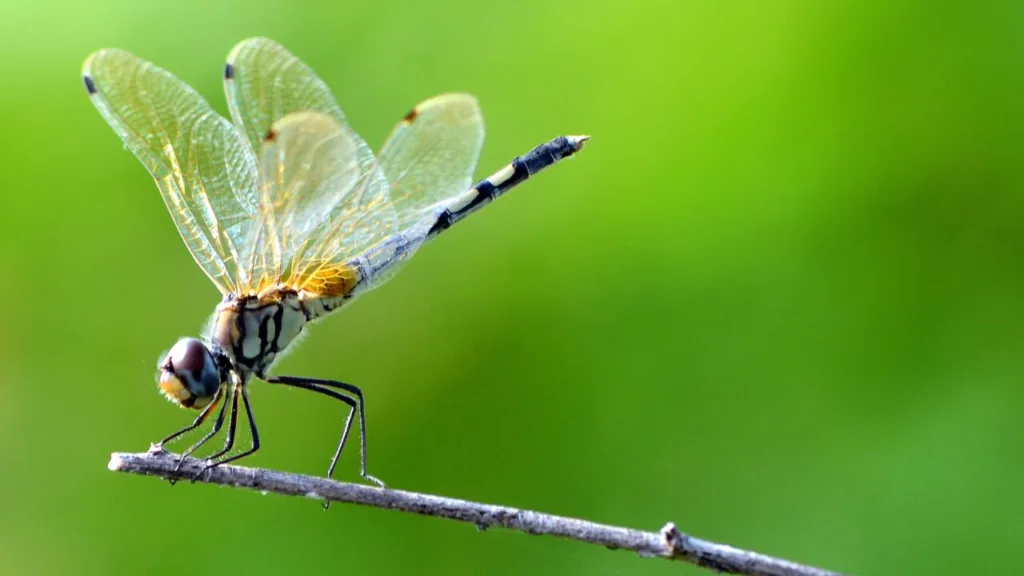
A dragonfly is a flying insect with a long body, huge eyes and two pairs of see-through wings. It is one of the fastest and most skilful fliers in the insect world.
There are roughly 3,000 species of dragonfly. They live near fresh water, such as ponds, lakes, rivers and marshes, on every continent except Antarctica.
Dragonflies are hunters. They catch other flying insects, especially mosquitoes and flies, which makes them very welcome visitors to a garden pond.
Dragonflies and damselflies
Dragonflies have close cousins called damselflies. Both belong to a group of insects called the Odonata, and people often mix them up.
Here is how to tell them apart. When a dragonfly lands, it holds its wings out flat to the sides. A damselfly usually folds its wings together along its back.
Dragonflies are also bigger and stronger, with a heavier body. Their front and back wings are different shapes, while a damselfly’s four wings are almost the same.
| Dragonfly | Damselfly | |
|---|---|---|
| Wings at rest | held out flat to the sides | usually folded along the back |
| Body | thicker and stronger | thin and delicate |
| Front and back wings | different shapes | almost the same shape |
| Flying | very strong and fast | more fluttery |
What dragonflies look like
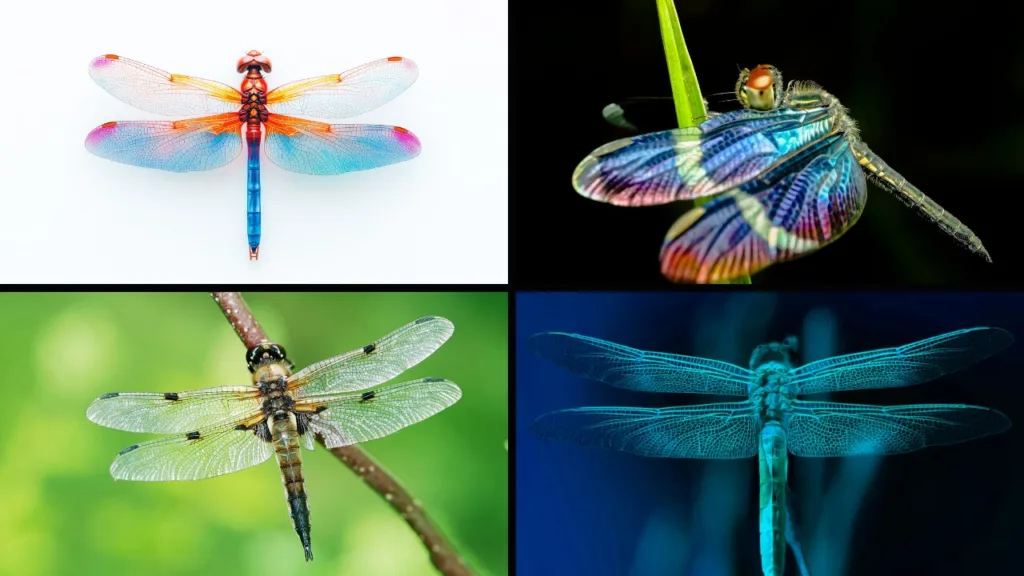
Dragonflies come in many colours, from shiny metallic greens and blues to soft pastel shades. Their wings are usually clear, though some have coloured markings.
For insects, they are big. The largest have wingspans of up to 16 cm, about as wide as your hand. Even the smallest are about 2 cm across.
Their bodies are long and thin, and their wings are full of tiny veins that make them strong but light.
Enormous eyes
A dragonfly’s eyes are huge. They bulge out and cover most of its head.
Each eye is made of thousands of tiny parts working together. They give some dragonflies a view almost all the way around them, close to 360 degrees. That means they can see prey, and danger, coming from almost any direction. It is why dragonflies are so hard to sneak up on!
Flying champions
Dragonflies are among the fastest insects in the world, and they are amazingly agile. They can hover in one spot like a hummingbird, change direction in a flash, fly straight up and down, and even fly backwards.
Each of their four wings can move on its own. That gives them extraordinary control in the air, like a tiny helicopter.
Dragonflies need warm muscles to fly well. On a cool morning, a dragonfly may bask in the sun or buzz its wings to warm up before it takes off.
Hawkers, chasers and darters
People have given dragonflies many names. In Britain, groups of dragonflies are called hawkers, chasers, darters, skimmers and emeralds, depending on how they fly and look. In North America, some are known as darners.
Old country names for dragonflies include “devil’s darning needle”. It came from a made-up story that dragonflies could sew up the mouths of naughty children. Don’t worry: dragonflies cannot hurt you at all.
How dragonflies catch their food
A dragonfly catches prey on the wing. It holds its spiny legs together to make a kind of basket, then scoops up small insects as it flies.
It can even eat while it is still flying. Bigger prey is carried to a perch to be eaten.
What do dragonflies eat?
Adult dragonflies catch small flying insects, such as mosquitoes and flies, in mid-air.
They can be greedy eaters. Some dragonflies regularly eat prey weighing as much as 60% of their own body weight.
Because they eat so many mosquitoes and other biting insects, dragonflies help to keep their numbers down. They are also food for birds, frogs and fish, which makes them an important part of their ecosystem.
The dragonfly life cycle
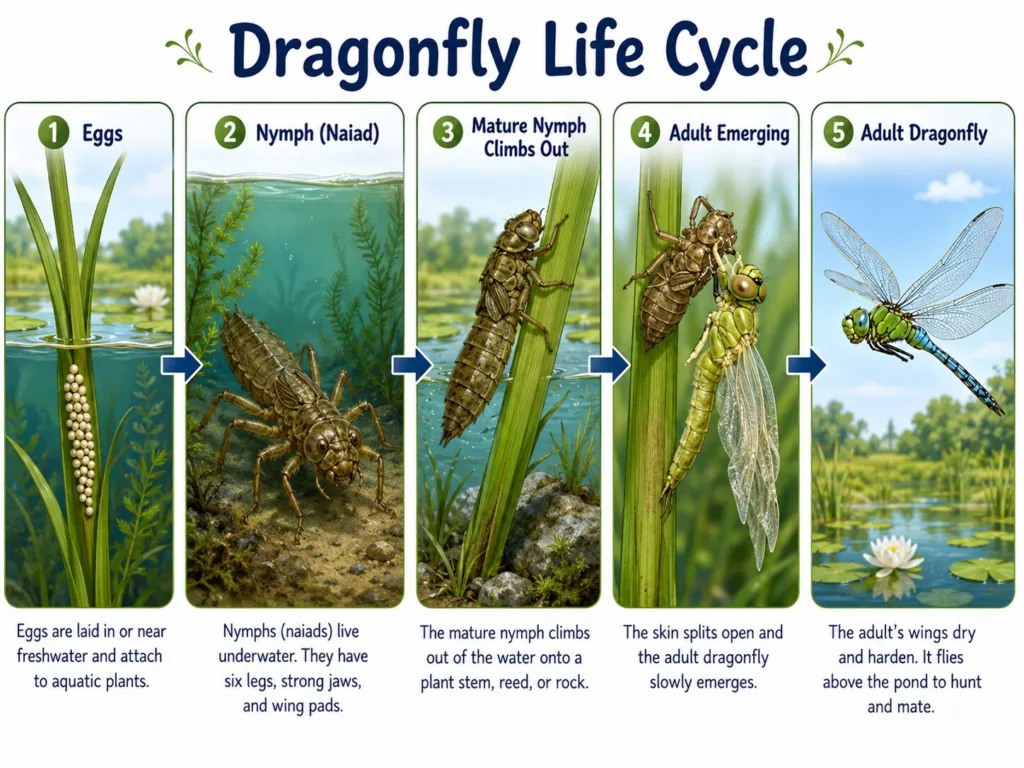
Dragonflies have three stages in their life: egg, larva and adult. The larva is also called a nymph.
Eggs: a female dragonfly can lay hundreds of eggs during her life, in batches over a few days or weeks. Some kinds push their eggs into water plants. Others drop them into the water, wrapped in a kind of jelly.
Larvae: the eggs hatch into larvae, which live underwater. They have no wings, and they are dull, mottled colours to match the mud and plants around them.
Adults: when a larva is fully grown, it climbs out of the water up a plant stem. Its skin splits open, and the adult dragonfly slowly pulls itself out, pumping up its crumpled wings. This is called emergence. It can take up to three hours, and the empty skin left behind is called an exuvia.
Fierce underwater hunters
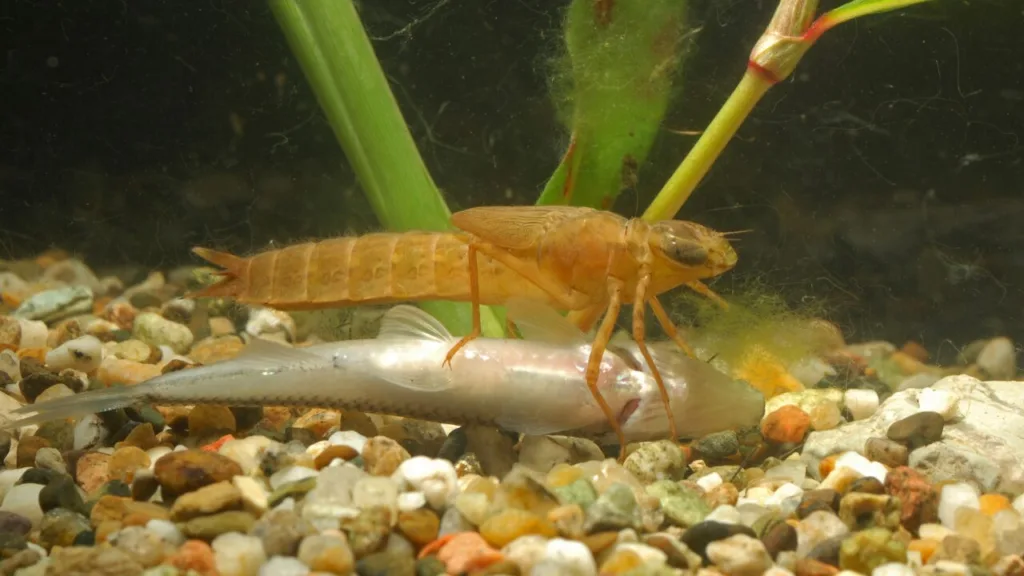
Dragonfly larvae are just as fierce as the adults. They hunt underwater for insect larvae, worms, snails, leeches, tadpoles and even small fish.
They have a secret weapon: a hinged jaw, called a mask, that folds under the head. When prey comes close, the mask shoots out in an instant and grabs it.
Larvae spend a very long time underwater. Most take one or two years to grow up, but it can be anything from two or three months to more than five years, depending on the species.
Dragonfly Words
- Odonata — The insect group dragonflies and damselflies belong to
- Nymph — Another name for a dragonfly larva
- Mask — A hinged jaw that shoots out to grab prey
- Hawker — The name of one group of British dragonflies
- Devil's darning needle — An old name that came from a made-up story
A short life in the air
After all that time underwater, the flying adult has a short life. Most adults live for only a week or two, although some last six to eight weeks.
In that time, they must feed, find a mate and lay eggs. When dragonflies mate, the pair join together in a loop shape called the wheel position, and sometimes fly like that.
So when you see a dragonfly zooming over a pond, you are seeing the very last part of a life that was mostly spent underwater.
A Dragonfly’s Life in Order
- Eggs A female lays her eggs in batches, in or near water.
- Hatching A larva hatches from each egg.
- Growing The larva hunts and grows, usually for one or two years.
- Climbing out The fully grown larva climbs up a plant stem out of the water.
- Emergence Its skin splits, and the adult pulls itself out and pumps up its wings.
- Mating The adult finds a mate, and the pair join in a loop called the wheel position.
Ancient insects
Dragonflies have been around for an extremely long time. Giant dragonfly-like insects were flying about 300 million years ago, long before the dinosaurs. Some of them were among the largest insects that have ever lived.
A sign of clean water
Because dragonfly larvae live underwater for so long, they need clean, healthy ponds, lakes and rivers.
That makes dragonflies a useful clue for scientists. If lots of different dragonflies live around a pond, it is likely that the water is in good condition. If they disappear, it can be an early warning that something is wrong.
Dragonflies in danger
In 2021, the International Union for Conservation of Nature published the first worldwide check on dragonflies and damselflies. It found that 16% of them are at risk of dying out.
The main problem is the loss of wetlands and damage to rivers, the places where their larvae live.
Dragonflies by Numbers
- About 3,000 — How many species of dragonfly there are
- Up to 16 cm — The wingspan of the biggest dragonflies
- Close to 360 degrees — How far around some dragonflies can see
- 60% — How heavy some dragonflies' prey is, compared with their own weight
- 16% — The share of dragonflies and damselflies at risk of dying out
How you can help dragonflies

One of the best ways to help dragonflies is to dig a wildlife pond, even a small one. Dragonflies and damselflies will often find it on their own.
Add some tall plants around the edges and in the water, so larvae have something to climb out on. Never add fish, because they will eat the larvae.
Then keep watch on a warm, sunny day, when dragonflies are most active. They often rest on reeds, sticks and sunny stones between flights, so look for a favourite perch. In summer, you might also find empty larval skins clinging to plants at the water’s edge. Each one is proof that a dragonfly has climbed out of the pond and flown away. In Britain, damselflies such as the azure damselfly can be seen around ponds from May to September.
Three things people get wrong
Dragonflies do not sting. They have no sting at all, and they are harmless to people.
Dragonflies do not live for only one day. Most spend one or two years underwater as larvae, then live for a week or more as adults.
Dragonflies and damselflies are not the same. Dragonflies rest with their wings spread flat; damselflies usually fold them together.
Did you know? Some dragonflies regularly eat prey weighing as much as 60% of their own body weight.
Dragonflies: Fact or Myth?
- Dragonflies can sting people.
- Dragonflies need warm wing muscles to fly well.
- Adult dragonflies live for only one day.
- Adult dragonflies catch mosquitoes in mid-air.
- Dragonfly larvae have wings.
- Dragonfly larvae can catch small fish.
- All dragonflies are the same colour.
- Dragonflies are among the fastest insects in the world.
Try it
Visit a pond on a warm, sunny day and watch for dragonflies and damselflies. When one lands, check its wings: spread flat means dragonfly, folded together means damselfly.
Knowledge check
How can you tell a dragonfly from a damselfly?
Show answer
A dragonfly rests with its wings spread flat; a damselfly usually folds its wings together along its back.
Where do dragonfly larvae live?
Show answer
Underwater, in ponds, lakes, rivers and marshes.
Frequently asked questions
What do dragonflies eat?
Adult dragonflies catch small flying insects, such as mosquitoes and flies, in mid-air. Their larvae hunt underwater for insect larvae, worms, snails, tadpoles and small fish.
How long do dragonflies live?
Most dragonflies spend one or two years underwater as larvae, and sometimes more than five. Adults usually live only a week or two, though some last six to eight weeks.
What is the difference between a dragonfly and a damselfly?
Dragonflies rest with their wings spread flat and have stronger, thicker bodies. Damselflies are thinner and usually fold their wings together along their back.
Do dragonflies sting or bite people?
Dragonflies have no sting and are harmless to people. They help us by eating mosquitoes and other biting insects.
What is the dragonfly life cycle?
Dragonflies have three life stages: egg, larva (or nymph) and adult. Larvae live underwater, then climb out, split their skin and emerge as winged adults.
Are dragonflies endangered?
Some are. In 2021 the IUCN found that 16% of dragonflies and damselflies are at risk of extinction, mainly because wetlands and rivers are being lost or damaged.
Sources
- Encyclopaedia Britannica: dragonfly — the number of species, flight, eyes, size, colour, diet, larvae and the 2021 IUCN assessment
- British Dragonfly Society: life cycle and biology — eggs, larvae, how long larvae live, emergence, adult lifespan and mating
- The Wildlife Trusts: azure damselfly — when to see azure damselflies and digging a wildlife pond
Dragonfly Final Challenge
- What is the main threat to dragonflies today?
- What is one of the best ways to help dragonflies?
- How many eggs can a female dragonfly lay in her life?
- What is the longest a dragonfly larva can take to grow up?
- How long can it take an adult dragonfly to pull itself out of its larval skin?
- What is the empty skin left behind called?
- When are dragonflies most active?
- Which damselfly can be seen around British ponds from May to September?