
Can you imagine a massive cat with curved fangs longer than your fingers, stalking the Ice Age plains where mammoths roamed? That’s the Saber-Tooth Tiger! Did you know there were many species of these prehistoric predators? Keep reading to learn more about Saber-Tooth Tiger species and their distinction from one another.
What Is a Saber-Tooth Tiger?
Did you know the Saber-tooth tiger is not related to tigers or lions? Scientifically they belong to a genus called “Smilodon” which belongs to the family Felidae (true cats) and the now-extinct subfamily Machairodontinae. This group included other distinct saber-toothed predators, such as Homotherium and Megantereon, which were not true tigers but shared the distinctive dental adaptation of long, curved canine teeth. These mighty creatures lived during the Pleistocene and early Holocene epochs (a particular period of time in history) before becoming extinct roughly 10,000 years ago.
How Many Saber-Tooth Tiger Species Were There?
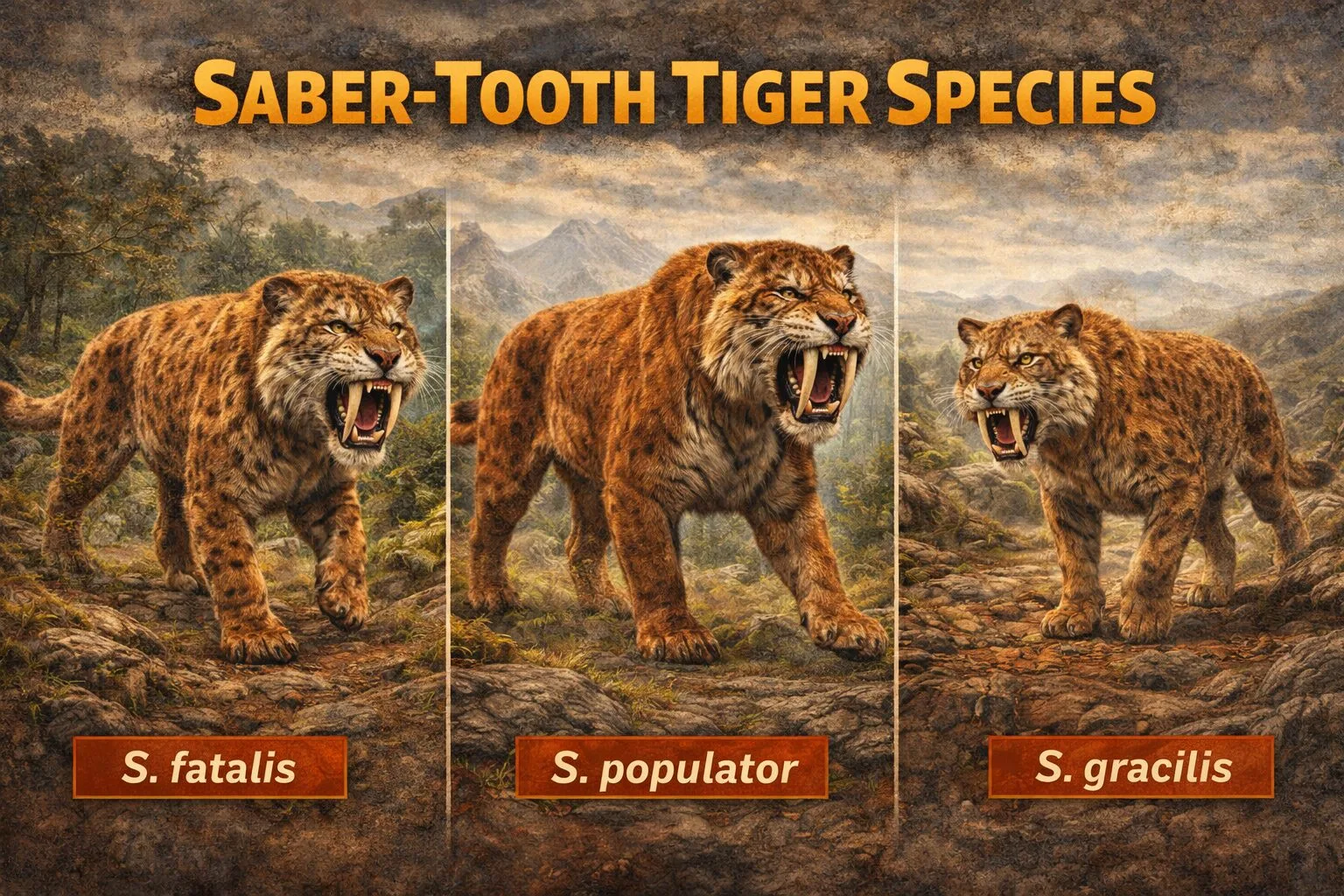
There were 3 primary species of Saber-tooth tigers (Smilodons):
- Smilodon gracilis are referred to as the smallest species which weighed between 55-100 kilograms (121 to 220 lb) and were found in North America, around 2.5 million years ago.
- Smilodon fatalis weighed between 160 to 280 kg (350 to 620 lb) and were most common in North America. Fossils were found in La Brea Tar Pits, Los Angeles, California.
- Smilodon populators are referred to as the largest and most powerful species which weighed between 220 to 436 kg (485 to 961 lb) and were commonly found in South America.
Physical Features and Adaptations
Here is a list of physical features and adaptations of the Saber-Tooth Tiger:
- Long saber-shaped upper canines (up to 11 inches)
- Stocky build with muscular forelimbs for wrestling prey.
- Short tail, unlike modern big cats.
- Jaws that opened extremely wide.
Where Did Saber-Tooth Tigers Live?
The Saber Tooth Tigers lived long ago, from about 2.5 million to 10,000 years ago, the Pleistocene Epoch. They lived in the current known areas of North and South America and their habitats ranged from:
- Grasslands
- Forests
- Open plains, rich in Ice Age megafauna

Differences Between the Three Saber-tooth tiger Species
| Species | Size | Time Period | Region |
| Smilodon gracilis | 100-150 kg | 2.5–1.5 million yrs ago | North America |
| Smilodon fatalis | 160-280 kg | 1.6 million–10,000 yrs ago | North America |
| Smilodon populator | Up to 420 kg | 1 million–10,000 yrs ago | South America |
Hunting and Diet of the Saber-Tooth Tiger
The Saber-Tooth Tiger preyed on animals like:
- Bisons
- Giant ground sloths
- Young Woolly mammoths, etc.
The majestic cats ambushed their prey by hiding and waiting, and during the strike they used their forelimbs to pin the prey. It is predicted by scientists that they likely hunted in groups (based on fossil injuries and social evidence) but still debated.
Extinction of Saber-Tooth Tigers
The Saber-Tooth Tiger went extinct for various reasons and scientists have not pinned down a specific one, hence, here are a couple of reasons that are suggested about Saber-tooth tigers slow extinction:
- Climate Change: According to research the time of extinction of the Smilodon is close to the time where the Ice age was ending. During the period glaciers and icecaps melted and flooded areas, which meant grasslands disappeared. This led to the reduction of habitat for the Smilodon and the prey it consumed.
- Prey Loss: Relating back to habitat shrinking, other species of animals started to go extinct like woolly mammoths, bisons, and other megafauna. Predators like the Saber-Tooth tiger and dire wolves began to starve and die due to the food chain breaking.
- Human Impact: Scientists also predict that the early humans hunted the same prey as the Smilodon or possibly killed and hunted the species as well. Human evolution with better weapons and tools could have pushed big predators on the lower level of the food chain and eventually caused extinction. An example of an animal being hunted to extinction is the Dodo bird.

Saber-Tooth Tigers vs. Modern Big Cats
| Categories | Saber-Tooth Tigers | Modern Big Cats |
| Weight | Up to 400–420 kg | Up to 220–300 kg |
| Teeth & Jaw | Fangs up to 28 cm | Fangs up to 7.5 cm |
| Habitat | Plains and Savannas | Forests & Grasslands |
| Speed | 35 km/h | 60-85 km/h |
Fun Facts About Saber-Tooth Tigers
- Did you know a Smilodon populator could weigh twice as much as a male lion?
- Did you know their name means “knife-tooth.”
- Fossils of Saber-Tooth Tigers have been found with healed injuries
- They had short tails unlike today’s big cats
- Saber-tooth tigers lived alongside Dire wolves and Woolly mammoths
- Saber-tooth tigers are predicted to be sociable creatures like lions
Legacy and Importance in Science
Studying Saber-tooth tiger fossils gives us insights into evolution, extinction, and our ecosystems. There is ongoing research at La Brea Tar Pits Museum, California and in regions of Argentina related to the long gone creature. So far scientists can create “proxy species” which are living animals engineered with traits of extinct ones, they can also use genetic modeling to reconstruct Smilodon evolutionary traits. Even if in the near future, due to lack of usable DNA of the Smilodon, studying the species DNA fragments will help scientists understand big-cat evolution, even if resurrection isn’t possible. DNA studies help compare extinct cats to modern felines and it is always interesting to learn more about the world we inhabit and its history.
Conclusion & Key Takeaways
Saber-Tooth Tigers were Ice Age predators with long curved fangs and there were 3 main species of the mighty creature. They lived across the Americas and went extinct 10,000 years ago. It is important to understand that they are not related to modern tigers and they belong to their own extinct subfamily. We know that the roar of the saber-tooth tiger may be gone, but its legend still echoes through the bones buried beneath our feet.