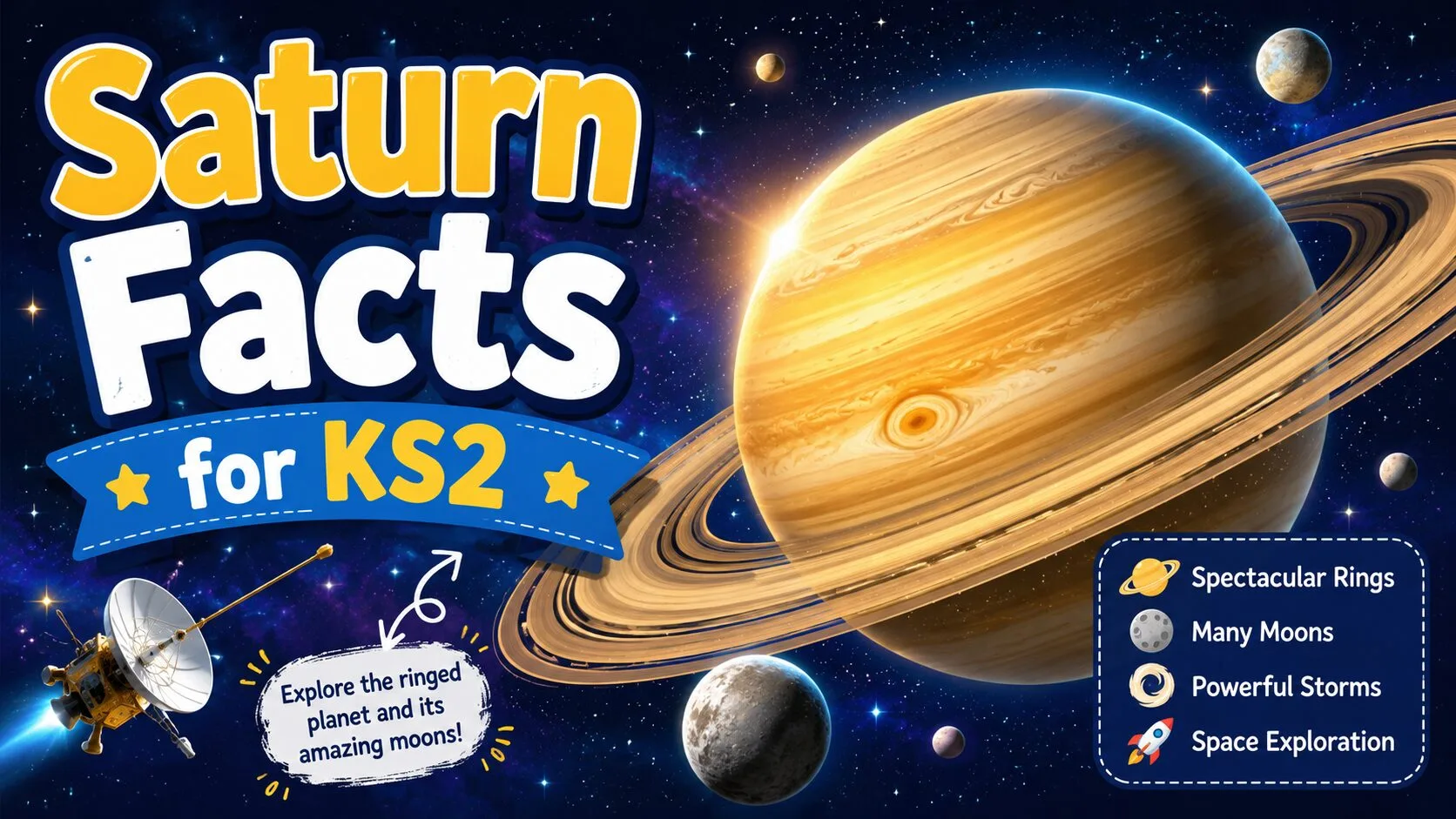
Saturn is the sixth planet from the Sun and the second largest in the solar system. It is a gas giant made mostly of hydrogen and helium, circled by seven main rings of water ice. NASA listed 293 confirmed moons as of August 2026, more than any other planet.
Saturn quick facts
- Saturn is about 120,500 km wide, nine times wider than Earth.
- One Saturn day lasts 10.7 hours; one Saturn year lasts about 29.4 Earth years.
- The main rings are only about 10 metres thick from top to bottom.
- NASA listed 293 confirmed moons as of August 2026, up from 274 in March 2025.
- Saturn is the most distant planet you can see with your eyes alone.
What is Saturn?
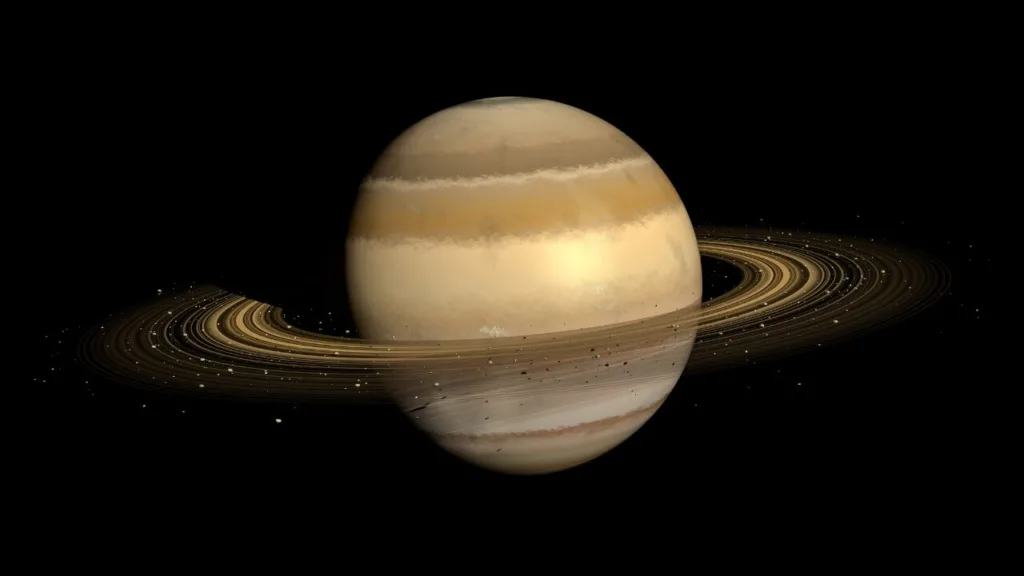
Saturn is the sixth planet from the Sun. NASA says it is the second largest planet in our solar system, after Jupiter. It is famous for its bright rings.
Saturn is a gas giant. That means it has no solid ground. NASA says it is made mostly of hydrogen and helium, the two lightest elements of all.
The planet is named after the Roman god of farming. You can see it from your garden without a telescope. NASA says it is the most distant planet you can see with your eyes alone.
| Saturn at a glance | |
|---|---|
| Place in the solar system | sixth planet from the Sun |
| Width across the middle | about 120,500 km (74,897 miles) |
| Distance from the Sun | about 1,426 million km (886 million miles) |
| Length of one day | 10.7 hours |
| Length of one year | about 29.4 Earth years |
| Made of | mostly hydrogen and helium |
| Confirmed moons | 293, as of August 2026 |
How big is Saturn?
Saturn is enormous. NASA gives its width across the middle as about 120,500 km, or 74,897 miles. That makes it nine times wider than Earth.
Its volume is 755 times greater than the volume of Earth. In other words, you could pour 755 Earths into the space Saturn fills.
Saturn has 95.16 times as much mass as our planet. Mass is the amount of stuff something is made of. So Saturn is very wide, but it is not as heavy as its size suggests.
The reason is that Saturn is not very dense. NASA gives its average density as 0.70 grams per cubic centimetre. Water is denser than that.
People sometimes say Saturn would float in a big enough bath. It is a nice picture, and the numbers behind it are real. No such bath exists, though, and Saturn has no surface to float on.
A short day and a very long year
A day is the time a planet takes to spin around once. On Saturn that takes only 10.7 hours. Your whole school day would be nearly half a Saturn day.
A year is the time a planet takes to travel once around the Sun. Saturn is a long way out, so its journey is slow. NASA says one Saturn year lasts about 29.4 Earth years.
If you were born on Saturn, you would wait nearly thirty Earth years for your first birthday. Most people would never reach their third.
Saturn is tilted by 26.73 degrees as it travels. Earth is tilted too, which is why we have seasons. Saturn has seasons for the same reason, but each one lasts more than seven Earth years.
What is inside Saturn?
Saturn is not empty gas all the way down. NASA says there is a dense core at its centre, made of rock, ice, water and other materials, squashed solid by huge pressure and heat.
Around that core is a strange layer of liquid metallic hydrogen. Outside that sits a layer of ordinary liquid hydrogen, and then the clouds we can see.
Because there is no solid ground, a spacecraft could never land on Saturn itself. There is simply nowhere to put its legs down.
It is also bitterly cold. NASA gives Saturn a temperature of about minus 178 degrees Celsius, which is minus 288 degrees Fahrenheit.
The windiest place you can imagine
Saturn has the fastest winds of almost anywhere we know. NASA says winds near its equator reach 500 metres per second, or 1,600 feet per second.
The strongest hurricane winds on Earth top out at about 110 metres per second. Saturn beats that more than four times over.
Those winds, along with heat rising from deep inside the planet, create the yellow and gold bands in Saturn clouds. The bands are simply weather, stretched all the way round the planet.
Saturn has a magnetic field 578 times as powerful as the magnetic field of Earth. Charged particles spiral down it towards the poles and make glowing auroras there.
The Hubble Space Telescope has even spotted a giant ten-sided wave of cloud circling the south pole of Saturn. Nobody expected a shape like that.
The rings
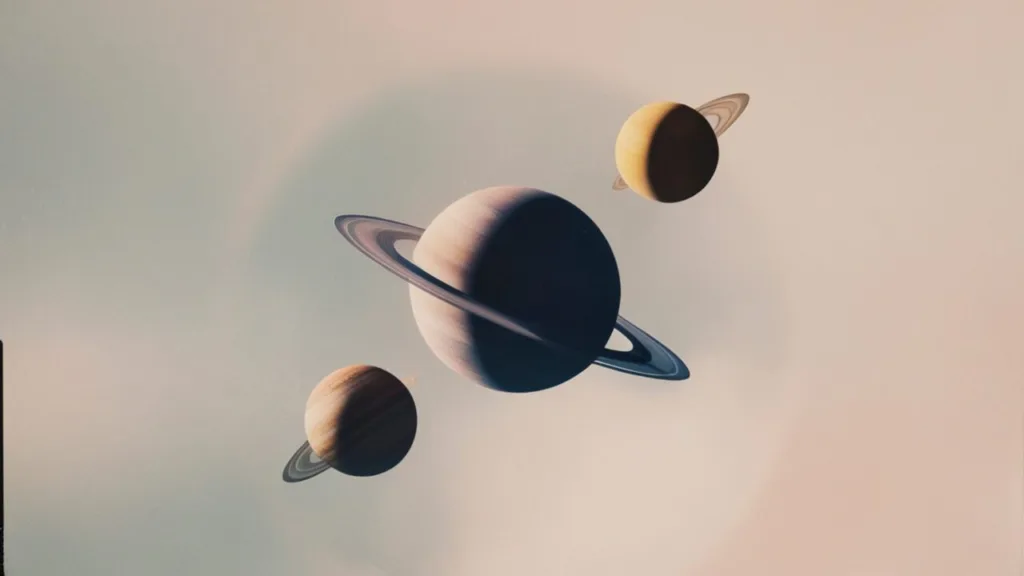
The rings are what everybody knows Saturn for. NASA says the ring system reaches up to 282,000 km, or 175,000 miles, out from the planet.
Here is the surprising part. Those huge rings are incredibly thin. NASA says the main rings are typically only about 10 metres thick from top to bottom, roughly the height of a house.
There are seven main rings, named C, B, A, D, F, G and E. The letters look jumbled because they were given in the order the rings were found, not in the order they sit.
The two Voyager spacecraft showed in the early 1980s that the rings are made mostly of water ice. They are countless separate pieces, not solid sheets, so you could not walk on them.
Voyager also photographed braided rings, thin ringlets, and dark marks called spokes that circle the planet at their own speed.
A gap made by a moon
Look closely at the rings and you will see a dark gap. It is called the Cassini Division, and NASA says it is 4,800 km wide. That is about 3,000 miles.
The gap is not empty by accident. The gravity of a moon called Mimas keeps tugging particles out of it, so the space stays swept clear.
The rings can pile up as well. During a Saturn equinox in autumn 2009, the Cassini spacecraft saw ring particles heaped into ridges more than 3 km high.
How people worked out the rings
In 1610 Galileo Galilei became the first person to point a telescope at Saturn. His telescope was small, and what he saw puzzled him.
Galileo thought Saturn was a planet with two smaller spheres stuck to its sides. Later he drew them as arms or handles. He never worked out that they were rings.
In 1659 a Dutch astronomer called Christiaan Huygens used a better telescope. He suggested that Saturn was surrounded by a thin, flat ring.
In 1675 an astronomer called Jean-Dominique Cassini spotted the gap in the rings. It still carries his name today.
A planet with hundreds of moons
Saturn has more officially recognised moons than any other planet. The number keeps changing as astronomers find more, so the date matters as much as the number.
In March 2025 NASA listed 274 confirmed moons. By August 2026 the count had reached 293. Expect it to grow again.
The moons come in wild sizes. One is bigger than the planet Mercury. Others are no larger than a sports arena, and some are shaped like potatoes or ravioli.
Titan, the moon with weather
Titan is the largest moon of Saturn and the second largest moon in the solar system. Only Ganymede, at Jupiter, beats it.
NASA gives its radius as about 2,575 km, or 1,600 miles. That makes Titan bigger than the planet Mercury.
Titan is the only moon we know of with a thick atmosphere. Its air is about 95 per cent nitrogen, with about 5 per cent methane.
It has clouds, rain, rivers, lakes and seas, which sounds a lot like home. They are not made of water, though. They are made of liquid methane and ethane.
The surface sits at about minus 179 degrees Celsius. It is so cold there that water ice behaves like solid rock.
Titan takes 15 days and 22 hours to travel once around Saturn, from about 1,222,000 km away. It is tidally locked, so it always shows Saturn the same face.
Scientists have also found signs of an underground ocean of liquid water below the icy crust of Titan, probably mixed with salts and ammonia.
Enceladus, the moon that sprays
Enceladus is much smaller, about 500 km across. NASA says it has the whitest, most reflective surface in the solar system.
It is also extremely cold, at about minus 201 degrees Celsius. Yet something astonishing is happening underneath.
Careful measurements of its gravity showed that a global ocean of liquid water lies beneath the icy shell of Enceladus.
In 2005 the Cassini spacecraft discovered jets of water bursting out of the moon at around 800 miles per hour. The jets carry water vapour, carbon dioxide, methane, salts and silica.
The ice thrown out by those jets makes the faint E ring of Saturn. Enceladus is a moon that builds its own ring.
Enceladus is squeezed by the pull of another moon, Dione, and that squeezing heats its inside. Cassini found that it has essentially all the ingredients needed for life.
Spacecraft that have been there
Four robotic spacecraft have visited Saturn: Pioneer 11, Voyager 1, Voyager 2 and Cassini. You can read NASA pages about Saturn facts and its moons.
Pioneer 11 arrived first, in 1979. It flew within 22,000 km of the cloud tops of Saturn.
In 1981 Voyager 2 used the gravity of Saturn as a slingshot. That shove sent it on to Uranus, then Neptune, then out of the solar system altogether.
Cassini launched on 15 October 1997 and arrived in 2004. It was the first spacecraft ever to orbit Saturn.
Cassini carried a European probe called Huygens. In January 2005 Huygens dropped through the thick air of Titan and studied the atmosphere and the surface.
The mission ended on 15 September 2017 with a manoeuvre called the Grand Finale. NASA steered Cassini into Saturn on purpose, so that the spacecraft could never drift down and contaminate Enceladus or Titan.
That decision mattered. The results from Cassini pushed space agencies to treat ocean worlds as a priority, which helped shape later missions. NASA also has a page on the moons of Jupiter if you want to compare.
How to see Saturn yourself
You do not need any equipment to find Saturn. It looks like a steady, creamy-yellow star that does not twinkle much.
A small telescope or strong binoculars will show the rings as a tiny pair of handles, much as Galileo saw them. Go out after dark with an adult, and never point binoculars or a telescope anywhere near the Sun.
Three things people get wrong
Saturn is not the only planet with rings. Jupiter, Uranus and Neptune have them too. NASA does call the ring system of Saturn the most spectacular, and it is the only one easily seen from Earth.
Galileo did not discover the rings. He saw something odd in 1610 and thought Saturn had two bodies stuck to it. Huygens explained the ring almost fifty years later.
The number of moons is not fixed. NASA counted 274 in March 2025 and 293 by August 2026. Always give the date along with the number.
Did you know? Saturn is less dense than water. If you could find a bath big enough, the numbers say Saturn would float in it.
Try it
Go outside after dark with an adult and look for a steady, creamy-yellow star that barely twinkles. That is Saturn. Through binoculars its rings look like tiny handles, just as they did to Galileo in 1610.
Knowledge check
How long is one day on Saturn, and how long is one year?
Show answer
A day takes only 10.7 hours, because Saturn spins very fast. A year takes about 29.4 Earth years, because Saturn is a long way from the Sun.
What are Saturn rings made of?
Show answer
Mostly water ice, in countless separate pieces. The two Voyager spacecraft showed this in the early 1980s. The main rings are only about 10 metres thick.
Frequently asked questions
How big is Saturn?
NASA gives Saturn a width of about 120,500 km, or 74,897 miles, which is nine times wider than Earth. Its volume is 755 times greater than the volume of Earth, and it has 95.16 times as much mass.
What are Saturn rings made of?
The rings are made mostly of water ice, in countless separate pieces rather than solid sheets. The two Voyager spacecraft showed this in the early 1980s. The main rings are only about 10 metres thick.
How many moons does Saturn have?
NASA listed 293 confirmed moons as of August 2026, up from 274 in March 2025. That is more than any other planet, and the count keeps rising as astronomers find more, so always give the date with the number.
How long is a year on Saturn?
One Saturn year lasts about 29.4 Earth years, or 10,755.7 Earth days, because Saturn is about 1,426 million km from the Sun. A day, by contrast, takes only 10.7 hours.
What is Titan?
Titan is the largest moon of Saturn and the second largest moon in the solar system. It is the only moon known to have a thick atmosphere, and it has rivers, lakes and seas made of liquid methane and ethane, not water.
Can you see Saturn without a telescope?
Yes. NASA says Saturn is the most distant planet you can see with your eyes alone. It looks like a steady, creamy-yellow star. Binoculars or a small telescope will show the rings as tiny handles.
Sources
- NASA: Saturn facts — size, distance, day and year length, tilt, rings, winds, magnetic field and the March 2025 moon count
- NASA: Saturn — what Saturn is made of, its core, spacecraft visits and naked-eye visibility
- NASA: Saturn moons — the confirmed moon count as of August 2026, and the range of moon sizes
- NASA: Titan — Titan size, atmosphere, lakes, temperature, orbit and buried ocean
- NASA: Enceladus — Enceladus size, plumes, ocean, reflectivity and the E ring
- NASA: Cassini — the Cassini launch, arrival, the Huygens probe and the Grand Finale