
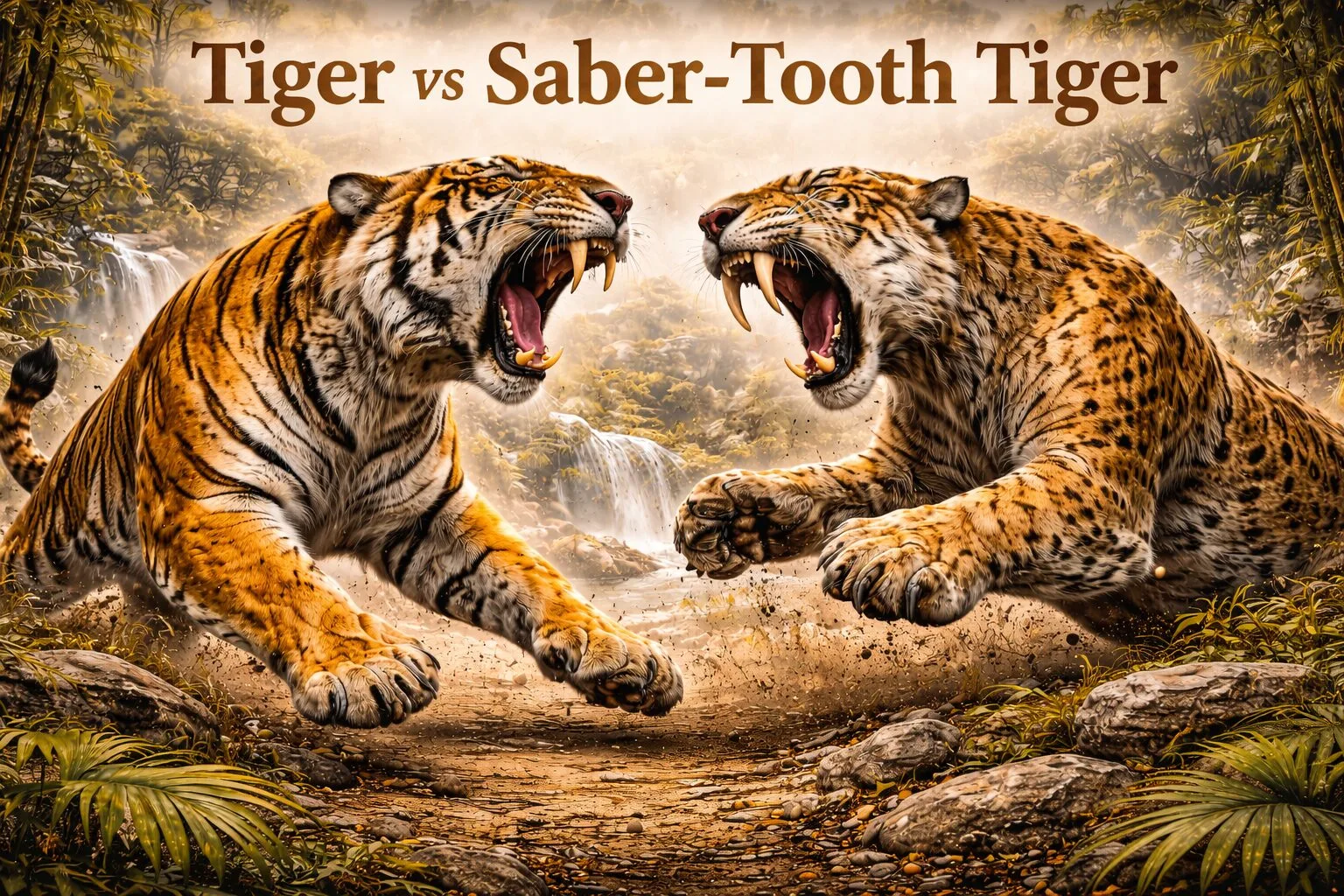
The Tiger and the Saber-tooth tiger are two apex predators separated by time, one rules today’s jungles, the other ruled the Ice Age plains. What would happen if they met? This comparison is not fantasy but a scientific comparison between the Panthera tigris (modern tiger) and Smilodon (saber-tooth “tiger”). Keep reading to learn about Saber-Tooth Tiger vs Modern Tiger, their differences in size, strength, hunting style, etc.
Meet The Modern Tiger (Panthera Tigris)
The modern Tiger (Panthera tigris) which is referred to as the largest living cat in Asia. Tigers evolved in Asia, with early tiger fossils found in parts of China and Southeast Asia, and later tiger populations spread across different regions of Asia and according to WWF there are two recognized subspecies of tigers:
- The Continental (Panthera tigris tigris) Males may weigh up to 660 pounds.
- The Sunda (Panthera tigris sondaica) Males may weigh up to 310 pounds. Within both subspecies, males are heavier than females.
The current population of this big cat expands through lands like India, Russia, Southeast Asia, and Sumatra. Modern tigers are solitary animals which means they live independently, spending most of their time alone except for mating and raising young. Their habitat is a combination of grasslands, and mangroves and they ambush predators like deers and boars, etc.
- They Ambush predators through stealth, speed (which goes up to 60 km/h), and powerful bite (up to 1,000 psi).

Meet The Saber-Tooth Tiger (Smilodon)
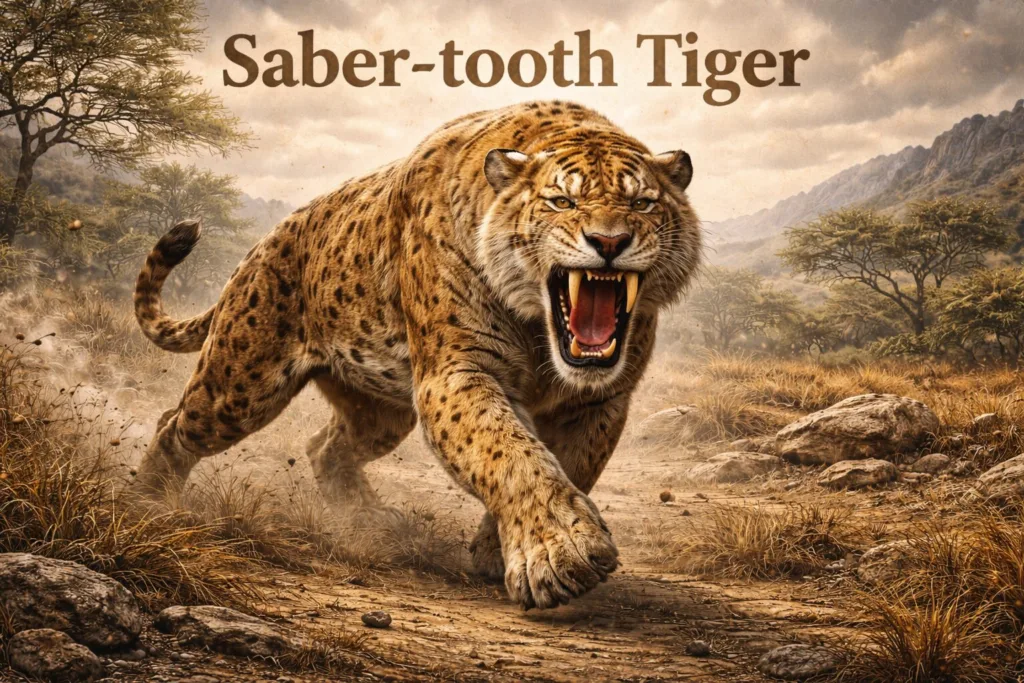
Despite the nickname, Smilodon wasn’t a true tiger. It was a different branch of the cat family (Felidae), more distantly related to modern tigers and lions than they are to each other. Scientifically they belong to a genus called “Smilodon” which belongs to the family Felidae (true cats). This group included other distinct saber-toothed predators, such as Homotherium and Megantereon, which were not true tigers but shared the distinctive dental adaptation of long, curved canine teeth. There were 3 primary species of Smilodons:
- Smilodon gracilis is referred to as the smallest specie which weighed between 55-100 kilograms (121 to 220 lb)
- Smilodon fatalis weighed between 160 to 280 kg (350 to 620 lb)
- Smilodon populator is referred to as the largest specie which weighed between 220 to 436 kg (485 to 961 lb)
These mighty creatures lived during the Pleistocene and early Holocene epochs (a particular period of time in history) before becoming extinct roughly 10,000 years ago.
Size and Strength Comparison
| Trait | Modern Tiger(Panthera tigris) | Saber-Tooth Tiger (Smilodon populator) |
| Weight | 220–300 kg | 350–420 kg |
| Length | 3.3 m (11 ft) | 2.8 m (9 ft, stockier) |
| Bite Force | 950-1000 psi | 600 psi (weaker but wider gape) |
| Fang Length | 7.5 cm | 28 cm |
| Speed | 50-65 km/h | 30–40 km/h |
| Habitat | Forests & grasslands | Plains & savannas |
Weapons and Anatomy
- Modern Tiger: According to the Panthera tigris anatomy they have 30 specialized teeth, which include long, sharp canines (up to 3 inches) and self-sharpening carnassial teeth for slicing meat and crushing bone, unlike the Smilodons. Tigers have strong jaws and retractable claws similar to those of Saber-tooth tigers. Tigers have long limbs and a flexible spine for pouncing at prey and running fast speeds, up to 65 km/h.
- Saber-tooth tiger: According to Smilodon’s anatomy they had long saber teeth which were used for slicing soft tissue, not bone. While the creature had a gigantic chest and shoulder muscles for grappling predators bigger than them. Archaeologists studied the fossils found in La Brea Tar Pits in Los Angeles, California, this enabled them to discover that the species had weak jaw hinge strength with a wide gape of 120°.
Hunting Styles – How They Fought in Real Life
Modern Tigers: The Panthera Tigris has many hunting techniques like:
- Stalking & Camouflage: Tigers have distinctive stripes that allow them to become nearly invisible in dense forests. This process is called camouflage, they move silently to get within striking distance of their prey.
- Ambush Attack: Once close, they launch a sudden, powerful burst of speed, using their immense strength and sharp claws to knock prey off balance.
- The Bite: They aim for the neck or throat, using their powerful jaws and bite strength of 950-1000 psi to suffocate or break the neck of animals.
- Nocturnal and Water Hunting: They are primarily nocturnal, using their superior night vision to their advantage. While tigers are also adept swimmers and have been known to hunt in water.
While the behavior of Tigers is solitary animals unlike Smilodons or the modern lions.
Saber-tooth tiger: The Smilodon likely hunted giant herbivores like bison, sloths, and young woolly mammoths. They relied on ambushes from cover, using their weight to pin their prey. Archaeologists have studied that the Smilodons fossils reveal healed injuries which imply group care and sociable behavior, but this has yet been confirmed.
Hypothetical Battle – Who Would Win?
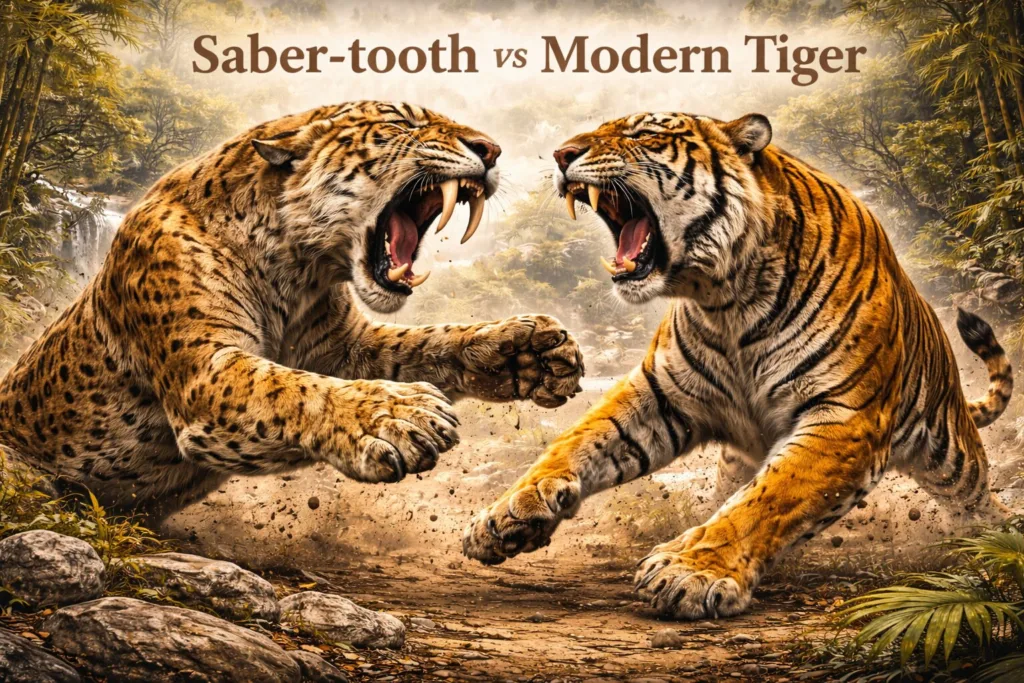
Lets try to imagine what would happen if these titans met on neutral ground, say an open savanna?
Tigers have advantages in:
- Speed
- Endurance
- Bite strength
Smilodons have advantage in:
- Size
- Power
- Longer killing teeth
Analysis: In a short-range ambush the Smilodon might overpower first but in a longer chase or endurance fight, tiger’s agility and modern evolution dominates. Smilodon’s fragile canines could break if misused while the tiger’s bite is more reliable. Smilodon wins brute strength battles, tiger wins in adaptability, but nature never wrote this fight.
Did Tigers and Saber-Tooth Tigers Ever Meet?
Modern tigers lived in Asia, while Smilodon lived in the Americas, so those two didn’t meet. However, other saber-toothed cats (like Homotherium and Megantereon) lived in Eurasia at different times, so some saber-tooth species may have overlapped with early big cats in parts of the Old World.
Fun Science Facts About Both Cats
- Did you know Tigers can swim?
- Both Tigers and Smilodons are apex predators in different ecosystems.
- Smilodon’s roar (if it had one) would have been deeper and shorter.
- Tigers are an endangered species; Smilodons are extinct.
- Smilodon fossils show healed bones, suggesting social behavior.
Conclusion & What We Learn From This Comparison
From the comparison of these mighty creatures we learn how predators and prey adapt to their environmental requirements. We also learn how adaptability becomes possible through the tigers or impossible like the Smilodon. It is important to note that one vanished when its Ice Age kingdom melted. The other survives in shrinking forests, both remind us how fragile power can be.