the Amazon River quick facts
- The Amazon is at least 6,400 km (4,000 miles) long.
- It carries about one-fifth of all the water that runs off Earth’s land.
- About 2,500 kinds of fish have been found in the Amazon.
- Its basin covers about 7 million square kilometres.
- Amazon fresh water makes the ocean less salty for over 160 km from shore.
What is the Amazon River?
The Amazon River is the greatest river in South America. Britannica says it is the largest river system in the world by the amount of water it carries and the size of the area it drains.
It flows about 6,400 km (4,000 miles) from the Andes Mountains in Peru, across the continent to the Atlantic Ocean on the north-east coast of Brazil.
Along its banks grows the Amazon rainforest, the biggest rainforest on Earth. Together, the river and the forest are home to an astonishing number of plants and animals. Explore the forest in our Amazon rainforest facts.
| Amazon River at a glance | |
|---|---|
| Length | at least 6,400 km (4,000 miles); one study says 6,800 km |
| Source | the Andes Mountains of southern Peru |
| Mouth | the Atlantic Ocean, in north-east Brazil |
| Countries in its basin | Brazil, Peru, Colombia, Ecuador, Bolivia and Venezuela |
| Basin size | about 7 million sq km (2.7 million sq miles) |
| Share of Earth’s river water | about one-fifth |
| Fish species | about 2,500 found so far |
Where is the Amazon River?
The Amazon flows across the northern part of South America, from west to east. Britannica says its westernmost source is high in the Andes, within about 160 km (100 miles) of the Pacific Ocean.
The river crosses the whole continent to reach the Atlantic. Britannica says roughly two-thirds of the main river, and by far the largest part of its basin, is in Brazil.
The Amazon basin also covers large parts of Peru, Colombia, Ecuador and Bolivia, and a small area of Venezuela.
How long is the Amazon River?
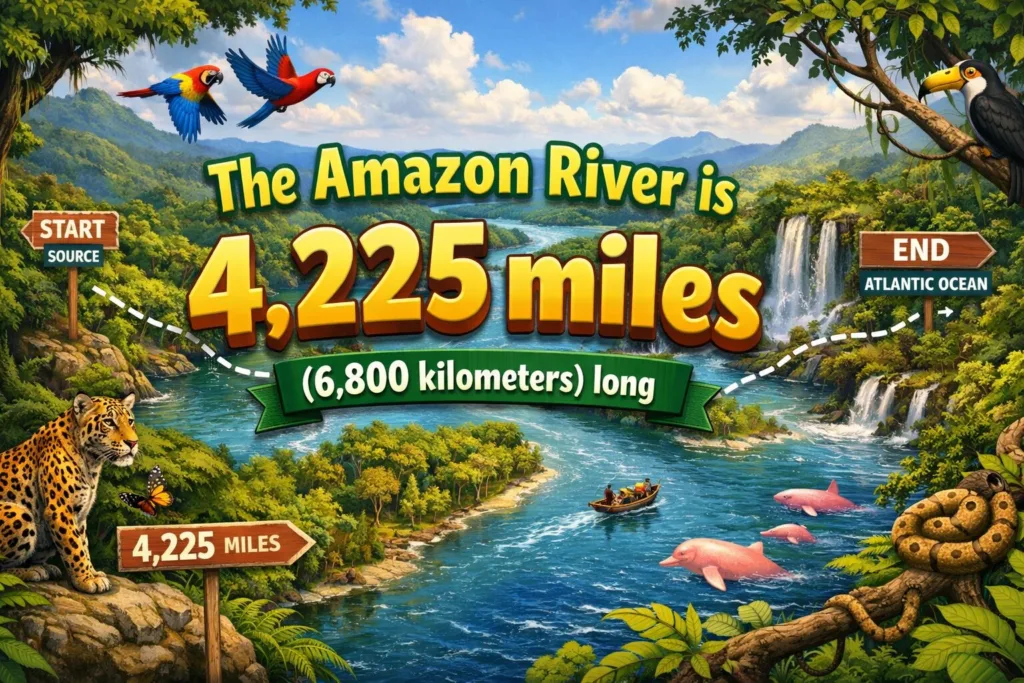
That is a surprisingly tricky question. Britannica says most researchers think the Amazon is at least 6,400 km (4,000 miles) long, which would make it the second-longest river in the world after the Nile.
But nobody can be completely sure. Britannica explains that experts disagree about exactly where the Amazon begins in the Andes, and where it ends, because it reaches the ocean through several wide mouths.
National Geographic reported a study by Brazilian scientists who traced the river to a new, more distant source in southern Peru. They measured the Amazon at 6,800 km (4,225 miles), longer than the Nile’s 6,695 km (4,160 miles).
Other scientists doubt that result. The Amazon’s mouth is so wide that it is hard to choose an exact end point. So for now, the Amazon and the Nile are still competing for the title of world’s longest river.
The river with the most water
Even if it is not the longest, the Amazon carries far more water than any other river. Britannica says about one-fifth of all the water that runs off the Earth’s land flows out through the Amazon.
When it is in flood, the Amazon pours out four times as much water as the Congo River, and more than 10 times as much as the Mississippi.
So much fresh water flows into the sea that Britannica says it makes the ocean less salty for more than 160 km (100 miles) from the shore.
The Amazon basin
The Amazon basin is all the land whose rivers and streams drain into the Amazon. Britannica says it covers about 7 million sq km (2.7 million sq miles), almost twice the size of the Congo basin.
WWF says the Amazon basin covers about 40% of South America, and holds about 20% of the world’s liquid fresh water.
Many large rivers flow into the Amazon, called tributaries. Some carry dark water stained by rotting leaves, while others carry pale, muddy water from the mountains.
Floods and floodplains
Every year, the Amazon and its tributaries rise and flood the land along their banks. Britannica says these low floodplains are called várzeas, and the floods leave behind rich, fertile soil.
During the floods, fish swim among the trees of the flooded forest, eating fruit and seeds that fall into the water. When the water drops, the fish return to the river channels.
Most of the basin, though, is higher land that stays above the floods. Britannica says this is called terra firme, which means firm land.
Amazing Amazon River animals
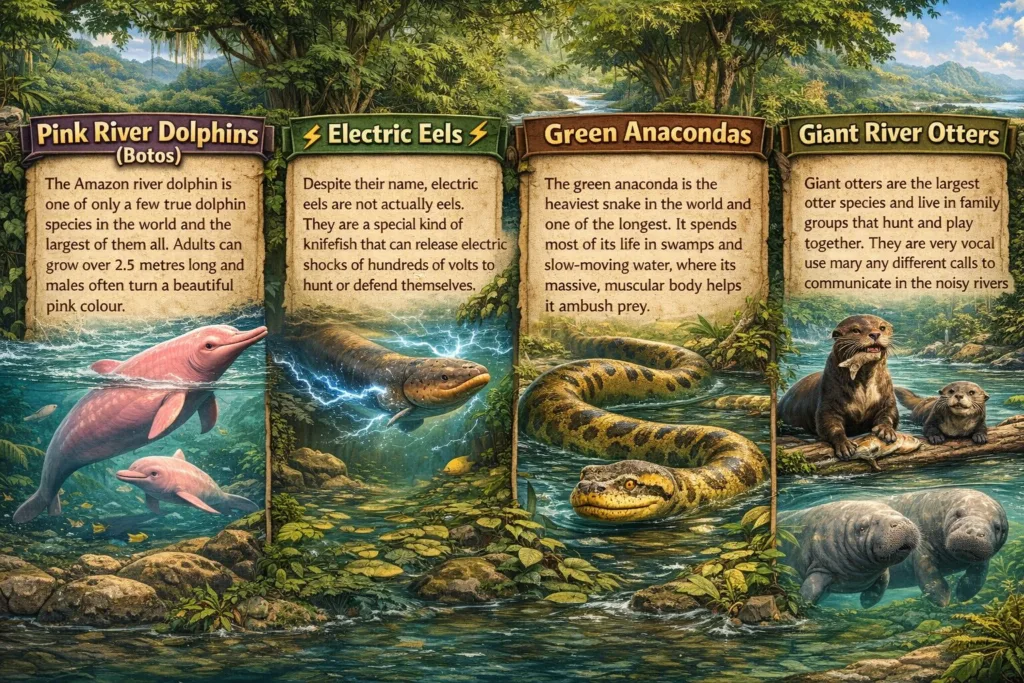
The Amazon is one of the richest rivers on Earth for wildlife. Britannica says about 2,500 kinds of fish have been found in the Amazon system, and many more have yet to be identified. WWF puts the number of freshwater fish species at about 2,400.
Pirarucu: one of the largest freshwater fish in the world.
Piranhas: small, sharp-toothed fish. Britannica says they generally eat other fish but may attack any animal that enters the water.
River dolphins: the Amazon river dolphin, or boto, can be bright pink. Meet it in our pink river dolphin facts.
Manatees: gentle, plant-eating mammals that graze on water plants.
Caimans and river turtles: caimans are relatives of alligators that hunt in the shallows.
Capybaras: Britannica says the semi-aquatic capybara, the world’s largest rodent, lives here too. Find out more in our capybara facts.
The Amazon rainforest connection
The river and the rainforest depend on each other. The forest makes rain, and the rain feeds the river.
WWF UK says the Amazon’s trees release about 20 billion tonnes of water into the air every day, and a single large tree can release more than 1,000 litres in 24 hours. That water forms clouds, which fall as rain.
WWF says the Amazon is home to about one in 10 of all known species on Earth. Britannica calls the Amazon rainforest the world’s largest store of living things, home to more than a million species. Discover how living things depend on each other in our ecosystem facts.
People and the Amazon
Millions of people live in the Amazon. WWF UK says 47 million people live there, including more than 2 million Indigenous people from more than 400 different groups, speaking around 300 languages.
For thousands of years, people have used the river for fishing, travel and trade. Even today, boats are the main way to travel in many parts of the Amazon, where there are few roads.
Dangers to the Amazon
The Amazon faces serious threats. WWF UK says an area of rainforest the size of about five football pitches is cut down every minute.
WWF UK says about 17% of the Amazon rainforest has already been lost, an area about the size of France. When forests are cleared, less rain falls, and the river and its wildlife suffer.
Pollution from mining, dams that block rivers, and overfishing are other dangers to the river and its animals.
How can we help the Amazon?
You can help by learning about the Amazon and sharing what you know. Choosing products that do not come from cleared rainforest, and wasting less paper and wood, can make a difference too.
Many conservation groups work with Indigenous peoples and local communities to protect the Amazon’s forests and rivers.
One river, many names
The Amazon has different names along the way. Britannica says that in Peru, the upper river is called the Marañón until it meets the Ucayali River. From there to the Brazilian border, it is called the Amazonas.
In Brazil, the river is called the Solimões until it meets the Negro River near the city of Manaus. From there to the Atlantic, it is called the Amazonas again.
How the Amazon got its name
Britannica says the first European to explore the Amazon was a Spanish soldier called Francisco de Orellana, in 1541.
Orellana named the river after reporting fierce battles with groups of women warriors. He compared them to the Amazons, the women warriors of Greek myths.
A river with three mouths
The Amazon does not reach the sea through one simple mouth. Britannica says it has three outlets to the Atlantic Ocean: two on the north side of Marajó Island in Brazil, and one to the south that joins the Pará River.
This is one reason the Amazon is so hard to measure. One team of researchers chose the southern outlet, because it gave the longest route from the source to the sea. Britannica says that choice added about 353 km, and their final measurement was about 6,992 km (4,345 miles).
Three things people get wrong
We do not know for sure that the Amazon is the longest river. The Amazon and the Nile are still competing for the title.
The Amazon does not flow through only one country. Its basin covers parts of six countries.
Piranhas are not always dangerous. They usually eat other fish.
Did you know? The Amazon’s trees release about 20 billion tonnes of water into the air every day, making rain that feeds the river.
Try it
Trace the Amazon River on a map from the Andes to the Atlantic. How many countries does its basin touch?
Knowledge check
Where does the Amazon River begin and end?
Show answer
It begins in the Andes of southern Peru and ends in the Atlantic Ocean in Brazil.
What is a várzea?
Show answer
A floodplain along the Amazon that floods every year.
Frequently asked questions
How long is the Amazon River?
Britannica says the Amazon is at least 6,400 km (4,000 miles) long. One Brazilian study measured 6,800 km, but experts still debate its exact length.
Is the Amazon longer than the Nile?
Nobody knows for sure. Most sources rank the Nile first, but one study measured the Amazon as longer. It depends on where each river is measured from.
Which countries does the Amazon River flow through?
The Amazon’s basin covers parts of Brazil, Peru, Colombia, Ecuador, Bolivia and Venezuela. About two-thirds of the main river is in Brazil.
What animals live in the Amazon River?
About 2,500 kinds of fish, including piranhas and giant pirarucu, live there, along with river dolphins, manatees, caimans, turtles and capybaras.
Why is the Amazon River important?
It carries about one-fifth of all river water on Earth and feeds the world’s largest rainforest, home to about one in 10 known species.
What threatens the Amazon River?
Forest clearing, mining pollution, dams and overfishing threaten the Amazon. About 17% of the Amazon rainforest has already been lost.
Sources
- Encyclopaedia Britannica: Amazon River — length, source and mouth, countries, basin size, flow, floodplains and animals
- National Geographic: Amazon longer than the Nile? — the Brazilian measurement and the length debate
- WWF UK: Amazon facts — rainforest size, species, people, trees and rain, carbon and forest loss
- WWF: the Amazon — basin size, share of fresh water, species and fish