
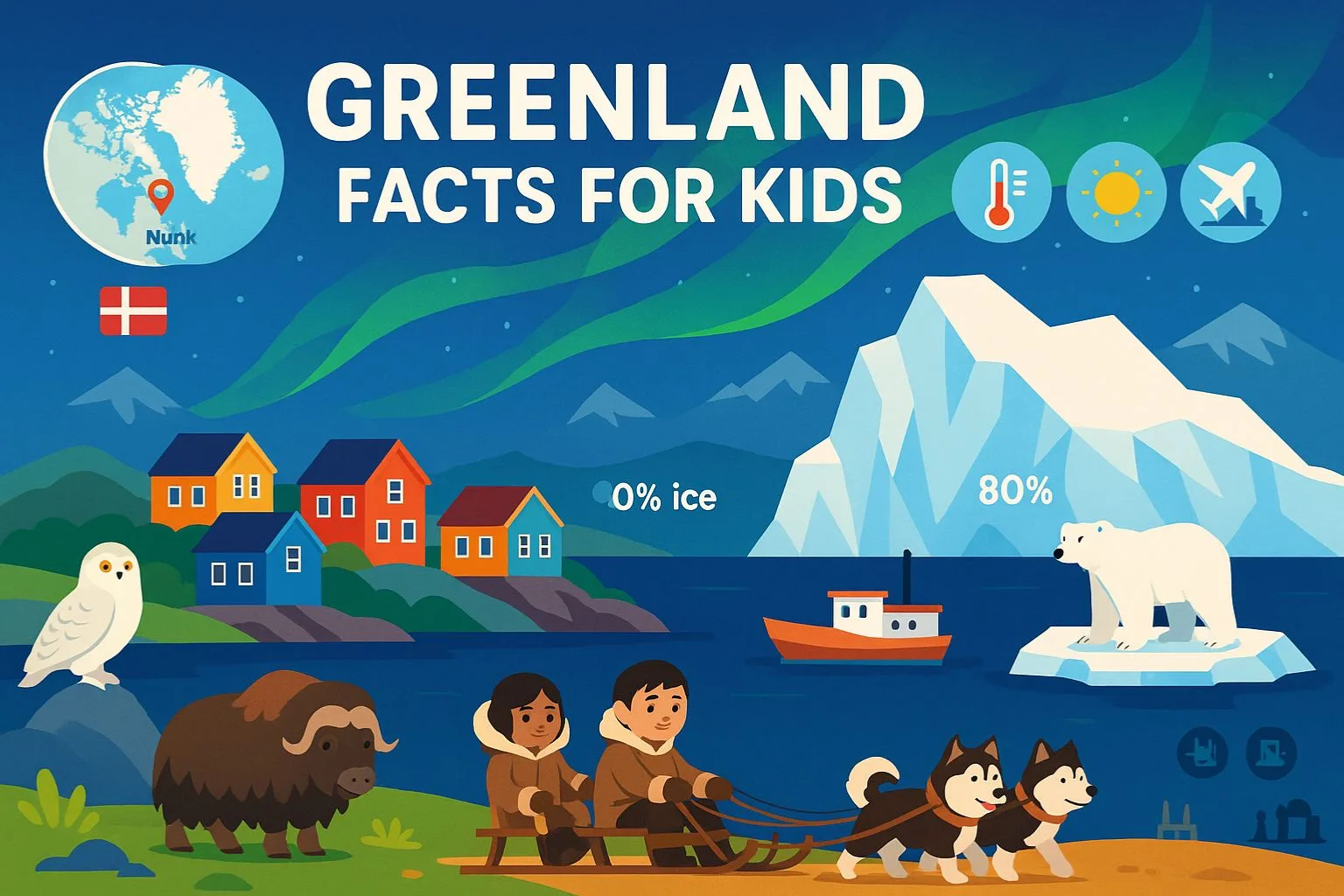
Greenland is the largest island in the world, covering about 2.16 million sq km in the far north. About 80% is covered by ice, up to more than 3 km thick. About 56,000 people live there, mostly Inuit. Greenland governs itself but is part of the Kingdom of Denmark, and its capital is Nuuk.
Greenland quick facts
- Greenland is the largest island in the world.
- About 80% of Greenland is covered by an ice sheet.
- Erik the Red chose the name Greenland to attract settlers.
- About 56,609 people lived in Greenland in 2023.
- Northeast Greenland National Park is the largest national park in the world.
What is Greenland like?

Greenland is the largest island in the world. It lies in the far north, between the Arctic Ocean and the North Atlantic Ocean, and most of it is covered by a gigantic sheet of ice.
Greenland is home to about 56,000 people, most of them Inuit. They live in colourful towns and villages along the rocky coast, where the land is free of ice.
Greenland governs itself, but it is still part of the Kingdom of Denmark. In their own language, Greenlanders call their country Kalaallit Nunaat, which means “land of the people”.
| Greenland at a glance | |
|---|---|
| Area | about 2.16 million sq km (836,000 sq miles) |
| Covered by ice | about 80% |
| People | 56,609 (1 January 2023) |
| Capital | Nuuk |
| Official language | Greenlandic |
| Government | self-governing, within the Kingdom of Denmark |
How big is Greenland?
Greenland is enormous. Visit Greenland, the country’s official tourism organisation, says it covers about 2.16 million sq km (836,000 square miles).
Even the parts without ice are huge. Visit Greenland says the ice-free land alone is roughly as big as Sweden.
Geologically, Greenland is part of North America, even though it belongs to the Kingdom of Denmark in Europe. Visit Greenland says nearby Iceland sits where the North American and European plates meet.
The Greenland Ice Sheet
Most of Greenland is buried under ice. The National Snow and Ice Data Center (NSIDC) says the Greenland Ice Sheet covers about 80% of the island, an area about three times the size of Texas.
The ice is incredibly thick. NSIDC says it is 2 to 3 km (1 to 2 miles) thick over most of the island, and more than 3 km thick in places.
It holds about 2.9 million cubic km of ice. NSIDC says it is the second-largest body of ice on Earth, after the ice sheet that covers Antarctica.
An ice sheet builds up very slowly. NSIDC explains that when winter snow does not fully melt in summer, the layers pile up year after year and are squashed into ice over thousands of years.
The Greenland Ice Sheet
- How thick is the Greenland Ice Sheet over most of the island?
- Which body of ice on Earth is bigger than the Greenland Ice Sheet?
- How does an ice sheet build up?
- The ice sheet covers an area about how many times the size of Texas?
A melting giant
Greenland’s ice is changing. NSIDC says the ice sheet has been losing ice in recent decades, as more of its surface melts in summer and glaciers at the edges flow faster into the sea.
In 2012, the surface melted across almost the whole ice sheet at once. NSIDC says it was the biggest melt seen since satellite records began in 1979.
This matters for the whole world. NSIDC says that if all of Greenland’s ice melted, sea levels would rise by about 7 m (24 feet). NASA explains more about Greenland’s ice, and National Geographic has more on Greenland and climate change.
Midnight sun and northern lights
In summer, parts of Greenland have the midnight sun. Visit Greenland says the sun does not set at all in some places from about 25 May to 25 July.
In the dark winter, the sky can put on a show. Visit Greenland says there is so little light pollution that people often see the northern lights from their windows, even in Nuuk.
Visit Greenland describes the weather in the north and south of Greenland, which can be very different.
Fact or Myth: Ice and Light
- In 2012, the surface melted across almost the whole Greenland Ice Sheet at once.
- If all of Greenland's ice melted, sea levels would rise by only a few centimetres.
- In some parts of Greenland, the sun does not set at all for weeks in summer.
- You have to travel far from any town to see the northern lights in Greenland.
- Geologically, Greenland is part of North America.
A long history
People have lived in Greenland for thousands of years. Visit Greenland says the first people arrived from northern Canada about 2500 BC, and more groups followed over the centuries.
Around 982 AD, a Norseman from Iceland called Erik the Red reached southern Greenland. Visit Greenland says he chose the name “Greenland” to make the land sound attractive, so that settlers would want to come.
About 1200 AD, the Thule people arrived and settled both the east and west coasts. Visit Greenland says Greenland’s Inuit today are descended from them.
The Norse settlements disappeared by about 1500, and nobody knows exactly why. The last written record of the Norse is a wedding at Hvalsey Church in 1408.
In 1721, a Norwegian priest called Hans Egede arrived near today’s Nuuk. Greenland later became a Danish colony, until 1953, when it became part of the Danish Kingdom.
Governing itself
Greenland has gradually taken more control of its own affairs. Statistics Greenland says Home Rule began on 1 May 1979, when Greenland’s own parliament was set up.
In 2008, Greenlanders voted to take on even more power. The Danish Prime Minister’s Office says 75.5% voted yes, and Self-Government began on 21 June 2009.
Greenland’s parliament is called Inatsisartut, which means “those who make laws”. It has 31 elected members. The Danish Prime Minister’s Office says Denmark still handles foreign policy, defence and money policy, and the law sets out a path to independence if Greenlanders ever choose it.
Greenland Through Time
- First peoples The first people arrive from northern Canada.
- Erik the Red A Norseman from Iceland reaches southern Greenland.
- The Thule people They settle the east and west coasts; today's Inuit descend from them.
- Hvalsey Church A wedding here is the last written record of the Norse.
- Hans Egede A Norwegian priest arrives near today's Nuuk.
- Home Rule Greenland's own parliament is set up.
- Self-Government Greenland takes on more power after a vote.
The people of Greenland

Statistics Greenland says 56,609 people lived in Greenland on 1 January 2023. About a third of them live in the capital, Nuuk.
Visit Greenland says about 88% of the people are Inuit, called Kalaallit, or of mixed Inuit and Danish heritage. Most people speak both Greenlandic and Danish, and young people also learn English at school.
Greenland has the lowest population density of any country in the world, Visit Greenland says. That means there are very few people for its size.
There are no roads or railways linking the towns. Visit Greenland says people travel between them by plane, boat, helicopter, snowmobile or dog sled. The three largest towns are Nuuk, Ilulissat and Sisimiut.
Greenland’s National Day is 21 June, the longest day of the year.
Animals of Greenland

Greenland is home to hardy Arctic animals. Visit Greenland says muskoxen, polar bears, walruses and narwhals live in its huge national park.
Other Arctic animals, such as the Arctic wolf and the harp seal, also live in and around Greenland. National Geographic has more about polar bears.
Northeast Greenland National Park is the largest national park in the world. Visit Greenland says it covers 972,000 sq km, bigger than Spain and France put together. It was created in 1974, and only about 40 people live there, all of them working at military, research or weather stations.
The Biggest National Park
- Northeast Greenland National Park is bigger than which two countries put together?
- Who are the only people living in the national park?
- When was the national park created?
- Which of these animals is NOT named as living in the park?
Work and industry

Fishing is Greenland’s most important industry. Visit Greenland says that, through the company Royal Greenland, it is the world’s biggest supplier of cold-water prawns.
The cold, clean seas around Greenland are rich in fish and shellfish, and many Greenlanders work in fishing or in processing seafood. Tourism is growing too, as visitors come to see the ice, the whales and the northern lights.
The map trick
On many world maps, Greenland looks enormous, about as big as Africa. But that is a trick of the map.
NPR explains that the Mercator map, made in 1569, was designed to help sailors steer in straight lines. It keeps the shapes of countries right, but it stretches their size near the poles.
In reality, Africa is about 14 times bigger than Greenland. Newer maps, such as the Equal Earth map from 2018, show countries at their true sizes.
Greenland and Iceland
People often mix up Greenland and Iceland, partly because of their names. Visit Greenland says Iceland is an independent country with mostly Norse heritage, while Greenland is self-governing within Denmark and mainly Inuit.
Funnily enough, Greenland is mostly ice, while Iceland is much greener. That is thanks to Erik the Red’s clever choice of name.
Early peoples
Greenland’s first peoples came in waves from northern Canada. Visit Greenland says the Saqqaq culture lived there from around 2400 BC.
Later came people of the Independence II and Dorset cultures, from about 800 BC. Another Dorset group arrived in the 700s and 800s AD. Each group learned to hunt and survive in the cold.
When Erik the Red arrived in 982 AD, he settled at a place now called Qassiarsuk, in the south of Greenland, Visit Greenland says.
Towns and settlements
Most Greenlanders live in towns. Statistics Greenland says that in 2023, 49,690 people lived in towns and 6,854 lived in small settlements.
The Danish Prime Minister’s Office says Greenlandic is the official language of Greenland. Greenland’s own government is called Naalakkersuisut.
Visit Greenland says Denmark’s King Frederik X is Greenland’s head of state, but this is mostly a ceremonial role. Greenland’s leaders make most decisions at home.
Greenlandic Words
- Kalaallit Nunaat — Greenlanders' name for their country
- Inatsisartut — The parliament, 'those who make laws'
- Naalakkersuisut — Greenland's own government
- Kalaallit — Greenland's Inuit people
- Nuuk — The capital
Guarding the wild north
Northeast Greenland National Park is so remote that it needs special guards. Visit Greenland says the Danish Sirius Patrol travels along its coast by dog sled.
The park became a UNESCO Man and the Biosphere reserve in 1977. Visit Greenland says polar bears are more likely to be seen there than anywhere else in Greenland.
Visitors
Greenland is still a quiet place for tourists. Visit Greenland says it had about 100,000 tourists in 2019, while Iceland had about 2 million.
Three things people get wrong
Greenland is not very green. About 80% of it is covered in ice.
Greenland is not as big as Africa. Africa is about 14 times bigger; some maps stretch Greenland.
Greenland is not an independent country. It governs itself but is part of the Kingdom of Denmark.
Did you know? On Mercator maps, Greenland looks as big as Africa, but Africa is really about 14 times bigger.
Try it
Compare Greenland and Africa on a Mercator world map, then on an Equal Earth map. How different do they look?
Knowledge check
What covers most of Greenland?
Show answer
The Greenland Ice Sheet.
Why is Greenland called Greenland?
Show answer
Erik the Red chose the name to make it sound attractive to settlers.
Frequently asked questions
Is Greenland a country?
Greenland governs itself, with its own parliament, but it is part of the Kingdom of Denmark. Denmark still handles defence and foreign policy.
How much of Greenland is covered in ice?
About 80% of Greenland is covered by the Greenland Ice Sheet, which is 2 to 3 km thick over most of the island.
Why is Greenland called Greenland?
Erik the Red, who arrived around 982 AD, chose the name Greenland to make the land sound attractive to settlers.
How many people live in Greenland?
Statistics Greenland says 56,609 people lived there on 1 January 2023. About a third live in the capital, Nuuk.
What animals live in Greenland?
Greenland is home to muskoxen, polar bears, walruses, narwhals, Arctic wolves and seals, especially in its huge national park.
Is Greenland bigger than Africa?
No. On Mercator maps Greenland looks as big as Africa, but Africa is really about 14 times bigger.
Sources
- National Snow and Ice Data Center: ice sheet quick facts — the ice sheet’s size, thickness and volume, and how ice sheets form; its page on the Greenland Ice Sheet today was also used
- Statistics Greenland: population estimates 2023 — population, Nuuk and towns; its page on self-government was also used
- Danish Prime Minister’s Office: Greenland — the 2008 vote, Self-Government, the official language and the path to independence
- Visit Greenland: history of Greenland — the first peoples, the Norse, the Thule and Hans Egede; its pages on modern Greenland, the national park and Iceland were also used
- Visit Greenland: 10 facts about Greenland — area, people, languages, the midnight sun, the name and transport
- NPR: the Mercator map and Africa — why Greenland looks so big on maps
Greenland Facts Quiz
- Visit Greenland says Greenland's ice-free land alone is roughly as big as which country?
- How do people travel between Greenland's towns?
- Why is Greenland's National Day on 21 June?
- What is Greenland's most important industry?
- What was the Mercator map of 1569 designed to do?
- Which of these describes Iceland rather than Greenland?
- What was the Saqqaq culture?
- Where did Erik the Red settle when he arrived in 982 AD?
- How does the Sirius Patrol travel along the national park's coast?
- In the 2008 vote, what did Greenlanders choose?
- Which of these does Denmark still handle for Greenland?
- What does 'lowest population density' mean for Greenland?


