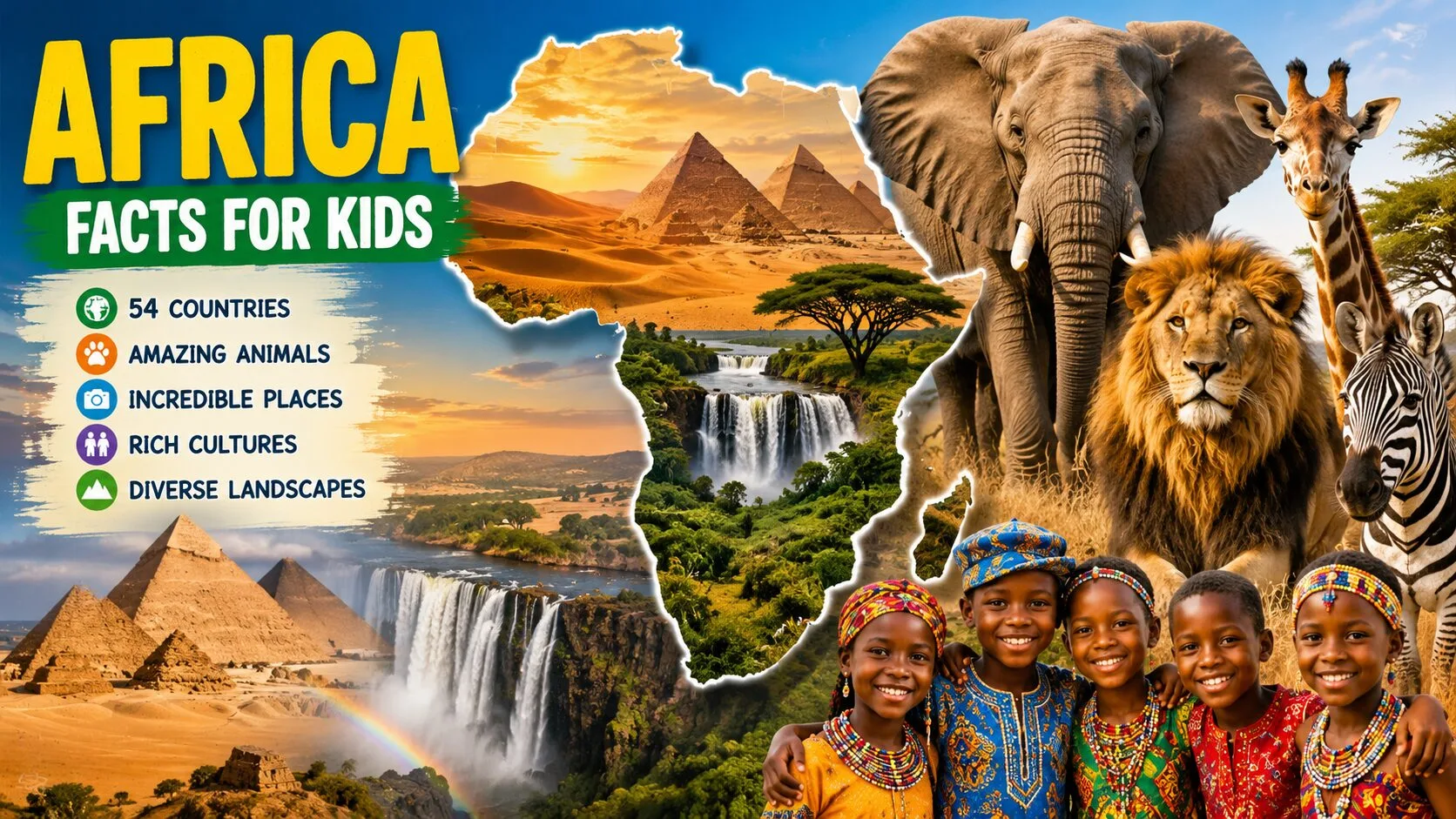
Africa is the world’s second-largest continent, covering about one-fifth of Earth’s land. It has 54 countries and more than 1.5 billion people. It is home to the Sahara, the largest hot desert, the River Nile, and animals such as elephants, lions and gorillas.
Africa quick facts
- Africa is the second-largest continent in the world.
- Africa has 54 recognized countries.
- More than 1.5 billion people live in Africa.
- Algeria is the largest African country by area, and Seychelles is the smallest.
- The Nile is Africa’s longest river, and Mount Kilimanjaro is its tallest mountain.
- Africa crosses the Equator and Prime Meridian, placing it in all four hemispheres.
Africa is not just one type of place. Some parts are dry and sandy, while others are full of forests, lakes and grasslands. It is also home to famous animals like elephants, lions, giraffes, zebras, cheetahs, hippos, gorillas and even penguins.
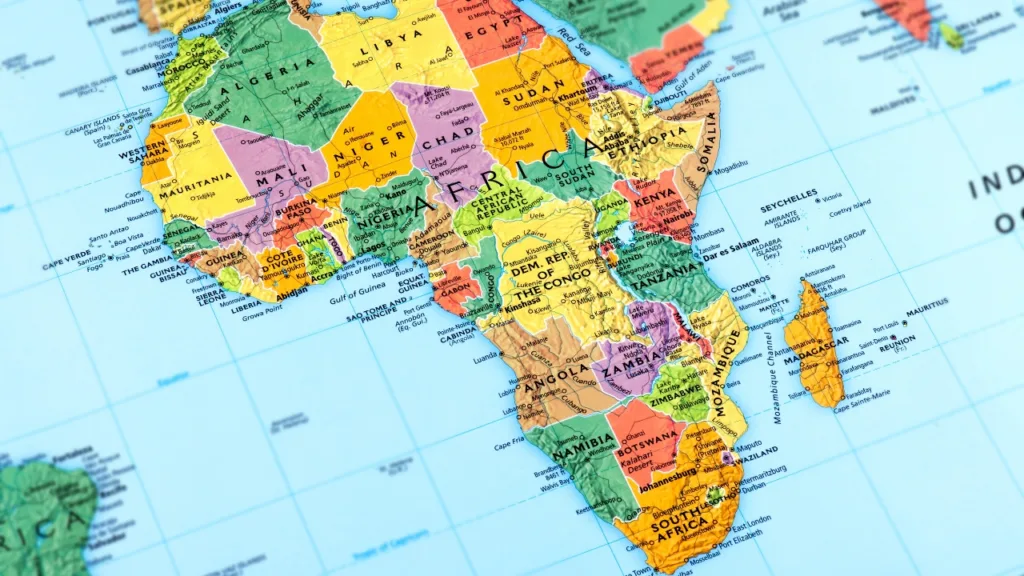
Where Is Africa on the World Map?
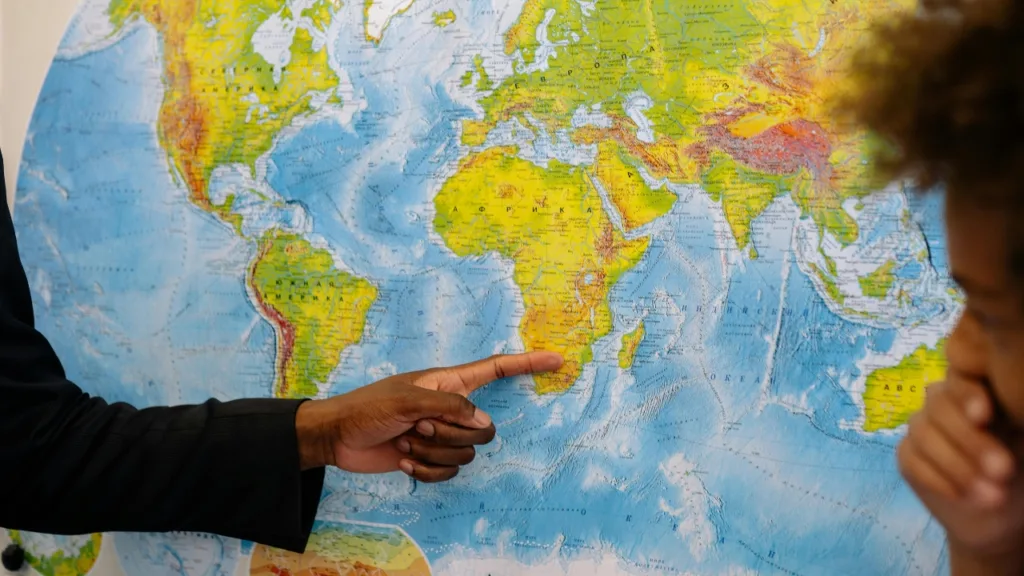
Africa is located near the centre of the world map. It is surrounded by water on many sides.
The Atlantic Ocean is on the west side of Africa. The Indian Ocean is on the east side. The Mediterranean Sea is north of Africa, and the Red Sea is found between northeastern Africa and the Arabian Peninsula.
The equator runs through Africa. This means many parts of Africa are warm throughout the year. The equator passes through several African countries, including Kenya, Uganda, the Democratic Republic of Congo, Gabon, Republic of Congo and Somalia.
Africa also crosses the Prime Meridian, which helps divide the Eastern and Western hemispheres. This is why Africa is found in all four hemispheres.
How big is Africa?
Africa is enormous. It covers about 30.4 million square kilometres, which is about one-fifth of all the land on Earth. Only Asia is bigger.
From north to south it stretches about 8,000 km. From east to west it is about 7,400 km across.
Here is a surprise. Africa’s coastline is about 30,500 km long, which is shorter than Europe’s. That is because Africa’s coast has few deep bays and inlets, so it runs in long, smooth lines.
The Equator cuts Africa almost exactly in half, so most of the continent lies in the tropics. The prime meridian, the line of 0° longitude, crosses it too, passing just east of Accra, the capital of Ghana.
Nobody is completely sure where the name Africa comes from. One idea is the Latin word aprica, meaning “sunny”. Another is the Greek aphrike, meaning “without cold”.
What Africa Looks Like
Africa has many different landscapes. In the north, you can find the huge Sahara Desert, with sand dunes, rocky plains and very dry areas. The Sahara is the largest hot desert on Earth.
Near the equator, Africa has tropical rainforests. These forests receive a lot of rain and are home to many plants, birds, insects and animals. Some rainforests are found in Central and West Africa.
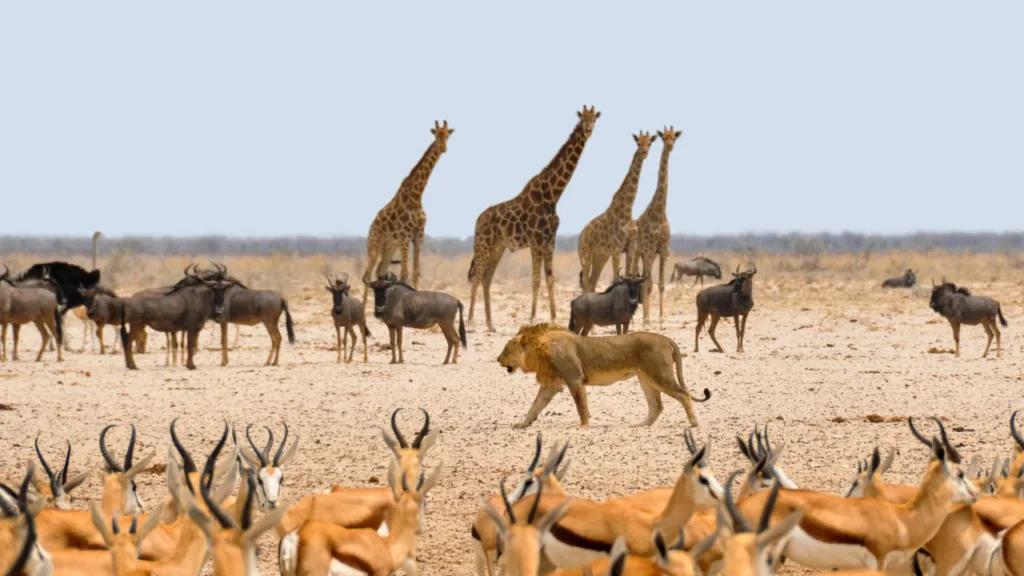
Africa is also famous for savannahs. Savannahs are wide open grasslands with scattered trees. Many well-known African animals live there, including zebras, giraffes, elephants, antelopes and lions.
Africa also has mountains and volcanoes. Mount Kilimanjaro in Tanzania is the tallest mountain in Africa. It is about 5,895 meters, or 19,340 feet, high.
Africa has many important lakes and rivers. Lake Victoria is the largest lake in Africa by area. Lake Tanganyika is the deepest lake in Africa and one of the deepest lakes in the world. The Nile River is usually described as the longest river in the world. Other major rivers include the Congo River and the Niger River.
Africa’s record-breaking places
- The Sahara — the largest hot desert on Earth
- Mount Kilimanjaro — the tallest mountain in Africa, about 5,895 metres high
- Lake Victoria — the largest lake in Africa by area
- Lake Tanganyika — the deepest lake in Africa
- The Great Rift Valley — a famous feature of East Africa
- The Atlantic Ocean — the ocean on the west side of Africa
African Countries
Africa has 54 recognised countries. Each country has its own flag, government, culture, languages and traditions.
Different organisations count slightly differently. The United Nations lists 54 African countries, while the African Union has 55 member states. Both split Africa into five regions.
Geographers often divide Africa into five main regions:
North Africa
North Africa includes countries such as Egypt, Morocco, Algeria, Tunisia and Libya. This region is known for deserts, ancient history and Mediterranean coastlines.
East Africa
East Africa includes countries such as Kenya, Tanzania, Ethiopia, Uganda and Somalia. This region is famous for wildlife, mountains, the Great Rift Valley and the Indian Ocean coast.
West Africa
West Africa includes countries such as Nigeria, Ghana, Senegal, Mali and Ivory Coast. It is known for music, food, history, trade routes and rich cultures.
Central Africa
Central Africa includes countries such as the Democratic Republic of Congo, Cameroon, Gabon and the Republic of Congo. This region has large rainforests and many rivers.
Southern Africa
Southern Africa includes countries such as South Africa, Botswana, Namibia, Zimbabwe and Zambia. This region has deserts, grasslands, mountains, wildlife parks and famous places like Victoria Falls.
Some African countries are famous around the world. Egypt is known for the pyramids. Kenya and Tanzania are known for safari wildlife. South Africa is known for Table Mountain, African penguins and beautiful coastlines. Nigeria is known for its large population, music and film industry.
African Animals
Africa is home to many famous animals. Some live in grasslands, some live in forests, and others live in rivers, lakes, deserts or coastal areas.
Elephants
African elephants are the largest land animals on Earth. They use their trunks to drink water, pick up food, smell things and communicate.
Lions
Lions are powerful big cats that often live in groups called prides. They are mostly found in grasslands and savannahs.
Giraffes
Giraffes are the tallest animals in the world. Their long necks help them reach leaves high in trees.
Zebras
Zebras are known for their black-and-white stripes. Each zebra has a stripe pattern that is different, almost like a fingerprint.
Cheetahs
Cheetahs are the fastest land animals. They can run very fast for short distances while chasing prey.
Hippos
Hippos spend much of the day in rivers and lakes. Even though they look slow, they can be very dangerous.
Gorillas
Gorillas live in African forests. They are great apes and are closely related to humans.
Crocodiles
Crocodiles live in rivers, lakes and wetlands. The Nile crocodile is one of the largest crocodiles in the world.
Lemurs
Lemurs are mainly found on Madagascar and nearby islands. Many lemurs are found nowhere else on Earth.
African Penguins
Yes, penguins live in Africa. African penguins live along the southwestern coast of Africa, especially in South Africa and Namibia. Sadly, they are critically endangered.
Famous Places in Africa
Africa has many famous places that kids may recognize from books, movies or school lessons.
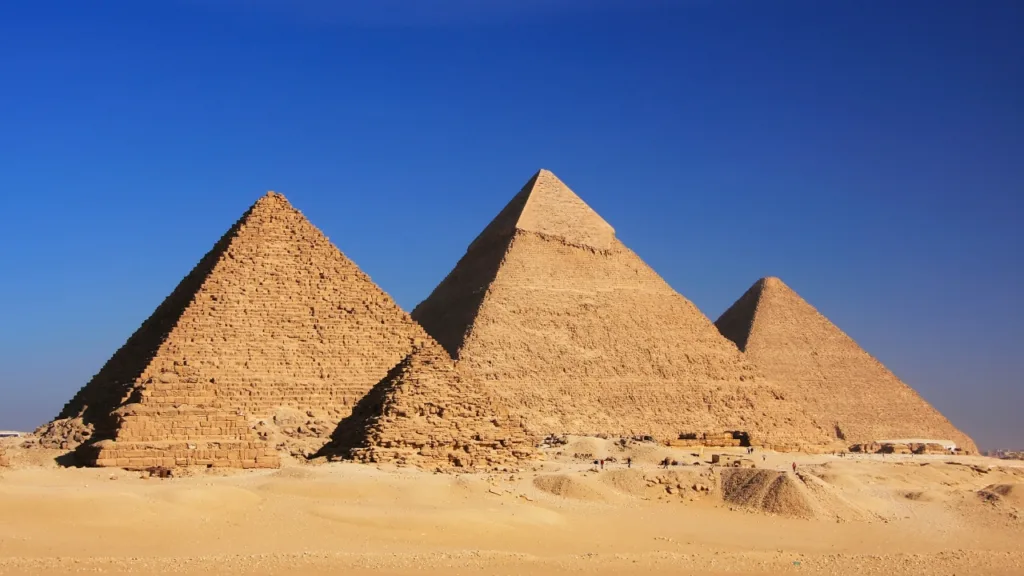
The Pyramids of Giza
The Pyramids of Giza are in Egypt. The Great Pyramid was completed around 2560 BCE and is the only surviving Wonder of the Ancient World. The pyramids were built as tombs for ancient Egyptian pharaohs.
Mount Kilimanjaro
Mount Kilimanjaro is in Tanzania. It is the tallest mountain in Africa and one of the most famous mountains in the world.
Victoria Falls
Victoria Falls is a huge waterfall on the Zambezi River between Zambia and Zimbabwe. Its local name is “Mosi-oa-Tunya,” which means “The Smoke that Thunders.”
Madagascar
Madagascar is the world’s fourth-largest island. It is home to many animals and plants that are found nowhere else, including many species of lemurs.
Serengeti National Park
Serengeti National Park is in Tanzania. It is famous for the great migration, when huge numbers of wildebeest, zebras and other animals move across the plains.
Sahara Desert
The Sahara Desert is the largest hot desert in the world. It covers a huge area of North Africa.
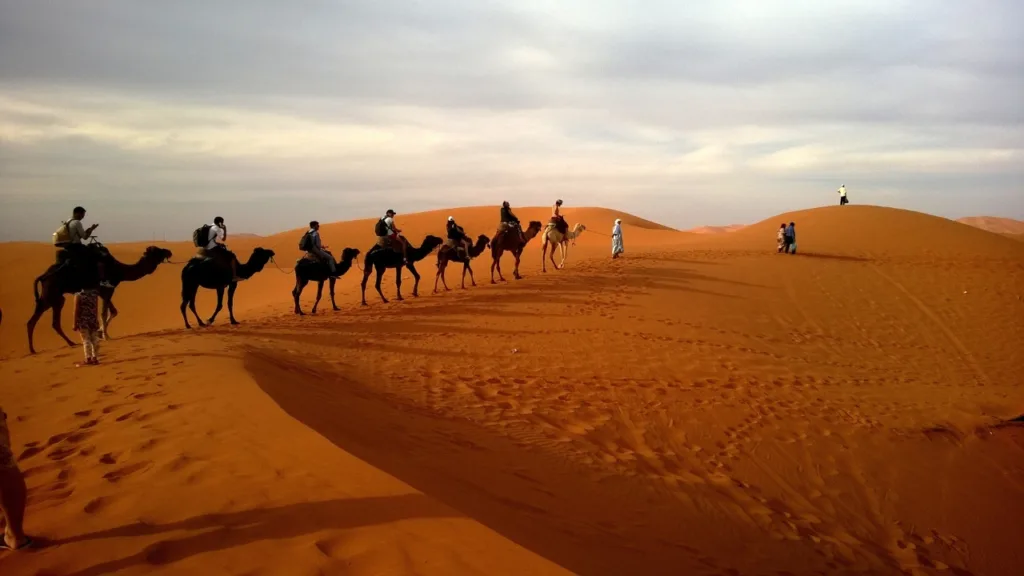
Table Mountain
Table Mountain is in South Africa. It has a flat top and is one of the most famous landmarks in Cape Town.
Nile River
The Nile River flows through northeastern Africa. Ancient Egyptian civilization grew along its banks because the river provided water, food and fertile land.
Famous places
- The Pyramids of Giza — the only surviving Wonder of the Ancient World
- Victoria Falls — a huge waterfall whose local name means The Smoke that Thunders
- Serengeti National Park — famous for the great migration of wildebeest and zebras
- Madagascar — the world's fourth-largest island, home to many lemurs
- Table Mountain — the flat-topped landmark above Cape Town
- The Nile — the river that ancient Egyptian civilisation grew along
What Is the Weather Like in Africa?
Africa is a huge continent, so the weather is not the same everywhere.
The Sahara Desert can be extremely hot during the day. Some desert areas can become much cooler at night.
Rainforests near the equator are usually hot, humid and rainy. These areas receive a lot of rainfall and have many trees and plants.
Savannah areas often have wet and dry seasons. During the wet season, grass grows and animals find more food. During the dry season, many animals move to find water and fresh grass.
Some mountains in Africa, such as Mount Kilimanjaro and Mount Kenya, can have snow or ice near their peaks. However, glaciers on these mountains have been shrinking over time.
People and Cultures of Africa
Africa is home to thousands of cultures, communities and languages. It is better to say “African cultures” instead of “African culture,” because the continent is very diverse.
Many Africans speak more than one language. Some widely spoken languages in Africa include Arabic, Swahili, Amharic, Hausa and Zulu.
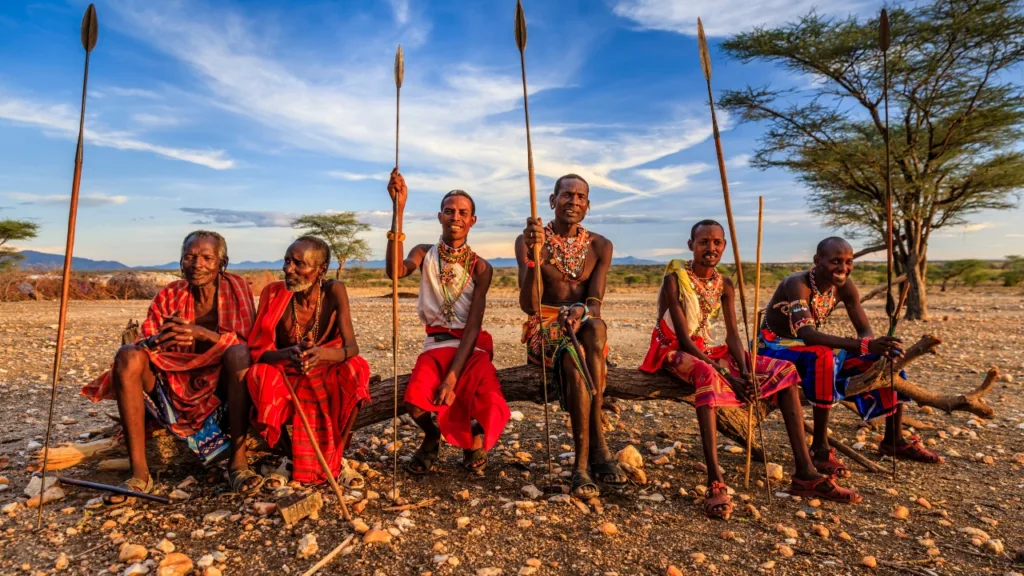
African clothing is also very diverse. In Ghana, people may wear colorful kente cloth. In parts of North Africa, people may wear flowing robes suited to hot climates. In East Africa, Maasai communities are known for beautiful beadwork and bright clothing.
African music and dance have influenced the world. Many music styles around the world have roots connected to African rhythms and traditions. Music is often used for celebrations, storytelling, ceremonies and social events.
African art includes masks, wood carvings, pottery, beadwork, textiles and paintings. These artworks often tell stories or show important beliefs, history and traditions.
African Food for Kids
African food is different from region to region. Each dish tells something about the people, climate and culture of that area.
Here are some examples of African foods:
Couscous
Couscous is a tiny pasta-like food often eaten in North Africa.
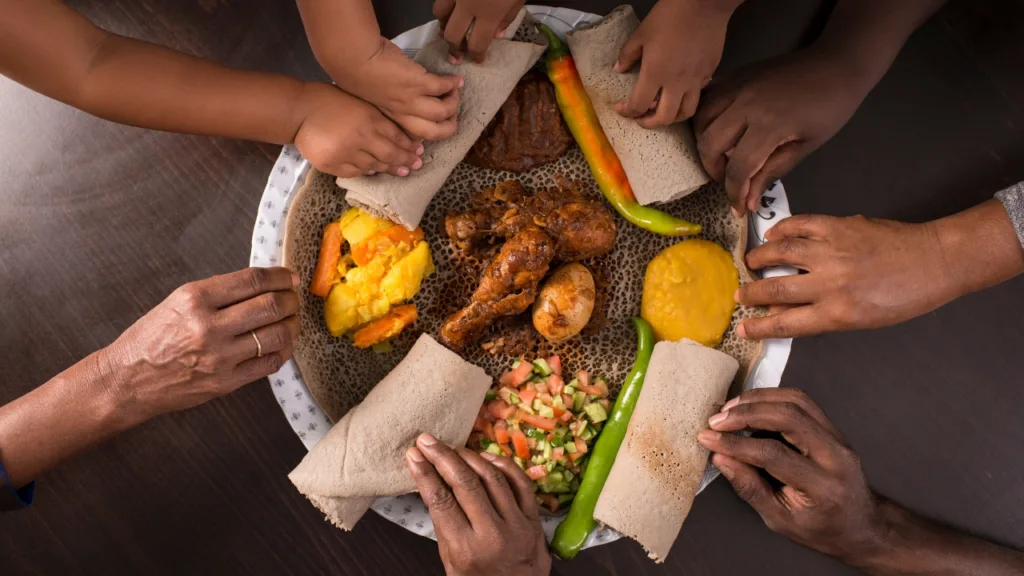
Injera
Injera is a soft, spongy flatbread eaten in Ethiopia and Eritrea.
Jollof Rice
Jollof rice is a popular rice dish in West Africa. It is usually cooked with tomatoes, onions, spices and sometimes meat or vegetables.
Mandazi
Mandazi is a sweet fried bread eaten in East Africa. It is sometimes called an East African doughnut.
Bunny Chow
Bunny chow is a South African street food from Durban. It is made with a hollowed-out loaf of bread filled with curry.
African History for Kids
Africa has a long and fascinating history. Long before modern countries existed, Africa had ancient civilizations, kingdoms, trade routes and cities.
Ancient Egypt
Ancient Egypt was one of the world’s great civilizations. It lasted for thousands of years and is famous for pyramids, pharaohs, temples, mummies, hieroglyphic writing and papyrus.
The ancient Egyptians used hieroglyphics, a writing system made of pictures and symbols. They also made paper-like sheets from papyrus plants. Their buildings and monuments still amaze people today.
Kingdom of Kush
The Kingdom of Kush was located in what is now Sudan. It was influenced by ancient Egypt but also had its own powerful rulers, culture and pyramids.
Kingdom of Ghana
The Kingdom of Ghana was in West Africa. It became rich through trade, especially gold and salt.
Mali Empire
The Mali Empire was one of the most famous empires in African history. Its ruler Mansa Musa is widely considered one of the wealthiest people in history. He ruled in the 1300s and became famous for his gold, power and pilgrimage to Mecca.
Great Zimbabwe
Great Zimbabwe was a powerful city in southern Africa. It is known for its impressive stone walls and ruins.
Colonization and Independence
In the late 1800s, European countries colonized much of Africa. They divided land without respecting many existing communities, cultures and borders. This period changed Africa’s history in many ways.
Many African countries gained independence during the 1950s and 1960s. Today, Africa’s countries are modern nations with their own governments, economies, cultures and identities.
In 1964, as many African countries were becoming independent, UNESCO began a huge project to write the history of Africa from an African point of view. More than 550 historians and experts worked on it over 60 years, and it now fills 11 volumes.
African Languages
Africa is one of the most language-rich places on Earth. Experts estimate that between 1,500 and 3,000 languages are spoken across the continent.
Some well-known African languages are Arabic, Swahili, Amharic, Hausa, Yoruba, Zulu, Somali, Igbo and Xhosa.
Many African children grow up speaking more than one language. They may use one language at home, another at school and another in their community.
African Kids’ Daily Life
African kids have many things in common with children around the world. They go to school, play games, help their families, enjoy music and spend time with friends.
In cities, children may travel to school by bus, car or on foot. In rural areas, some children may walk long distances to reach school. Some schools have large classes with many students.
Football, also called soccer, is one of the most popular sports for children in Africa. Africa has produced many world-famous footballers, including Mohamed Salah, Sadio Mané and Didier Drogba.
Children also enjoy games like jump rope, tag, hide-and-seek and storytelling games. In coastal areas, kids may swim or play near the ocean. In rural areas, some children help with chores like fetching water, helping in gardens or caring for animals.

Cool African Inventions and Discoveries
Africa has made many important contributions to science, mathematics, medicine and technology.
- The Ishango bone, found in the Democratic Republic of Congo, is over 20,000 years old and may show early mathematical thinking.
- Ancient Egyptians used geometry and engineering to build pyramids and temples.
- The Edwin Smith Papyrus from ancient Egypt describes medical treatments and surgical knowledge.
- The Nok culture in present-day Nigeria was known for early ironworking.
- The Lebombo bone from southern Africa has markings that some researchers believe may be linked to counting or tracking time.
Africa is still important in science today. Scientists study African wildlife, rainforests, deserts, fossils, climate, languages and ancient history.
African history in order
- Around 2560 BCE The Great Pyramid of Giza is completed in ancient Egypt.
- After Egypt The Kingdom of Kush rises in what is now Sudan, with its own rulers and its own pyramids.
- Later, in West Africa The Kingdom of Ghana grows rich through trade, especially in gold and salt.
- The 1300s Mansa Musa rules the Mali Empire and becomes famous for his gold and his pilgrimage to Mecca.
- In southern Africa Great Zimbabwe becomes a powerful city, known for its stone walls.
- The 1950s and 1960s Many African countries gain independence and become modern nations.
- 1964 UNESCO begins writing the history of Africa from an African point of view. It now fills 11 volumes.
Africa’s record-breakers
| Record | Where |
|---|---|
| Largest country | Algeria |
| Smallest country | Seychelles |
| Longest river | the Nile |
| Highest mountain | Mount Kilimanjaro, Tanzania, 5,895 m |
| Largest lake | Lake Victoria |
| Deepest lake | Lake Tanganyika |
| Largest hot desert | the Sahara |
| Biggest island | Madagascar, the fourth-largest island in the world |
Fun Facts About Africa
Here are some fun facts about Africa:
- Africa is the second largest continent in the world.
- Africa has 54 recognised countries.
- The Sahara is the largest hot desert in the world.
- The Nile River is usually described as the longest river in the world.
- Mount Kilimanjaro is the tallest mountain in Africa.
- Lake Victoria is the largest lake in Africa by area.
- Lake Tanganyika is the deepest lake in Africa.
- Madagascar is the fourth-largest island in the world.
- Many animals in Madagascar are found nowhere else on Earth.
- African elephants are the largest land animals.
- Giraffes are the tallest animals in the world.
- Cheetahs are the fastest land animals.
- African penguins live in South Africa and Namibia.
- The Pyramids of Giza are in Egypt.
- The Great Pyramid of Giza is the only surviving Wonder of the Ancient World.
- Victoria Falls is one of the world’s most famous waterfalls.
- Africa has rainforests, deserts, savannahs, mountains and lakes.
- Africa crosses the equator.
- Africa is found in all four hemispheres.
- More than 1.5 billion people live in Africa.
- Africa has thousands of languages.
- Swahili is widely spoken in East Africa.
- Arabic is widely spoken in North Africa.
- Jollof rice is a famous West African dish.
- Injera is a famous food in Ethiopia and Eritrea.
- The baobab tree can store large amounts of water in its trunk.
- Lions often live in groups called prides.
- Gorillas live in African forests.
- Hippos spend much of the day in water.
- Africa has some of the youngest populations in the world.
African Flags
Every African country has its own flag. A flag is like a symbol for a country. It can show history, nature, freedom, unity or hope.
Many African flags use colours such as green, red, yellow, black, white and blue.
Green often stands for land, farming, forests or hope. Red can stand for courage, strength or the sacrifices made during struggles for independence. Yellow or gold may stand for sunshine, minerals or wealth. Black can stand for African identity or people. Blue often stands for water, peace or the sky.
For example, Nigeria’s flag has green and white. Kenya’s flag uses black, red, green and white. South Africa’s flag has many colours and stands for unity after a difficult history.
Three things people get wrong
Africa is not a country. It is a continent of 54 countries, each with its own government, flag, languages and history. People from Kenya and people from Morocco are as different as people from Norway and Spain.
Africa is not all desert, or all jungle. The Sahara is huge, but Africa also has rainforests, grasslands, snowy mountain peaks, great lakes and long coastlines. The Equator runs through the middle, so the weather changes hugely from place to place.
Africa is bigger than it looks on most maps. Many world maps stretch the lands near the poles and shrink the lands near the Equator. On those maps Africa looks small, but it really covers about a fifth of all the land on Earth.
Did you know? Africa is a continent of 54 recognized countries, with many different landscapes, languages, governments and cultures.
Africa: fact or myth?
- Penguins live in Africa.
- Africa's coastline is longer than Europe's.
- Every zebra has the same pattern of stripes.
- Snow can fall on mountains in Africa.
- Between 1,500 and 3,000 languages are spoken across Africa.
- Nobody is sure where the name Africa comes from.
Try it
Find Africa on a map or globe. Label the Equator, the Sahara, the Nile and one country from each of Africa’s five regions.
Knowledge check
Which five regions does this guide use to organise African countries?
Show answer
North Africa, East Africa, West Africa, Central Africa and Southern Africa.
Why is it inaccurate to describe Africa as if it were one country?
Show answer
Africa is a continent of 54 recognized countries, with many different landscapes, languages, governments and cultures.
Frequently asked questions
What is Africa famous for?
Africa is famous for its wildlife, the pyramids of Egypt, the Sahara Desert, the River Nile, Mount Kilimanjaro, Victoria Falls, and its many cultures, languages, foods and music.
How many countries are in Africa?
The United Nations counts 54 countries in Africa, while the African Union has 55 member states. The largest African country by area is Algeria, and the smallest is the Seychelles.
How big is Africa?
Africa covers about 30.4 million square kilometres, about one-fifth of Earth’s land. It is the second-largest continent after Asia, stretching about 8,000 km from north to south.
What is the biggest desert in Africa?
The Sahara is the biggest desert in Africa and the largest hot desert in the world. It covers a huge area of North Africa.
What is the longest river in Africa?
The Nile is the longest river in Africa and is usually described as the longest river in the world. It flows through north-eastern Africa.
How many people live in Africa?
More than 1.5 billion people live in Africa. It has some of the youngest populations in the world.
Sources
- Encyclopaedia Britannica: Africa — its area, size, coastline, the Equator and the prime meridian, and where the name may come from
- United Nations Statistics Division: country and area codes (M49) — Africa’s countries and its five regions
- African Union: member states — the African Union’s 55 member states and five regions
- United Nations: World Population Prospects 2024 — Africa’s population
- UNESCO: General History of Africa — the 11-volume history project begun in 1964
Africa Final Challenge
- Which is the only continent bigger than Africa?
- Why is Africa in all four hemispheres?
- How many countries does the United Nations count in Africa?
- Which is the largest African country by area?
- What is a savannah?
- Which animal is the tallest in the world?
- Where are lemurs mainly found?
- What is injera?
- What is bunny chow?
- On many African flags, what does green often stand for?