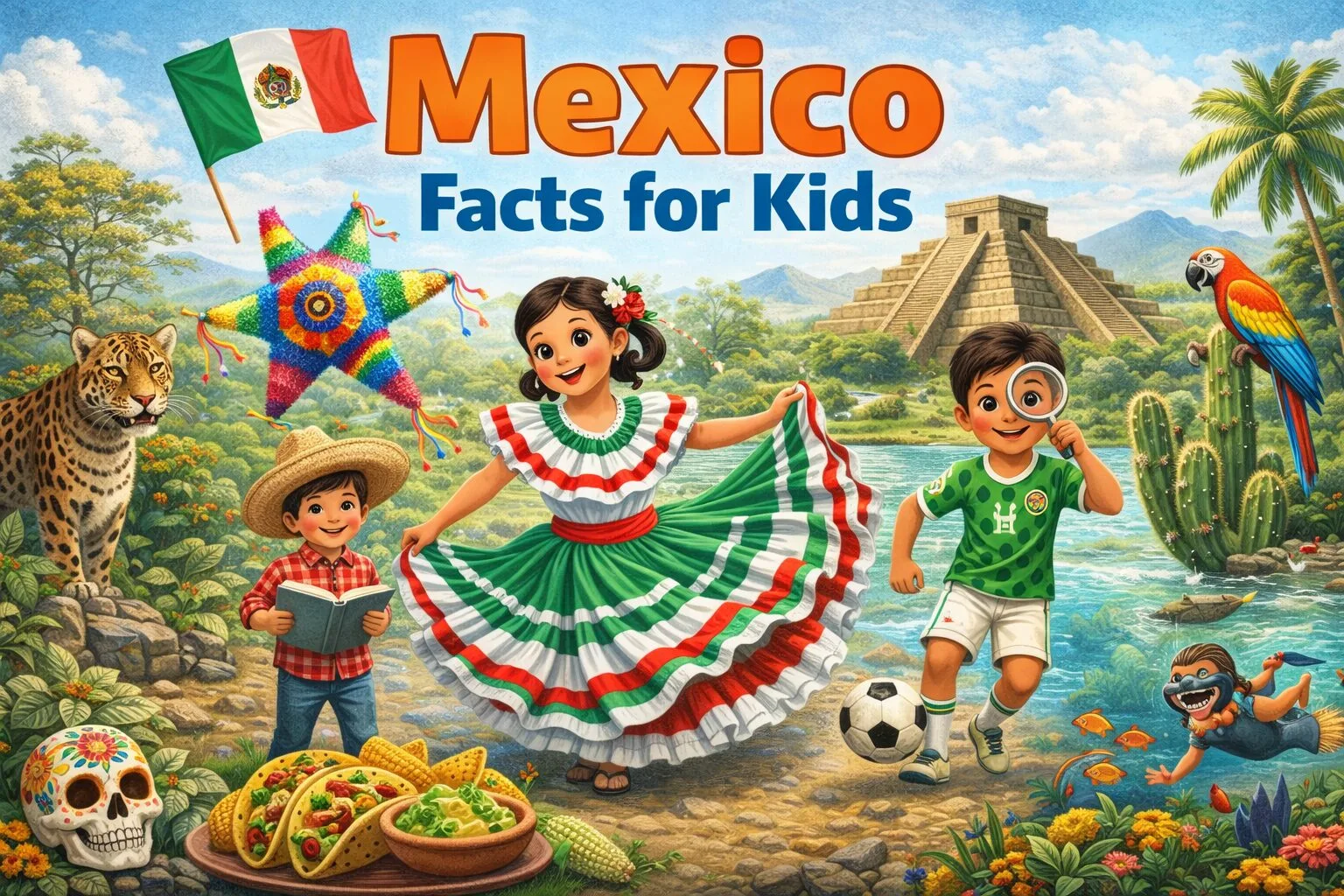
Mexico is a country in North America, south of the United States, with about 130 million people. Its capital is Mexico City, built on the site of the Aztec city of Tenochtitlan. Almost everyone speaks Spanish, but Mexico has no single official language: it recognises 68 indigenous languages as national languages. Chocolate, maize, tomatoes, chillies and vanilla all come from this part of the world.
Mexico quick facts
- Mexico is in North America, not South America, and shares its northern border with the United States.
- Mexico’s 2020 census counted 126.0 million people. Today the estimate is around 130 million.
- Mexico recognises 68 indigenous languages as national languages alongside Spanish.
- Cinco de Mayo is not Independence Day. Mexico celebrates independence on 16 September.
- The axolotl, a salamander that never grows up, lives wild only in the canals of Xochimilco.
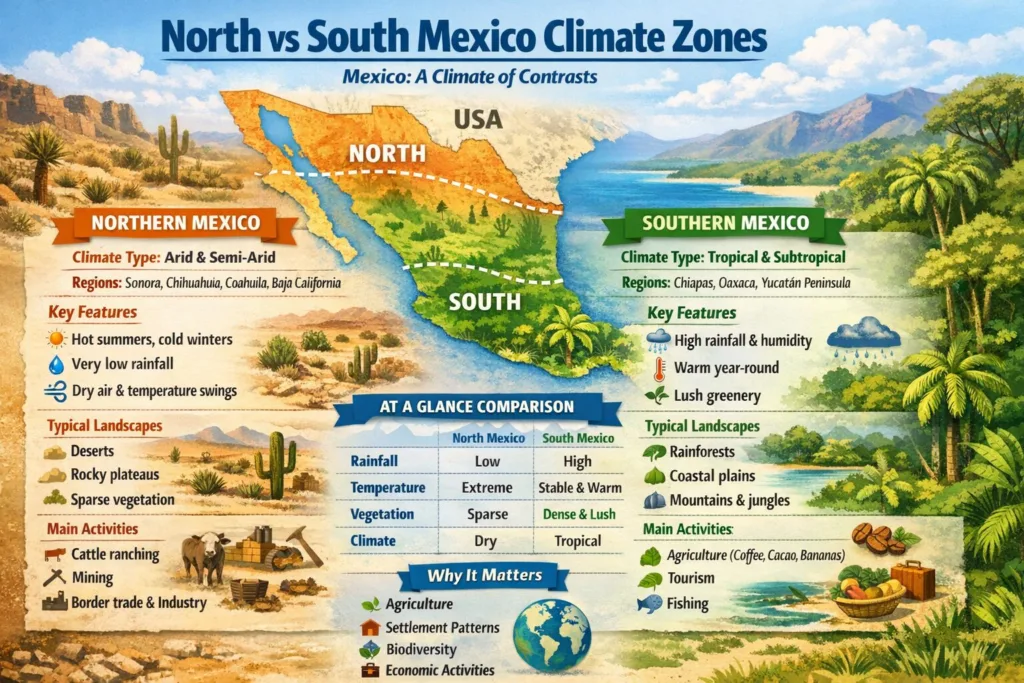
Mexico is a country of about 130 million people. It sits at the southern end of North America, just below the United States.
It is also the birthplace of chocolate, chilli, maize and vanilla. If you have ever eaten any of those, you have tasted something Mexico gave the world.
Mexico fact file
- Capital city
- Mexico City, built on the site of the Aztec city of Tenochtitlan
- Population
- 126.0 million at the 2020 census, about 130 million today
- Languages spoken
- Almost everyone speaks Spanish, but Mexico has no single official language: it recognises 68 indigenous languages
- Currency
- Mexican peso
- Continent
- North America, not South America
- Bordering countries
- The United States to the north, and Guatemala and Belize to the south
- Famous landmark
- Chichén Itzá, the Maya city, and the ancient city of Teotihuacan
- Flag
- Three stripes, green, white and red, with an eagle perched on a cactus in the middle
And a few things no report form asks for:
| Official name | United Mexican States (Estados Unidos Mexicanos) |
| Area | about 1,964,000 km² |
| Highest point | Pico de Orizaba, 5,636 m |
| States | 31 states, plus Mexico City |
What language do people speak?
Almost everyone in Mexico speaks Spanish. Here is the surprising part. Spanish is not an official language of Mexico at the national level.
Mexico does not name one official language. Instead it names 68 native languages as national languages too. They include Nahuatl, Maya and Zapotec.
Nahuatl was the language of the Aztec people. Several English words come from it, including chocolate, tomato, avocado and coyote.
Ancient cities and empires
People built great cities in Mexico long before Europeans arrived. The best known are the Maya and the Aztec, but they were not the first.
That honour goes to the Olmec, Mexico’s first complex society. They appeared in the south-east of the country around 1200 BC. After them came the Maya, the Toltec and the Aztec, who built great cities, huge pyramids and remarkable works of art.
The Maya lived in southern Mexico and Central America. They built stone cities such as Chichén Itzá. They also had their own writing and a detailed calendar.
The Aztec empire came later. Its capital, Tenochtitlan, was built on an island in a lake. Mexico City stands on that same spot today, which is why parts of the city are slowly sinking.
Spain took control in 1521. Mexico began its fight for independence in 1810 and became independent in 1821.
The eagle on the flag
Mexico’s flag has three stripes, green, white and red, with a picture in the middle: an eagle perched on a cactus, eating a snake.
The picture comes from an Aztec legend. The Aztec people were to settle where they found an eagle on a cactus devouring a snake. The story says they saw it on an island in a lake, and there they built Tenochtitlan, the city that became Mexico City.
The Cinco de Mayo mix-up
This one catches out a lot of people, so it is worth getting right.
Mexico’s story in order
- Around 1200 BC The Olmec appear in the south-east: Mexico's first complex society.
- After the Olmec The Maya build stone cities such as Chichen Itza, with their own writing and calendar.
- Later still The Aztec build their capital, Tenochtitlan, on an island in a lake.
- 1521 Spain takes control.
- 1810 Mexico begins its fight for independence.
- 1821 Mexico becomes independent.
Cinco de Mayo is not Mexican Independence Day. It marks the Battle of Puebla in 1862, when a smaller Mexican army beat French troops.
Mexican Independence Day is 16 September. It remembers the night in 1810 when a priest called Miguel Hidalgo rang his church bell and called for freedom.
Cinco de Mayo is a fairly small holiday in most of Mexico. It is celebrated far more widely in the United States.
Where the dinosaurs’ asteroid landed
More than 65 million years ago, a giant rock from space, more than 10 km wide, crashed into the tip of what is now Mexico’s Yucatán Peninsula.
It left a crater about 200 km across, centred on Puerto Chicxulub, near the city of Mérida. That is why scientists call it the Chicxulub crater (say CHEEK-shoo-loob).
The crash threw huge amounts of dust and gas into the sky. The dust blocked out sunlight, so plants struggled to grow and food chains collapsed. The dinosaurs died out, along with more than half of all the plants and animals on land and in the oceans.
Wildlife you will not find anywhere else
Mexico is one of the most wildlife-rich countries on Earth. Two creatures stand out.
The axolotl is a salamander that never grows up. It keeps its feathery gills for life. It can even regrow lost body parts. In the wild it lives only in the canals of Xochimilco, near Mexico City. Very few are left.
Every autumn, millions of monarch butterflies fly south from Canada and the United States. They gather in fir forests in central Mexico. So many land together that the branches bend under their weight.
Mexico is also home to the vaquita, the most endangered sea mammal in the world. It is a small, shy porpoise, about 1.5 metres long, and it lives only in the northern Gulf of California. NOAA Fisheries says the vaquita now numbers as few as ten animals. Most were drowned in illegal fishing nets set for a large fish called the totoaba.
Every winter, gray whales swim down the Pacific coast to Mexico. Their round trip is about 16,000 km, one of the longest journeys of any mammal. From early January to mid-February, mothers give birth in Mexico’s shallow lagoons and bays. A newborn calf is already about 4.5 metres long.
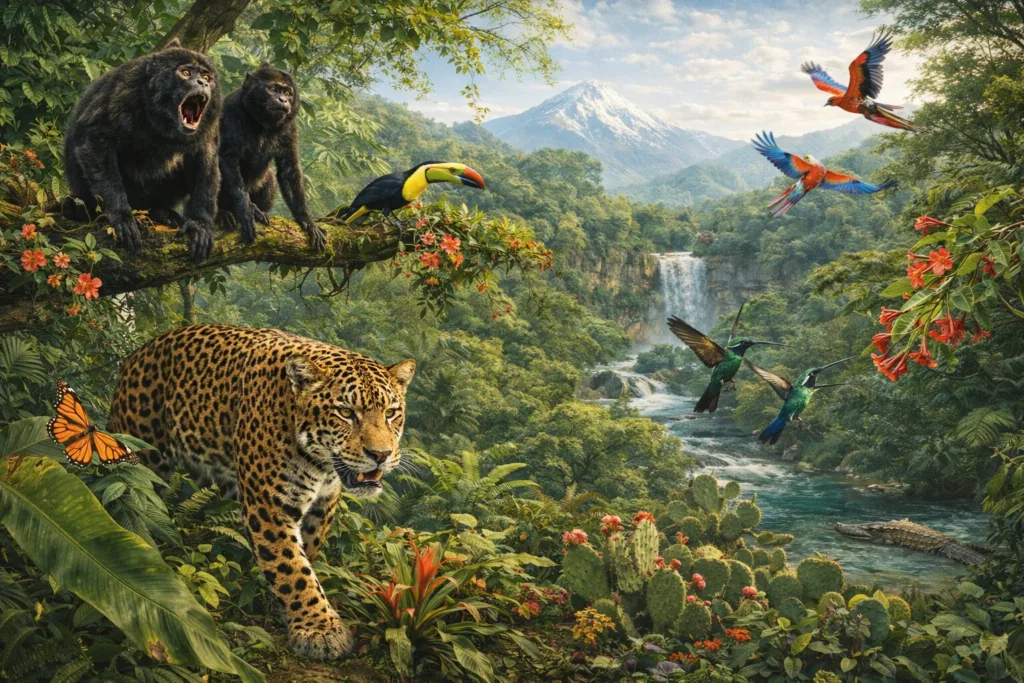
Jaguars prowl its forests, and in the south lives the quetzal, a bird with long, shimmering green tail feathers. Few countries on Earth have as many kinds of plants and animals as Mexico.
Food Mexico gave the world
Many everyday foods were first grown in Mexico and nearby lands. Maize, tomatoes, chilli peppers, avocados, vanilla and cacao all began here.
Cacao beans become chocolate. The Maya and the Aztec drank it as a bitter, spiced drink, not a sweet one. They also used the beans as money.
Traditional Mexican cooking is protected by UNESCO. It is on the list of the world’s living cultural treasures.
Animals of Mexico
- The axolotl — a salamander that never grows up and can regrow lost body parts
- The vaquita — the most endangered sea mammal in the world
- The monarch butterfly — arrives in millions each autumn and weighs down the fir branches
- The gray whale — swims about 16,000 km a year and gives birth in shallow lagoons
- The quetzal — a bird with long, shimmering green tail feathers
- The jaguar — the big cat that prowls Mexico's forests
36 World Heritage Sites
UNESCO has named 36 places in Mexico as World Heritage Sites. 28 are cultural sites, 6 are natural and 2 are both.
They include the Maya city of Chichén Itzá, the ancient city of Teotihuacan, the old centre of Mexico City with the canals of Xochimilco, and the Monarch Butterfly Biosphere Reserve, where the butterflies spend the winter. The whale sanctuary of El Vizcaíno, where gray whales raise their calves, is on the list too.
Some are surprising. The blue agave fields and old distilleries of Tequila are on the list, and so is the main university campus in Mexico City. The newest, added in 2025, is the Wixárika Route, a path through sacred sites of the Wixárika people.
Day of the Dead
Día de Muertos takes place on 1 and 2 November. Families remember relatives who have died.
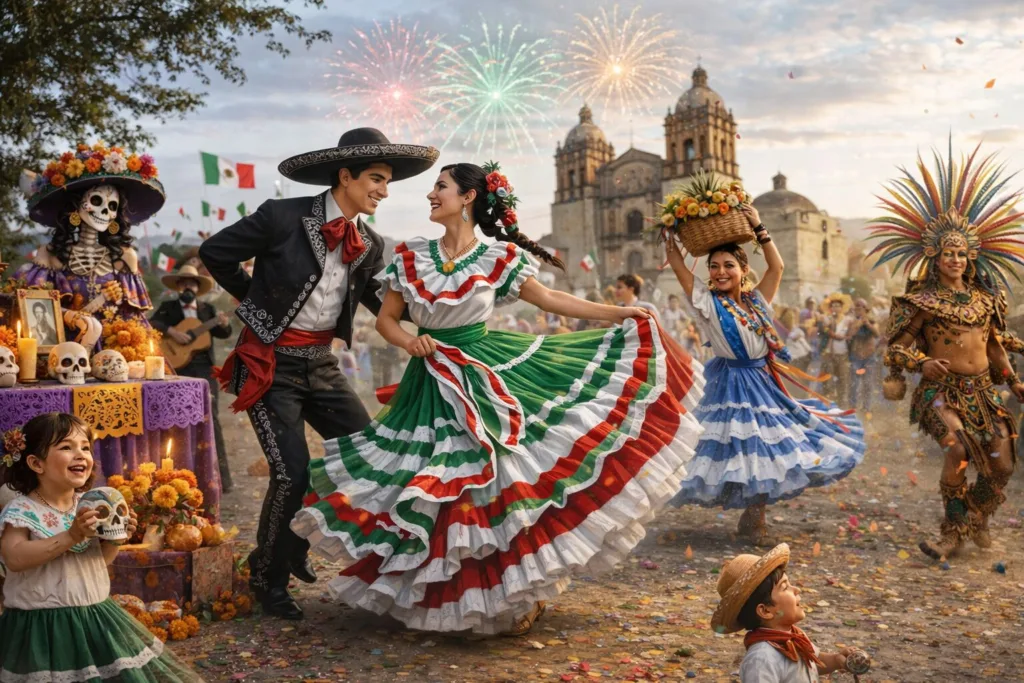
They build small altars at home. On them go photos, marigold flowers, candles and the foods that person loved. It is a warm, colourful day rather than a sad one.
UNESCO lists Day of the Dead as part of the world’s cultural heritage.
Numbers and places
- 5,636 m — the height of Pico de Orizaba, Mexico's highest point
- About 200 km across — the size of the Chicxulub crater
- About 1.96 million square kilometres — the area of Mexico, the 13th largest country in the world
- 36 — Mexico's UNESCO World Heritage Sites
- Tenochtitlan — the Aztec capital that Mexico City now stands on
- Teotihuacan — an ancient city on the World Heritage list
If you enjoyed this, try our guides to Colorado, Antarctica and ecosystems.
Did you know? The Aztec and the Maya used cacao beans as money. A single bean could buy a piece of fruit, and about a hundred beans could buy a turkey. So for a while, chocolate really did grow on trees.
Try it
Four English words came to us from Nahuatl, the Aztec language: chocolate, tomato, avocado and coyote. Say each one slowly and listen for the “tl” sound at the end of the original words — xocolatl, tomatl, ahuacatl, coyotl.
Knowledge check
Is Cinco de Mayo Mexico’s Independence Day?
Show answer
No. It marks the Battle of Puebla in 1862. A smaller Mexican army beat French troops that day. Mexican Independence Day is 16 September. It remembers the call for freedom made in 1810.
Mexico: fact or myth?
- Mexico is in South America.
- The Maya and the Aztec drank chocolate as a bitter, spiced drink.
- The whole of Mexico is desert.
- Parts of Mexico City are slowly sinking.
- The axolotl eventually grows into an ordinary adult salamander.
- Traditional Mexican cooking is protected by UNESCO.
What is unusual about Mexico’s official language?
Show answer
Mexico does not have one. Almost everyone speaks Spanish. But the country also names 68 native languages as national languages, such as Nahuatl, Maya and Zapotec.
Frequently asked questions
Where is Mexico?
Mexico is in North America. It sits directly south of the United States. To its own south are Guatemala and Belize. The Pacific Ocean lies to the west. The Gulf of Mexico lies to the east. People often place Mexico in South America by mistake.
What is the capital of Mexico?
Mexico City. It stands on the site of Tenochtitlan, the Aztec capital. That city was built on an island in a lake. The ground below is soft old lakebed, so parts of Mexico City are slowly sinking.
What language do people speak in Mexico?
Almost everyone speaks Spanish. But Mexico has no single official language. It names 68 native languages as national languages too. These include Nahuatl, Maya and Zapotec.
Why is Cinco de Mayo celebrated?
Cinco de Mayo marks the Battle of Puebla on 5 May 1862. A smaller Mexican army beat French troops that day. It is not Mexican Independence Day, which falls on 16 September. In most of Mexico it is a small holiday. It is much bigger in the United States.
What animals live only in Mexico?
The axolotl is the most famous one. It is a salamander that never grows up. It keeps its feathery gills for life and can regrow lost body parts. In the wild it lives only in the canals of Xochimilco. Very few are left.
What food comes from Mexico?
Maize, tomatoes, chilli peppers, avocados, vanilla and cacao all began here. Cacao beans are used to make chocolate. The Maya and Aztec drank it as a bitter, spiced drink, not a sweet one.
What is on the Mexican flag?
Mexico’s flag has green, white and red stripes with an eagle perched on a cactus eating a snake. The picture comes from an Aztec legend about where their people should settle, the place where they built Tenochtitlan, now Mexico City.
Did the dinosaur asteroid hit Mexico?
Yes. More than 65 million years ago an asteroid more than 10 km wide struck the tip of Mexico’s Yucatán Peninsula, leaving the Chicxulub crater, about 200 km across. The dust it threw up blocked sunlight, and the dinosaurs died out.
How many World Heritage Sites does Mexico have?
Mexico has 36 UNESCO World Heritage Sites: 28 cultural, 6 natural and 2 mixed. They include Chichén Itzá, Teotihuacan, the historic centre of Mexico City and Xochimilco, and the Monarch Butterfly Biosphere Reserve.
What is a vaquita?
The vaquita is a small, shy porpoise about 1.5 metres long that lives only in the northern Gulf of California in Mexico. It is the most endangered sea mammal in the world, and NOAA Fisheries says as few as ten are left.
Sources
- Britannica: Mexico — geography, population, government and the independence timeline.
- INEGI, Mexico’s national statistics institute — the 2020 census population of 126,014,024.
- UNESCO: traditional Mexican cuisine — its listing as intangible cultural heritage.
- Britannica: axolotl — how the axolotl keeps its larval features and where it survives in the wild.
- WWF: monarch butterfly — the autumn migration to the fir forests of central Mexico.
- National Geographic Kids: Mexico — Mexico’s landscape, wildlife, the Olmec and later civilisations, and the flag’s legend
- NOAA Fisheries: vaquita — the vaquita’s size, range, numbers and the gillnets that threaten it
- NOAA Fisheries: gray whale — the gray whale migration and calving in Mexico’s lagoons
- NASA: deep impact and the mass extinction of species — the Chicxulub impact, its crater and its effects
- UNESCO World Heritage Centre: Mexico — Mexico’s 36 World Heritage Sites
Mexico Final Challenge
- What is the capital of Mexico?
- Which ocean lies to the west of Mexico?
- Which people were Mexico's first complex society?
- What is shown in the middle of the Mexican flag?
- Which of these foods first came from Mexico and nearby lands?
- How wide was the asteroid that hit the Yucatan Peninsula?
- What happened after that asteroid struck?
- When is Day of the Dead?
- What do families put on their Day of the Dead altars?
- Where do monarch butterflies spend the winter?