Saber-Toothed Cats quick facts
- Smilodon was not a tiger and was not closely related to one. Scientists call it the saber-toothed cat.
- Its canine teeth reached about 28 cm, but its bite was roughly a third as strong as a lion’s.
- It could open its jaws to about 120 degrees, compared with about 65 degrees for a lion.
- Over 166,000 Smilodon bones, from around 3,000 cats, have come out of the La Brea Tar Pits.
- It went extinct about 10,000 years ago, as the last ice age ended.
Start with the most useful fact about the saber-toothed tiger: it was not a tiger. It was not especially closely related to one either. Tigers and Smilodon both belong to the cat family, but they sit on branches that split apart millions of years ago, and the last saber-tooths died out before anybody alive today could have seen one.
Scientists usually call it the saber-toothed cat for exactly that reason, and the Natural History Museum has written about why Smilodon was not a tiger. If you are writing a school project, opening with that distinction will get you off to a very good start.
What was Smilodon?
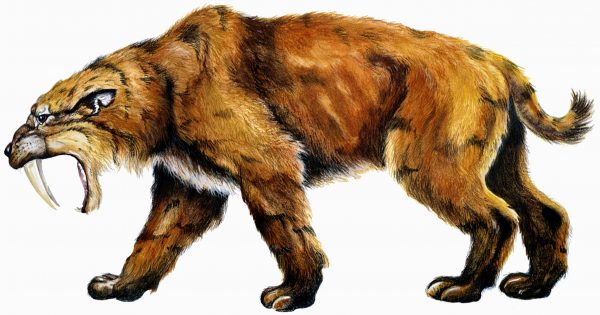
Smilodon was a heavily built cat that lived in North and South America and went extinct around 10,000 years ago. The best-known species, Smilodon fatalis, is the one found in enormous numbers at the La Brea Tar Pits in Los Angeles.
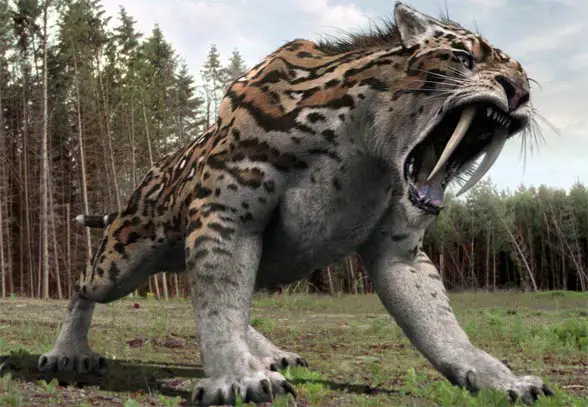
Picture something the weight of a lion but shaped completely differently: shorter in the back legs, immensely thick through the neck, chest and shoulders, and finished with a pair of curved canine teeth up to 28 centimetres long. It was not built to run. It was built to grab, and to hold on. The University of California Museum of Paleontology explains clearly why it is not a tiger.
Those teeth
The canines are the whole point of the animal, and they present a puzzle. They were long, flattened side to side, and had fine serrations like a steak knife. They were also surprisingly fragile. A tooth that long snaps if it twists against bone.
This is why the popular image of Smilodon biting through a mammoth’s skull is wrong. Its bite was actually weaker than a modern lion’s, roughly a third of the force. What it had instead was an enormous gape: it could open its jaws to around 120 degrees, where a lion manages about 65.
So the likely method was this. Wrestle the prey to the ground using those massive forelimbs, hold it completely still, then place a single precise bite into the soft throat or belly where there is no bone to break a tooth against. Power came from the arms. The teeth were the finishing blow, not the weapon.
How big was it?
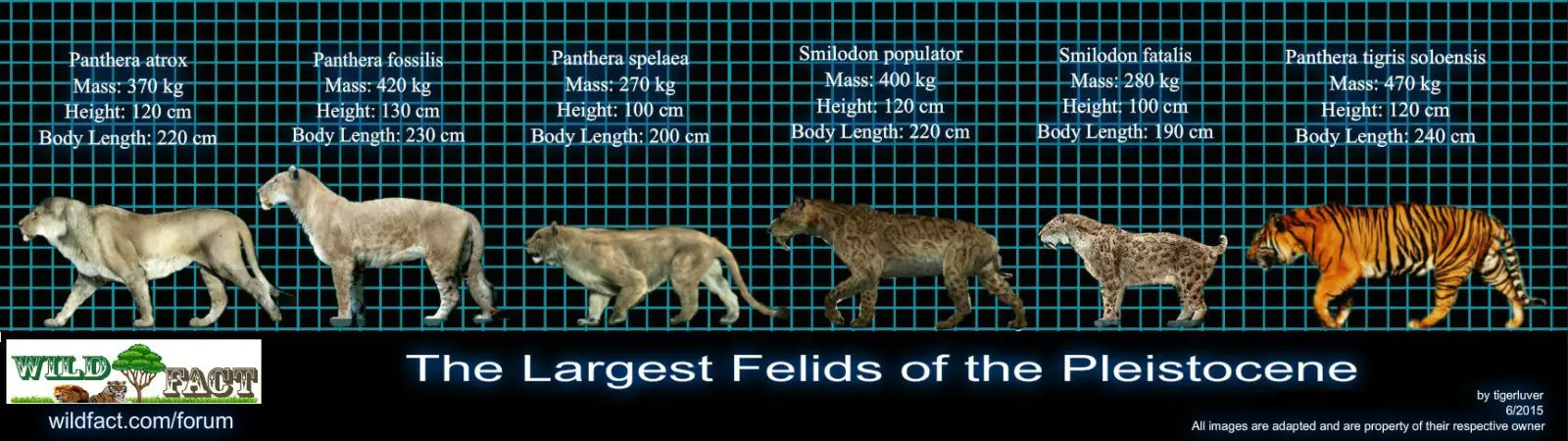
Smilodon fatalis weighed roughly 160 to 280 kg, which puts it in the same range as a large African lion but far more solidly built. The South American species Smilodon populator was bigger still, possibly over 400 kg, making it one of the largest cats that has ever lived.
It was not tall. It stood around a metre at the shoulder, lower at the back than a lion, with a short bobbed tail. If you met one it would look less like a big cat and more like a bear that had been redesigned by somebody who really liked teeth. There is more detail in our guide to Saber Tooth Tiger size.
Where did it live?
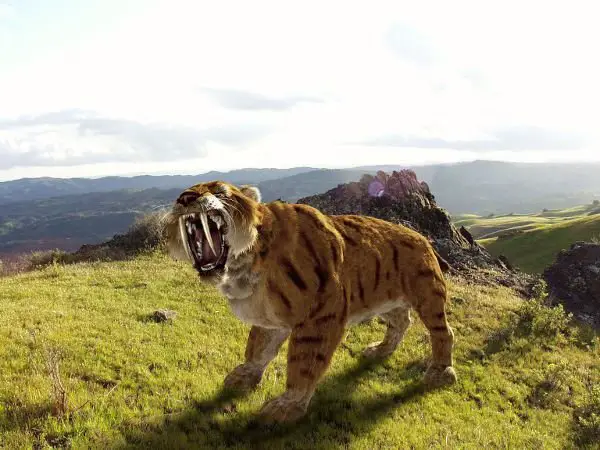
Across the Americas, from western North America down into Argentina and Chile, in a mixture of open grassland, scrub and woodland. It preferred country with enough cover to ambush from, because a heavy, short-legged cat cannot chase anything down over open ground.
Our page on Saber Tooth Tiger Habitat covers this in more detail.
What did it eat?

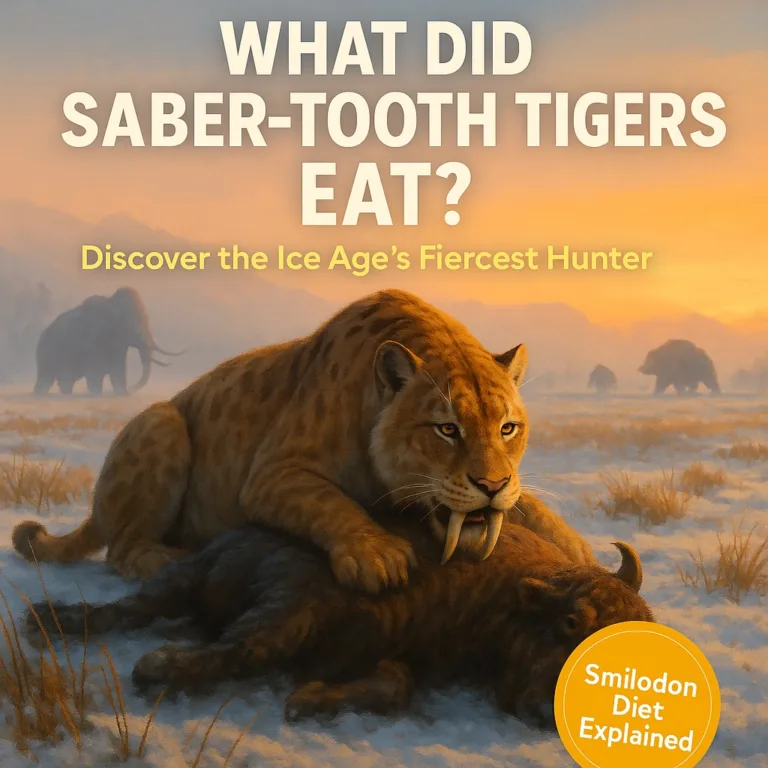
Large, slow, heavy animals: bison, ancient horses, camels, ground sloths, and young mammoths and mastodons. Chemical analysis of the bones shows the North American ones mostly hunted animals from forest and woodland edges rather than open plains.
It almost certainly did not eat people. Smilodon lived alongside humans in the Americas for a while at the very end, but there is no good evidence of it hunting them. Our guide covers what saber-toothed cats ate in more depth.
Did they live in groups?
This is one of the liveliest arguments in palaeontology, and it is worth including in a project because it shows how scientists actually work.
Many La Brea Smilodon skeletons show serious injuries, badly broken hips, damaged spines, that healed. An animal with a shattered hip cannot hunt. For it to survive long enough for the bone to knit, something must have been feeding it, which suggests these cats lived in groups and shared food, rather like lions.
The counter-argument is that the tar pits themselves may distort the picture. A trapped, struggling animal attracts predators, which then get stuck too, so the pits may simply over-collect cats that came alone. Both readings are defensible, and honest scientists say so.
The La Brea Tar Pits
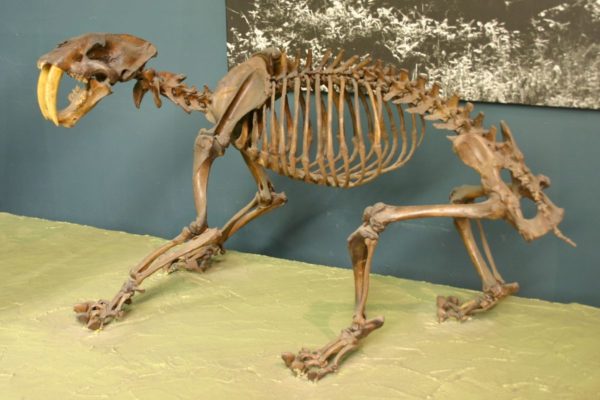
Almost everything we know about Smilodon fatalis comes from one place: a set of natural asphalt seeps in the middle of Los Angeles, next to a busy road.
For tens of thousands of years, sticky asphalt welled up and was hidden by dust and leaves. An animal walked in, could not pull free, and its distress attracted predators, which also became trapped. The result is over 166,000 Smilodon bones from an estimated 3,000 individual cats, and excavation is still going on today.
Smilodon fatalis is the official state fossil of California, and you can read the Natural History Museum’s overview of saber-toothed cats or the National Park Service on the big cats.
Why did it die out?
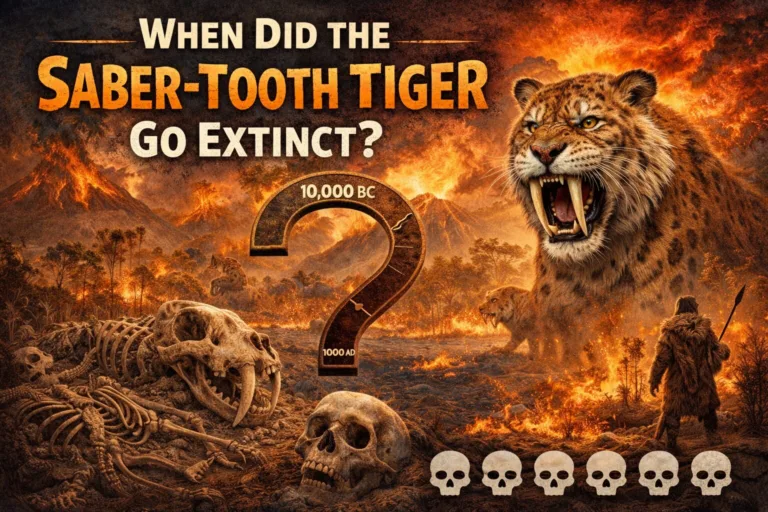
Around 10,000 years ago, at the end of the last ice age, most of the large mammals of the Americas disappeared. Smilodon went with them. Two things were happening at once and scientists still argue over which mattered more.
The climate warmed sharply, changing grassland into forest and shifting where prey animals could live. At the same time, humans spread across the Americas and hunted many of those same large animals.
A specialist like Smilodon was in real trouble either way. It was built for one job, ambushing big heavy prey, so when the big heavy prey vanished it had no fallback. A leopard can live on anything from a beetle to an antelope. A saber-tooth could not. Our guide explains why the Saber Tooth Tiger went extinct in more detail.
Six things people get wrong
- “It was a tiger.” It was not, and it was not closely related to one. “Saber-toothed cat” is the accurate term.
- “It had a crushing bite.” Its bite was about a third as strong as a lion’s. Its strength was in its forelimbs.
- “It hunted dinosaurs.” Around 55 million years separate the last dinosaurs from the first Smilodon.
- “It could not close its mouth.” It could. The lips covered the canines when the jaw was shut.
- “Saber teeth evolved once.” They evolved several separate times in different animals, including in marsupial relatives in South America. That is called convergent evolution.
- “It was killed off by the ice age.” It died out as the ice age ended and the world warmed.
Using this for a school project
If you want a project that stands out, do not just list facts. Pick one of the genuine arguments and lay out both sides: did Smilodon live in groups or alone? Was it climate or humans that finished it off? Showing that scientists disagree, and explaining why, is worth far more than a page of statistics.
More detail on each topic: How big was a Saber Tooth Tiger, Saber Tooth Tiger Diet, Saber-toothed tiger life cycle and Saber-toothed tiger vs lion.
The three kinds of Smilodon
Smilodon is not one animal. Scientists usually recognise three species, and they were not the same size at all.
| Species | Where | Weight |
|---|---|---|
| Smilodon gracilis | North America | about 55–100 kg |
| Smilodon fatalis | North and South America | about 160–280 kg |
| Smilodon populator | South America | up to about 400 kg |
S. gracilis came first and was the smallest. S. fatalis is the one found in huge numbers at La Brea, and it is the animal most people picture.
S. populator lived in South America and was the giant of the three. At around 400 kg it may have been the heaviest cat that has ever lived, bigger than any tiger or lion alive today.
Cubs and growing up
A Smilodon cub was not born with the famous teeth. It grew a set of milk canines first, exactly as a kitten does.
The adult sabres pushed through later and grew slowly, at roughly 6 millimetres a month. For a while a young cat carried both sets at once, the milk tooth sitting alongside the growing sabre.
The sabres were not fully grown until the cat was around three years old. That is a long time to be carrying a weapon you cannot yet use properly, which suggests cubs stayed with their mother well past the age when a lion cub would be hunting.
Cub bones turn up at La Brea too, so we can watch that whole process in the fossils.
Frequently asked questions
Was the saber-toothed tiger really a tiger?
No. It was a cat, but not a tiger and not closely related to one. Tigers and Smilodon sit on branches of the cat family that split apart millions of years ago. Scientists call it the saber-toothed cat.
How long were a saber-toothed tiger’s teeth?
Up to about 28 centimetres, roughly the length of a school ruler. A good part of that length was rooted inside the skull, so less of it showed than you might expect.
How big was a saber-toothed tiger?
It depends which species. Smilodon gracilis weighed about 55 to 100 kilograms, Smilodon fatalis about 160 to 280 kilograms, and Smilodon populator reached around 400 kilograms. That makes S. populator possibly the heaviest cat that has ever lived.
When did saber-toothed cats go extinct?
About 10,000 years ago, at the end of the last ice age, along with most other large American mammals. The likely causes were a changing climate and the loss of the big prey animals it depended on.
Did humans ever see a saber-toothed tiger?
Yes. People had already reached the Americas before Smilodon died out, so humans and saber-toothed cats overlapped for a time.
Where did saber-toothed tigers live?
Only in the Americas, across both North and South America. They never lived in Africa, Asia or Europe, so they never met a lion or a tiger in the wild.
Could a saber-toothed cat beat a lion?
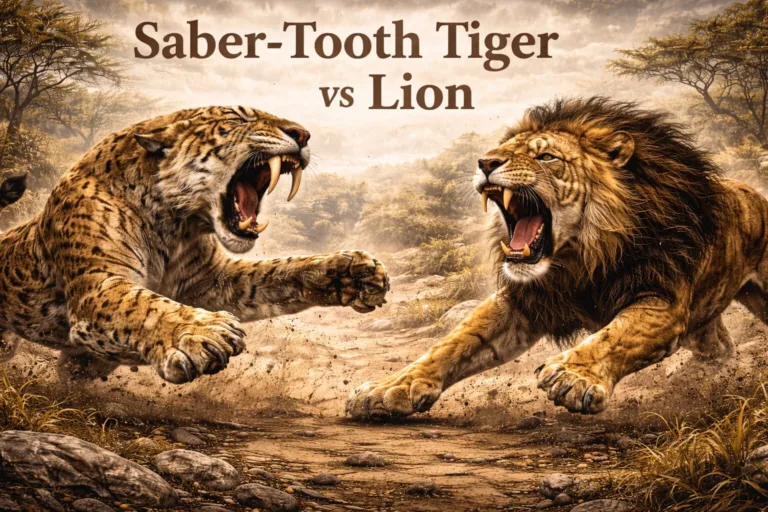
They never met, because they lived on different continents at different times. Smilodon was heavier and far stronger in the forelimbs, while a lion is faster and bites harder.
Did you know? Saber teeth are not a one-off. Long stabbing canines evolved separately several times in different animals, including in marsupial relatives in South America that were not cats at all. Scientists call that convergent evolution.
Try it
Measure 28 cm on a ruler to see how long a Smilodon canine was. Then open your own jaw as wide as it goes and compare it with the 120 degrees Smilodon managed.
Knowledge check
Was the saber-toothed tiger actually a tiger?
Show answer
No. It was a cat called Smilodon, but only distantly related to tigers. The accurate name is saber-toothed cat.
If its bite was weak, how did Smilodon kill large prey?
Show answer
It used its very powerful forelimbs to wrestle prey to the ground and hold it still, then delivered one precise bite to the soft throat or belly, where there was no bone to snap its long, fragile teeth.
Sources
- La Brea Tar Pits and Museum — the fossil collection and ongoing excavation.
- Natural History Museum of Los Angeles County: saber-toothed cats — biology and behaviour.
- Natural History Museum: why Smilodon was not a tiger — the naming and classification.
- UC Museum of Paleontology: sabretooth cats — how Smilodon relates to living cats.
- US National Park Service: the big cats — background on Ice Age predators.