California is an amazing state. It has both the highest (Mount Whitney) and the lowest point (Badwater, Death Valley)in the United States. The largest living thing in the world, Sequoiadendron giganteum (the giant Sequoia tree) is in California. The oldest living thing on earth alive today, the Pinus longaeva (Bristlecone Pine) is also in California. We have gathered a complete set of California Facts For Kids that will help you in learning all about California. You are going to learn California information about its name, nicknames, regions, geography, climate, history, statistics, culture, food, state symbols, economy, state government, and many interesting California facts for kids.
Geography quick facts
- It has both the highest (Mount Whitney) and the lowest point (Badwater, Death Valley)in the United States.
- The largest living thing in the world, Sequoiadendron giganteum (the giant Sequoia tree) is in California.
- The oldest living thing on earth alive today, the Pinus longaeva (Bristlecone Pine) is also in California.
- California is a state in the USA located in the Pacific region and with the Mexican border on the other side.
California Facts For Kids
1. What Is California – California Description
- California is a state in the USA located in the Pacific region and with the Mexican border on the other side.
- By population, it is the largest state in the US while by area, it is the third-largest state of the US.
- Of all the American states, California has the largest economy of $2.9 trillion and is the world’s greatest sub-national economy.
- The economy of California is even greater than the economies of well-known developed countries like the United Kingdom, France, and India.
2. What Is Ca – California State Name
- There are several shortened forms of the name of California, like “CA”, “Calif”, “Cal”, and “US-CA”.
3. How Did The State Of California Get Its Name
- The origin of the word “California” is a fictional tale of ‘Queen Calafia’ in the Spanish chivalric romance novel by Garci Rodriguez de Montalvo, in which “California” was a mythical island.
- The novel was written in 1510 and the story of Queen Calafia was recorded in the fifth book of the novel series named “Las Sergas de Esplandian”.
- In the story, the kingdom of Queen Calafia was described as a prosperous, inaccessible far away land in the ocean.
- Pretty black women were the inhabitants of the land who wore armor of gold and had a lifestyle like Amazons.
- In the story, the emperor Queen Calafia fought beside Muslims, and her name may have been selected as a matching call to the Muslim leader’s title “the Caliph”.
- Probably, the name “California” was meant to indicate the island was a Caliphate.
4. What Is California’s Nickname
- The nickname of California state is “The Golden State”.
- This nickname was officially assigned to it in 1968.
- There are more than 10 other nicknames of California state which are:
- Grape State
- Golden West
- The Land of Sunshine and Opportunity
- El Dorado State
- The Land of Fruits and Nuts
- The Land of Milk and Honey
- Where states are buried
- The Sunshine State
- The Eureka State
- The Cereal Bowl of the Nation
- The Bear State
5. Why Is California Called The Golden State – How Did California Get Its Nickname
- California is called “The Golden State” due to several reasons, some of which are:
- The rush of mineral gold in the state was discovered in 1848 and mined on a large scale.
- In every spring, golden poppies bloom in the wild fields everywhere in the state. Since 1903, the golden poppy is the official flower of the California state.
- When the sun sets every day over the Pacific Ocean in California, the ocean looks golden in color.
- The Golden Gate Bridge, which is one of the state’s famous landmarks, is also one of the reasons why California is called the golden state.
- The color of gold is also one of the official colors of the California state.

6. California State Zip Code
- There are 2589 zip codes that California state covers.
- The zip codes of California City are:
- 93501
- 93504
- 93505
7. Where Is California Located – What Region Is California Located In
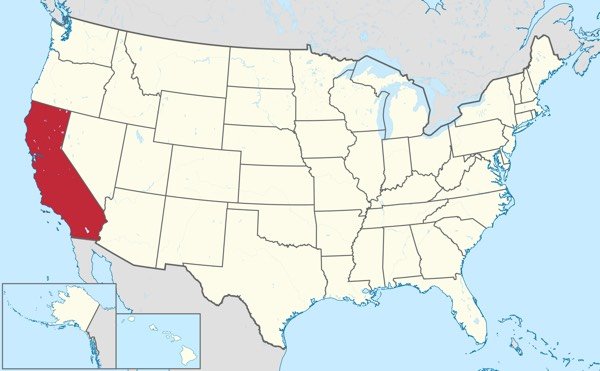
- California is located in the western part of the United States.
- It is located along with the Arizona, Nevada, Oregon states of the USA, the Mexican state Baja California, and the Pacific Ocean.
8. California Regions
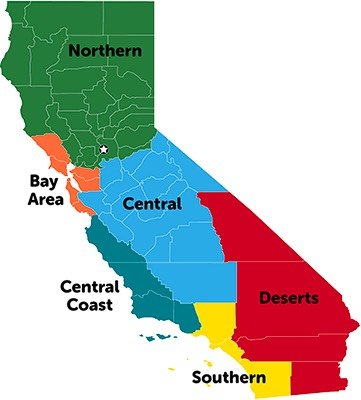
- California state has 58 counties that are comprised of 482 municipalities. However, the state is mainly divided into two regions:
 Northern California, and
 - Southern California
 Northern California, and
 - Both the regions are further divided into several regions. That is:
- Northern California
- Central California
- North Coast
- San Francisco Bay Area
- Sierra Nevada
- Shasta Cascade
- Surprise Valley
- Southern California
- Central Coast
- South Coast
- Desert Region
- Northern California
9. What States Border California – What States Are Close To California
- On the east side, California is bordered by the Arizona and Nevada states, at the north side by the Oregon state, at the south side by the Baja California state of Mexico, and at the west side by the Pacific Ocean.
10. What Is The Area Of The State Of California
- The area of California state is 423,970 km² (163,696 square miles).
11. When Did California Became A State – What Year Did California Became A State
- California became the state of the USA on September 9, 1850.
12. Is California A State Or A Country – What Number State Is California
- By population, California is the number one largest state in the USA.
- By area, it is the third-largest state.
13. California Weather Facts
- The weather of a region depends on the altitude, latitude, distance, and closeness to the coast.
- On this basis, there is a wide variation in the weather of California from hot desert to cold polar climates.
- The coastal regions of the state like most parts of the Central Valley and the foothills of the Sierra Nevada have weather like the Mediterranean region that is characterized by dry hot summers and wet cooler winters.
- The ocean usually moderates the rises and falls of temperature in the coastal regions by making summers considerably cooler and winters warmer.
14. California Geography Facts – Geographical Features Of California
- The California state has a diverse geography.
- Generally, the state is divided into Northern and Southern regions without a well-defined boundary.
- The State’s geographic center is described by the US Geological Survey at a point somewhere nearby the North Fork.
- Some of the significant geographical features of the California state are the mountain range of the Sierra Nevada, the most fertile agricultural region of the Central Valley, the coastal region along the Pacific Ocean, and the dry rain-shadow Mojave Desert.
- Some of the world’s extraordinary trees are also found in California State like the coast redwood (the tallest living tree), bristlecone pine (the oldest and long-lived tree), and the giant sequoia (the earth’s most massive tree).
- In the 48 adjoining states (contiguous states) of the USA, the lowest (Death Valley) and highest (Mount Whitney) points are found in the California state.
15. California Desert Region Facts
- The desert region of California is located in the eastern part of Southern California and is mainly consists of three deserts, the Mojave Desert, the Colorado Desert, and the Great Basin Desert.
- The desert region covers Imperial County, San Diego County, Los Angeles County, Riverside County, Kern County, and parts of the Inyo, Mono, and San Bernardino Counties.
- The annual rainfall in the desert region is only 4 to 10 inches.
- The Death Valley of the Mojave Desert is one of the world’s hottest places in summer.
- Native Americans were the earlier known inhabitants of the California desert region.
- Today, there are well-known major cities, towns, famous tourist destinations, and historical legends in the desert region of California.
16. California Mountain Region Facts
- The mountain region of California is divided into three ranges; the Sierra Nevada range, the Coastal Range, and the Cascade range.
- The Sierra Nevada and Coastal ranges collectively have 41 mountains.
- Most of the mountain region has a cool and moist climate.
- The highest elevation point in the contiguous US, Mount Whitney, is in the Sierra Nevada range.
- The Cascade range of California also has two volcanic mountains that are Mount Lassen and Mount Shasta.
17. California Coastal Region Facts
- The coastal region of California is located on the west side of the state that extends 2034 km (1264 miles).
- The coastal region is divided into the Northern and Southern parts, which are different in geography.
- The Northern coastal region has mountains, rocks, and narrow shores while the Southern coastal region has long beaches and low hills.
- The coastal region of California also has many islands.
- Los Angeles, San Francisco, and San Diego are the coastal cities of California.
- 68% of the total population of California inhabits the coastal region.
18. Capital Of California State USA
- The capital of California state is Sacramento.
19. When Was California Founded
- California was founded on September 9, 1850, the day at which it was acknowledged as the 31st state of the USA.
20. Who Discovered California – Who Founded California
- Juan Rodríguez Cabrillo (a Portuguese man who worked for Spain) was the first European who explored California in 1542.

Juan Rodríguez Cabrillo
21. California History Facts – California State History
- Five parts of the history of California are; the period of Native Americans, the period of European exploration (1542 to 1769), the colonial period of Spain (1769 to 1821), the Mexican period (1821 to 1848), and the period of United States (from 1850 to present day).
- Native Americans were the first inhabitants of California, whose population is estimated from 100,000 to 300,000.
- In 1542, Juan Rodríguez Cabrillo who was a Spanish captain explored California.
- Spanish set up 21 missions in California. The San Francisco city developed from the San Francisco mission while the San Jose and Los Angeles cities developed from the two pueblos.
- During the Spanish colonization, a large number of Native Americans died from various diseases that Europeans had brought with them like diphtheria and measles.
- In 1821, Mexico (and California) obtained independence from Spain through the Mexican War of Independence.
- The Alta California (that included the US States of California, Nevada, Utah, and some regions of Arizona, Colorado, New Mexico, and Wyoming) lasted as a far away, northwest less populated district of Mexico for the subsequent 25 years.
- In 1846, a conflict began between the USA and Mexico, which is known as the Mexican-American War, and ended in 1848 on a treaty due to which the Alta California became part of America.
- In 1850, the California State was admitted as the 31st state of the United States of America.
22. California Gold Rush Facts
- The California Gold Rush date back to January 24, 1848, when sawmill operator Jams. W. Marshall found gold at the sawmill, which was owned by John Sutter in Coloma, California.
- Due to the Gold Rush, about 300,000 people move to California from the United States as well as from abroad.
- The unexpected gold influx strengthened the economy of America and an increase in the population make a way for California to become a state in 1850.
- Due to the Gold Rush, the native Americans of California had been affected severely and their population abruptly decreased due to genocide, starvation, and diseases.
- At the end of the Gold Rush in 1855, California had enough population to have two U.S. Senators.
23. California Missions Facts
- The Spanish Missions in California is consists of a series of 21 religious missions from 1769 to 1833.
- The Spanish Franciscan priest Father Junipero Serra was the founder of the missions.
- The evangelization (conversion to Christianity) of the Native Americans and the creation of the Spanish province (Alta California) in a newly discovered world to expand the Spanish Kingdom were the main purposes of the missions.
- About 80,000 Native Americans were baptized by the missions.
- During the period of the missions, about 60,000 Native Americans died of European diseases like measles, smallpox, and diphtheria, as they had no natural immunity for such diseases.
24. How Did California Become Part Of The United States
- California became part of the United States after the Mexican-American war (1846 to 1848).
- The war ended on the Treaty of Guadalupe Hidalgo in 1848, according to which California was ceded to America.
25. When Did California Became Part Of The United States
- At the end of the Mexican-American War in 1848, California became part of the United States. However, it became a state in 1850 after the increase of population due to the gold rush.
26. California Inhabitants – People Of The State Of California
- Based on race, the percentage of the inhabitants of California according to the 2016 estimation of the United States Census Bureau is:
- White (Hispanic and non-Hispanic): 72.7%
- Asians: 14.8%
- African Americans: 6.5%
- Alaska Natives and Native Americans: 1.7%
- Pacific Islanders or Native Hawaiians: 0.5 %
- Other races: 3.8%
- Based on religion, the percentage of the people of California according to the 2014 census is:
- Protestants: 32%
- Roman Catholics: 28%
- People with no religion: 27%
- Jews: 2%
- Buddhists: 2%
- Hindus: 2%
- Muslims: 1%
- Mormons: 1%
- Other religions: 5%
27. California Culture Facts
- In general, the culture of California is linked with the culture of the United States, but some characteristics are special to the culture of California.
- The traditions, food, and languages of California are integrated from throughout the world as the state’s citizens have roots in Spain, Asia, Mexico, and eastern America.
- The home of the American film industry, Hollywood is in the Los Angeles city of California.
- California has also a name in the world-class literature, arts, performing arts, and music.
- Many of the world’s prestigious universities are found in California.
- The Hippie movement was also started in the San Francisco city of California in 1960.
28. California Food Facts
- In the entire USA, California is the largest food producer state.
- A large variety of fruits, vegetables, nuts, and other crops grow in California.
- California has state foods like an artichoke is the state vegetable, avocado is the state fruit, rice is the state grain, and almond is the state nut.
- Shrimp tostada along with local ingredients, In-N-Out “Double-Double” cheeseburger along with French fries, Pizza, and Dungeness crab are some of the traditional foods of California.
29. California State Symbols – Things That Represent California
- State symbols of California are:
| Type | Symbol |
| Animal | California grizzly bear (Ursus arctos californicus) |
| Amphibian | California red-legged frog (Rana draytonii) |
| Bird | California quail (Callipepla californica) |
| Colors | Golden (the color of gold) and blue (the color of the sky) |
| Dinosaur | Augustynolophus |
| Dance | West Coast Swing |
| Freshwater fish | Golden trout (Oncorhynchus mykiss aguabonita) |
| Folk dance | Square dance |
| Flower | California poppy (Eschscholzia californica) |
| Fruit | Avocado (Persea Americana) |
| Fossil | Saber-toothed cat (Smilodon californicus) |
| Fabric | Denim |
| Gemstone | Benitoite |
| Grass | Purple needlegrass (Stipa pulchra) |
| Grain | Rice |
| Historical society | California Historical Society |
| Insect | California dogface butterfly (Colias eurydice) |
| Marine Mammal | Grey Whale (Eschrichtius robustus) |
| Marine Fish | Garibaldi (Hypsypops rubicundus) |
| Marine Reptile | Leatherback sea turtle (Dermochelys coriacea) |
| Mineral | Gold |
| Military museum | California State Military Museum |
| Nut | Almond |
| Reptile | Desert tortoise (Gopherus agassizii) |
| Rock | Serpentine |
| Soil | San Joaquin |
| Sport | Surfing |
| Tartan | California State Tartan |
| Tall ship | Californian |
| Theater | Pasadena Playhouse |
| Tree | Coast redwood and Giant sequoia (Sequoiadendron giganteum and Sequoia sempervirens) |
| Vegetable | Artichoke (Cynara cardunculus var. scolymus) |
30. California State Flag Facts
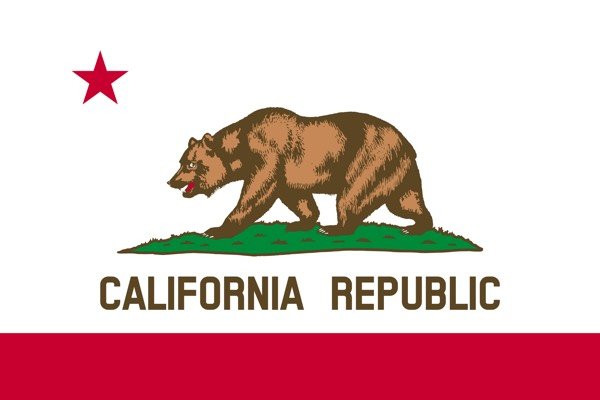
- The official state flag of California is the Bear Flag.
- In 1846, a group of American colonists raised the Bear Flag as a rebel against the rule of Mexico.
- William Todd was the designer of the flag.
- The star in the flag represents the Texas single star, while the grizzly bear imitates the bears found in California.
- The word “California Republic” was put in the lower part of the flag beneath the bear and star.
- In 1911, the Bear Flag was officially admitted as the state flag of California.
31. What Is California’S Motto – California State Motto
- The state motto of California is “Eureka”, a Greek word that means “I have found it”.
- It was made the official state motto of California in 1963, and also seem on the state seal.
- The motto most probably refers to the gold discovery in California.
32. California State Bird Facts
- The California quail (Callipepla californica) is the official state bird of California.
- In 1932, it was admitted as the state bird of California.
33. California State Flower Facts
- The California poppy, which is also called the California golden poppy or just the golden poppy is the official state flower of California since 1903.
- In every spring, golden poppy grows in the wild fields all over California.
- Every year, April 6 is celebrated as the “Poppy Day” and May 13 to 18 is celebrated as the “Poppy week” in California.
34. California Agriculture Facts
- California is the largest food producer state in the United States of America and the 5th largest supplier of agricultural items like food, cotton, and fiber in the world.
- More than 450 types of crops grow in the fertile lands of California due to the Mediterranean-like climate.
- Some special crops of California are almonds, artichoke, figs, dates, persimmons, pomegranates, avocados, prunes, pistachios, clover, raisins, kiwifruits, olives, and walnuts.
- California is the world’s largest exporter of almonds.
- It is also the top dairy producer state in the USA.
- California produces about 80% of the country’s total ripe olives, 83% of all the nation’s strawberries (fresh and frozen), 94% of tomatoes, and 25% of the onions.
35. State Governor Of California
- Gavin Christopher Newsom is the current and 49th governor of the California state.
36. California State Government Facts
- California state has a constitution that established the structure of the state government.
- The government is consist of 3 main branches:
- The Executive Branch:- This branch is composed of the State’s Governor and other officers that are appointed and elected constitutionally.
- The Legislative Branch:- This branch is composed of the California State Legislature. It comprises the Senate and the State Assembly.
- The Judicial Branch:- This branch consists of all the courts (the Supreme Court and the lower courts) of California.
37. California Economy Facts
- In the entire United States, the economy of California is the largest and is also the 5th largest economy in the world.
- In 2017, the gross regional domestic product (GRDP) of California was $2.9 trillion.
- Some of the world’s most valuable corporations are in California, like Google, Apple, Facebook, and Alphabet Inc.
- Agriculture, trade, science and technology, tourism, and media are the most prominent sectors of the economy of California.
- The coastal cities like San Francisco and Los Angeles are the center of economic activities.
- Due to the coastal region, California is the main gateway of trade in America.
38. What Is California Known For – What Is California Famous For
- California is famous or known for:
- The Showbiz (Show business) includes Hollywood, TV, music, and movie studios like Pixar and Skywalker Ranch, etc.
- Technology and Silicon Valley, like Google, Facebook, Apple, etc.
- The beautiful landscape of the coastline, Sierra Nevada, Yosemite National Park, Disneyland Park, the Death Valley, and the tallest redwoods.
- Agriculture
- World-class universities (University of California, California State University, Berkeley, Stanford).
39. How Long Is California – How Long Is The State Of California
- California is the third-largest state of America by area after Alaska and Texas.
- From the north to south, its length is nearly 1287 km (800 miles), while the length of the coastline is about 1351.5 km (840 miles).
40. What Is The Population Of California – California Population – California State Population
- According to the 2017 census, the population of California state is 39.54 million.
41. Cities In California
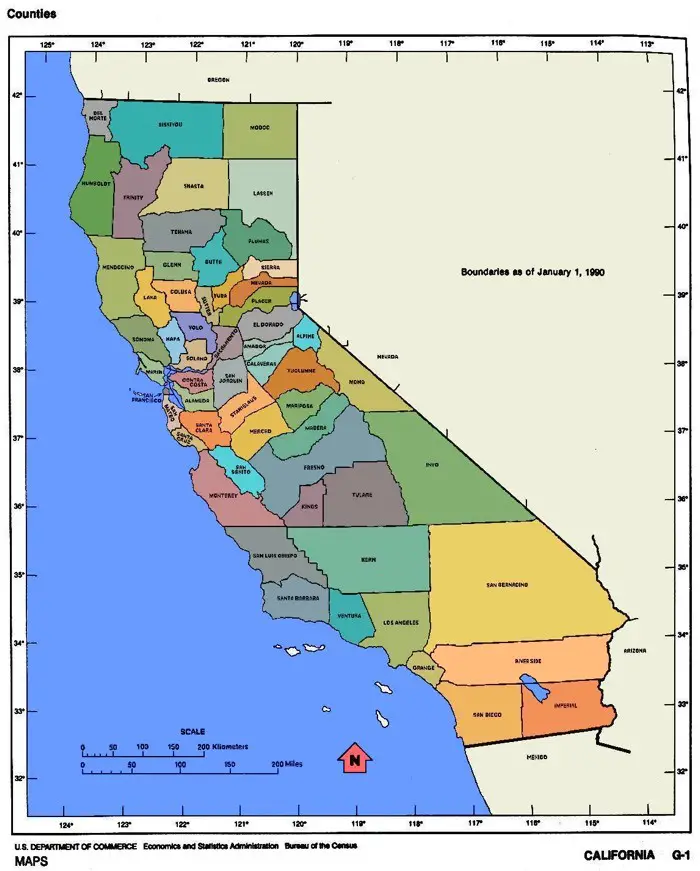
- There are 58 counties in the State of California that have 482 municipalities.
- There is no difference between a town and a city according to the law of California.
- The major cities are:
- Los Angeles
- San Diego
- San Jose
- San Francisco
- Fresno
- Sacramento
- Long Beach
- Oakland
- Bakersfield
- Anaheim
- Santa Ana
- Riverside
- Stockton
- Chula Vista
- Irvine
- Fremont
- San Bernardino
- Modesto
- Fontana
- Oxnard
- Moreno Valley
- Huntington Beach
- Glendale
- Santa Clarita
- Ocean Side
- Garden Grove
- Rancho Cucamonga
- Santa Rosa
- Ontario
- Elk Grove
42. Map Of California USA – California State Map – California Map For Kids
43. California Colleges And Universities – Colleges In California – Universities In California
- California is the home of some world-class universities. The major colleges and universities in California are:
| S.No | Universities | Colleges |
| 1 | University of California | El Camino College |
| 2 | University of Southern California | Pasadena City College |
| 3 | Stanford University | American River College |
| 4 | California Polytechnic State University | Mt. San Antonio College |
| 5 | California State University | Santa Monica College |
| 6 | California State Institute of Technology | Chaffey College |
| 7 | Pepperdine University | Bakersfield College |
| 8 | Loyola Marymount University | Palomar College |
| 9 | University of San Diego | Occidental College |
| 10 | Chapman University | San Joaquin Delta College |
| 11 | University of San Francisco | Fullerton College |
| 12 | Santa Clara University | East Los Angeles College |
| 13 | Ashford University | Rio Hondo College |
| 14 | California Lutheran University |
44. California State University
- The California State University (CSU or Cal State) is one of the top and world-class public university systems of California, along with the University of California system and the California Community Colleges system.
- In the United States, California State University is the largest public university system of 4-year education.
- The number of Campuses of the California State University is 23, while it also has 8 off-campus centers.
- The number of faculty members is 26,858, staff members are 25,305, and the enrolling students are 484,300.
- The oldest campus of California State University is the San Jose State University which was established in 1857.
45. California Phone Code
| Phone Code | Region |
| 805 and 820 | San Luis Obispo, Santa Barbara, Ventura, and the southernmost parts of Monterey County |
| 213 and 323 | Central Los Angeles, Beverly Hills, Pasadena, the Bell, and Huntington Park |
| 310 and 424 | Western and South Bay areas of Los Angeles. |
| 619 and 858 | San Diego, Coronado, Chula Vista |
| 415 and 628 | San Francisco, Sausalito, San Rafael |
| 714 and 657 | Northern Orange County and a part of Los Angeles County |
| 949 | Southern Orange County and the northwest of San Diego County |
| 408 and 669 | Northern Santa Cruz County and most of the Santa Clara County |
| 760 and 442 | Imperial, Inyo, Mono Counties, and parts of the San Diego, San Bernardino, Los Angeles, and Kern counties. |
| 510 and 341 | Alameda County and the Western Contra Costa County |
| 916 and 279 | Sacramento, Folsom, Alameda counties |
| 909 | Eastern Los Angeles and Southwestern San Bernardino Counties |
| 951 | The western Riverside County |
| 209 | Modesto, Stockton, Merced, etc |
| 562 | Most parts of the southeastern Los Angeles County and portions of the northern Orange County |
| 626 | Northeastern parts of the Los Angeles County |
| 650 | The San Francisco Bay area |
| 707 | Northern San Francisco Bay area, North Coast, and the northwestern parts of the state |
| 925 | Inland parts of the East Bay counties of Contra Costa and Alameda |
| 530 | Sacramento Valley, northern Sierra Nevada, and the Shasta Cascade |
| 661 | Most of the Kern County and parts of the Los Angeles, Santa Barbara, and Tulare Counties |
| 559 | Fresno, Madera, Kings, and Tulare Counties |
| 541 | Oregon |
| 831 | Monterey, San Benito, and Santa Cruz Counties |
| 213 and 323 | Central Los Angeles |
| 619 and 858 | San Diego County |
46. Where To Go In California – California Travel – California Sites To See
- Some of the best places and sites to visit and see in California are:
- The Yosemite Falls in the Yosemite National Park
- Palm Springs in Southern California
- Sturtevant Falls in Angeles National Park
- Santa Cruz
- Pfeiffer Beach
- San Diego
- Disneyland
- Big Sur
- San Francisco
- Monterey Beach
- Cathedral Park
- Napa Valley
- Mendocino Coast
47. Disneyland California Facts
- Disneyland is a theme park in California that was opened for visitors on July 17, 1955.
- It is located in the Anaheim city of Oregon county, at the Disneyland Resort.
- Walter Elias Disney was the designer of Disneyland and its whole construction was completed under his direct supervision.
- In 2017, Disneyland was the world’s highly visited theme park that had attended 708 million visitors since its opening.
- The Pirates of the Caribbean is the most favored attraction at Disneyland.
48. California Fun Facts For Kids – Fun Facts About California – Interesting Facts About California – California Weird Facts
- California is the greatest food producer state in the USA.
- The economy of California State is the 5th largest economy in the world, even greater than the economy of the United Kingdom, France, and India.
- It is the most populous state in the United States of America with a population more than Canada and Australia.
- Originally, the California state was called the Grizzly Bear State.
- California is home to Silicon Valley, Holywood, and the world’s oldest and tallest trees.
- Badwater Basin of the Death Valley in California is the lowest elevation point in North America, which is 86 meters (282 feet) below the level of the sea.
- In the Contiguous United States, the highest elevation point Mount Whitney is located in California, which is 4,421 meters (14,505 feet) above sea level.
- San Francisco is the largest landlocked harbor in the world.
- Blue jeans and fortune cookies were invented in San Francisco, California.
- The tallest living thing on earth, the Sequoia sempervirens (Coast Redwood) is found in California.
- The largest living thing in the world, Sequoiadendron giganteum (the giant Sequoia tree) is found in California.
- The oldest living thing on earth alive today, the Pinus longaeva (Bristlecone Pine) is also found in California.
Did you know? It has both the highest (Mount Whitney) and the lowest point (Badwater, Death Valley)in the United States.
Try it
Find Geography on a map or globe, then record three geographical details from this guide.
Knowledge check
What is one important fact about Geography?
Show answer
It has both the highest (Mount Whitney) and the lowest point (Badwater, Death Valley)in the United States.