The Golden Gate Bridge is a suspension bridge in California that links San Francisco with Marin County across the Golden Gate strait. It opened in May 1937 as the world’s tallest and longest suspension bridge. Its main span is 4,200 feet (1,280 m) long, its towers rise 746 feet (227 m) above the water, and it is painted orange-red so ships can see it in fog.
the Golden Gate Bridge quick facts
- The Golden Gate Bridge opened in May 1937.
- Its towers rise 746 feet (227 m) above the water.
- Each main cable is made of 27,572 wires.
- A safety net saved 19 workers during construction.
- About 40 million vehicles cross the bridge every year.
What is the Golden Gate Bridge?
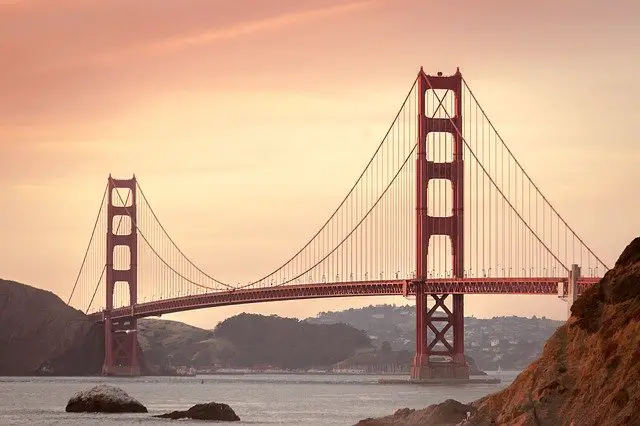
The Golden Gate Bridge is a huge suspension bridge in California, in the United States. It crosses the Golden Gate, the narrow strait where the Pacific Ocean flows into San Francisco Bay.
The bridge links the city of San Francisco, to the south, with Marin County, to the north. Britannica says that when it was finished in 1937, it was the tallest and longest suspension bridge in the world.
Today it is one of the most famous landmarks on Earth. Britannica says it is often called the most photographed bridge in the world, thanks to its beautiful setting.
| Golden Gate Bridge at a glance | |
|---|---|
| Opened | May 1937 |
| Main span | 4,200 feet (1,280 m) |
| Total length | 1.7 miles (2,737 m) |
| Tower height | 746 feet (227 m) above the water |
| Width | 90 feet (27 m) |
| Cost | $35 million in the 1930s |
| Vehicles a year | about 40 million |
Why is it called the Golden Gate Bridge?
The bridge is named after the strait it crosses, the Golden Gate, not after its colour. In fact, the bridge is not gold at all. It is a bright orange-red.
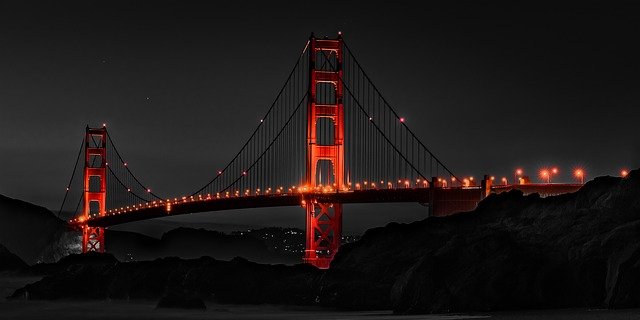
At night, though, the bridge is lit up by floodlights. Britannica says it then shines with a golden glow that reflects off the water of the bay.
Why was the bridge built?
After the California Gold Rush of the late 1840s, San Francisco grew very quickly. Towns grew up north of the Golden Gate too, but there was no road across the water.
People and goods had to cross the strait by ferry. Britannica says that in 1920, San Francisco was the largest city in America that still relied mainly on ferries, and this held back its growth.
The idea of a bridge was not new. A railway businessman, Charles Crocker, suggested one as early as 1872. The plan gained support in 1916, and in 1919 the city engineer, Michael O’Shaughnessy, began to study whether it could really be built.
Most engineers he asked were doubtful. They warned that the rocky ground, strong tides and deep water would push the cost to about $100 million.
Who designed the Golden Gate Bridge?
A civil engineer called Joseph Strauss said he could build a bridge for about a quarter of that cost. He went on to lead the whole project.
Strauss worked with a team of experts. Britannica names Leon Moisseiff, who had designed the Manhattan Bridge in New York City, and Charles Ellis, a professor who did much of the difficult maths for the bridge’s design.
The consulting architect, Irving Morrow, also played a big part. He suggested the bridge’s famous colour.
Paying for the bridge
At first, the bridge was expected to cost about $25 million. City leaders asked the US government to pay, but in 1929 the Great Depression began, a time when many businesses failed and people lost their jobs. The request was turned down.
In 1930, voters in San Francisco and nearby counties agreed to raise $35 million by selling bonds, a kind of loan. But in such hard times, few people could afford to buy them.
Amadeo Giannini, the founder of the Bank of America, stepped in. Britannica says his bank bought the bonds, which allowed building work to begin in early 1933.
The Golden Gate Bridge website says the bridge cost $35 million in the 1930s, about $1.5 billion in 2016 money.
Building the bridge
Work began on 5 January 1933 and took just over four years. Britannica says it was full of challenges. The strait has fast tides, frequent storms and thick fog.
In the fog on 14 August 1933, a cargo ship crashed into a walkway the workers used, causing serious damage. Workers also had to blast rock deep underwater to build foundations strong enough to survive earthquakes.
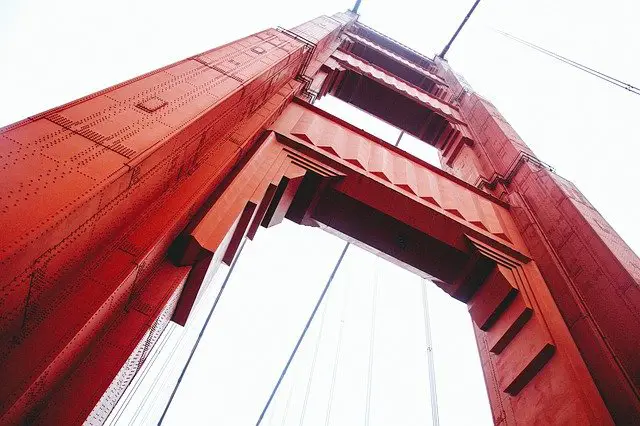
The towers were built from ready-made steel sections, lifted into place by cranes that climbed up the towers as they grew. Each tower used 44,000 tons (40,000 tonnes) of steel, made in Pennsylvania and shipped all the way through the Panama Canal.
Just getting to work was hard. The bridge’s website says it took workers up to 20 minutes to climb the ladders to their jobs high on the towers.
The safety net
Building a bridge high above the sea was dangerous. Joseph Strauss had a movable safety net hung under the work area, which was a new idea at the time.
Britannica says the net saved 19 men from falling to their deaths. Sadly, on 17 February 1937, a scaffold collapsed and tore through the net. Of the 13 men on it, one jumped clear, two survived the fall into the water, and 10 were killed.
One other worker died earlier in the building work, so 11 workers lost their lives in all.
How a suspension bridge works
In a suspension bridge, the road hangs from cables. Two enormous main cables stretch over the tops of the towers, and thinner cables hang down from them to hold up the roadway.
The main cables are held firmly at each end by huge blocks of concrete, called anchorages, which stop them pulling loose.
The Golden Gate Bridge’s main cables are giants. The bridge’s website says each one is 36 and three-eighths inches (0.92 m) thick and 7,650 feet (2,332 m) long, and is made of 27,572 separate wires.
How big is the Golden Gate Bridge?
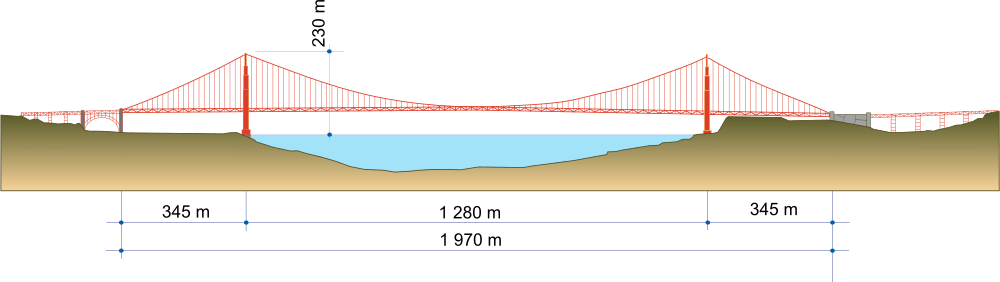
The main span, the part between the two towers, is 4,200 feet (1,280 m) long. Britannica says it was the longest main span in the world until the Verrazzano-Narrows Bridge opened in New York City in 1964.
The whole bridge is 1.7 miles (2,737 m) long, and 90 feet (27 m) wide. The towers rise 746 feet (227 m) above the water, and 500 feet (152 m) above the road. That is higher than a 60-storey building.
The bridge is heavy too. Its website says it weighs about 840 million pounds (382 million kg), which is more than the Empire State Building.
Fog and the bridge
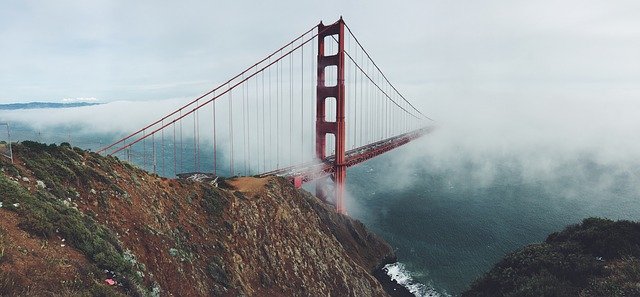
San Francisco is famous for its fog. Thick banks of it often roll in from the Pacific Ocean, especially on summer afternoons, and pour through the Golden Gate into the bay.
Sometimes the fog is so thick that only the tops of the towers poke out above it. At other times the whole bridge disappears from view.
Fog was one of the reasons the bridge was so hard to build. It is also why its colour matters so much for the ships that pass beneath it.
Crossing on foot
You do not need a car to cross the Golden Gate Bridge. It has a walkway for people on foot, and many visitors walk out over the water.
From the middle, you can see the city of San Francisco, the bay and its islands, and the open Pacific Ocean. On a windy day, you can feel just how exposed the bridge is to the weather.
Why is it orange?
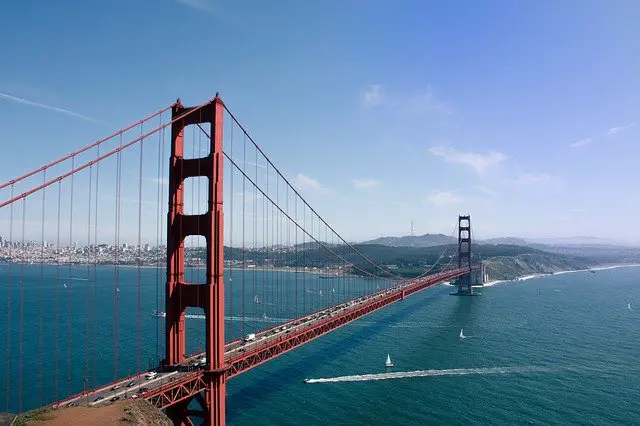
The bridge is painted a bright orange-red, often called International Orange. Britannica says the colour, suggested by Irving Morrow, has two jobs.
First, it fits in beautifully with the hills, sea and sky around it. Second, it is easy for ships to see in the thick fog that often rolls in from the Pacific Ocean.
The bridge needs painting all the time to protect the steel from salty sea air and rust.
Opening day
The Golden Gate Bridge opened in late May 1937, under budget and ahead of schedule, according to Britannica.
Sources give slightly different dates for the first cars. Britannica says the bridge opened to traffic on 28 May 1937, while the bridge’s own website says 29 May.
The bridge today
The Golden Gate Bridge is still a busy road. Its website says about 40 million vehicles cross it every year. It carries US Route 101 and California State Route 1, and it has a walkway for people on foot.
Ferries and buses still carry people across the bay too. The bridge’s website says ferries carry about 2.5 million passengers a year, and buses more than 6 million.
The bridge is a film star as well. It has appeared in movies such as Vertigo (1958), Superman (1978) and Rise of the Planet of the Apes (2011).
Three things people get wrong
The Golden Gate Bridge is not gold. It is orange-red and is named after the strait it crosses.
It is no longer the world’s longest suspension bridge. It was when it opened in 1937, but many longer bridges have been built since.
It is not in Los Angeles. It links San Francisco with Marin County in northern California.
Did you know? The steel for each tower was made in Pennsylvania and shipped to San Francisco through the Panama Canal.
Try it
Make a simple suspension bridge with two chairs, string and a strip of card. Hang the card from the string with paper clips and see how much weight it can hold.
Knowledge check
What does the Golden Gate Bridge link?
Show answer
San Francisco and Marin County.
Why is the bridge painted orange-red?
Show answer
It fits the scenery and is easy for ships to see in fog.
Frequently asked questions
When was the Golden Gate Bridge built?
Construction began on 5 January 1933, and the bridge opened in late May 1937, after just over four years of work.
Who designed the Golden Gate Bridge?
Engineer Joseph Strauss led the project, working with Leon Moisseiff and Charles Ellis. Architect Irving Morrow suggested its famous orange-red colour.
How long is the Golden Gate Bridge?
The whole bridge is 1.7 miles (2,737 m) long. Its main span, between the two towers, is 4,200 feet (1,280 m) long.
Why is the Golden Gate Bridge orange?
Its orange-red colour, suggested by Irving Morrow, fits in with the natural scenery and makes the bridge easy for ships to see in thick fog.
How tall are the Golden Gate Bridge towers?
The towers rise 746 feet (227 m) above the water and 500 feet (152 m) above the road, taller than a 60-storey building.
How many people died building the Golden Gate Bridge?
Eleven workers died during construction, ten of them when a scaffold broke through the safety net in 1937. The net had earlier saved 19 men.
Sources
- Encyclopaedia Britannica: Golden Gate Bridge — history, designers, funding, construction, safety net, colour, opening and main span
- Golden Gate Bridge, Highway and Transportation District: facts and figures — construction dates, cost, lengths, tower heights, width, cables, weight and traffic
- Golden Gate Bridge, Highway and Transportation District: world’s tallest bridge towers — how the towers were built, their steel and climbing to work