Australia is the smallest continent in the world which is surrounded by the Indian and the Pacific oceans. Australia as a country is the 6th largest country in the world with some unique and interesting facts. We have gathered the complete set of Australia Facts for Kids which will give kids a brief overview of Australia as a continent and as a country.
Australia Facts for Kids – As a Continent
1. What is Australia?
- The word “Australia” is derived from the Latin word “terra australis incognita” meaning “unknown Southern Land”.
- Australia is the smallest among the 7 continents and the 6th largest country in the world.
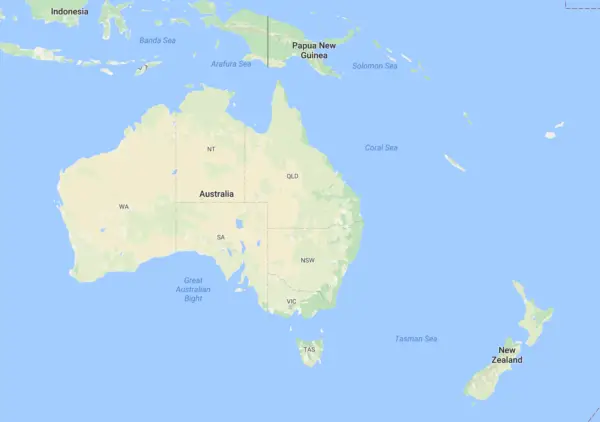
- The countries inside the continent of Australia are:
1. Australia (mainland)
2. New Zealand
3. Tasmania
4. Papua New Guinea
5. Other islands - The continent of Australia is surrounded by the Indian and Pacific oceans.
- The area of Australia as a continent is almost 8.5 million square kilometers.
- The country of Australia occupies 7.6 million square kilometers out of the total area of the continent.
2. What Does Australia Mean
- The origin of the word Australia is the Latin word “Terra Australis”, which means “Southern land”.
- Since ancient times, this word was used as a name for a hypothetical continent in the Southern Hemisphere.
- During the 17th century, when Europeans first started exploring and mapping Australia, the newly discovered region naturally got the name Terra Australis.
3. Where is Australia located in the World
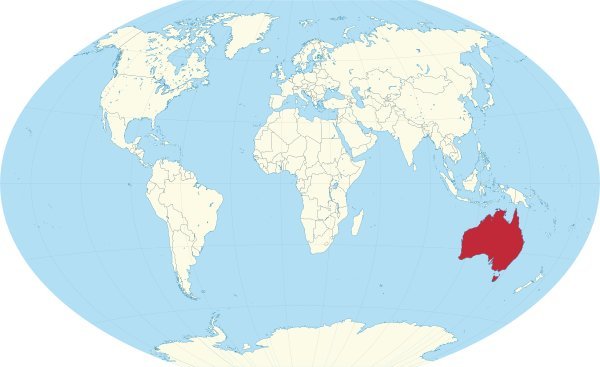
- Australia is situated between the Indian and Pacific oceans.
- It is located on the South-Eastern side of the world map.
4. Australia Total Area – Australia Square Kilometers
- The total area of Australia is 8,600,000 km sq.
- Out of the 8.6 Million km square area of the continent of Australia, 7.692 million km square is occupied by the Commonwealth of Australia.
5. How old is Australia – Origin of Australia
- About 200 Million years ago, all the continents of the earth were joined together in the form of a single landmass, called Pangaea (all earth).
- About 190 Million years ago, this huge landmass broke into two parts.
- Gradually, the two landmasses broke into smaller and smaller landmasses due to a process called Continental Drift.
- The final result of the Continental Drift is today’s location of the continents of the world.
- The continent of Australia was formed as a result of the Continental Drift 33.5 to 37 Million years ago. Australia got separated from its parent landmass and drifted towards its current position.
- Some archaeologists have speculated that human beings have been living there for the past 60,000 years.
6. How many countries in Australia
- There are 3 independent confirmed countries in the continent of Australia.
- The Commonwealth of Australia
- New Zealand
- Papua New Guinea
- The Continent of Australia also occupies some portions of Indonesia.
7. Australia’s Countries
| Country | Capital | National Language | Population | Area (sq. km) |
| Commonwealth of Australia | Canberra | Australian English | 23,792,009 | 7.692 Milion |
| New Zealand | Wellington | English | 4,579,000 | 268,021 |
| Papua New Guinea | Port Moresby | English & Hiri Motu | 8,219,000 | 462,840 |
Australia Facts for Kids – As a Country
1. Australia Profile – Australia Country Information
| Capital City | Canberra |
| Population | 24.13 million (2016) |
| Area | 7.7 million sq km (2.9 million sq miles) |
| Major Language | English |
| Major Religion | Christianity |
| Life Expectancy | 80 years (men), 84 years (women) |
| Currency | Australian Dollar |
- Australia is a sovereign country with an official name the “Commonwealth of Australia”.
- It is composed of the mainland of the Australian continent, Tasmania Island, and many other small islands.
- It is the biggest country in Oceania.
- Australia is the 6th largest country on Planet Earth.
- It is the world’s 12th largest economy.
- Napoleon Bonaparte referred to the Australian nation as “A nation of small businesses”.
- Australia is the 3rd most fascinating country in the world for students.
- The national language of Australia is Australian English.
- Besides English, more than 300 languages are spoken in Australia, which shows that Australia is a multicultural country.
- Australia is considered the “Happiest” developed country in the world.
- According to the BBC, Australia is the “Lifestyle Super Power” of the Globe.
2. Official Name of Australia:
- The Commonwealth of Australia is the official name of Australia.
3. Flag of Australia
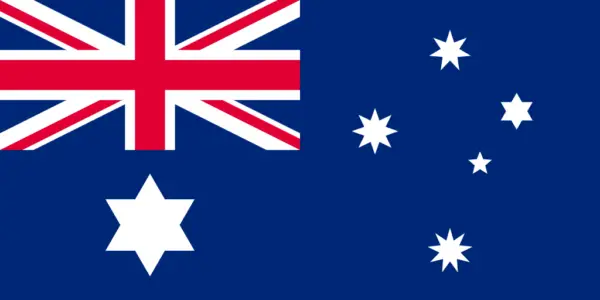
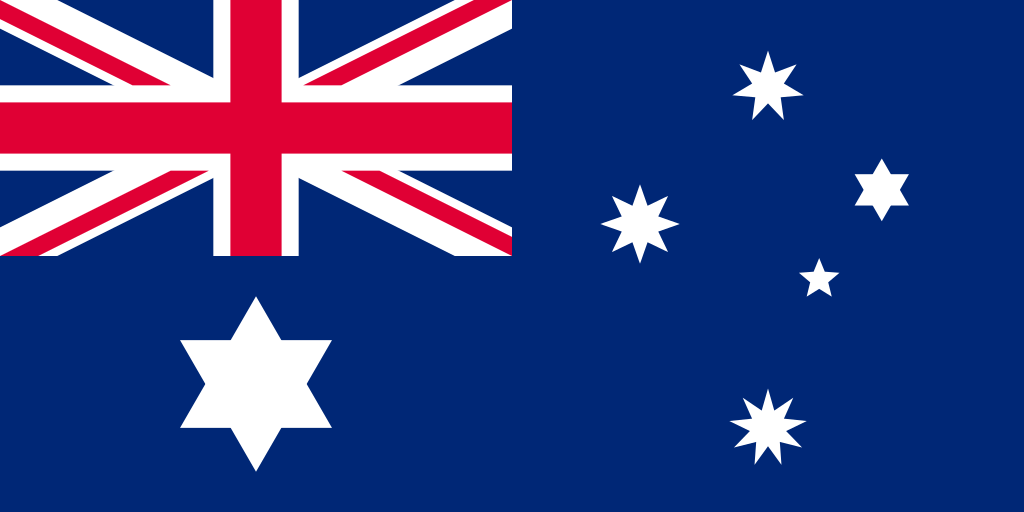
- The flag of Australia is made up of 3 sections:
- the Commonwealth Star
- the Southern Cross
- the Union Jack.
4. When did Australia become a Country and a Nation
- Australia became a country on 1 January 1901. Hence, it became an independent Nation on the same day.
- Also, on that day the name of Australia was changed to the Commonwealth of Australia.
5. How long has Australia been a country
- Australia has been a country for the past 118 years.
6. What Is The Capital City Of Australia – The Capital Of Australia
- The capital city of Australia is Canberra.
Canberra Facts For Kids
- Canberra is situated 410 miles northeast of Melbourne and 170 miles southwest of Sydney at the northern end of the Australian Capital Territory.
- In inland Australia, it is the biggest city.
- It is the 8th biggest Australian city in terms of population.
- The city was founded and named in 1913.
- Among Australian cities, it is an unusual and planned city located outside of any state.
- The city was constructed on the design plane of American architects Walter Burley Griffin and Marion Mahony Griffin.
- Unlike other Australian cities, there is no city government or local council in Canberra and all the functions are performed by the Australian Capital Territory Legislative Assembly.
- The country’s important federal government institutions, such as Parliament House, High Court, and the official residence of the Governor-General are in Canberra.
7. History of Australia
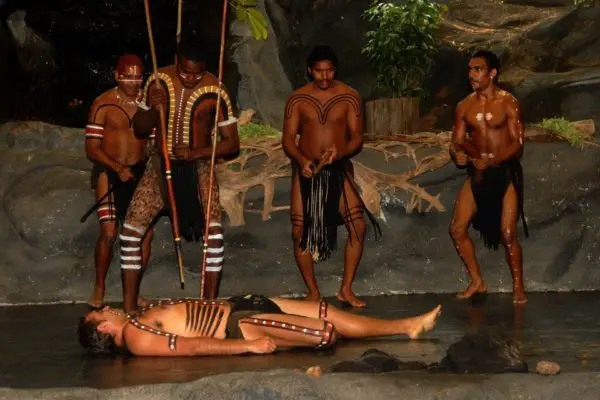
- Archaeological evidence suggests that the first people to settle in Australia were the Aboriginal people. They came from South-East Asia sometime between 60,000 to 40,000 years ago. They formed a society with a culture rich with traditions that are practiced to date.
- Australia was first discovered by the Dutch in the year 1606 when European expeditions were made in search of foreign lands.
- In 1770 the British came to Australia and made a settlement in Sydney. They established the first European colony in 1788.
- There were conflicts among the indigenous people of Australia and the Europeans in which the indigenous people were defeated.
- The population of indigenous people reduced rapidly due to the diseases brought by the Europeans.
- In the mid of the 19th century, the first parliamentary democracy was established and Australia began to make progress due to the industrialization of agriculture.
- In the year 1901, all the British colonies united and established a united federation through a referendum. As a result, Australia was formed as a country.
8. Australian History Timeline – Historical Events In Australia
- 40,000 BC: The first Aboriginal people arrived in Australia
- 20,000 BC: The Aboriginal people spread all over mainland Australia and Tasmania
- 1606: A ship of Dutch East India Company, named Dyfeken explored the western coast of the Cape York Peninsula (now Weipa) under the leadership of Captain Willem Janszoon. It was the first European landfall on the soil of Australia.
- 1770: English Lieutenant James Cook made a voyage to Australia in a British Royal Navy research vessel named HMS Endeavour. He charted the east coast and claimed it as a British possession. He named this region “New South Wales”.
- 1787: British Royal Navy officer, Admiral Arthur Philip led the First Fleet of 11 ships from Great Britain to Australia to start European colonization.
- 1788: In Sydney, Arthur Philip established a penal settlement for about 800 convicts he brought in the fleet of 11 ships. It is thought that the Aboriginal population was several hundred thousand at that time.
- 1803: English navigator, Captain Matthew Flinders, completed the first navigation around the entire Australian continent (circumnavigation).
- 1829: Captain James Stirling established the colony of Western Australia in Perth.
- 1836: The state of South Australia was established and Adelaide was declared as its capital.
- 1850: The discovery of gold led to a gold rush throughout the decade. In 10 years, the population of Australia increased three times and crossed the million mark. Aboriginal people were treated extremely badly and their population fell.
- 1856: Australia became the first country in the world that introduce the secret ballot for the election, which was also known as the Australian ballot.
- 1868: Convicts transportation to Western Australia was ceased.
- 1877: The first-ever cricket Test match between Australia and England was played in Melbourne.
- 1901: All the colonies united and on 1st January, the Commonwealth of Australia came into being. The introduction of the Immigration Restriction Act put the basis of the White Australia Policy, which ceased the progress of non-white immigration to Australia.
- 1911: Canberra city was founded and was declared the capital of the country.
- 1914: The outbreak of World War I was greeted in Australia and thousands of soldiers were sent to the British war effort.
- 1915: Australian soldiers suffered heavy casualties in the Battle of the Somme at the Western Front.
- 1929: After the Wall Street Crash, the Great Depression also hardly hit Australia.
- 1939: Australia followed Britain and was involved in the Second World War.
- 1940: A team of Australian scientists under the leadership of Howard Florey developed Penicillin antibiotic.
9. How did Australia become a country
- Australia became a country through a process called “Federation”.
- Six different British colonies united and formed the “Commonwealth of Australia”.
- Before this, all states of Australia were different countries.
10. How Big Is Australia – How Large Is Australia
- Australia is the sixth-largest country on planet earth.
- It has a total area of 7,692,024 km² (2,969,907 sq miles).
- It covers 5% of the total land area of the world (149,450,000 km²).
How Big Is Australia In Square Miles
- In square miles, the area of Australia is 2.97 million mi².
How Big Is Australia In Km
- In kilometers, Australia is 7.7 million km² large.
How Big Is Australia Compared To The United States
- The area of the United States is 9.834 million km², while the area of Australia is 7.692 million km².
- The United States is around 2 million km² bigger than Australia.
- There is also a huge difference between the populations of both countries. The population of Australia is much lower than that of the United States.
How Big Is Australia Compared To Canada
- The area of Canada (9.985 million km²) is 2.3 million km² bigger than that of Australia (7.692 million km²).
- The population of Canada (37.59 million) is around 12 million greater than that of Australia (25 million).
How Big Is Western Australia
- The area of Western Australia is 2.646 million km², while its population is 2.589 million.
- It is the world’s second-largest country subdivision.
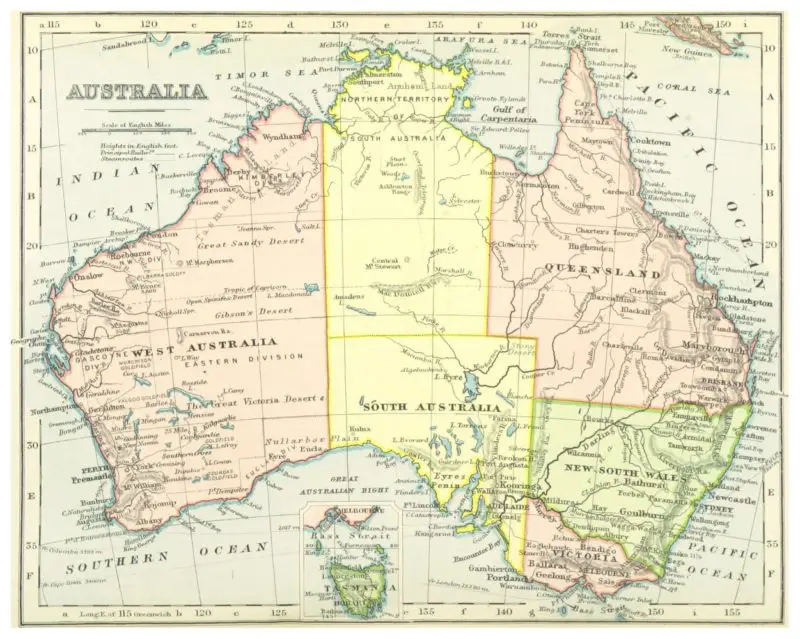
11. Australia Country Map
12. Australia Geography Facts – Geographical Features Of Australia
- Australia is a continent as well as an isle and its geography covers a wide variety of biogeographic regions.
- On the worlds’ map, the location of Australia is in Oceania between the South Pacific Ocean and the Indian Ocean.
- The country with the same name, the Commonwealth of Australia or just Australia, claims control over the whole continent and outlying small islands, which makes it the world’s sixth-largest country by area.
- The total area of Australia is 7,686,850 km² (2,967,910 sq mil), which is 31.5 bigger than the area of the United Kingdom.
- The total coastline length of mainland Australia is 35,877 km (22,293 miles), while the length of the island coastlines is 23,859 km (14,825 miles).
- There are 758 estuaries throughout the country, most of which are located in the subtropical and tropical zones.
- The exclusive economic zone of Australia is 8,148,250 km², which is the 3rd largest in the world.
- Australia is the world’s only country that controls the largest area of ocean jurisdiction.
- Australia has no land borders.
- The western half of Australia is composed of the largest drainage division of the country, known as the Western Plateau.
- Various mountain ranges break the generally flat region of the Western Plateau, such as the MacDonnell Ranges and the Hamersley Range.
- Near the eastern coast of Australia lies the Great Dividing Range or the Eastern Highlands. It separates the narrow coastal plain from the other parts of the continent.
- The Central Lowlands region lies between the Western Plateau and the Eastern Highlands. This region is made up of the largest river systems of Australia (the Lake Eyre Basin and Murray-Darling Basin) and the Great Artesian Basin.
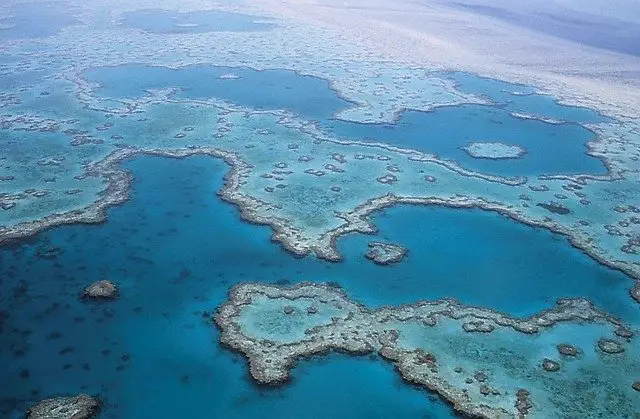
- The Great Barrier Reef is the largest coral reef complex in the world, which lies off the eastern coast of Australia.
- At the south-eastern corner of mainland Australia lies Tasmania island. It is a large mountainous island as well as the state of Australia. It receives high annual rainfall and has extremely fertile soil as compared to mainland Australia.
13. How Many Islands Does Australia Have – Australian Islands
- There are 8,222 islands within the marine borders of Australia.
- Each Australian island is unique and has its unique features, geography, and beauty.
- The following islands have large than 1,000 km² surface area:
- Tasmania Island
- Melville Island
- Kangaroo Island
- Groote Eylandt
- Bathurst Island
- Fraser Island
- Flinders Island
- King Island
- Mornington Island
14. Australia Statistics
Australia Population Statistics
- Australia is the world’s 53rd most populous country.
- Of all the countries in Oceania, Australia has the largest population.
- Its current population is estimated as 25,573,800 individuals.
- The average population density in Australia is 3.3 persons per square kilometer.
- Australia is also included in the world’s most urban countries.
- 86% of its entire population lives in small urban areas.
Australian Economy Statistics
- The Australian economy is a highly developed market economy.
- In 2019, its estimated GDP was A$1.89 trillion.
- The service sector of Australia dominates the economy and is comprised of 61.1% of the GDP.
- In terms of domestic market capitalization or market cap, the Australian Securities Exchange in Sydney is the world’s 16th-largest stock exchange.
- In June 2016, the total wealth of Australia was AUD 8.9 trillion.
- In 2018, its nominal GDP was $1.420 trillion while its PPP-adjusted GDP was $1.318 trillion.
- The GDP growth of Australia was 2.8% in 2016, 2.4% in 2017, 2.7% in 2018, and 1.7% in 2019.
Education Statistics Australia – Education Rate In Australia
- In 2019:
- ⅔ of Australians from 15 to 64 years of age (66% of the population) were fully involved in study or work.
- ⅕ of Australians from 15 to 64 years of age (19% of the population) were currently studying.
- 6/10 of the school leavers were enrolled for further education.
- The education budget was AUD$ 111.8 billion (5.9% of GDP).
15. What Is The Population Of Australia – Australia Population Facts
- According to the 2016 census, the population of Australia was 23,401,892.
- In 2020, it is estimated as 25,595,400.
- In terms of population, Australia is the 53rd largest country in the world.
- Australia is the 8th country in the world with the largest immigrant population, which makes up 29% of the whole population.
- More than 80% of the population lives in the southeast region of the country as the inner regions of the country are mostly desert.
- Australia is also one of the highly urbanized countries in the world. According to the 2018 estimation, more than 67% of the population live in urban areas (the Greater Capital City Statistical Areas).
- Australia is one of the world’s most sparsely populated countries with a population density of only 3.3 persons/km².
Indigenous Population Of Australia – Aboriginal Population Australia
- According to the 2016 census, the indigenous population of Australia is 798,365.
- They make up 3.3% of the whole Australian population.
- They are distributed in the following territories or states:
| State / territory | Percentage | Number of people |
| New South Wales | 3.55% | 265,685 |
| Queensland | 4.57% | 221,276 |
| Western Australia | 3.93% | 100,512 |
| Northern Territory | 30.34% | 74,546 |
| Victoria | 0.93% | 57,767 |
| South Australia | 2.47% | 42,265 |
| Tasmania | 5.51% | 28,537 |
| Australian Capital Territory | 1.86% | 7,513 |
Australia Population Density
- The average population density in Australia is only 3.3 persons per square kilometer (8.5/sq mil).
What City In Australia Has The Highest Population
- Sydney is the highly populated city of Australia with a population of 4,627,342.
The following are the largest and most populated cities in Australia (2018 data):
| S.No | City Name | Population |
| 1 | Sydney | 5,230,330 |
| 2 | Melbourne | 4,936,349 |
| 3 | Brisbane | 2,462,637 |
| 4 | Perth | 2,059,484 |
| 5 | Adelaide | 1,345,777 |
| 6 | Gold Coast-Tweed Head | 679,127 |
| 7 | New Castle-Maitland | 486,704 |
| 8 | Canberra-Queanbeyan | 457,563 |
| 9 | Sunshine Coast | 333,436 |
| 10 | Wollongong | 302,739 |
| 11 | Geelong | 288,277 |
| 12 | Hobart | 232,606 |
| 13 | Townsville | 180,820 |
| 14 | Cairns | 152,72 |
16. Australia Demographics – Australia Population Demographics
- Australia has up to 25 million population.
- 49.8% of the total population are males while 50.2% are females.
- In 2019, the median age in Australia was 37.3 years.
The following table shows the age groups and their share of the total population:
| Age Group | Share of Total Population |
| 0 to 14 years | 19.3% |
| 15 to 24 years | 12.2% |
| 25 to 54 years | 40.6% |
| 55 to 64 years | 11.6% |
| 65 years and older | 16.2% |
Australia Population Ethnicity – Australia Ethnic Demographics
The following table shows the ethnic demographics of Australia (2016 census):
| Ethnic Group | Percentage Of The Total Population |
| English | 36.1% |
| Australian | 33.5% |
| Irish | 11.0% |
| Scottish | 9.3% |
| Chinese | 5.6% |
| Italian | 4.6% |
| German | 4.5% |
| Indian | 2.8% |
| Indigenous | 2.8% |
| Greek | 1.8% |
| Dutch | 1.6% |
| Flipino | 1.4% |
| Vietnamese | 1.4% |
| Lebanese | 1% |
Australia Religious Demographics
The following are the religious demographics of Australia:
| Religion | Percentage |
| Christianity | 52.1% |
| Anglican | 13.3% |
| Islam | 2.6% |
| Buddhism | 2.4% |
| Hinduism | 1.9% |
| Sikhism | 0.5% |
| Judaism | 0.4% |
| Other religions | 0.4% |
| No religion | 30.1% |
| Undefined / not stated | 9.7% |
17. What Is The GDP Of Australia – Australia Gross Domestic Product
- In 2018:
- The nominal GDP of Australia was $1.420 trillion and was ranked as the 14th largest in the world.
- Its PPP-adjusted GDP was $1.318 trillion and was the 20th largest in the world.
- Its nominal GDP per capita was $56,420 and was ranked 10th in the world.
- Its PPP-adjusted GDP per capita was $52,379 and was ranked 17th in the world.
- GDP by sector was; services (61.1%), construction (8.1%), mining (6.9%), manufacturing (6.0%).
18. Government of Australia
- Australia has both representative democracy and a monarchy.
- The parliamentary system of government runs the country with Queen Elizabeth II of the United Kingdom recognized as the Queen of the country.
- A viceroy represents the queen as she lives in the United Kingdom.
- The Constitution of Australia is the final authority and the authority to exercise its powers rests with the Governor-General.
- There are 3 arms of Government:
1. Parliament
2. Executive
3. Judiciary
19. Countries close to Australia
- Some countries close to the Commonwealth of Australia are
1. New Zealand
2. Papua New Guinea
3. Indonesia
20. Australia is Famous for
- Australia is famous for three things:
1. Sydney Opera House
2. Beaches
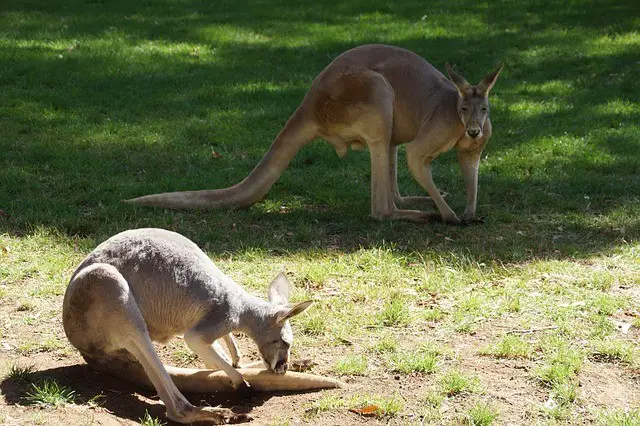
3. Kangaroos
21. Climate of Australia
- Australia has many different climatic zones due to its large continental size.
- The climate in the Southern Hemisphere of the earth is opposite to that of the climate in the Northern Hemisphere.
- In Australia, December and January are the hottest while July and August are the coldest.
- In Australia, the highest temperature limit is 50°C (Central Australia), and the lowest temperature limit is -3°C (Southern Australia).
Southern Australia
- The climate in Southern Australia is temperate to warm.
- Summer daytime temperature ranges from 25 to 30°C.
- Winter daytime temperature ranges from 5 to 10°C.
- Storms occur during the “Southern” summer months from November to April.
- The Tasmanian mountains and the Australian Alps in the south are very cold. Their peaks remain snow-capped throughout the year.
Central Australia
- The “desert and bush” region lies in Central Australia.
- The temperature may go up to 50°C!
- Rain may not fall in this region for years.
Northern Australia
- This part of Australia contains the coastal area.
- The north coastal areas have a tropical and hot climate.
- The temperature is above 18°C throughout the year.
- The average yearly rainfall in the north-eastern part of Australia is 100 inches.
- Sometimes, tropical storms occur in the coastal areas resulting in cyclones and heavy rainfall.
22. Animals of Australia
Australia is home to a very wide variety of animals. Many animals are only found in Australia and nowhere else in the world. The different types of animals found in Australia are:
Mammals
- There are 140 different species of only Marsupials and many other species of Monotremes (egg-laying mammals) and other mammals in Australia. Some of the famous mammals of Australia are:
- Dingo (Wild dog)
- Numbat (Banded anteater)
- Quoll (Carnivorous Marsupial)
- Tasmanian devil (Carnivorous Marsupial)
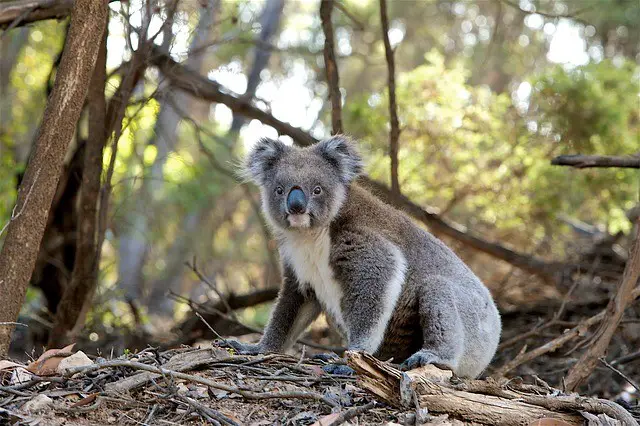
- Koala (Learn more: Koala Facts for Kids)
- Kangaroo (Learn more: Kangaroo Facts for Kids)
- Duck-billed Platypus (Monotreme)
- Spiny Anteater (Monotreme)
Learn more: Koala Facts for Kids
Birds
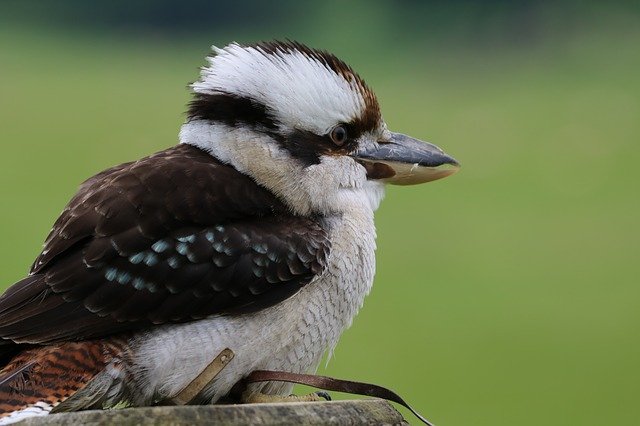
- There are more than 800 species of birds in Australia, half of which are indigenous to Australia. Some of the famous birds are:
- Honeyeaters
- Emu (largest and flightless)
- Cassowaries
- Kookaburras
- Penguins
- Lyrebirds
- 55 different species of parrots
- Honeyeaters
Reptiles
- Australia has 21 out of the 25 most venomous and deadliest snakes in the world. There are also many other reptiles like:
- Crocodiles (Fresh-water and Salt-water)
- Pythons
- Tree snakes
- Six out of the seven species of Turtles
- Lizards
- Goannas (Monitor lizards)
- Thorny devils
- Crocodiles (Fresh-water and Salt-water)
Marine Animals
- The marine environment of Australia is home to many different species of different animals. Some of these animals are:
- 4,000 out of 22,000 different species of Fish
- 30 out of 58 Seagrass species
- 1,700 different species of Coral
- Whales (Humpback, Southern right, Orca)
- Dugong (Manatee)
- Many Dolphin species
- Some different Sharks
- 4,000 out of 22,000 different species of Fish
23. Australian People
- The Australian people are also known as “Aussies” and “Antipodeans”.
- They belong to more than 270 ethnic groups.
- Australia has the 9th largest immigrant population in the world, and about one of every four Australians is born outside of Australia.
- The majority of the people are of British, Scottish, Welsh, Cornish, and Irish lineage.
- Australian people are somewhat relaxed and easy-going, friendly, and humorous.
24. Australian Culture Facts
- Australian society is one of the world’s most multicultural societies.
- The modern Australian culture is a combination of the elements of indigenous, British, American, and recent immigrants’ customs, languages, and religions.
- The Australian culture is primarily a western culture, however, the country’s unique geography has a great influence on it.
- The culture of Aboriginal Australians and Torres Strait Islanders is one of the world’s oldest surviving cultures.
- Arts, sports, humor, religions, cushions, and clothing are important parts of the overall Australian culture.
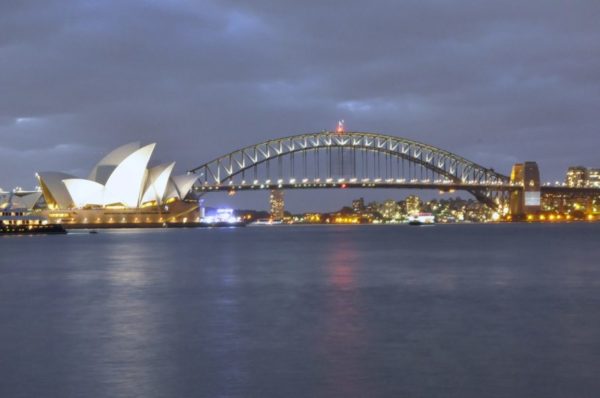
- Sydney is the hub of art and architecture and has world-class architecture in the form of Sydney Opera House and Sydney Harbor Bridge.
- Australian visual arts, cinema, theatre, music, and literature are also well known and are an important part of Australian culture.
25. Australian Food Facts
- The present Australian cuisines are a combination of British and indigenous origin along with Mediterranean and Asian influence.
- Due to the abundance of natural resources, Australia is well-known for a wide variety of high-quality meat.
- Barbecue of lamb or beef in the open air is a lovingly national tradition of Australia.
- Australia is also well-known for its high-quality seafood as the majority of the Australian population lives close to the sea. The seafood restaurants in Australia are among the best restaurants in the world.
- There is also a large variety of plant and animal foods that are indigenous to the Australian bush and are known as the Bush Tuckers. Examples of bush tucker fruits are finger lemon, Kakadu plums, and desert quandong. While the animal foods are the bushmeat of kangaroo and emu and the shellfish found in the saltwater river system of Australia.
- There is a popular snack in Australia known as the ANZAC-biscuit. It is a nutritionally rich biscuit and was primarily prepared in the past for the Australian and New Zealand Army Corps fought in the First World War.
- The Aboriginal people of Australia eat wood-eating larvae as their traditional diet. These larvae are a rich source of proteins and they eat them to build their body muscles and bones.
26. Famous People From Australia – Famous Australians
- The following are some of the famous people from Australia:
- Dame Joan Alston Sutherland (Opera singer)
- Patric Victor Martindale White (author) winner of the 1973 Nobel Prize for Literature
- Sir Frank Macfarlane Burnet (virologist) co-recipient of 1960 Nobel Prize in Physiology or Medicine
- Sir John Carew Eccles (Neurophysiologist) co-recipient of 1963 Nobel Prize in Physiology or Medicine
- Sir John Warcup Cornforth (scientist) winner of the 1975 Nobel Prize in Chemistry
- Mathew Hayden (cricketer)
- Peter Charles Doherty (immunologist) winner of the 1996 Nobel Prize in Physiology or Medicine
- Allan Robert Border (former captain of the Australian cricket team)
- Adam Roy Goodes Australian rules footballer and an Aboriginal community leader
- 27Hugh Jackman (actor)
- Cate Blanchett (actress)
27. Famous Indigenous Australians
- The following are some of the famous indigenous Australians:
- Lionel Edmund Rose was the first indigenous Australian to win the world boxing title and the first Aboriginal Australian to be named Australian of the year
- Neville Thomas Bonner the first Aboriginal Australian elected to the Parliament of Australia
- Galarrwuy Yunupingu a leader in the community of Aboriginal Australians and the activist of Native Title
- Lowitja Lois O’Donoghue Smart Aboriginal health worker and retired public administrator. She was the inaugural chairperson of the Aboriginal and Torres Strait Islander Commission from 1990 to 1996.
- Oodgeroo Noonuccal an Aboriginal artist, educator, and political activist
- Albert Namatjira an Aboriginal Artist
- David Unaipon and Aboriginal author, preacher, and inventor
28. Tourist Places In Australia
- There are many places in Australia to amuse tourists.
- Sydney, the largest city in Australia has the following tourist points:
1. Sydney Opera House (Built-in 1973)
2. Sydney Harbour Bridge
3. Sydney Beach - Besides Sydney, there are many other places in Australia for tourists like:
1. Great Barrier Reef
2. Blue Mountain National Park
3. Melbourne
4. Daintree National Park
5. Fraser Island
6. Great Ocean Road
7. Broom and the Kimberley region
29. Australia’s Official Website
- The official website of Australia is http://www.australia.gov.au/
- The owner of this website is the Government of Australia.
- This website was created by the Department of Finance.
30. What Is Australia Famous For – Famous Things In Australia
- Australia is famous for many things. Some of which are:
- The Great Barrier Reef
- Sydney Opera House
- Sydney Harbor Bridge
- Bondi Beach
- Stunning coastlines
- Unique flora and fauna
- Uluru-Kata Tjuta National Park
- The culture of Aboriginal people
- Blue Mountain National Park
31. What Is Special About Australia
The following are some of the many features of Australia, which make it special:
- The unique geography of Australia makes it a global anomaly. It is the world’s biggest island as well as a continent.
- Australia is a nation of immigrants and most of the population are themselves immigrants or either their ancestors came from other countries.
- The Great Barrier Reef in Australia is the largest Coral Reef in the world, as well as the largest ecosystem in the world.
- Australia is also special due to its flora and fauna. About 80% of the animals found there are unique and found no elsewhere in the world. For example; kangaroos, koalas, platypus, and a huge variety of birds.
32. Best Places To Visit In Australia – Australia Famous Places To Visit
The following are some of the best and most famous places to visit in Australia:
- Sydney Opera House, Sydney Harbor Bridge, Bondi Beach, and Darling Harbor in Sydney.
- Federation Square, Eureka Skydeck, and Royal Botanic Gardens in Melbourne, Victoria.
- Rainforests, Surfers Paradise, and The Great Barrier Reef in Queensland.
- Uluru sacred Rock in Uluru-Kata Tjuta National Park.
33. Attractions in Australia
Australia has many places to attract tourists from all over the world:
Some attractions in Sydney are:
- Sydney Opera House (Built-in 1973)
- Sydney Harbour Bridge
- Sydney Beach
Attractions from other cities are:
- Great Barrier Reef
- Blue Mountain National Park
- Daintree National Park
- Fraser Island
- Great Ocean Road
- Broom and the Kimberley region
Historical Sites In Australia – Historical Places In Australia
The following are some of the major historical sites in Australia:
- Fremantle Prison in Fremantle, Western Australia
- Hyde Park Barracks, New South Wales
- Royal Exhibition Building, Melbourn
- Cockatoo Island, New South Wales
- Historic Village Herberton, Queensland
- Shrine of Remembrance, Melbourne
- Port Arthur Historic Site, Tasmania
- Old Melbourne Gaol, Melbourne
- Commissariat Store, City of Brisbane, Queensland
- Carrick Hill, Springfield, South Australia
34. Fun Facts About Australia For Kids
- Australia is the largest island in the world.
- It is the world’s smallest continental landmass.
- Australians eat the meat of their national symbols kangaroo and emu.
- The air of Tasmania Island is the cleanest in the world.
- Fraser Island located in Queensland state is the world’s largest sand island.
35. Interesting Facts About Australia For Kids
- After New Zealand, Australia was the world’s 2nd country that allowed women to vote.
- Australia homes the largest coral reef in the world; The Great Barrier Reef.
- About 70% of the total Australian landmass receives less than 500 mm annual precipitation.
- Up to 40% of the total Australian land area is uninhabitable.
- Approximately 84% of the total Australian population lives within 50 km of the coast.
- About 80% of the animals found in Australia are unique and do not found elsewhere in the world.
- Australia homes the world’s largest cattle station which is bigger than Israel.
- The first Australian police force was made up of the most well-mannered convicts.
- Uluru is not the largest rock in the world. The world’s largest rock is Mount Augustus located in Western Australia and is double the size of Uluru.
- Australia is among the big exporters of wine and there are up to 60 regions of wine in Australia.