Stone Age quick facts
- The Stone Age lasted about 3.3 million years, roughly 99% of all human history.
- It has three parts: Palaeolithic (Old), Mesolithic (Middle) and Neolithic (New Stone Age).
- The oldest known stone tools, from Lomekwi in Kenya, are 3.3 million years old and were made before our genus Homo existed.
- Most Stone Age people did not live in caves. Caves simply preserve the evidence best.
- The Stone Age ended when people learned to work metal, which happened thousands of years apart around the world.
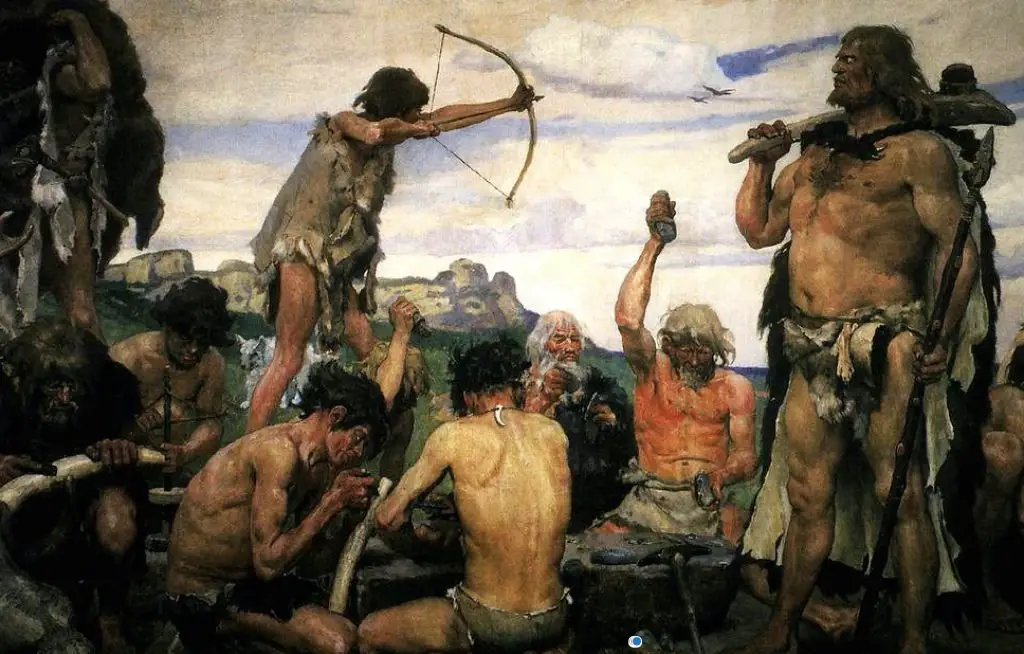
The Stone Age is the longest chapter in the human story by an enormous margin. It runs from the moment somebody first struck one rock against another to make a sharp edge, all the way to the moment people started working metal. That is roughly 3.3 million years, which is about 99% of the time humans and our ancestors have existed.
Everything since then, farming, writing, cities, cars, the internet, fits into the last 1%.
When was the Stone Age?
There is no single answer, and that is the first surprising thing about it. The Stone Age did not begin and end on the same date everywhere. It ended when a particular group of people learned to work metal, and different parts of the world reached that point thousands of years apart.
For Britain, the usual dates look like this:
| Period | Roughly when | What changed |
|---|---|---|
| Palaeolithic (Old Stone Age) | about 800,000 – 10,000 BC | Hunting and gathering, simple chipped stone tools, the control of fire, cave painting |
| Mesolithic (Middle Stone Age) | about 10,000 – 4000 BC | The ice retreats, forests spread, tools get small and precise, boats and fishing gear appear |
| Neolithic (New Stone Age) | about 4000 – 2500 BC | Farming arrives, people settle in one place, pottery, Stonehenge |
Worldwide the picture stretches much further back. The oldest stone tools yet found are about 3.3 million years old, from a site called Lomekwi 3 near Lake Turkana in Kenya, published in 2015. They are so old that they were made before our own genus, Homo, existed at all. Somebody else was making tools first, which overturned a very confident assumption archaeologists had held for decades.
The people of the Stone Age
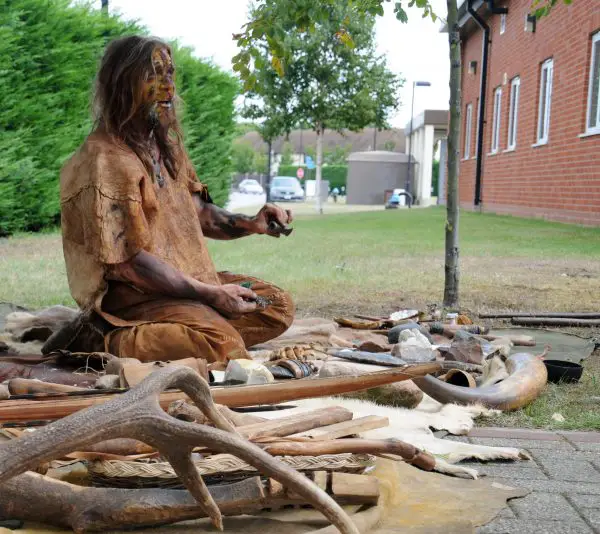
For most of the Stone Age, our own species was not the only kind of human around. Neanderthals lived across Europe and western Asia for hundreds of thousands of years. Denisovans lived further east. There were others, and for a long stretch several kinds of human shared the planet at the same time.
They also met, and sometimes had children together. If your family comes from outside Africa, roughly 1–2% of your DNA is Neanderthal. You are carrying a small piece of the Stone Age around inside you right now.
Stone Age people were not stupid and they were not lucky. They tracked animals across whole landscapes, knew which plants healed and which killed, navigated by stars, and passed all of it on without writing anything down. Learn more about how they lived in our guide to Stone Age People.
Did they really live in caves?
Mostly, no. Caves are where the evidence survives, which is not the same thing as where people lived. A cave protects bones, ash and paint from rain and wind for tens of thousands of years, so caves are where archaeologists keep finding things.
Most Stone Age people lived in the open, in shelters made from wood, hide, turf and bone, which rot away and leave almost nothing behind. Caves were used as shelter in bad weather and as special places for burial and painting, but calling everyone a caveman is a bit like judging where you live from your garden shed.
What did they eat?
Whatever was there, and the list is longer than most people expect: deer, wild horse, fish, shellfish, birds and their eggs, nuts, berries, roots, seeds, mushrooms and honey. Hunting large animals gets all the attention, but day to day, gathering plants and shellfish probably fed more people more reliably than hunting mammoth ever did.
Fire changed everything. Cooking makes food safer and much easier to digest, which means the body gets more energy out of the same meal. Some scientists think cooking is a large part of why human brains were able to grow so big, because a big brain is extremely expensive to run.
Then, around 4000 BC in Britain, people stopped chasing food and started growing it. That single change, farming, is what ends the Stone Age story and begins everything else. Once you grow food you stay in one place, and once you stay in one place you build villages, own things, and need somebody to be in charge.
Stone Age: Fact or Myth?
- For most of the Stone Age, our own species was the only kind of human alive.
- Most people whose families come from outside Africa carry a little Neanderthal DNA.
- Stone Age people ate only meat.
- Gathering plants and shellfish probably fed more people than hunting mammoths did.
- Stone Age people passed on what they knew without writing anything down.
- Shelters made of wood and animal hide can last for tens of thousands of years.
- Stone Age people could find their way using the stars.
- In Britain, farming began right at the start of the Stone Age.
Stone Age art
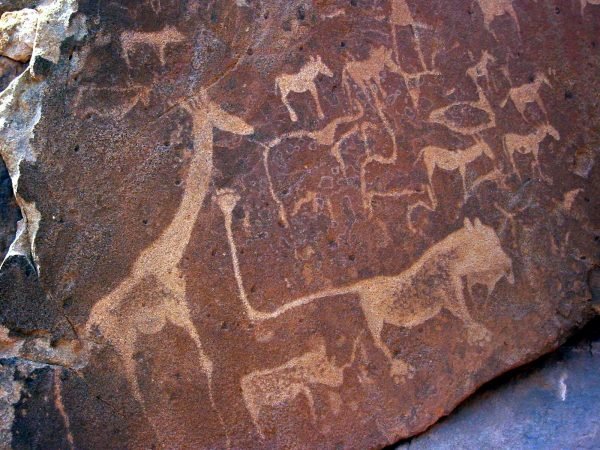
The oldest known figurative cave painting in the world is in a cave on the Indonesian island of Sulawesi, and it is at least 51,200 years old. It shows three human-like figures with a wild pig. Researchers dated it in 2024 using a laser technique, and it is now the earliest known picture that tells a story rather than simply showing a shape.
Europe has famous painted caves too. Chauvet in France is around 36,000 years old, and Lascaux around 17,000. The animals in them are drawn with real skill: lions, rhinos, horses and bison, some sketched to use the bumps in the rock so they look like they are moving in firelight.
What almost never appears in cave art is people. Thousands of animals, hardly any humans, and nobody knows why.
You also find hand stencils, made by putting a hand on the rock and blowing paint around it. They are on cave walls across the world, made by people who never met each other. Some of them are small enough to be children’s.
Animals of the Stone Age
During the coldest stretches, Europe looked like the Arctic. Woolly mammoths, woolly rhinos, cave bears, cave lions, giant deer with antlers nearly four metres across, and the wolf, which is the one animal on that list still with us.
The wolf matters more than the others, because at some point during the Stone Age wolves and people started living alongside each other, and those wolves slowly became dogs. Dogs were domesticated well before sheep, cattle or wheat. The first animal humans ever befriended was a predator.
Stone Age Britain
Britain was not an island for most of this. A stretch of low land called Doggerland joined it to mainland Europe, with rivers, marshes and people living on it. Fishing boats still drag up mammoth bones and Stone Age tools from the bottom of the North Sea. Around 6000 BC rising seas finally drowned it and Britain became separate.
The best-known thing Stone Age Britain left behind is Stonehenge, begun around 3000 BC and finished in stages over centuries. Some of its smaller bluestones came from the Preseli Hills in Wales, about 150 miles away, moved by people with no wheels and no metal tools. How they did it is still argued about.
Skara Brae in Orkney is less famous and, in some ways, more remarkable: a Neolithic village that was buried in sand and preserved so well you can still see the stone dressers, beds and fireplaces inside the houses. It is older than the pyramids.
Match the Discovery
- Hand stencils — Made by blowing paint around a hand pressed on the rock
- Neanderthals — Another kind of human who lived across Europe and western Asia
- Wolves — Became dogs, long before any farm animal
- Giant deer — Had antlers nearly four metres across
- Skara Brae — A Neolithic village in Orkney, older than the pyramids
- Stonehenge's bluestones — Brought about 150 miles from the Preseli Hills in Wales
Things people get wrong about the Stone Age
- “They all lived in caves.” Most did not. Caves preserve evidence, which is a completely different thing.
- “Cavemen fought dinosaurs.” The last dinosaurs died about 66 million years ago. The oldest stone tools are 3.3 million years old. Nothing human ever saw a living Tyrannosaurus.
- “The Stone Age was one period.” Three, at least: Old, Middle and New, and they are wildly different from each other.
- “It ended everywhere at once.” It ended whenever a given people took up metal, which happened thousands of years apart in different places.
- “Homo habilis made the first tools.” That was the standard answer until 2015, when tools 3.3 million years old turned up in Kenya, older than the genus Homo itself.
- “They were primitive and stupid.” They crossed oceans, made rope, sewed clothing, performed surgery on skulls and painted work we still find beautiful. They simply had no metal.
Ten Stone Age facts worth remembering
- The Stone Age covers about 99% of human history.
- The oldest known stone tools are 3.3 million years old and predate our own genus.
- The oldest known storytelling picture is a 51,200-year-old cave painting in Indonesia.
- Dogs were domesticated during the Stone Age, long before any farm animal.
- Britain was joined to Europe by a drowned land called Doggerland.
- Skara Brae in Orkney is older than the Egyptian pyramids.
- Stone Age people carried out trepanation, cutting holes in living skulls, and some patients survived, because the bone healed afterwards.
- Ötzi the Iceman, found frozen in the Alps, died around 3300 BC and still has his clothes, tools and last meal.
- Obsidian tools can be sharper than a modern steel scalpel.
- Most people outside Africa carry 1–2% Neanderthal DNA.
Common questions
How long did the Stone Age last?
About 3.3 million years, from the first stone tools until people began working metal. It ended at different times in different parts of the world.
What are the three Stone Age periods?
The Palaeolithic or Old Stone Age, the Mesolithic or Middle Stone Age, and the Neolithic or New Stone Age. Farming begins in the Neolithic.
What ended the Stone Age?
Metal. Once people could smelt copper and then bronze, they had tools and weapons that stone could not match, and the Bronze Age begins.
Did Stone Age people live with dinosaurs?
No, and the gap is enormous. The last dinosaurs died out about 66 million years ago, more than 60 million years before the first stone tools.
What tools did Stone Age people use?
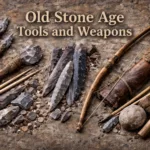
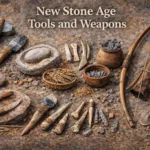
Hand axes, scrapers, blades, spears, harpoons and later bows and arrows, made from flint, obsidian, bone, antler and wood. Our guide to Stone Age Tools covers them in detail.
Did you know? The oldest known picture that tells a story is a cave painting on the Indonesian island of Sulawesi showing three figures and a wild pig. It is at least 51,200 years old.
The Stone Age Story in Order
- First stone tools Someone in Kenya strikes stones together and makes the oldest tools we know of.
- A story on a wall On Sulawesi, in Indonesia, people paint three figures and a wild pig.
- Chauvet Lions, rhinos and horses are painted in a cave in France.
- Lascaux More animals are painted in the Lascaux cave in France.
- Britain becomes an island Rising seas drown Doggerland, the land joining Britain to Europe.
- Farming arrives People in Britain start growing food instead of chasing it.
- Stonehenge Work begins on Stonehenge.
Try it
Make a Stone Age timeline on a long strip of paper. Put the first stone tools at one end and today at the other, then mark where farming begins. Almost all of your strip will be Stone Age.
Knowledge check
What are the three periods of the Stone Age?
Show answer
The Palaeolithic (Old Stone Age), the Mesolithic (Middle Stone Age) and the Neolithic (New Stone Age). Farming begins in the Neolithic.
Did Stone Age people live at the same time as dinosaurs?
Show answer
No. The last dinosaurs died out about 66 million years ago, more than 60 million years before the first stone tools were made.
Frequently Asked Questions About the Stone Age
When was the Stone Age?
The Stone Age began about 3.3 million years ago and ended at different times in different places, whenever a people learned to work metal. In Britain the usual dates are roughly 800,000 BC to 2500 BC. There is no single end date, because different parts of the world reached metalworking thousands of years apart.
What are the three parts of the Stone Age?
The Palaeolithic or Old Stone Age, the Mesolithic or Middle Stone Age, and the Neolithic or New Stone Age. The Palaeolithic was hunting and gathering with chipped stone tools. In the Mesolithic the ice retreated and tools became small and precise. In the Neolithic farming arrived and people settled in one place.
Why is it called the Stone Age?
Because people made their tools from stone, along with bone and wood, before anyone could work metal. The name describes the technology, not the people. It is one of three ages in a sequence: the Stone Age, then the Bronze Age, then the Iron Age.
Did Stone Age people live in caves?
Mostly not. Caves preserve evidence far better than open-air shelters, so that is where archaeologists find things, which makes caves look more important than they were. Most people built shelters from wood, hide, turf, stone and even mammoth bone.
How long did the Stone Age last?
About 3.3 million years, which is roughly 99% of the whole human story. Everything since then, including farming, writing, cities, cars and the internet, fits into the final 1%.
What ended the Stone Age?
Metal. Once people learned to smelt copper and then mix it with tin to make bronze, they had a material that could be melted, poured into moulds and resharpened, which stone cannot. The Stone Age ended wherever and whenever that happened.
Sources
- Nature: 3.3-million-year-old stone tools from Lomekwi 3, Kenya — the date of the oldest known stone tools.
- Nature: narrative cave art in Indonesia by 51,200 years ago — the oldest known storytelling picture.
- English Heritage: prehistoric England — the British dates for each Stone Age period.
- The British Museum — Stone Age tools, art and burial collections.
- Natural History Museum: the Neanderthal in us — how much Neanderthal DNA people outside Africa carry today.
Stone Age Final Challenge
- About how much of the whole human story does the Stone Age cover?
- Why did the Stone Age end at different times in different places?
- Why are so many Stone Age finds made in caves?
- What almost never appears in Stone Age cave paintings?
- Why do some scientists think cooking helped human brains grow bigger?
- What happened once people started farming?
- Why were the stone tools found in Kenya in 2015 such a surprise?
- Why is Ötzi the Iceman so useful to scientists?